The book aims at showing the most important topics and paradigms in modern Trinitarian theology. It is supposed to be a comprehensive guide to the many traces of development of Trinitarian faith. As such it is thought to systematize the variety of contemporary approaches to the field of Trinitarian theology in the present philosophical-cultural context.
The main goal of the publication is not only a description of what happened to Trinitarian theology in the modern age. It is rather to indicate the typically modern specificity of the Trinitarian debate and - first of all - to encourage development in the main areas and issues of this subject.
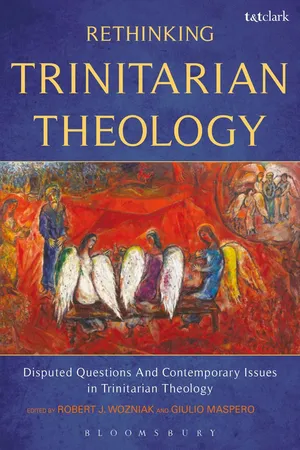
eBook - ePub
Rethinking Trinitarian Theology
Disputed Questions And Contemporary Issues in Trinitarian Theology
- 512 pages
- English
- ePUB (mobile friendly)
- Available on iOS & Android
eBook - ePub
Rethinking Trinitarian Theology
Disputed Questions And Contemporary Issues in Trinitarian Theology
About this book
Information
part one
Historical perspectives: what can and should we learn from history?
1
Into the Cloud of Witnesses: Catholic Trinitarian Theology Beyond and Before its Modern ‘Revivals’1
In one still very common narrative of Trinitarian theology, Latin theology over time wandered far from authentic Trinitarianism, and has only called back to its true path in the past few decades.2 This theological ‘fall’ was either the work of Augustine himself, or the result of a trajectory initiated by him and coming to fruition in the centuries that followed.3 In such narratives Latin Trinitarian theology stumbled by forgetting that Trinitarian doctrine moves us beyond any ultimate philosophical monism. Embracing such monism, Latin theology has spawned a variety of errors: treating God as fundamentally one mind or person; failing to grasp the wide metaphysical significance of relationship in the Godhead; forgetting that in the narrative and dynamic interactions of God’s actions in Christ (and in the Spirit-filled body of the Church), we see the nature of God reflected. In all of these errors a monistic theology of God in se is assumed as a reality prior to the ‘economic’ Trinity.4 At times Latin Trinitarianism’s wandering from the path of righteousness is even taken partially to have prepared the way for both the anti-Trinitarian movements in the sixteenth and seventeenth centuries, as well as Enlightenment and post-Enlightenment philosophical attacks on Christianity.
Those who hold to some version of this narrative do so as part of a commitment to one version or other of a ‘revival’ in Trinitarian theology, a re-articulation of Trinitarian thought that will reverse Latin theology’s ‘fall’. Interestingly, these ‘revivalists’ rarely offer any dense account of their proximate philosophical sources. In particular, while many of those who count themselves as ‘revivalists’ over the past three or four decades point to particular Biblical or Patristic themes as sources, it is rare for any who do so openly to embrace the strains of modern thought that have shaped their appropriation of pre-modern resources. It was not always so. There have, in fact, been a series of ‘revivals’ in Trinitarian theology stretching back to the early nineteenth century, and many of those revivalists acknowledged that their efforts depended on the achievement of particular philosophical traditions. These earlier revivalists do not share the same story of separation between Greek and Latin, or (at least universally) the same story of a peculiarly western failure, even if they do point to a consistent failure of Christians to grasp the heart of the doctrine; but they do share a set of philosophical inspirations. Hegel, his legacy, and various kinds of personalism used to similar ends are a constant presence.
The argument of this paper travels along a path marked on the one side by the undermining of the narratives on which the most recent revivalists depend and, on the other, by increasing recognition that the broader post-Hegelian revivalist project has depended on philosophical and theological trajectories that are not the only or perhaps even the most suitable resources for articulating Trinitarian theology, at least Trinitarian theology that embraces Nicene orthodoxy. While there were always figures who refused the idea of Latin Trinitarianism’s fall, recent decades have seen a considerable body of revisionist historical scholarship on the major figures of the Latin tradition that has undercut many of the pivotal assumptions of the narrative discussed in the first paragraph of this paper, scholarship that has increasingly followed the modern historiographical trend to place texts in proximate contexts, to avoid reading terminology in the light of its later development, and to be wary of assuming that texts which later become ‘classics’ for a tradition originally had the unitary focus and summative qualities with which tradition invests them. It is also noteworthy that in the case of, for example, Augustine and Thomas, while this revisionist scholarship has opened new debates about the meaning of each figure and the relationship between the two, it has not met with any scholarly attempt to defend the older readings that are taken to enable the ‘fall’ narrative.
My intention in this paper is not, however, to argue further against the narrative described above, but the more positive one of indicating some new conversations that are now emerging within Latin traditions and to suggest that in these conversations we will find the most appropriate and generative source of Catholic Trinitarian theology in the next few years. The contours of these new conversations remain unclear, and thus I have not tried to offer a typology but sought only to offer as examples three very personal conversations that have emerged from my own work on Augustine and some of his Latin and Greek contemporaries over the past few years. This personal reflection should be taken as an indication that many more conversations remain to be uncovered.
Two general features of these new conversations demand mention. First, when I suggest that these debates in historical scholarship should serve as the points of departure for good Trinitarian theology my intent could fairly be described as tactical; as interventions in current Trinitarian discussion these conversations have the effect of de-centring some of the questions and dynamics that the revivalists take to be normative. I do not necessarily think that these conversations answer all the concerns of the revivalists, but they do suggest a range of rather different questions. But second, and more strategically, part of my intention in focusing on these conversations is to argue for a different conception of good practice in Trinitarian theology.
Hegelian Revivalists
As a backdrop to the new conversations I want to highlight, it is important that I give a little more density to my comments about the significance of Hegel for the modern ‘revivalist’ projects in Trinitarian theology. How may Hegel be described as their fountainhead? Most importantly, of course, Hegel sees himself as ‘reviving’ the doctrine by revealing its true philosophical content. By describing dialectical difference as partly constitutive of Geist and thus drawing together the history of our world and the being of God, Hegel fashioned a powerful account of the doctrine’s utility – whatever its relationship to classical Christianity!5 The attempts of Protestant theologians and philosophers, even of many who resisted Hegel’s particular way of conceiving the relationship between God and world, to make use of the resources he offered, constitutes the first of the modern ‘revivals’. Writing in the late 1870s, Isaac Dorner congratulates the followers of Hegel for keeping alive the doctrine in what had seemed otherwise dark days. Dorner prefers other strands of Idealist thought in his own attempts at reconstructing the doctrine, but he could recognize the common work of reconstruction at which he and his opponents all aimed.6
But if we are to understand the character of the revival that Hegel offers, we must make brief mention of his own sources. One of the most interesting recent attempts at placing Hegel’s Trinitarian vision in broader context is that of Cyril O’Regan. Whether or not one buys into O’Regan’s account of the return of a theological grammar that can be termed ‘Gnostic’, his account of the relationship between Jacob Boehme’s seventeenth-century overturning of some classical Trinitarian fundamentals remains highly illuminating. O’Regan’s account depends on distinguishing the ‘narrative of divine manifestation’ one find in Boehme from that found in late medieval exponents of ‘negative theology’, such as Eckhart.7 For O’Regan, one must read Eckhart within the tradition of Latin Neoplatonic Christian thought, and against this context, Eckhartian emphasis on the divine as process and becoming occurs against the background of an equally fundamental emphasis on the divine unity and overflowing plenitude. At the same time, Eckhart sustains the Pseudo-Dionysian division between the ‘super-essential Godhead’ who is known only in unknowing and the Trinity of manifestation, revelation and faith; the latter draws us to the former and is only formally distinct. Nevertheless, Eckhart, for O’Regan, points toward Boehme in his talk of a divine birth, the eternal speaking of the Word which moves the divine – some narrative language is here possible – into manifestation, into self-consciousness.8
Eckhart’s Christian, Trinitarian insistence that God is also eternally thus enables (as it had for many others before him in different ways) this adapta...
Table of contents
- Cover
- Rethinking Trinitarian Theology
- Contents
- Introduction
- Part One: Historical Perspectives: what can and should we learn from history?
- Part Two: Modern Analytical Perspectives
- Part Three: New Readings
- Part Four: Anthropological Paradigms
- Part Five: New Systematic Perspective
- Index
- Copyright Page
Trusted by 375,005 students
Access to over 1.5 million titles for a fair monthly price.
Study more efficiently using our study tools.
Frequently asked questions
Yes, you can cancel anytime from the Subscription tab in your account settings on the Perlego website. Your subscription will stay active until the end of your current billing period. Learn how to cancel your subscription
No, books cannot be downloaded as external files, such as PDFs, for use outside of Perlego. However, you can download books within the Perlego app for offline reading on mobile or tablet. Learn how to download books offline
We are an online textbook subscription service, where you can get access to an entire online library for less than the price of a single book per month. With over 1.5 million books across 990+ topics, we’ve got you covered! Learn about our mission
Look out for the read-aloud symbol on your next book to see if you can listen to it. The read-aloud tool reads text aloud for you, highlighting the text as it is being read. You can pause it, speed it up and slow it down. Learn more about Read Aloud
Yes! You can use the Perlego app on both iOS and Android devices to read anytime, anywhere — even offline. Perfect for commutes or when you’re on the go.
Please note we cannot support devices running on iOS 13 and Android 7 or earlier. Learn more about using the app
Please note we cannot support devices running on iOS 13 and Android 7 or earlier. Learn more about using the app
Yes, you can access Rethinking Trinitarian Theology by Giulio Maspero, Robert J. Wozniak, Giulio Maspero,Robert J. Wozniak in PDF and/or ePUB format, as well as other popular books in Theology & Religion & Christian Theology. We have over 1.5 million books available in our catalogue for you to explore.