Christian ethicists from a wide spectrum of methods and commitments come together in arguing for some kind of social conception of the self, noticing that convergence sheds new light on the current range of theoretical options in Christian ethics. But it also opens up an important conversation about political reform. Social visions of the self help ethicists comprehend and evaluate the moral work of institutions--comprehension that is especially important in a time of crisis for democratic participation. But not all visions of the social self are equal. Snarr's book explores and evaluates five different visions of the social self from five key ethicists (Rauschenbusch, Niebuhr, Hauerwas, Harrison, and Townes). It identifies insights and risks associated with each vision of the self and considers the adequacy of each vision for reforms that deepen democracy. The book concludes with a proposal for six core convictions about the social self that help form Christian political ethics able to respond to contemporary needs for democratic reform.
eBook - ePub
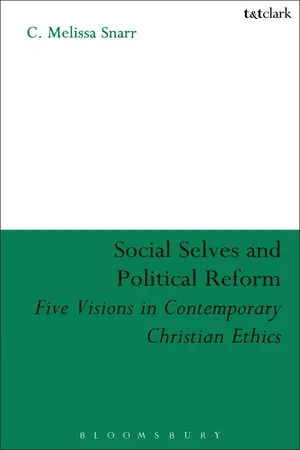
Social Selves and Political Reforms
Five Visions in Contemporary Christian Ethics
- 160 pages
- English
- ePUB (mobile friendly)
- Available on iOS & Android
eBook - ePub
About this book
Information
CHAPTER 1
Walter Rauschenbusch and Organizing the Social
Walter Rauschenbusch, the most important figure in the social gospel movement in the United States, based his call for the transformation of institutions, including the political, on a social conception of sin and salvation. His work exemplified the interplay between sociological and theological warrants for a social conception of the self as he sought to connect political and social reform with the Christian doctrine of sanctification. In many ways, Rauschenbusch laid the cornerstone for twentieth-century ethicists’ monument to the social self. Even those who ultimately disagreed with his conclusions (e.g., Niebuhr) understood the importance of work on the social nature of the self and felt compelled to articulate their version of it. After Rauschenbusch, Christian ethicists found it hard to ignore the sociological firmament of theological anthropology, even if there were eventually great variations in their rising ethical structures.
Rauschenbusch’s particular understanding of the self, which I label “socially enabled,” led him to see substantive structural criticism and reform as a requirement for Christian sanctification. If the social order “enables”—that is, provides the self with the capacity, means, and opportunity to grow morally and to develop fuller moral agency—then Christians in the kingdom of God must participate politically to reform the social order. Individual sanctification, or moral and religious growth, is intertwined with the quality of the social order.1 Emphasizing the social nature of sin and salvation, Rauschenbusch wove together sociological observations and theological claims about the social nature of the self to argue that work for the kingdom is historically grounded in regenerating rather than transcending social relations.
My analysis in this chapter proceeds in five stages. First, I sketch the social context of Rauschenbusch’s work in order to situate his ethics in relation to the intellectual and material challenges of his day, particularly the poverty and suffering within urban industrialism. Second, through textual analysis, I show how Rauschenbusch establishes his view of the self and its formation. I argue that Rauschenbusch begins with an Augustinian view of the self as torn between inherent self-love and the capacity to love and serve God and humanity. But his attention to social formation also leads him beyond his Augustinian framework toward an understanding of the kingdom of God that entails the reformation of social structures in order to enable Christian love and moral agency. Third, I examine Rauschenbusch’s understanding of politics, the necessity of political participation, and his approach to political reform. Here I show that Rauschenbusch’s view of the self entails a particular political worldview—one that sees the self as substantively constructed by politics. Political participation and reform are vital for individual Christians and the church as a whole, because the Christianization of institutions cultivates or stunts the full development of the person and thus the humanization of society. Fourth, I argue that Rauschenbusch employs these concepts in relation to concrete political reform, specifically his call for democratization—that is, the spread of democracy as coterminous with the spread of God’s realm on earth. I conclude that Rauschenbusch’s vision of the “socially enabled” self led him to prioritize political reform through democratization as a constituent of sanctification and as necessary to the kingdom of God.
Finally, studying Rauschenbusch’s view of the social self and its application to political contexts provides the first piece or stepping-stone of a cumulative critical comparison. It provides a first model for integrating a particular conception of the social self with a program of political participation and transformation against which other approaches can be compared for the purpose of mutual critique. For example, while Rauschenbusch’s exploration of the breadth of the socialization of the self is admirable and informs an important summons for Christian political participation, his work also evidences at least four issues that must be addressed before appropriating his political ethic: the origin of morality outside of politics, the optimism about adequate reform in all spheres except the economic, the equation of Christianizing with humanizing, and the limited attention to self-deception. While Rauschenbusch’s socially enabled self informs a reformation of all social institutions, dimensions of Rauschenbusch’s view of moral formation still leave gaps that must be addressed in a Christian political ethic.
The central claim put forward by this chapter, then, is this: in terms of the overall adequacy of his moral anthropology for a Christian political ethic, Rauschenbusch’s socially enabled social self provides an essential groundwork for understanding the formative power of institutions but loses its analytical edge by underestimating the depth of human and institutional corruption.
Social Context
Like many evangelical ministers of his day (and our own), Rauschenbusch was not trained academically to do economic and political analysis, nor did he begin his career with an interest in social analysis.2 Rauschenbusch’s education at Rochester Seminary was relatively isolated from social problems. Conservative scholars Howard Osgood and Augustus Hobgood Strong oversaw his course of study. Strong, Rauschenbusch’s theology professor, stayed close to the theology that he thought best accorded with Scripture. Strong thought theology ought to study “the holiness of God, human depravity, Christ’s substitutionary death, the election of some for salvation, the baptism and gathering of the elect into the church, the final sanctification of the elect, and the final destruction of the wicked.”3 While Rauschenbusch challenged some of this theology in his essay “The Bushnellian Theory of Atonement,” he did not stray far from his evangelical Baptist roots and the corresponding commitment to saving individual souls. Rauschenbusch later complained, however, that despite the rapid industrialization occurring at the time, social issues did not find a place in Rochester’s curriculum. Theological education was thus a rather insulating experience for Rauschenbusch.
Rauschenbusch’s spiritualized theological focus was soon challenged, however, as he began a pastorate in the Hell’s Kitchen section of New York City. Immersed in his congregation and the surrounding community, Rauschenbusch found himself overwhelmed by the social displacement, grinding poverty, and disease caused by the industrial revolution. Chroniclers describe the New York of Rauschenbusch’s day as marked by bleak social conditions: “Three-quarters of New York’s population lived in tenements; as many as two dozen families pressed into the dimly Ht, foul-smelling, five-story buildings. “4 Grief became his constant companion. High child mortality proved hardest for him to deal with but remained a tragically common occurrence: “in one section of the city.. .68 percent of the deaths that occurred were among children five and under.”5 Rauschenbusch agonized over the suffering of his congregation and neighbors: “Oh, the children’s funerals! They gripped my heart—that was one of the things I always went away thinking about—why did the children have to die?”6
While struggling with the endemic suffering surrounding him, Rauschenbusch also began to wrestle with the inadequacy of his individualistic, evangelical approach to ministry. “Single cases of unhappiness are inevitable in our frail human life,” he notes in Christianity and the Social Crisis, “but when there are millions of them, all running along well defined grooves, reducible to certain laws, then this misery is not an individual but a social matter, due to causes in the structure of our society and curable only by social reconstruction.”7 The radical poverty of his congregants and the local neighborhoods pushed Rauschenbusch to reflect for the first time on what he termed “the social question.” As he states, this “‘social note’ did not come from the church. It came from the outside. It came through personal contact with poverty.”8 While the church may have sensitized Rauschenbusch to the well-being of his congregants, he found that his theological training had not given him the tools to analyze and address their well-being in concrete social ways. For such tools he had to look outside his previous educational networks and begin to rebuild his theological and ethical system. In many ways, Rauschenbusch’s journey mirrors the experience of many church-connected persons at the turn of the century who encountered the brutalities of the industrial revolution and were moved to launch reform movements and rework their theologies.9 The combination of immense social need and inadequate theo-ethical resources provided the seedbed for the rise of the social gospel movement.
Rauschenbusch slowly made his way toward the development of the social gospel by turning to the work of Henry George and Richard Ely to investigate the “social question” facing the workers he served. George was a charismatic journalist running for New York City mayor with the backing of labor unions and socialists. His speeches at city rallies fascinated Rauschenbusch. As Minus notes, George’s writings convinced him that “the Creator God intended the land and its bounty to be used to support all people, but a system of injustice allowing some people to monopolize these resources and charge exorbitantly for them had arisen, thereby bringing unearned wealth to themselves and poverty to others.”10 George proposed a unique “single tax” on all undeveloped land that would free land held for speculation and fund programs for the needy. Rauschenbusch was won over, as well, by the candidate’s nonviolent approach. George believed that applying democratic and religious principles to the capitalistic system would lead to progress. Although George eventually lost the mayoral race, Rauschenbusch later commented, “I owe my first awakening to the world of social problems to the agitation of Henry George in 1886 and wish here to record my lifelong debt to the single-minded apostle of a great truth.”11 For Rauschenbusch, the teachings of the charismatic journalist served as the initial catalyst for a new era of social analysis.
After his encounter with George, Rauschenbusch continued to seek systemic explanations and solutions for the poverty and corruption engendered by industrialism. He turned next to economist Richard Ely, an Episcopal layman and professor at Johns Hopkins. Ely, following German historicist economists, rejected much of classic English economic theory, which argued that immutable laws caused some to be wealthy and others poor. Ely became part of the institutionalist school of economics that investigated the historical and social factors that influenced the distribution of wealth. For example, in his Property and Contract in Relation to the Distribution of Wealth, Ely documented how the allocation of property rights determined the social stratification of cities.12 Because he saw every economic outcome as the product of a social choice, Ely became very active in social reform movements and argued that political action was essential for reshaping the economic landscape of society. He also agreed with many of the tenets of F. D. Maurice’s “Christian Socialism” and proclaimed that churches had only been preaching a “one sided half-gospel.” The whole gospel, Ely maintained, necessarily included both the individual and the social.13
Intensive study of George and Ely helped prompt Rauschenbusch to become a socialist and a neophyte ...
Table of contents
- Cover
- Title Page
- Contents
- Preface: Faithful Participation
- Introduction: Politics and Christianizing the Social Self
- Chapter 1: Walter Rauschenbusch and Organizing the Social
- Chapter 2: Reinhold Niebuhr and Social Anxiety
- Chapter 3: Stanley Hauerwas and the Church Social
- Chapter 4: Beverly Harrison and Radical Sociality
- Chapter 5: Emilie Townes and the Socially Resilient Self
- Conclusion: Socializing Christian Political Ethics
- Postscript: The Work That Lies Ahead
- Bibliography
- Index
- eCopyright
Trusted by 375,005 students
Access to over 1.5 million titles for a fair monthly price.
Study more efficiently using our study tools.
Frequently asked questions
Yes, you can cancel anytime from the Subscription tab in your account settings on the Perlego website. Your subscription will stay active until the end of your current billing period. Learn how to cancel your subscription
No, books cannot be downloaded as external files, such as PDFs, for use outside of Perlego. However, you can download books within the Perlego app for offline reading on mobile or tablet. Learn how to download books offline
Perlego offers two plans: Essential and Complete
- Essential is ideal for learners and professionals who enjoy exploring a wide range of subjects. Access the Essential Library with 800,000+ trusted titles and best-sellers across business, personal growth, and the humanities. Includes unlimited reading time and Standard Read Aloud voice.
- Complete: Perfect for advanced learners and researchers needing full, unrestricted access. Unlock 1.5M+ books across hundreds of subjects, including academic and specialized titles. The Complete Plan also includes advanced features like Premium Read Aloud and Research Assistant.
We are an online textbook subscription service, where you can get access to an entire online library for less than the price of a single book per month. With over 1.5 million books across 990+ topics, we’ve got you covered! Learn about our mission
Look out for the read-aloud symbol on your next book to see if you can listen to it. The read-aloud tool reads text aloud for you, highlighting the text as it is being read. You can pause it, speed it up and slow it down. Learn more about Read Aloud
Yes! You can use the Perlego app on both iOS and Android devices to read anytime, anywhere — even offline. Perfect for commutes or when you’re on the go.
Please note we cannot support devices running on iOS 13 and Android 7 or earlier. Learn more about using the app
Please note we cannot support devices running on iOS 13 and Android 7 or earlier. Learn more about using the app
Yes, you can access Social Selves and Political Reforms by C. Melissa Snarr in PDF and/or ePUB format, as well as other popular books in Theology & Religion & Theology. We have over 1.5 million books available in our catalogue for you to explore.