Can tragic views of the human condition as known to Westerners through Greek and Shakespearean tragedy be identified outside European culture, in the Indian culture of Hindu epic drama? In what respects can the Mahabharata epic's and the Bhagavadgita's views of the human condition be called 'tragic' in the Greek and Shakespearean senses of the word?
Tragic views of the human condition are primarily embedded in stories. Only afterwards are these views expounded in theories of tragedy and in philosophical anthropologies. Minnema identifies these embedded views of human nature by discussing the ways in which tragic stories raise a variety of anthropological issues-issues such as coping with evil, suffering, war, death, values, power, sacrifice, ritual, communication, gender, honour, injustice, knowledge, fate, freedom. Each chapter represents one cluster of tragic issues that are explored in terms of their particular (Greek, English, Indian) settings before being compared cross-culturally. In the end, the underlying question is: are Indian views of the human condition very different from Western views?
eBook - ePub
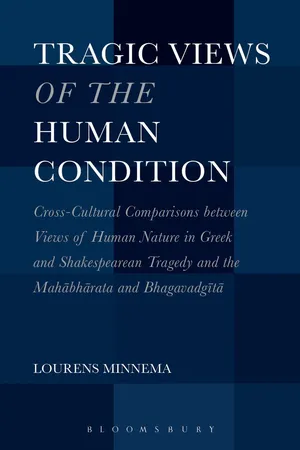
Tragic Views of the Human Condition
Cross-Cultural Comparisons between Views of Human Nature in Greek and Shakespearean Tragedy and the Mahabharata and Bhagavadgita
- 584 pages
- English
- ePUB (mobile friendly)
- Available on iOS & Android
eBook - ePub
Tragic Views of the Human Condition
Cross-Cultural Comparisons between Views of Human Nature in Greek and Shakespearean Tragedy and the Mahabharata and Bhagavadgita
About this book
Information
1
Introduction
1 Scope and key questions
Gliding silently over the fields, flying across one cultural landscape to the other and back again, this book aspires to compare cross-culturally Western and Indian tragic views of the human condition. The wider scope of interest of the cross-cultural comparisons is marked off by a broad key question: Can tragic views of the human condition, as known to Westerners through Greek and Shakespearean tragedy, be identified outside European culture, in the Indian culture of Hindu epic drama?
This broad key question has to be narrowed down for practical reasons. For one thing, of the core texts that can be considered prototypical of Greek and Shakespearean tragedy, I will mainly concentrate on Sophocles’ Oedipus Tyrannus and Antigone and on Shakespeare’s Hamlet. These three texts are widely held to be among the best examples of what tragedy is about, as a literary genre. Hindu epic drama appears to be quite different as a literary genre, but the Mahābhārata epic, which includes the Bhagavadgītā, can be used to make a good comparison when it comes to issues regarding views of human nature. The anthropological issues seem much more similar cross-culturally than the literary genres which contain them might suggest. My main interest is in the anthropological issues.
Whether this first impression will hold remains to be seen, but it can serve to narrow down the broad key question of the wider scope of interest. The major key question limiting the actual frame of reference and guiding the cross-cultural comparisons can then be formulated as follows: in what respects can the Mahābhārata epic’s and the Bhagavadgītā’s views of the human condition be called ‘tragic’ in the Greek and Shakespearean senses of the word? There are no universal criteria to measure the extent to which views of the human condition in various cultures differ. However, this observation does not make the question altogether impossible to answer. It makes the question answerable in many different ways depending on the framing of the comparisons. Properly framing the comparisons is one methodological problem to be faced.
Taking seriously the generic variety of cultural sources is another problem at hand. Views of human nature are expounded in theories, condensed in concepts, imagined in symbols and embedded in stories. Tragic views of the human condition are primarily embedded in stories, the plots of tragedies. Only afterwards are these tragic views of the human condition expounded in theories of tragedy and in philosophical anthropologies. In order to trace tragic views of the human condition, the methodological starting point has to be the stories in which these tragic views of human nature are embedded. In the West, these stories and their dramatic performance constitute a specific narrative genre – ‘tragedy’.
2 Aspects of tragedy and embedded anthropological issues
In ancient Greece and in early modern England, the tragic genre represents an art form whose ‘tragic’ character is related to a wide range of aspects. In this book, I shall heuristically identify seven (clusters of) aspects of tragedy – narrative aspects (Chapter II), artistic–communicative aspects (Chapter III), socio-political aspects (Chapter IV), literary–cultural aspects (Chapter V), martial aspects (Chapter VI), psycho-ethical aspects (Chapter VII) and religious aspects (Chapter VIII). Why these aspects instead of other ones? How has the drawing of demarcation lines between these aspects come about? It was not inspired by a particular scholarly tradition or theory. In fact, the aspects and issues presented here could have been defined differently, and most likely would have been if the material at hand had been processed by a different mind. Those salient aspects related to Greek and Shakespearean tragedy that struck me as characteristic of the tragic genre had to be arranged and presented in a form that would both cover the most important anthropological issues raised and make for good cross-cultural comparison, enabling the reader to perceive more clearly some fundamental similarities and differences between Western and Indian views of (wo)man.
Each set of aspects of tragedy will have its own chapter. By devoting separate chapters to these seven aspects of tragedy, I try to cope with several methodological problems simultaneously.
First of all, by describing each cluster of aspects of tragedy in detail, I stay as close as possible to the Greek and Shakespearean cultural sources from which the embedded tragic views of human nature have to be extracted in order to be compared to their Indian counterparts. Embedded views of human nature are identified in terms of the anthropological issues raised in the stories (issues such as coping with evil, suffering, loss, death, power, gender, injustice, fate and freedom) and they are understood in terms of their particular settings before being compared cross-culturally. In my partly phenomenological approach to tragedy and to embedded views of human nature, I try to stay as close as possible to the phenomena at hand, that is to say, to the images of human nature as they are presented in the stories. Taking as their starting point ‘that which lights up and appears to us’, phenomenological approaches expect understanding to emerge out of the description of patterns, that is to say, they take their point of departure in the appearances instead of imposing thought on ‘objects’, attempting, as Douglas Allen puts it, ‘to uncover various structural differentiations within their data’.1 But, I hasten to add that I highly welcome the light that theories can shed on these images. Different theories enable different views of the same phenomena, which then appear differently under different angles. Different theories all cast some light, one way or another, and are presented in this study to do just that. Pure description does not exist, let alone pure understanding. More on that will be said in the following sections. At this stage, let me underscore that the focus is on the appearance of the phenomena themselves under the conditions of a variation in lightning. Basically, I am inclined rather to observe and show than to judge and argue for or against phenomenal patterns and theoretical views, to observe and show the particular ways in which anthropological issues are raised and understood culturally.
Secondly, doing justice to the richness and complexity of each set of aspects of tragedy also allows for a wide range of specific cross-cultural comparisons. Thus, generalizations are avoided. Each set of aspects of tragedy provides for a particular context within which specific anthropological issues will be treated and compared. In other words, each particular context (and thus every single chapter) constitutes its own frame for cross-cultural comparisons. The framing operates in two ways. On the one hand, a particular context raises particular anthropological issues. This enables comparisons with corresponding issues elsewhere. In India, for example, similar questions will be dealt with differently, depending on the cultural differences. On the other hand, the framing does not only enable comparisons, it also limits and specifies their scope. Western and Indian views of the human being will turn out to be strikingly similar when it comes to certain issues, yet very different when it comes to other issues.
Tragedy deals with issues it does not expound philosophically, politically or historically, but which it raises artistically. The main purpose of discussing several aspects of tragedy in some detail is to develop a sense of what the related issues (concerning human affairs) and the various ways they are dealt with are about. Methodologically speaking, I shall not be comparing texts, but the main issues the texts and contexts are dealing with. Of concern are the anthropological issues which the texts and contexts have in common cross-culturally and the respects in which they differ. The same species of dolphin jumping out of the water seems to generate fairly similar patterns of jumping and of waves on the surface in different oceans worldwide, but the same species of homo sapiens appears to generate fairly different patterns of expression and association when raising the ‘same’ anthropological issues in different cultures worldwide. The ‘same’ human suffering, for example, is not experienced and expressed identically everywhere. Similar issues are addressed differently to such an extent that the difference may strike one as more impressive than the similarity. In this study, common anthropological issues are described as embedded within their original cultural contexts before being compared cross-culturally.
A summary of the most important anthropological issues that will be raised in the following chapters is meant to convey a first impression of what one should expect in terms of points of cross-cultural comparison. Each set of aspects of tragedy raises certain issues dealing with human affairs. In the chapter on narrative aspects, attention is drawn to the extreme ways in which life stories develop into tragic life stories; disorder has to be rectified at terrible cost; suffering and loss determine the mood; a sense of unavoidable necessity takes over; evil and destruction have a long-lasting disturbing effect; and despair, obscurity and irony colour the world views of communities and individuals alike. The chapter on artistic–communicative aspects highlights the ways in which dialogues on the tragic stage seem doomed to fail. Audiences are not only influenced by the tragic effects of the representation of events, but also themselves influence the extent to which life stories, characters and events are perceived as tragic or comic. The chapter on socio-political aspects brings to the fore how the state, the family, religion and the theatre have been prominent institutional sources of legitimation and conflict, and how ‘serious’ tragedy was often, despite its democratic origins, expected to exclusively feature aristocratic characters and treat majestic affairs. In the chapter on literary–cultural aspects, it is shown that there are historical shifts in dealing with traditional norms and values, introducing critically reflective views of (wo)man in the transition from epic stories and heroes to tragic stories and heroes that are symptomatic of increased individualization and internalization. The chapter on martial aspects demonstrates some striking ways in which the martial values of warrior heroism have cross-cultural parallels in cultures that are separate in space and time, especially when it comes to status, honour and manliness. Also, the use of violence can be seen from a victim’s perspective instead of a victor’s perspective. The chapter on psycho-ethical aspects raises the issues of personal moral responsibility, individual freedom and social constraint, of the weight of human intention and action, of the power and powerlessness of passion, will and reason, of the available vocabulary for attitudes of mind and heart, and of the acquisition of human self-knowledge. The chapter on religious aspects touches upon the tensions and interactions between human freedom and supernatural necessity, fate and fortune, and upon the issue of divine intentions and interventions.
3 Definition and cross-cultural applicability of the notion of the ‘tragic’
To define what is ‘tragic’ about tragic views of the human being is not an easy task. It goes without saying that there is no one concept of the ‘tragic’. In fact, a wide range of aspects of the tragic genre has to be accounted for because each cluster of aspects generates its own definitions. Definitions of ‘tragedy’ and the ‘tragic’ will, therefore, be addressed in all chapters. Readers familiar with, say, philosophical definitions and approaches may appreciate and benefit from reading more on narrative or socio-political approaches, and vice versa.
In order to define the ‘tragicness’ of tragedy and consider the applicability of the notion cross-culturally, I shall, in the first instance, apply Benson Saler’s prototype approach of conceptualizing religion. Prototype theory exploits the practical competence of users of a category to distinguish between obvious examples and dubious examples of the category involved.2 All examples are more or less debatable. This ‘more or less’, however, is not considered to be the problem, but the solution. It allows for the broadening and application of categories beyond the initial prototypes from which they derive.3 In establishing resemblances, ‘unbounded’ analytical categories guide us from the better known to the less known or unknown.4
Sophocles’ Oedipus Tyrannus and Antigone and Shakespeare’s Hamlet are nowadays considered to be among the most outstanding examples of what tragedy is all about. It seems that these examples are already being recognized as such before scholars can prove whether this so-called ‘recognition’ is justified, but their recognition as prototypes depends on the cultural fashion of the age.5 Saler’s prototype approach suggests that we should take these plays particularly seriously as actual prototypes. What the three plays have in common is that they are about killing one’s own relatives and oneself. To turn against and kill one’s own relatives and oneself is widely considered a drama and a crime, but it is not necessarily considered a tragedy; if the killing is done inevitably and/or unwillingly, however, the event has turned into a tragedy. This intuitive insight into a good example of what tragedy is about can guide us in recognizing tragic constellations in the first instance, even if it does not exhaust the notion of the ‘tragic’.
The examples of Sophocles’ Oedipus Tyrannus and Antigone and of Shakespeare’s Hamlet are not on a par with each other if one takes the historical development of the Western notion of ‘tragedy’ into account. Saler suggests that history should be taken seriously as a matter of fact, as the actual starting point from which the specific meanings of categories have developed into broader ones. The history of a category does not just refer to its origin, but includes the very development of that category away from its origin, provided the later development has been recognized as such by dramatic practice or by a considerable number of scholars. Such a development is, in fact, illustrated by the plays of Shakespeare being called ‘tragedies’. The occurrence of the category ‘tragedy’ in early modern England marks a historical move of the genre from classical Greek culture (via Roman culture) to modern English culture, but the historical move is based more on literary links to Roman culture than on historical continuity with Greek culture, as we shall see. This invites us to undertake a first cross-cultural comparison within Western culture itself, before pushing the limits even further by comparing issues in two bodies of Western texts and their contexts with the corresponding issues in a body of Indian texts and their contexts. The cross-cultural move from Greece to England has become an integral part of the history of the development of the ‘tragic genre’. Hardly any scholar would deny that Shakespeare has written real tragedies. Since Gotthold Ephraim Lessing (1759), the neo-classic recognition of Greek tragedy at the expense of Shakespearean tragedy has been dismissed as false classicism.6 Whether the category of the ‘tragic genre’ can be extended beyond the borders of Western culture remains to be seen. W...
Table of contents
- Cover-Page
- Frontispiece
- Half-Title
- Title
- Dedication
- Contents
- Acknowledgements
- 1 Introduction
- 2 Narrative aspects
- 3 Artistic–communicative aspects
- 4 Socio-political aspects
- 5 Literary–cultural aspects
- 6 Martial aspects
- 7 Psycho-ethical aspects
- 8 Religious aspects
- 9 Concluding observations regarding views of the human condition
- Notes
- Bibliography
- Author Index
- Subject Index
- Copyright
Trusted by 375,005 students
Access to over 1.5 million titles for a fair monthly price.
Study more efficiently using our study tools.
Frequently asked questions
Yes, you can cancel anytime from the Subscription tab in your account settings on the Perlego website. Your subscription will stay active until the end of your current billing period. Learn how to cancel your subscription
No, books cannot be downloaded as external files, such as PDFs, for use outside of Perlego. However, you can download books within the Perlego app for offline reading on mobile or tablet. Learn how to download books offline
Perlego offers two plans: Essential and Complete
- Essential is ideal for learners and professionals who enjoy exploring a wide range of subjects. Access the Essential Library with 800,000+ trusted titles and best-sellers across business, personal growth, and the humanities. Includes unlimited reading time and Standard Read Aloud voice.
- Complete: Perfect for advanced learners and researchers needing full, unrestricted access. Unlock 1.5M+ books across hundreds of subjects, including academic and specialized titles. The Complete Plan also includes advanced features like Premium Read Aloud and Research Assistant.
We are an online textbook subscription service, where you can get access to an entire online library for less than the price of a single book per month. With over 1.5 million books across 990+ topics, we’ve got you covered! Learn about our mission
Look out for the read-aloud symbol on your next book to see if you can listen to it. The read-aloud tool reads text aloud for you, highlighting the text as it is being read. You can pause it, speed it up and slow it down. Learn more about Read Aloud
Yes! You can use the Perlego app on both iOS and Android devices to read anytime, anywhere — even offline. Perfect for commutes or when you’re on the go.
Please note we cannot support devices running on iOS 13 and Android 7 or earlier. Learn more about using the app
Please note we cannot support devices running on iOS 13 and Android 7 or earlier. Learn more about using the app
Yes, you can access Tragic Views of the Human Condition by Lourens Minnema in PDF and/or ePUB format, as well as other popular books in Theology & Religion & Comparative Religion. We have over 1.5 million books available in our catalogue for you to explore.