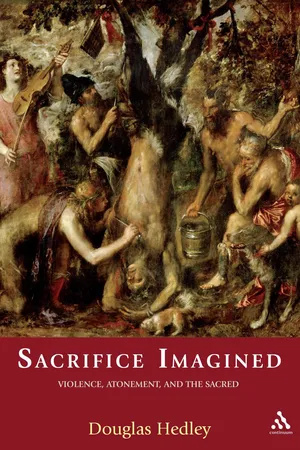
Sacrifice Imagined is an original exploration of the idea of sacrifice by one of the world's preeminent philosophers of religion.
Despisers of religion have poured scorn upon the idea of sacrifice as an index of the irrational and wicked in religious practice. Nor does its secularised form seem much more appealing. One need only think of the appalling cult of sacrifice in numerous totalitarian regimes of the twentieth century. Yet sacrifice remains a part of our cultural and intellectual 'imaginary'. Hedley proposes good reasons to think that issues of global conflict and the ecological crisis highlight the continuing relevance of the topic of sacrifice for contemporary culture.
The subject of sacrifice has been decisively influenced by two books: Girard's The Violence and the Sacred and Burkert's Homo Necans. Both of these are theories of sacrifice as violence. Hedley's book challenges both of these highly influential theories and presents a theory of sacrifice as renunciation of the will. His guiding influences in this are the much misunderstood Joseph de Maistre and the Cambridge Platonists.
- 256 pages
- English
- ePUB (mobile friendly)
- Available on iOS & Android
eBook - ePub
About this book
Information
1
The Theophanic Imagination: “Making Sacred” and the Sublime
To think is to speculate with images.
Bruno
Das ausschliessend Eigenthumlich der Absolutheit ist, das sie ihrem Gegenbild mit dem Wesen von ihre Selbstandigkeit verleiht. Dieses in-sich selbst-sein, diese eigentlich und wahre Realitaet des Angeschauten, ist Freiheit.
(The exclusive particularity of the Absolute is that it offers its counter-image independence. This independent existence, the proper and real reality of observed, is freedom.)
Schelling
Shut your eyes and awake to another way of seeing, which everyone has but few use.
Plotinus
In this chapter we consider the status of mankind’s involvement or participation in the process of “making sacred” — an involvement in the sacrificial rite — as coexisting with the activity of God. The physical cosmos bears within it its own logos or creative essence, but these Divine energies cannot be realized without the corresponding human contribution. The role of the imagination employed in this process is outlined. The locus of this perception of the Divine within the Israelite prophetic tradition was the Temple, as the point of correspondence between the finite cosmos and the mind of God.
Plato and Aristotle both saw wonder as the inspiration of philosophy. And the love of a beautiful and intelligible universe, and the source or principle (arche) “that moves the sun and other stars” has inspired much traditional metaphysics. Indeed, one could argue that philosophy is itself chimerical if the universe is a brute absurdity. If consciousness and freedom, the soul and responsibility are systematic illusions, or perhaps at best the epiphenomena of a deterministic universe, these are metaphysical positions and not the simple inferences from scientific facts. More fundamentally still, is there an uncreated necessary Being, the source of the vast contingent cosmos and the realm of becoming? Is there a transcendent Mind beyond the flux of fleeting thoughts, intentions, and aspirations? Plato and Aristotle claim that the answer is yes! The imagination of this transcendent uncreated reality has inspired the greatest poetry from the Upanishads to the Sufi mystics, Dante, Wordsworth, and Eliot.
Sir William Jones, the great Sanskritist, believed that the subtle theology of ancient India “induced many of the wisest among the Ancients, and some of the most enlightened among the Moderns, to believe, that the whole Creation was rather energy than a work, by which the Infinite Being, who is present at all times and in all places, exhibits to the minds of his creatures a set of perceptions”.44 It is a doctrine of original uncreated oneness, of māyā as the fall into deception and multiplicity, and of a return to oneness where only God is perceived.
False philosophical extremes continue to trouble serious Christian theology. One extreme consists of a crude essentialism and the other might be deemed loosely nominalism. According to the first, God can be grasped as an object of intellectual inquiry. Theology is not possible if its supreme object is viewed as an entity that can be captured as an item among others: si comprehendis non est Deus. However, equally corrosive is the second option, the nominalism that insists that our abstract names and predicates are universal expressions for a de facto plurality of discrete concrete items. The denial of abstract universals infects theology with a radical and untenable skepticism. The proper balance must consist in a balance between the proper respect for the limits of conceptual definition and sufficient epistemological optimism. Imagination constitutes the inward light of the soul. If faith is the substance of things hoped for, the evidence of things not seen, then these objects cannot be seen by the physical organs or deduced rationally. If God is beyond thought and language, then imagination is necessary for theology. As Wordsworth insists,
This spiritual love acts not nor can exist
Without imagination, which, in truth,
Is but another name for absolute power
And clearest insight, amplitude of mind,
And Reason in her most exalted mood.45
Love is the means by which the deepest nature of reality is revealed. The very reason for the world’s existence is love: the bonum diffusivum sui of God. Imagination is an inward light that can be identified with rationality in its most sublime function. Philosophy is etymologically the love of wisdom, not wisdom itself. Notwithstanding the power of specific arguments for the existence of God or the nature of the soul, the key to the knowledge of God is that joy of experience of the Divine presence by a living soul that Wordsworth describes as “spiritual love.” Already in book 2 of The Prelude Wordsworth writes:
Wonder not/
If high the transport, great the joy I felt
Communing in this sort through earth and heaven
With every form of creature, as it looked
Towards the Uncreated with a countenance
Of adoration, with an eye of love.46
Christian theology, in particular, should be partial to the claims of the imagination, notwithstanding the dangers of idolatry and superstition. Even in an age of disenchantment, the mysterious but central doctrine of the imago Dei must mean that there is a special and unique link between the human being and God. This doctrine is reinforced by the doctrine of the incarnation. In a political world where “rights” and “human dignity” are so momentous, it is ironic that we fail to see those “fire darting steeds,”47 the horses of the Titan Helios, the sun God, in the movement of the sun from East to West: we know the sunset to be an illusion because it is the earth, not the sun, that is moving; a fact that any rational and educated mind knows since Copernicus. Thus, not only is nature rendered devoid of meaning but also human agency seems redundant: the product of mechanical processes that we are incapable of understanding; we are thus robots deluded by the belief in freedom. As the sense of the cosmos as meaningful has been eroded by the scientific revolution of the seventeenth century, so too the belief in human freedom seems battered. A deterministic and scientistic view of human nature, however, leaves out the role of ideas upon the events of history. The etymology of words often sheds light upon the history of philosophy. Any philosophy overlooks, at its peril, the important of history and tradition for
a creature who not prone
And brute as other creatures, but endued
With sanctity of reason, might erect
His stature, and upright with front serene
Govern the rest, self-knowing, and from thence
Magnanimous to correspond with heaven.48
Modern theology is embarrassed about immanence. For various reasons, philosophy in both the analytic and the continental traditions tends to conceive of God as an entirely transcendent. Continental philosophers have been so concerned about Heidegger’s critique of “onto-theology” that any retrieval of God-talk is almost paralyzed by the fear of collapsing into reification of the Divine. Analytic philosophers have been traditionally more concerned by the objections of Humean and Kantian provenance. The predominant model, is, however, that of a deus absconditus — that is, a radically transcendent agent.
One of the major problems with the emphasis upon Divine transcendence is that it is open to Schellenberg’s objection. Schellenberg claims that hiddenness of God is an argument for atheism.49 A good God would have provided adequate evidence of his existence. Clearly, however, there exist many who would like to believe in God but who sincerely lack the requisite evidence. Any serious theology must be able to provide examples of the experience of God.50
If the presence of God is described in terms of the goodness, truth, and beauty of the world, this has many attractions to the philosophical theist. Yet human experience is deeply perplexing and troubling what abour death and suffering?
Environment, shaping, and shaped?
Animals are shaped by their environment; we are makers of our own milieu. The evolution of the long neck of the giraffe is a striking instance of a genetic adaptation to the environment. Clearly humans also adapt to their environment via their genetic inheritance. Tibetans, for example, have developed a distinct physiological adaptation to high altitude. The Tibetan can naturally withstand conditions at high altitude that would be intolerable for other human beings. However, much more characteristically human is the capacity to shape the environment rather than be shaped by it. The town or city is a good example of how human beings structure their immediate environment. The town provides amenities and protection from predators. Yet the architecture of the city is an imaginative structure. The forms of building and the ornamental designs, the “concrete music”51 of even the most functional architecture constitutes a distinctive and imaginative representation of reality, one that varies enormously between different human cultures.
The shaping imagination of human beings — evident in, for example, the city — has a positive and a negative dimension. The environmental crisis is an example of the destructive power of the human imagination. This Promethean or Faustian energy, lamented in the book of Job, or by Tolkien in The Lord of the Rings, is the capacity of human technical process to put “nature on the rack” and wars and pollution and ugliness and cruelty of much contemporary civilization exhibits this negative shaping energy of the human mind. The scientific and industrial revolutions of the early Modern period have greatly enhanced this characteristic of homo sapiens.
As makers, humans are intensely aware of the impact of this creative imagination, and the great myths explored this theme long before the seventeenth century. Our special place in the created order as creative beings brings special responsibilities and burdens. The normative is fused with an obligation that precedes any conscious agreement.
The ambivalence of the normative
Plato’s cave is a graphic imaginative expression of the epistemic, ontological, and axiological gap between appearance and reality. What we take to be reality is suffused with illusion. Knowledge, for Plato, is linked to a process of liberation from ignorance, a process that he sees as an ascent. The idea of the sacred is tied to the sense of gulf of rupture between value and empirical reality. This odd tension between the axiological (the sense of value in the world) and the kakurgic (the tendency towards needless suffering and destruction) provides a puzzling rift in human experience.
Consider the battle of Mers-el-Kébir in July 1940 when the Royal Navy destroyed most of the French fleet, killing 1,297 men. Britain and France were recent allies. Since France had agreed an armistice with Nazi Germany, Britain was concerned that the considerable French fleet in this port would be employed by the Germans and Italians to isolate Britain from its empire and thus gain easy victory. British and F...
Table of contents
- Cover
- Title
- Copyright Page
- Contents
- Dedication
- Acknowledgments
- Prologue
- 1: The Theophanic Imagination: 'Making Sacred' and the Sublime
- 2: Costly Signaling or Hallowed Violence: Explaining Sacrifice?
- 3: Failed Oblations and the Tragic Imagination
- 4: Thraldom, License, and Liberty: Sacrificial Renunciation
- 5: Evil, Sacrifice, and the Bloodstained Logos
- 6: Responsibility, Atonement, and Sacrifice Transformed
- 7: Madness, Metamorphosis, and the Pathetic God: Dionysus and the Crucified
- 8: The 'Quire-Musick of the Temple' and the Heavenly Banquet
- Epilogue
- Bibliography
Trusted by 375,005 students
Access to over 1.5 million titles for a fair monthly price.
Study more efficiently using our study tools.
Frequently asked questions
Yes, you can cancel anytime from the Subscription tab in your account settings on the Perlego website. Your subscription will stay active until the end of your current billing period. Learn how to cancel your subscription
No, books cannot be downloaded as external files, such as PDFs, for use outside of Perlego. However, you can download books within the Perlego app for offline reading on mobile or tablet. Learn how to download books offline
Perlego offers two plans: Essential and Complete
- Essential is ideal for learners and professionals who enjoy exploring a wide range of subjects. Access the Essential Library with 800,000+ trusted titles and best-sellers across business, personal growth, and the humanities. Includes unlimited reading time and Standard Read Aloud voice.
- Complete: Perfect for advanced learners and researchers needing full, unrestricted access. Unlock 1.5M+ books across hundreds of subjects, including academic and specialized titles. The Complete Plan also includes advanced features like Premium Read Aloud and Research Assistant.
We are an online textbook subscription service, where you can get access to an entire online library for less than the price of a single book per month. With over 1.5 million books across 990+ topics, we’ve got you covered! Learn about our mission
Look out for the read-aloud symbol on your next book to see if you can listen to it. The read-aloud tool reads text aloud for you, highlighting the text as it is being read. You can pause it, speed it up and slow it down. Learn more about Read Aloud
Yes! You can use the Perlego app on both iOS and Android devices to read anytime, anywhere — even offline. Perfect for commutes or when you’re on the go.
Please note we cannot support devices running on iOS 13 and Android 7 or earlier. Learn more about using the app
Please note we cannot support devices running on iOS 13 and Android 7 or earlier. Learn more about using the app
Yes, you can access Sacrifice Imagined by Douglas Hedley in PDF and/or ePUB format, as well as other popular books in Theology & Religion & Philosophy of Religion. We have over 1.5 million books available in our catalogue for you to explore.