Philosophy and the Christian Worldview is a collection of new essays written by fifteen philosophers of religion. Bringing together some of the leading lights in current academic philosophy of religion, including William Hasker, Charles Taliaferro and Keith Yandell, it offers a fresh perspective on four major areas of discussion: Religion and Epistemology; Religion and Morality; Religion and Metaphysics; and Religion and Worldview Assessment.
United by the argument that the core claims of religion have metaphysical, epistemic and moral entailments, these essays represent a state of the art discussion in contemporary philosophy of religion.
eBook - ePub
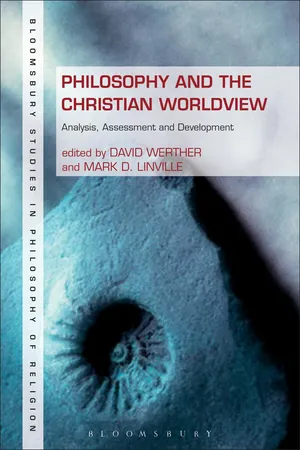
Philosophy and the Christian Worldview
Analysis, Assessment and Development
- 288 pages
- English
- ePUB (mobile friendly)
- Available on iOS & Android
eBook - ePub
Philosophy and the Christian Worldview
Analysis, Assessment and Development
About this book
Information
Part One
Religion and Worldview Assessment
Chapter 1
IS PHILOSOPHY OF RELIGION POSSIBLE?
Keith E. Yandell
1.1 Introduction
The idea that religion lies outside the realm of rational assessment is still widely accepted. Since philosophy of religion has an essential task of (if not “just is the task of”) endeavoring to state religious doctrine clearly and fairly, in philosophically accessible terms, and assessing the results by rational standards, this would make philosophy of religion impossible. There are various ways of conceiving the articulation of this task—different accounts of what the rational standards are and what the results of applying them may be. For instance, a physicalist epistemology will view such things very differently from Reformed epistemology. I will not discuss them here.
To question whether philosophy of religion is possible in the present situation, when there are books and articles galore, and several journals, devoted in whole or part to philosophy of religion, has an unrealistic ring. Nonetheless, there is an aspect of the question often not even mentioned. Philosophy of religion is possible only if it can be done cross-culturally—only if the issues, claims, and arguments of the field can be genuine issues, true or false claims, sound or unsound and valid or invalid arguments, independent of time and place. Philosophy, and so philosophy of religion, is inherently universal if there is any such thing at all. The point is not that it must be recognized as such. Most people in any place or time have little acquaintance with formal philosophy, though some of the central questions of philosophy enjoy wide concern. The issue is not acceptance, or even accessibility. It is applicability—the issues themselves are not limited to temporally and spatially local issues, nor are the claims and arguments offered about them. This is compatible with those issues, claims, and arguments being raised in one form in one context and in another form elsewhere. Language and culture will differ. The question, say, as to what persons are is universal in the sense that its answers are, if true, then true universally, whether or not the question is universally raised. It is mistaken to infer from the fact, if fact it is, that in a given culture philosophical questions are rarely if ever raised, that the answers to those questions, if true, are not universally true. It is equally mistaken to infer from the fact that philosophical issues are raised, if at all, in some geographical, cultural, and temporal context, that the questions or answers are somehow restricted to that context. In what follows, I briefly consider some challenges to the perspective just outlined, and then look at some particular issues in epistemology, metaphysics, and ethics that are not culturally or temporally local.
1.2 Challenges Briefly Answered: Crass empiricism, Anti-Realism, Cultural Relativism
One prejudice, common in philosophy and our culture, is the view that verification or falsification by sensory experience, perhaps supplemented by purely formal considerations, is all there is in terms of confirmation and disconfirmation. If this is so, then rational assessment of religious doctrine is limited to sensory evidence and discernment of incompatible claims. The fact that this claim itself is not confirmable by sensory experience or formal considerations seems not enough to erase it, though it should be.
Supposedly trivial examples of necessary truths such as No proposition is both true and false and If it is true that P, and true that if P then Q, then it is true that Q—taken as they would be taken by traditional philosophers who accepted them—are far from trivial. The presupposition of such simple claims is part and parcel of thinking at all, whether or not these are explicitly stated. It is absurd to regard them as only locally true. empiricist analyses of such truths ground them in linguistic conventions, the way the brain or mind works, or social convention. This grounds them in things that might never have obtained, thus rejecting rather than explaining their necessary truth, and thus this attempt at grounding fails.
In addition to self-contradictions being necessarily false, there are various routes to what we might call intellectual suicide. Here are three. The claim No one can know anything said in English is self-defeating in that no one could know it were it true. The claim Nothing said in English can be true is self-refuting in that its being true is incompatible with what it says being true. Nothing can be said in English is self-destroying, being an instance of what it says cannot exist. A more interesting example of self-destruction is the claim, All language is metaphorical; as a non-metaphorical use of language, it is itself the very sort of thing it says there cannot be. Such claims, and views to which they are essential, commit intellectual suicide; there is no chance that they constitute knowledge. Plenty of secularists seem to believe One ought to believe nothing but what science teaches, but that claim is not something that science teaches, so they are inconsistent in believing it. Only what passes the Verification Principle of the Logical Positivists is meaningful did not pass the test of the Verification Principle. We may legitimately add to our simple truths, No view that commits intellectual suicide can be known to be true.
I have heard the claim made that to say that God exists is true is to say that this claim is included in, or entailed by, at least one of our best theories. If so, then God did not pre-exist our theories, depends for existence on us (since our theories do), can go out of existence and come back in as our theories change, and can be annihilated by perpetrating mass frontal lobotomies (since then we’d not be able to hold theories). We could destroy disease by holding no best theory that includes its existence, and commit universal suicide by having among our best theories one that is person-denying.
There is the view that truth and knowledge, at least outside of natural science, logic, and mathematics, are culture-bound. My anthropology professor recited the mantra All our beliefs are culturally determined (and so not true beyond our culture) which, if true, is true of all beliefs in all cultures but held in his, and so false. Truth is relative to conceptual systems cannot be true, as it is the very sort of claim it says cannot be true. These sorts of “discoveries” are self-refuting. So this challenge joins the limitation-to-sensory-data as views that eliminate themselves from serious consideration. None of these perspectives is internally defensible, and so none poses any real challenge to philosophy of religion.
1.3 A Word about Evidence
There being evidence shares universality with truth. Here, with regrettable brevity, are claims about evidence.
1. That E is evidence for proposition P does not entail that P is true. Nonetheless, that E is evidence for proposition P does entail that E is evidence that P is true. Evidence is truth-favoring, not truth-entailing.
2. That a proposition is false does not preclude there being evidence that it is true.
On the standard definition of entailment, proposition P entails proposition Q if and only if it is logically impossible that P be true and Q be false. But entailment holds between any proposition whatever and any necessary truth, and entailment holds between any necessary falsehood and any proposition whatever. It follows that:
3. That P entails Q does not entail that P is evidence for Q.
4. One can take something as evidence when it isn’t and not take something to be evidence when it is; whether something is evidence or not is independent of whether it is taken to be.
5. There can be evidence for and against the same proposition, and for two logically contrary claims.
6. That there is evidence for P and also for Q, does not entail that there is evidence for the conjunct of P and Q.
7. Perhaps surprisingly, that E raises the probability of P does not entail that E is evidence for P.
That (a) Ralph has more true beliefs than false and (b) Ralph believes that God does not exist entails that, on (a) and (b), atheism is more probable than otherwise. This does not entail that (a) and (b) are evidence for atheism. Nonetheless, that E is evidence for P does increase P’s probability.
These features illustrate and support the universality and objectivity of evidence, as opposed to our recognition and use thereof, reinforcing the point of the previous section.
1.4 Epistemology
Among the many epistemological issues in Philosophy of Religion are two questions: is there any direct experiential evidence, and is there any indirect experiential evidence, for any religious belief? One way of stating the distinction, where (roughly) “O” ranges over things and “Q” over properties, is:
Where C is the claim O is Q, S’s experience E meets the direct relevance conditions with respect to claim C only if S’s having E is a matter of there phenomenologically seeming to S to be an O that is Q.
In contrast:
E meets the indirect relevance conditions with respect to claim C only if S’s having E is a matter of there phenomenologically seeming to S to be an item O* that has property Q* and for good truth-preferring reasons S accepts a theory that contains as an essential element the claim that If O* is Q* then O is Q, and S infers O is Q from O* is Q* and If O* is Q* then O is Q
So deciding whether an experience meets direct relevance conditions for providing evidence for a claim does not, and deciding whether an experience meets indirect relevance conditions for a claim does, require considering what relevant theories are supported by good reasons. I take it that, typically, sensory experience provides good direct evidence concerning our physical environment. In what follows, I will consider whether religious experiences provide direct evidence for beliefs central to Jain, Buddhist, and (briefly) theistic traditions, saving discussion of Advaita Vedanta Hinduism for the next section.
The Jain claim is that, both in everyday introspective and introspection-like enlightenment experience, the subject is aware of herself as a subject of experience—to feel pain is to feel oneself in pain. The relation of subject to experience is not that the former is constituted by the latter. For an experience to occur is for a being to be in a conscious state. Conscious states are states of persons, and cannot be unowned. This is clear to common sense and evident in enlightenment experience. It is also claimed that the subject of introspection and enlightenment is implicitly omniscient and inherently immortal, though this is not recognized by us when we are embodied, short of our becoming enlightened. The core of this view was also held by an early Indian Buddhist school (Pudgala) which was condemned as heretical.
A more typical Buddhist claim is that all there is to what li...
Table of contents
- Cover
- Half-Title
- Introduction
- Part One: Religion and Worldview Assessment
- Part Two: Religion and Epistemology
- Part Three: Religion and Morality
- Part Four: Religion and Metaphysics
- Index
- Copyright
Trusted by 375,005 students
Access to over 1.5 million titles for a fair monthly price.
Study more efficiently using our study tools.
Frequently asked questions
Yes, you can cancel anytime from the Subscription tab in your account settings on the Perlego website. Your subscription will stay active until the end of your current billing period. Learn how to cancel your subscription
No, books cannot be downloaded as external files, such as PDFs, for use outside of Perlego. However, you can download books within the Perlego app for offline reading on mobile or tablet. Learn how to download books offline
Perlego offers two plans: Essential and Complete
- Essential is ideal for learners and professionals who enjoy exploring a wide range of subjects. Access the Essential Library with 800,000+ trusted titles and best-sellers across business, personal growth, and the humanities. Includes unlimited reading time and Standard Read Aloud voice.
- Complete: Perfect for advanced learners and researchers needing full, unrestricted access. Unlock 1.5M+ books across hundreds of subjects, including academic and specialized titles. The Complete Plan also includes advanced features like Premium Read Aloud and Research Assistant.
We are an online textbook subscription service, where you can get access to an entire online library for less than the price of a single book per month. With over 1.5 million books across 990+ topics, we’ve got you covered! Learn about our mission
Look out for the read-aloud symbol on your next book to see if you can listen to it. The read-aloud tool reads text aloud for you, highlighting the text as it is being read. You can pause it, speed it up and slow it down. Learn more about Read Aloud
Yes! You can use the Perlego app on both iOS and Android devices to read anytime, anywhere — even offline. Perfect for commutes or when you’re on the go.
Please note we cannot support devices running on iOS 13 and Android 7 or earlier. Learn more about using the app
Please note we cannot support devices running on iOS 13 and Android 7 or earlier. Learn more about using the app
Yes, you can access Philosophy and the Christian Worldview by David Werther, Mark D. Linville, David Werther,Mark D. Linville in PDF and/or ePUB format, as well as other popular books in Theology & Religion & Philosophy of Religion. We have over 1.5 million books available in our catalogue for you to explore.