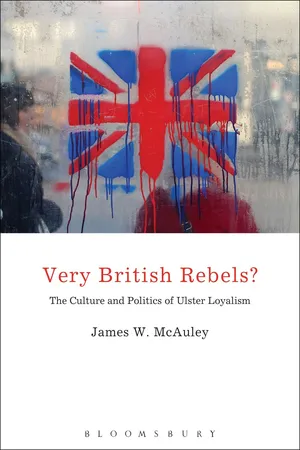
Challenging traditional narrow views, this unique work proposes to rethink and reinterpret Ulster loyalism from the beginning of the "Troubles" to the present day, by tracing its religious, paramilitary, political, and community influences.
The work examines the core values of loyalist communities, the roots of violence, and the shift toward peaceful coexistence with former enemies. Also discussed are the DUP's claims that it represents loyalism's "true voice" along with the complex and varying degrees of commitment to the Crown, the Protestant Faith, and the British governance of Northern Ireland. Lastly, it looks at how cultural expressions of loyalist identity, such as poetry or cartoons, are being used in the (re)construction of a loyalist memory.
Written by a leading expert on Ulster loyalism, the work is based on extensive interviews with loyalists and loyalist literature to provide an inside account of the processes of loyalist identity formation and transformation. Drawing on political science, sociology and cultural studies, it will appeal to anyone interested in Irish politics as well as conflict and peace processes.
- 176 pages
- English
- ePUB (mobile friendly)
- Available on iOS & Android
eBook - ePub
About this book
Information
1
Ulster Loyalism, Identity and Belonging
A sense of belonging, experienced as an everyday awareness of identity, expression of ideological belief, common political desire and emotional attachment, is central to understanding contemporary loyalism. This involves family and friendship networks, alongside various religious and community associations as well as paramilitary organizations, fraternal organizations, formal political groupings, marching bands, pressure, protest and other social groupings. All of these groupings (and more) are framed by the loyalist sense of identity and bonded by a narrative endorsing and bolstering what is seen as the distinctive cultural and political history of loyalism.
Central to that narrative is the identification of several key locations for the construction of loyalist collective memory and identity. We highlight some of the central historical reference points used in the composition of loyalism, which present the reasons for conflict and its history to members1 to provide a coherent narrative,2 which consequentially carries great weight in the group’s self-portrayal. The resulting account links collective memories in a highly accessible, if often rather simplified, account of political and social relations and the causes for conflict and its political consequences.
For some, the Northern Ireland polity is still best understood as an ethnic frontier society,3 where the social categories of ‘native’ and ‘planter’ continue to resonate and convey meaning on a daily basis. Within an identifiable geographical and political terrain, competing national claims create ‘chronic territorial force fields’,4 and the ensuing social and political tensions and divisions propel events of the past to the fore and make them subject to consistent reinterpretation and representation through the lens of the present. Indeed, Marianne Elliott has suggested that such processes form part of ‘a deep sense of insecurity in Protestant psyche’, whereby the fundamental divisions of planter and native are constantly revived, for example, to explain ‘the attacks on Protestant property in successive IRA campaigns’.5
Thus, the reproduction, redefinition and reinterpretation of the past remain crucial. While the notion that social and political divisions in Ireland have deep historical roots, or that the major issues of contemporary Irish politics are framed by the past are far from novel,6 this book is not directly concerned with ‘history’. Rather, this book seeks to provide an analysis of Ulster loyalism through considering identified political ideas, leadership and events. Its focus is on how memories of the past become enclosed and reproduced within certain social groups, and how this often provides the framework for replication and reinforcement of common ideas, concerns and political perspectives. These processes are clearly witnessed in the contested and competing narratives of political history available at the everyday, populist and academic levels.7
Ireland has, of course, a long and divisive political history and has been subject to political and military intervention from England since the late twelfth century. Indigenous opposition was increasingly met with military force interspersed with phases involving the importation of people from England and Wales. For most, the origins of the modern conflict are located in the mutually antagonistic social relations and conflicting identities that arose on the Island following a series of Plantations (the confiscation of land and raw materials and the colonization of land with settlers by the English Crown), which began under the reign of James VI.8 The strategic plantation of Ulster in the late Tudor and early Stuart monarchies in a bid to subdue the ‘most remote and troublesome of the Irish provinces’9 was a sizeable economic and political venture, involving the transportation of around 170,000 people, the vast majority of whom were Presbyterians from lowland Scotland.
Social, cultural and political divisions were amplified, and as Ed Moloney suggests, it was at this time the notion of ‘conditional loyalty’ was also implanted, through ‘the idea that citizens and the state are bound together by a contract in which the citizens agree to support and defend the state only as long as the state defends and supports them’.10 As we shall see, the concept of conditionality is one to which sections of loyalty have consistently returned. As a consequence, fundamental ethno-political and religious divisions were sharpened, making the history of the seventeenth century one of unadulterated hostility between settler and native.11 The period from the 1640s saw the Scottish Presbyterian foothold established in the north-east of Ireland, consolidated by a further exodus from south-west Scotland, the stronghold of Covenanting Presbyterianism, part of a tradition upon which unionists were to draw upon directly in the years to come.
This produced a ‘significant body of Irish Protestants who were tied through religion and politics to English power’,12 the bulk of planters following a reformed religion that was disdainful towards the indigenous faith. As competing interpretations and experiences of colonization and conflict deepened, assimilation became all but impossible as the ethnic and social estrangement of native from settler was further underpinned by other cleavages built around discordant cultural and religious dimensions.13 Ireland’s colonial experiences created long-lasting fundamental social, ethnic and political boundaries and a template for much of the subsequent conflict in Ireland.14
By the end of the seventeenth century, the Island had witnessed a further dramatic set of events that have become deeply located in the collective political memories of Ireland, as the Williamite war separated Irish society along with already established sectarian frontiers. As we shall encounter throughout the remainder of the book, for many Protestants these occurrences also formed the platform for a long history of celebration and commemoration of the King William’s victory including activities such as the ‘renaming of streets, painting the monarch on prominent buildings, and construction of monuments’.15 Events such as the siege of Derry16 and the series of skirmishes and battles, culminating in the conflict at the river Boyne gave rise to competing communal histories and collective memories to reflect and reinforce ‘a prior history (and earlier remembrance) of colonization and resistance’.17
As a consequence, John Darby18 suggests the next two centuries are best categorized as a period of continuing divergence when the consolidation of differences between the social groups and competing political loyalties was firmly established. In repost to continuing resistance towards English rule, which manifested in frequent risings, rebellions and generalized opposition, the Act of Union was introduced in 1801, abolishing the Irish parliament and allowing Westminster to take direct charge of Irish matters. The nineteenth century continued to witness the emergence of Irish nationalist social and political movements, some parliamentary based, others resting in militarism and expressions of physical force, but all intended to overthrow the Union.
Calls for Irish self-government culminated under the stewardship of Charles Stuart Parnell, founder of the Irish National League and first leader of the Irish Parliamentary Party (IPP). Parnell found the support of the British Liberal Prime Minister, William Gladstone, whose attempt to introduce Home Rule (as a form of semi-independent devolution of authority) was defeated in Westminster, albeit narrowly, in 1886. A second attempt to introduce Home Rule in 1893 won support in the Commons only to be defeated in the House of Lords, although Gladstone continued to promote Home Rule until the end of his public life in 1894.19
The gravest of disasters
Throughout the period, the vast bulk of Irish Protestantism remained united in its opposition to a Home Rule Parliament and remained solid in its political commitment to a future of Kingdom and Empire. Most believed that under a Dublin parliament, ‘their religion, their way of life, and their economic interests would be endangered’.20 In a culmination of much of the political activity from the 1880s onwards, the early twentieth century saw almost continual pressure build on the British government to grant Ireland independence. Home Rule introduced a political dynamic that fashioned the character of the Ulster problem and the dynamic of the politics surrounding it. Further, Liberal support for Home Rule ‘had a seismic impact on British politics, reshaping the party system into two blocs, for and against Irish autonomy, in a struggle that would last until 1921’.21
Home Rule again came to the forefront of the political agenda in 1910, when following general election that resulted in a hung parliament, it became clear that the IPP would hold sway at Westminster. The IPP and the Liberal Party entered into a pact involving Asquith introducing a third Bill for Home Rule in return for Redmond’s support in parliament. The Bill was supported through the Commons, and although there was widespread opposition in the Lords, the upper House could do no more than delay the implementation of the legislation.
Ulster Protestants began to make plans to organize against the possibility of Home Rule for Ireland. In an intensifying political atmosphere, sections of unionism openly threatened secession for the industrialized Norther...
Table of contents
- Cover
- Halftitle Page
- Title Page
- Dedication Page
- Contents
- Acknowledgements
- Abbreviations
- Introduction
- 1. Ulster Loyalism, Identity and Belonging
- 2. Establishing Loyalism and the Unionist State
- 3. Modernization, Loyalist Reaction and Identity
- 4. Inside a Loyalist Community
- 5. Memory, Narratives and Popular Culture
- 6. Paramilitarism and Commemoration
- 7. (In)security, (Dis)connection and Culture Wars
- 8. Ulster Loyalism and Futures Past
- Bibliography
- Index
- Imprint
Trusted by 375,005 students
Access to over 1.5 million titles for a fair monthly price.
Study more efficiently using our study tools.
Frequently asked questions
Yes, you can cancel anytime from the Subscription tab in your account settings on the Perlego website. Your subscription will stay active until the end of your current billing period. Learn how to cancel your subscription
No, books cannot be downloaded as external files, such as PDFs, for use outside of Perlego. However, you can download books within the Perlego app for offline reading on mobile or tablet. Learn how to download books offline
Perlego offers two plans: Essential and Complete
- Essential is ideal for learners and professionals who enjoy exploring a wide range of subjects. Access the Essential Library with 800,000+ trusted titles and best-sellers across business, personal growth, and the humanities. Includes unlimited reading time and Standard Read Aloud voice.
- Complete: Perfect for advanced learners and researchers needing full, unrestricted access. Unlock 1.5M+ books across hundreds of subjects, including academic and specialized titles. The Complete Plan also includes advanced features like Premium Read Aloud and Research Assistant.
We are an online textbook subscription service, where you can get access to an entire online library for less than the price of a single book per month. With over 1.5 million books across 990+ topics, we’ve got you covered! Learn about our mission
Look out for the read-aloud symbol on your next book to see if you can listen to it. The read-aloud tool reads text aloud for you, highlighting the text as it is being read. You can pause it, speed it up and slow it down. Learn more about Read Aloud
Yes! You can use the Perlego app on both iOS and Android devices to read anytime, anywhere — even offline. Perfect for commutes or when you’re on the go.
Please note we cannot support devices running on iOS 13 and Android 7 or earlier. Learn more about using the app
Please note we cannot support devices running on iOS 13 and Android 7 or earlier. Learn more about using the app
Yes, you can access Very British Rebels? by James White McAuley in PDF and/or ePUB format, as well as other popular books in Politics & International Relations & Comparative Politics. We have over 1.5 million books available in our catalogue for you to explore.