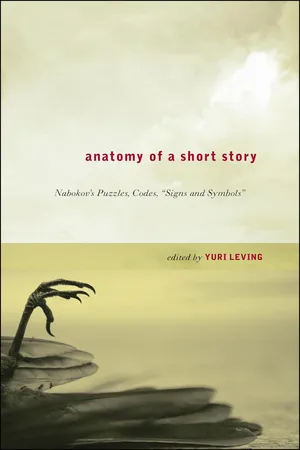
Since its first publication in 1948, one of Vladimir Nabokov's shortest short stories, "Signs and Symbols," has generated perhaps more interpretations and critical appraisal than any other that he wrote. It has been called "one of the greatest short stories ever written" and "a triumph of economy and force, minute realism and shimmering mystery" (Brian Boyd, Vladimir Nabokov: The American Years).
Anatomy of a Short Story contains:
• the full text of "Signs and Symbols," line numbered and referenced throughout
• correspondence about the story, most of it never before published, between Nabokov and the editor of The New Yorker, where the story was first published
• 33 essays of literary criticism, bringing together classic essays and new interpretations
• a round-table discussion in which a screenwriter, a theater scholar, a mathematician, a psychiatrist, and a literary scholar bring their perspectives to bear on "Signs and Symbols"
Anatomy of a Short Story illuminates the ways in which we interpret fiction, and the short story in particular.
- 432 pages
- English
- ePUB (mobile friendly)
- Available on iOS & Android
eBook - ePub
About this book
Information
CRITICISM
PART ONE
Bone Structure
Frameworks
Vladimir Nabokov’s correspondence with The New Yorker regarding “Signs and Symbols,” 1946–8
Vladimir Nabokov first met Katharine Sergeant Angell White, the editor at The New Yorker and one of its founders, through Edmund Wilson. Mrs White, who had taken a leave of absence from the magazine to spend time in Maine with her husband, writer E. B. White, admired Nabokov’s stories, published in The Atlantic. In January, 1944, after returning to New York and resuming her job, she told Wilson her dream—to have Nabokov shift allegiances and start publishing for them. Wilson introduced this idea to his Russian friend, mentioning, among other things, The New Yorker rates (they were much higher than those at The Atlantic). In a letter to Wilson on January 11, Katharine White mentioned her being “anxious to have Mr Nabokov send us prose as well as poetry.” In June, the money-conscious Nabokovs received the first advance from The New Yorker. “Time and Ebb,” however, the short story Nabokov submitted in September, failed to launch the relationship with perfect mutual understanding and good will. Referring to her colleagues (“we all feel”), Mrs White rejected Nabokov’s “mocked learned style” and regretted that, “sometimes, in spite of its being parody, [the story] becomes rather heavy reading” (September 28, 1944).1 Nabokov retorted in a similarly blunt manner: “I was a little shocked by your readers’ having so completely missed the point of my story” (October 26, 1944).
The sharpness of this early exchange is emblematic of what followed. By and large, the relationship between a writer and an editor progresses towards greater mutual understanding. Professional sympathies may or may not lead to a friendship, but the evolution of reciprocal tolerance is typically expected. Nabokov took an immediate liking to the impeccably polite, knowledgeable, ironic, and responsive Mrs White as well as to her talented husband, whose love of the outdoors and a life-long fondness for dachshunds he found most endearing. But no matter how affable their letters were regarding all matters personal, their arguments of technique never ceased. Neither Nabokov’s increasing fame nor his firmness in resisting editorial interference would stop Mrs White from unfailingly criticizing chapters from what was to become Conclusive Evidence and Pnin. She insisted that “Curtain Raiser,” an autobiographical story, was written “more hastily” than Nabokov’s other work (July 28, 1948). She demanded that he take scientific words out of “Portrait of My Mother,” and complained that the famous synaesthesia passage was too long (“Once the reader gets the idea we believe that he may find the color description of your mental images of the letters a bit prolonged and we do honestly feel that, coming so near the start of the story, it might make him think the piece to be of a very different nature from what it turns out to be” [March 1, 1949]). Finally, she would become alarmed at Nabokov’s “political passages,” asking him to shorten them as well as to change the tone of “Student Days,” which seemed to her “a little harsh and hysterical” (November 8, 1949). To these comments, expressed in a patient and often apologetic tone, Nabokov responded curtly and without remorse. “Do please, please say you will rework [“Student Days”] for us,” pleaded Mrs White. “I am terribly sorry but what you suggest is quite impossible” was the typical reply she would get (November 9, 1949).
This was not a battle of wills, as it may seem at first glance. Nabokov appreciated every correction from his editor that might help him avoid embarrassment. Though he was a master like no other, he was still grappling in the 1940s with the intricacies of English, some of them semi-hidden, like tree roots on a wanderer’s path, others lying in plain view. The correspondence about “Signs and Symbols,” which yielded the greatest number of letters per one Nabokov story published in The New Yorker, ended with Nabokov’s request that Mrs White alter the line “with his elbows raised” to “with his bare arms clasped under his head” (March 29, 1948). The change was impossible, she said: “Arms can’t be clasped—only hands” (April 1, 1948).
Nabokov was mortified even more to find out that his reference to “broken blossoms” in the same story harbored sexual connotations. “You are absolutely right about the broken blossoms affair,” he wrote back in haste. “I did not mean it to come through the mother’s mental screen but I confess I did not realize the whole effect of the platitude” (March 29, 1948).
Authorial ambition also had little to do with Nabokov’s resistance. After a few short stories and poems edited by Katharine White, the writer began to value her judgment and anticipate her disapproval even before it was expressed. On July 5, 1945, for example, he began his letter of submission with self-criticism, saying that not only the title of “Curtain Raiser” was “optional,” but that one of the passages in the story might “be not quite seemly on the pages of a magazine.” Calling himself a “self-centered author,” Nabokov thanked Mrs White for her “readiness to see [his] point of view” (March 29, 1948).
The real crux of whatever misunderstanding there existed between Nabokov and Katharine White was the difference in their picturing the audience for Nabokov’s work. The New Yorker catered to the “average” reader, characterized by his or her affiliation with the middle class, some academic background, and whole range of interest in literature, from ardent to none. For Nabokov, such a reader was nonexistent. He kept telling his editor to stop imagining bubbleheads and philistines lurking behind The New Yorker pages. She could not. In a letter of November 8, 1949, the phantom reader re-emerged:
[A]gain, this is the matter of tone, into which the reader reads so much more than the author sometimes intends. Understatement, we think, usually conveys the point more convincingly than overstatement, and you do not want your readers to take sides, in their emotion, against your point of view just because you have expressed it too strongly. Do you see what I mean?
Nabokov responded without hesitation. He withdrew the story,2 commenting on his decision in a mockingly regretful voice: “It is quite staggering to think that those immortal dumpy club women will not foregather any more on your pages” (November 9, 1949).
His disapproval of the imagined community of The New Yorker readers notwithstanding, Nabokov remained with the magazine for 30 years. During five of them, Katharine White nursed his English and nurtured it to perfection. Distrustful of others who might misinterpret Nabokov’s intentions, she was one of his most attentive and caring readers. She left the magazine in 1949, passing Nabokov on to William Maxwell and other editors. Their correspondence about “Signs and Symbols” reveals her exactness and an almost maternal circumspection. It also speaks of Nabokov’s unfailing gratitude to his editor.
January 1, 1946
Dear Mrs White,
Thanks for your charming letter. I do have a story for you—but it is still in my head; quite complete, however; ready to emerge; the pattern showing through the wingcases of the pupa. I shall write it as soon as I get rid of my novel,3 i.e. in a couple of months. […]
Very sincerely yours,
V. Nabokov
I (and my son) enjoyed hugely your husband’s last book.4 I have admired his art since his red barn cast that blue shadow (in Harper’s?)5
January 30, 1946
Dear Mr Nabokov,
[…] Bunny6 says you are very much involved in your novel, but, even so, here I am nagging you again with the wild hope you may have a poem or a story to send us. I know that sometimes authors who are doing a book like to take a breather and write something short, and I’m hoping this might be true of you. So many of our current contributors seem to be in a slough of bad writing that we badly need your touch. […]
Sincerely Yours,
K. White
April 9, 1946
Dear Mrs White,
[…] I have a story kicking in my womb, but it will have to stay there until I am through with the novel. […]
Sincerely yours,
V. Nabokov
April 11, 1946
Dear Mr Nabokov,
[…] I am anxious to have your novel go well and quickly so that you can give birth to the story which is kicking around so actively. Remember, it is very dangerous for the child to be delayed! […]
Sincerely yours,
Katharine S. White
January 2, 1947
Dear Mr Nabokov,
This note is to wish you Happy New Year and to ask whether there’s a chance that you may be able to send us some poetry or a story before long. I’m afraid that there notes from me sound like the buzzings of a gadfly. Please don’t read them that way for I only write because it’s such a pleasure to all of us here when one of your manuscripts comes in that we miss them when they don’t. A Nabokov story or poem would start the new year off well in these offices. […]
Sincerely yours,
Katharine S. White
July 3, 1947
Dear Mr Nabokov:
This is just a note, typed by myself as my country secretary comes only every other day, to tell you that the answer is “yes” on “Symbols and Signs,” which we think a most unusual and effective story. A check will go to you when it is edited and in proof and I’m assuming that we have your usual permission to edit. I don’t foresee any very drastic changes—just routine. Ross seems to feel that the severing of the tusks of saliva from the dental plate is just too disagreeable—or anyway that he’d prefer not to have them there. Is that okay? One thing we need to know is whether Herman Brink is a real name or not and whether “referential mania” is a real disease or one you invented. If the name is that of a real doctor we might have to change it or reword to show he was not in charge of this boy’s case. If the term “referential mania” is invented, that presents more of a problem. Possibly you’d write me an airmail note about these small points. In any case I’ll go ahead to put the piece through and we can thrash the details out in proof.
It’s a pleasure to be buying one of your stories again. I hope that you’ll soon have the Russian memories for us again, in new form. Colorado must be good to be in—so is Maine. I was awfully disappointed not to be able to come to Cambridge that night or to see you and Mrs Nabokov. The journey really had put me to bed. I have a miserable trouble in my spine that gets stirred up to be seriously painful when I motor, go on trains, or do things like packing trunks. That Friday night was the end of a frightful two weeks. I ought to have known better than even to have planned to see you and I hope that I did not upset your plans too badly.
Sincerely yours,
Katharine S. White
July 6, 1947
Dear Mrs White,
Thank you for your note. I am very glad you like the story.
The doctor is purely fictional. Should you discover that one of that name exists—which would be an odd coincidence—I would not object to a re-christening.
The saliva is another matter. I would hate to see it go. I would agree to part with it, if you insist, but the parting would be quite a wrench.
“Referential mania” (mihi) is a special form of persecution mania. I am the first to describe it and give it a name.
We both regretted very much that you were so sick when you came to Boston. We hope that you will be well again after your summer rest.
Sincerely yours,
V. Nabokov7
July 10, 1947
Dear Mr Nabokov:
I hope that the first check for “Symbols and Signs” has reached you now—it should have.
About the story, I’ve decided to ask you what your intention is in it, since there are differing interpretations on that point in the office. Do you mean it to be straight fiction, or do you mean it to be a parody or satire on the gloomy new school of psychiatric fiction? I believe that it is the latter—and if I am wrong you’ll be very annoyed with me. On the other hand, Mr Ross and Mr Lobrano, unless I misinterpret their opinion sheets, think it is a straight-forward and moving short story, (and as for its being moving, I agree on that, satire or no satire, and I admit that on first reading I took it to be straight. The point is that if it is satire, we ought not to remove the tucks of saliva and your other particularly gruesome, realistic details, and we probably should give it a subtitle of some sort, to give the reader a steer. Some such thing as “After a Holiday Excursion into the Gloomy Precincts of the Modern Psychiatric Novel” might do it, or any thing you can think of that is better. Then every touch you give of what might be considered over-writing in a straight realistic story ought to be retained and even heightened. If, however, it is pure realism, then we ask your permission to tone down the realism, just for fear the story might be considered overwritten and overwrought, and seem like a parody without your intending it to be one.
I have been at a disadvantage on this piece because of your being at a distance and because of my working at long distance from the office. It is always more difficult to discuss details of any manuscript with my colleagues by letter instead of in conversation, and one long distance telephone call, when I might have been able to clarify matters, proved almost entirely inaudible.
I’ll go as far as to say that I believe this story, whatever your intention, will be better as satire than as realism and hope that you’ll be willing to let it read that way, and to add a clarifying subtitle and possibly some additional touches of grimness that you could add in proof. (I don’t of course yet know whether the other editors will agree with me on this, but I rather think they will.) For one thing, your invention of a new mania, which, by the way, seems to be wonderfully ingenious, seems to me to throw the whole thing out as straight fiction. That section would be very funny if the reader were really on it.
I hope you’ll be willing to admit that the two differing interpretations show that you have not quite put the story over, either as one thing or the other. But this doesn’t mean that it can’t be made to go either way you intend, with a bit of fussing. Whatever your answer, I hope you’ll find the situation in the New Yorker office rather comic, and trust you’ll be more amused than annoyed by it.
Let me hear. Referential mania (mihi)!
K. S. White
July 15, 1947
Dear Mrs White,
I have tried to look at my story from every possible point of view, and this is the result of my re-examination.
Not withstanding all my efforts, I fail to see your point. I do not see it as a parody, and I do not see why it matters whether it is or is not one. It is a good sample of my usual style and outlook and I do not find it either overwrought or overwritten.
If you insist on having a subtitle (which I do not think necessary), have one by all means. I should prefer it to be as short as possible, —I am afraid, I do not understand to what ‘Modern Psychoanalytic Novels’ you refer (unless they are my own) for I don’t read much fiction.
Very sincerely yours,
V. Nabokov
July 19, 1947
Dear Mr Nabokov:
Thank you for your letter of the fifteenth. It’s exactly the definitive sort of answer that clarifies the whole business, and you’ll be glad to kno...
Table of contents
- Cover
- Title Page
- Dedication
- Contents
- Contributors
- Acknowledgments
- Introduction
- A PRIMARY TEXT: Heart
- FORUM: High Pressure
- CRITICISM
- Part Two: Vascular System
- Part Three: Muscles of the Story
- Part Four: Nervous System
- Part Five: Dissection
- Part Six: DNA Testing
- Endnotes
- Alternative tables of contents
- Credits
- Bibliography
- Index
- eCopyright
Trusted by 375,005 students
Access to over 1.5 million titles for a fair monthly price.
Study more efficiently using our study tools.
Frequently asked questions
Yes, you can cancel anytime from the Subscription tab in your account settings on the Perlego website. Your subscription will stay active until the end of your current billing period. Learn how to cancel your subscription
No, books cannot be downloaded as external files, such as PDFs, for use outside of Perlego. However, you can download books within the Perlego app for offline reading on mobile or tablet. Learn how to download books offline
Perlego offers two plans: Essential and Complete
- Essential is ideal for learners and professionals who enjoy exploring a wide range of subjects. Access the Essential Library with 800,000+ trusted titles and best-sellers across business, personal growth, and the humanities. Includes unlimited reading time and Standard Read Aloud voice.
- Complete: Perfect for advanced learners and researchers needing full, unrestricted access. Unlock 1.5M+ books across hundreds of subjects, including academic and specialized titles. The Complete Plan also includes advanced features like Premium Read Aloud and Research Assistant.
We are an online textbook subscription service, where you can get access to an entire online library for less than the price of a single book per month. With over 1.5 million books across 990+ topics, we’ve got you covered! Learn about our mission
Look out for the read-aloud symbol on your next book to see if you can listen to it. The read-aloud tool reads text aloud for you, highlighting the text as it is being read. You can pause it, speed it up and slow it down. Learn more about Read Aloud
Yes! You can use the Perlego app on both iOS and Android devices to read anytime, anywhere — even offline. Perfect for commutes or when you’re on the go.
Please note we cannot support devices running on iOS 13 and Android 7 or earlier. Learn more about using the app
Please note we cannot support devices running on iOS 13 and Android 7 or earlier. Learn more about using the app
Yes, you can access Anatomy of a Short Story by Yuri Leving in PDF and/or ePUB format, as well as other popular books in Literature & Literary Criticism. We have over 1.5 million books available in our catalogue for you to explore.