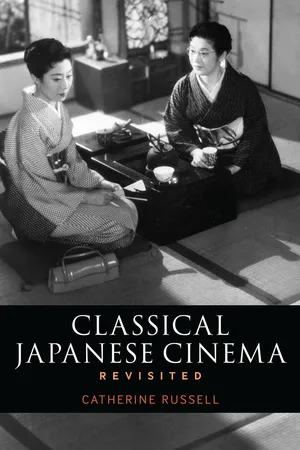
Catherine Russell's highly accessible book approaches Japanese cinema as an industry closely modeled on Hollywood, focusing on the classical period - those years in which the studio system dominated all film production in Japan, from roughly 1930 to 1960.
Respectful and thoroughly informed about the aesthetics and critical values of the Japanese canon, Russell is also critical of some of its ideological tendencies, and her analyses provide new insights on class and gender dynamics. Russell locates Japanese cinema within a global system of reception, and she highlights the importance of the industrial production context of these films.
Including studies of landmark films by Ozu, Kurosawa and other directors, this book provides a perfect introduction to a crucial and often misunderstood area of Japanese cultural output. With a critical approach that highlights the "everydayness" of Japanese studio-era cinema, Catherine Russell demystifies the canon of great Japanese cinema, treating it with fewer auteurist and Orientalist assumptions than many other scholars and critics.
- 192 pages
- English
- ePUB (mobile friendly)
- Available on iOS & Android
eBook - ePub
Classical Japanese Cinema Revisited
About this book
Information
Chapter One
The Classical, the Modern and Japanese Cinema in the Global System
Japanese cinema has often been thought of as an “other” to Hollywood classical cinema, exhibiting a stylistic alternative to the narrative realism associated with the American industry.1 The few great directors on whom this assessment is based, however, represent only a tiny fraction of an industry that produced hundreds of films a year for over 30 years. The achievements of Ozu, Mizoguchi and Kurosawa would not have been possible without an established commercial studio system. From 1925 to 1965, Japanese films played on the majority of Japanese screens in thousands of theaters,2 providing domestically produced entertainment for a nation that fed hungrily on a roster of stars, directors, studios and genres. Filmgoing became part of everyday life in urban Japan in the late 1920s and early 1930s, and with a downturn in production during the war (but not a break), it continued through to the introduction of television in the late 1950s.
Once we consider this era of Japanese cinema as its classical phase, it inevitably entails a coextensive rethinking of the term, and a decentralization of global cinema. Classical Japanese cinema designates another structure of cultural imperialism, and another discourse of modernity, which became a dominant form of mass culture in the twentieth century. The influence of Japanese film on neighboring Asian nations remains largely undocumented (or, more accurately, under-researched). However, even if the distribution of Japanese cinema outside Japan was quite limited during the classical period itself, it has become an important reference point for Japan’s former colonies and present trading partners in the region. Given that many films have had second lives on broadcast television, the larger Asian audience for Japanese cinema could be vast, and it arguably continues to grow with the renewed dissemination of films in DVD formats.
Film studies scholars are beginning to question the legitimacy and significance of the “classical” in the American context.3 In particular, Miriam Hansen’s reconceptualization of Hollywood as a form of vernacular modernism,4 along with Christine Gledhill’s and Linda Williams’s rethinking of melodrama,5 have shifted the terms of reference for classical Hollywood cinema from style to culture. These new methodologies have made it possible to consider Japanese cinema of the studio era as a parallel form of classicism. In this chapter, I would like to sketch the larger framework for consideration of modern Japanese cinema as a cultural production in terms of vernacular modernism and melodrama. Although there is a rich tradition of film study in Japan, little of it has been translated. Thus, the discourse on Japanese film in English has been largely framed from outside and, until recently, in markedly Orientalist terms. Recent work by Mitsuyo Wada-Marciano, Aaron Gerow, Peter High, Tom Lamarre and Mitsuhiro Yoshimoto has been instrumental in situating classical Japanese cinema within a more historical and geopolitical framework, augmenting art-historical methods with more sociopolitical approaches to cinema as a cultural practice.
As Eric Cazdyn has noted, the writing of Japanese film history has invariably entailed an implicit construction of a national discourse. If film historians are responsible for producing their objects of study — creating canons, pantheons and critical frameworks — they are also responsible for shaping the communities and social contexts in which films become meaningful.6 Cazdyn argues for a rethinking of Japanese cinema within a global, transnational context:
As the global system reconfigures and the contradiction between the national and the transnational comes into greater relief, connections between Japanese film and the world will appear less as esoteric deviations than as the passkeys that allow entrance to a whole new series of productive questions and problems.7
Japanese cinema is another global cinema that was produced in the middle decades of the last century, but continues to evolve in the transnational context of its afterlife. Modernity has tended to be perceived as a phenomenon emanating from “the West,” and yet the construction of the myth of the West is endemic to modernity itself. In Naoki Sakai’s critique of this “emanation model” of modernity, he points out that “[m]odernity is inconceivable unless there are occasions when many regions, many people, many industries, and many polities are in contact with one another despite geographic, cultural and social distance.”8 For Sakai, the key element of cultural heterogeneity in modernity entails that modernity “cannot be considered unless in reference to translation.”9 One way of thinking about classical Japanese cinema is as a translation of the Hollywood idiom into the Japanese vernacular, which is then translated again, with subtitles, to the rest of the world. While this might be fairly obvious in the case of specific directors, I am proposing that it is also true of the institutional context in which these directors worked. The constellation of genres, stars, aesthetics, technologies and personnel that define this cinema constitute a discourse of modernity that reconfigured the national Japanese subject within a global system of representation.
Vernacular Modernism
For Miriam Hansen, “classical cinema” is a “technical term that has played a crucial part in the formation of cinema studies as an academic discipline.”10 While popular cinema has tended to be opposed to “modernism,” Hansen points out that cinema has played a fundamental role in the historical formation of modernity. Hollywood, in this reading, becomes a key component for the emerging mass publics in the “modernizing capitals of the world.”11 Vernacular modernism incorporates the various cultural practices by which the experience of modernity has been articulated and modified, placing cinema alongside the “everyday” discourses and practices that it also mediates: fashion, architecture, advertising, and so on. In this, Hansen endorses and follows up on Walter Benjamin’s key insight that “artistic practices” need to be situated within “a larger history and economy of sense perception … the decisive battle-ground for the meaning and fate of modernity.”12 The paradigms of Orientalism have tended to emphasize the Japaneseness of Japanese cinema at the expense of its modernity. The framework of vernacular modernism, however, enables us to move beyond the binaries of East and West to recognize the modernity of this cinema as a discourse of mass culture. The aesthetic and sensual qualities that gave rise to an auteur cinema can be linked more directly to the changing structures of Japanese society, including its paradigms of class and gender.
The precise beginning and end points of classical Japanese cinema are debatable. One might say that this “classical” studio-era cinema evolved in Japan with the establishment of Shochiku film studio in 1920, or we can date it from the experimental phase of the late 1920s in which the scriptwriting advocates of “pure cinema” wrestled filmmaking away from those who had more theatrical stakes in the medium.13 Aaron Gerow has discussed the discursive context of the Pure Film movement in terms of Japanese modernity as a contradictory and contested social formation. Reformers arguing for the banishment of female impersonators and benshi, and pushing for a more “modern” film language, were at once influenced by foreign cinema and eager to promote a more specifically Japanese film style. The discourse of reform in the 1920s was not simply about film production, however. Gerow shows how “there was a supposition of a mass, homogenized audience,” and a need aided by institutions of censorship, to train audiences to participate in a “rationalized, urban, modernity.”14
The establishment and development of classical Japanese cinema in prewar Japan was inextricable from the role of state authority, culminating in the Film Law that was passed in 1939, designed to control film production during the war. But, as early as 1917, it is evident that the discursive context of Japanese cinema underlined its role in the construction of the modern Japanese subject. According to Gerow:
If Western modernism needed others (the East, the South) to define itself, so did this modernism of purity, only its others were located as much in Japan as in the colonies, if not also in the Japanese text and the Japanese subject. Modernism, in this case, was not a state to be achieved, but a seemingly self-perpetuating process.15
The beginnings of classical cinema could also be traced to the drawn-out transition to sound in the early 1930s, especially as it coincided with the beginning of the China-Japan war. It was during this period that many small, independent production companies floundered, and the industry became more streamlined and consolidated around three big companies: Nikkatsu, Shochiku and Toho. The hybridity and stylistic excess that characterized the silent period of Japanese cinema was slowly eliminated and the overall pace of film style slowed down, as prestige works became what one critic has described as “monumental.”16 By 1937 Toho had absorbed Photo Chemical Laboratories (PCL) to become a full-fledged production house, rivaling Shochiku and Nikkatsu, and by the end of the decade it dominated the Japanese industry. Toho, along with the rest of the industry during the 15 years of war, came under the direct control of the imperial government. Nevertheless, the range of filmmaking styles that were produced during the era, including spy films, women’s films and family melodramas, alongside the more well-known war films and period films, is surprisingly varied.
Japanese imperial cinema was exported to Taiwan, Korea, China and the Philippines, and after 1937 was also produced in Korea and Manchuria. The propaganda of Japanese colonialism inevitably met with resistance, and produced an increased antagonism among Asian audiences, but, as Sharon Hayashi argues, the framework of imperial oppression and colonial resistance is too simplistic, and cannot account for the full complexity of this transnational cinematic geography.17 This was the first time many filmmakers traveled overseas, and, in conjunction with the introduction of sound, during the 1930s the cinema solidified around a standardized language, which became necessary for both domestic and overseas audiences.18
Hayashi has shown how traveling filmmakers helped to accommodate the diverse regions and dialects of Japan into a national culture through the imagery of landscape made possible in cinematic representation. The urbanism of Japanese modernity was augmented and expanded during the war years with an increased attention to the populations and landscapes of the countryside. Hayashi’s research impels us to consider the deep-seated contradictions of this era, manifested in an industrial cinema that was definitely harnessed to the imperial mandate but that was, nevertheless, mobile and decentered. The contradictions of tradition and modernity became enmeshed with the added contradiction of the expanding geographical borders of colonialism. The director Hiroshi Shimizu, for example, produced a series of “road movies” that, Hayashi points out, “were part of the great structural changes in first domestic and then colonial travel and transportation taking place in society and are very much implicated in the colonial project.”19
Shimizu, like Naruse, has tended to be overlooked by film historians outside Japan because he was not considered “Japanese” enough to represent a national cinema.20 He made an incredible 163 films over the course of his career and, like Naruse, developed an idiosyncratic style from a hybrid of Japanese and other sources. Shimizu’s film practice took him to many different regions of the country and the colonies, and his films include portrayals of Korean communities in Japan, as well as the various social outcasts, migrants and itinerants who live “on the road,” beyond and outside the norms of urban society. A renewed approach to Japanese cinema that is better able to grasp its mobility and diversity is urgently needed before more directors such as Shimizu become lost to historical amnesia. Transnational cinema in this sense points to the porosity of a national culture; classicism denotes the integrity of stylistic and industrial characteristics by which we can group these films together.
Many of the key directors of the studio system — including Heinosuke Gosho, Teinosuke Kinugasa, Daisuke Ito, Masahiro Makino, Kenji Mizoguchi, Mikio Naruse, Yasujiro Ozu, Yasujiro Shimazu, Hiroshi Shimizu and Kajiro Yamamoto — began their careers in the late 1920s. In the hierarchical structure of the Japanese studio system, directors beget other directors through apprenticeships as assistant directors and scriptwriters. The late 1920s saw the establishment of key genres including the swordplay films (chambara) that became the main genre of period films (jidai-geki) and the home drama (shoshimin-eiga) that became a key form of contemporary drama (gendai-geki). The legacy of the directors and producers of the late silent period lasted well into the 1970s, as many of the generic formulas, including the samurai film and the home drama, were adapted as popular TV genres. Moreover, many directors — including Naruse, Gosho, Ichikawa and Kinoshita — actually outlasted the collapse of the industry and continued to work through the 1960s and 1970s.
The end point of the classical period is likewise subject to debate. The New Wave cinema had many key precedents in the 1950s and did not come out of nowhere. Seijun Suzuki, Yasuzo Masumura, Shohei Imamura and Kaneto Shindo all began their careers in the mid-1950s. And yet, the directors associated with the New Wave in the 1960s condemned the cinema of their predecessors and vowed to challenge what they saw as its staid aesthetics and repetitive formulas. The radical new aesthetics spearheaded by Nagisa Oshima confirm the designation of the cinema that came before as “classical.” Many of the new directors produced their films outside the studio system, and began to screen their films alongside the new “independent” cinemas of Europe and America. Insofar as the film industry turned more and more to pink (porno) films, and audiences turned more to TV, the critical rejection of classical Japanese cinema was accompanied by a diversification and fragmentation of the Japanese industry and its audiences.
While it may be difficult to pinpoint precise dates for the rise and fall of classical Japanese cinema, the constellation of changes around 1930 and 1960 leave little doubt that the volume of films produced by the industry through the middle decades of the twentieth century was accompanied by a coherency and stability that is historically circumscribed. To describe the Japanese cinema of the 1930s, 1940s and 1950s as a “classical cinema” is a means of recognizing its integrity as a mode of production that is unlike the cinema that preceded it and unlike that which followed. If classical Hollywood cinema can be described as a national cinema,21 it is not unreasonable to identify other national examples of industry-based commercial cinemas in countries such as China and India as classical cinemas that built on the model of the American “system” to develop indigenous modern mass cultures.
Anderson and Richie’s The Japanese Film: Art and Industry (1982) goes a long way toward outlining the contours of classica...
Table of contents
- Cover
- Title
- Copyright Page
- Dedication
- Contents
- Acknowledgments
- Preface
- Chapter One: The Classical, the Modern and Japanese Cinema in the Global System
- Chapter Two: Yasujiro Ozu: A Short History of the Home Drama
- Chapter Three: Kenji Mizoguchi and his Women
- Chapter Four: Men with Swords and Men with Suits: The Cinema of Akira Kurosawa
- Chapter Five: Mikio Naruse: A Japanese Woman's Cinema
- Chapter Six: Remembering the War: Three Postwar War Films
- Conclusion
- Notes
- Filmography
- Bibliography
- Glossary
Trusted by 375,005 students
Access to over 1.5 million titles for a fair monthly price.
Study more efficiently using our study tools.
Frequently asked questions
Yes, you can cancel anytime from the Subscription tab in your account settings on the Perlego website. Your subscription will stay active until the end of your current billing period. Learn how to cancel your subscription
No, books cannot be downloaded as external files, such as PDFs, for use outside of Perlego. However, you can download books within the Perlego app for offline reading on mobile or tablet. Learn how to download books offline
Perlego offers two plans: Essential and Complete
- Essential is ideal for learners and professionals who enjoy exploring a wide range of subjects. Access the Essential Library with 800,000+ trusted titles and best-sellers across business, personal growth, and the humanities. Includes unlimited reading time and Standard Read Aloud voice.
- Complete: Perfect for advanced learners and researchers needing full, unrestricted access. Unlock 1.5M+ books across hundreds of subjects, including academic and specialized titles. The Complete Plan also includes advanced features like Premium Read Aloud and Research Assistant.
We are an online textbook subscription service, where you can get access to an entire online library for less than the price of a single book per month. With over 1.5 million books across 990+ topics, we’ve got you covered! Learn about our mission
Look out for the read-aloud symbol on your next book to see if you can listen to it. The read-aloud tool reads text aloud for you, highlighting the text as it is being read. You can pause it, speed it up and slow it down. Learn more about Read Aloud
Yes! You can use the Perlego app on both iOS and Android devices to read anytime, anywhere — even offline. Perfect for commutes or when you’re on the go.
Please note we cannot support devices running on iOS 13 and Android 7 or earlier. Learn more about using the app
Please note we cannot support devices running on iOS 13 and Android 7 or earlier. Learn more about using the app
Yes, you can access Classical Japanese Cinema Revisited by Catherine Russell in PDF and/or ePUB format, as well as other popular books in Media & Performing Arts & Film & Video. We have over 1.5 million books available in our catalogue for you to explore.