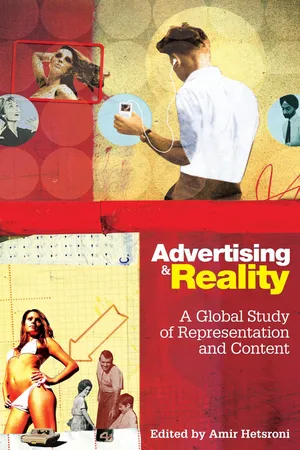
Advertising and Reality: A Global Study of Representation and Content offers, for the first time, an extensive study of the way our life is represented in advertising. Leading scholars from different countries, who specialize in marketing communication and media studies, review and analyze different advertising contents and give us a truly cross-cultural view of the matter. Among the contents that are thoroughly discussed throughout the book one finds sexuality, violence, family activities, gender roles, vocations, minorities roles, periodical reconstruction and more.
This book provides an up-to-date picture of the way modern life is portrayed in the most popular format of marketing communication worldwide.
- 272 pages
- English
- ePUB (mobile friendly)
- Available on iOS & Android
eBook - ePub
About this book
Information
PART ONE
Views, times, and places
1
Mass moralizing
Phil Hopkins
Southwestern University, USA
Key words
morality, narrative, personal identity, representation, tribe
Publicity adds up to a kind of philosophical system. It explains everything in its own terms. It interprets the world.
(JOHN BERGER, 1972, p. 149)
The noble lie
The discipline of philosophy has been slow to acknowledge and slower to examine how mass media discourse practices shape the ways we think about and practice morality. Mass marketing operates primarily in an existential register. Its messages no longer focus primarily upon product qualities or benefits, but, at least since the rise of branding, offer instead meaning systems designed to present group and individual identity as consumer choice. Even when its content is not overtly moralistic, such a dynamic is ineluctably moral. The question of who we are and who we want or ought to be is the central concern and territory of ethics. Many media practices, including advertising, have always been at least subtly moralistic in tone and content, co-opting and employing traditional moral ideas and values. In this chapter, however, I will argue that what one might call the ontological dynamics of mass media advertising present our relations to advertising as a profound and in some ways new moral question embedded in the very fabric of its practice.
At the heart of this argument is the claim that we are fundamentally and even primarily narrative beings. Most of our cognitive activities, those activities aimed at understanding ourselves and our world, are exercised in creating a coherent narrative that makes sense of experience. We are first and finally storytellers, telling stories of ourselves to ourselves and to others into a world we fashion as story. And it is the nature of marketing as story that both demands and will benefit from philosophical analysis. Jhally (2000) has said:
The right question would [be to] ask about the cultural role of advertising, not its marketing role. Culture is the place and space where a society tells stories about itself, where values are articulated and expressed, where notions of good and evil, of morality and immorality, are defined. In our culture it is the stories of advertising that dominate the spaces that mediate this function. If human beings are essentially a storytelling species, then to study advertising is to examine the central storytelling mechanisms of our society. The correct question to ask from this perspective, is not whether particular ads sell the products they are hawking, but what are the consistent stories that advertising spins as a whole about what is important in the world, about how to behave, about what is good or bad. Indeed, it is to ask what values does advertising consistently push.
This chapter explores, philosophically, that is, through analysis of the particular world structures that marketing discourse practices construct, just the question Jhally poses: What is the relation of current dominant modes of narrativity in advertising to moral narrative and moral heuristics?
To deal with this question, I must first argue that all ethics take the form of Plato’s “noble lie.” The rhetorical strategy behind any articulation of ethical guidelines is to posit a human subject which is capable of entering into the description of human nature or world structure that it offers with the idea that such a person will then act in ways that are better for him/her and better for all. We may be skeptical of some or all ethical formulations because they foreground some particular possible relations or behaviors on the basis of one or another view of human beings which we may not agree with. But that skepticism is not really to the point. Each ethical theory describes how one acts once one accepts a description of what generally matters and how the world is, not whether that description has ever been the case historically or theoretically. This is to say that an ethical system will always posit a human subject which is capable of entering into it, and that the posited human subject does not pre-exist the frame but arises with the ethical framework which has described it into existence. Each theorist frames interactions and elements of human nature corresponding to the demands his/her ethics makes of the people it describes.1
In precisely this way, advertising offers ethical narratives that explicitly state what matters and describe how the world is, and then place us, or at least strongly invite us to place ourselves, into that description. When they do so, they do not invite us to place some pre-existing self into their narratives. They create identities by means of their narratives which we may adopt. When we do so, we find ourselves in worlds that compete, overtly or subtly, with each other and with the world we take to be our actual world. To the extent that we inhabit those worlds, we do so in terms that organize our obligations and possibilities in different ways, and each of those ways constitutes a moral possibility for being in the world. Each advertisement frames interactions and elements of human nature corresponding to the demands of selling us its product. We may be skeptical of those demands, and even of the world the ad constructs, but that skepticism is beside the point. The very presentation of the possible world of the ad, and the possible selves we are positioned as free to choose creates an ethical framework that is necessarily critical of all alternate frameworks.
The primary impact of advertising discourse I want to examine is the way in which that practice presents us with possible selves and worlds, and so morality, as a commodity, something we can “shop” for and acquire, choosing between one “system of values” or another, adopting them as ways of establishing and maintaining “identities.” Morality as a set of obligations or duties we experience flows directly out of the metaphysics of the worlds we inhabit. Such worlds are narratively constructed. It is decidedly not the case that we find ourselves in a world with these or those elements, with this or that set of relations, and then freely choose between competing moral systems of values. Once we construct a world, by telling ourselves stories about what is and how it is, we have already constructed the moral system operative in that world.
Ethics, then, both in the sense of the process of living our lives, but also in the process of philosophical theorizing, is and has always been a narrative process. Ethics requires and inhabits stories. We tell stories, not just about human subjects and the sort of thing being human is through stories about what being a friend or being courageous means, but also about the way things are, the way the world is, such that this or that character or action is right or good. That is why, for Socrates, some story must be told, true or not, which provides the ground for specific obligations and relations which form the foundation of those values. We do not know how to posit such valuations without a narrative frame within which they achieve the character we assign to them and that provides the criteria for that valuation. They achieve that character, moreover, not as a result of their congruence or isomorphism with some rule or immutable category, but within and through the narrative elements as they are coherently related by a given story.
Selling selves through storytelling
In our world, mass marketing is the dominant source and medium of narrative and argument. It achieves this status if for no other reason than its saturation levels. As Louise Story (2007) said, there is very little space that isn’t occupied by marketing. There was perhaps a time when marketing was a kind of hawking of products, not unlike a mass mediated version of the snake-oil salesman, or the carnival barker, whose clear job it was to arrest attention and induce consumption of whatever ware was for sale. In such cases, the public distinguished the activity of the hawker from the normal activity of their lives. Such activity was a break from the norm, an entertainment, perhaps, but a novelty at least. Now, not only is it difficult to find any space that isn’t carnival space, as it were, that isn’t crowded with mass media barkers, but, if we take into account the way marketing has integrated into most other mass media, such messages are the stuff of daily life, the primary interpreters and narrators of experience for many of us.
Marketing is clearly about selling things by telling particular stories, both concerning the products about which it is ostensibly informing us, and, more importantly, about the way the world and we in it really are or can be. Because its discourses are the primary discourses we encounter, its particular form of argument is the argument form with which we are most familiar. Outside of law courts, or a few other very specialized and formal practices of arguing in our culture, no other practice is as fully engaged in “argument” in the classic sense of that term: a discourse that aims to produce conviction or provide persuasive conclusions by means of linked evidence in the form of grounds for belief and authoritative backing. Marketing arguments purport to tell us if not the “truth,” at least what we might, or even should, believe.
Moreover, it has risen to dominant status by colonizing other narrative forms taking them up as its own. This adoption and adaptation has allowed marketing to fold itself “seamlessly” into entertainment media. All media is, after all, packaged. The images are often the same, the graphics and soundtracks, the “sets.” All are broadcast through the same physical boxes, which, of course, no matter how large and immersive or small and handy, are still boxes. What we watch on any screen, we watch knowing that what we view is something distant, something elsewhere, happening to others. There is very little content or form difference to distinguish marketing from other forms of mass media storytelling. The real distinction is the truth conventions of each. This difference is largely a propaganda difference. But it is a difference that matters in terms of our reception.
Into these dominant “truth”-telling narratives, which have always exhibited a moral impulse, we have recently transferred a great deal of moral authority. We live in an age of carefully tailored images and exquisitely focused messages broadcast to audiences of staggering proportions at unimaginable frequencies and saturation levels, all saying largely the same few things structured according to a limited dynamic. The “truth” of that dynamic echoes something we seem to always have believed about ourselves: that the truth of who and what we are is grounded in “freedom.” Morality is intrinsically a matter of choice. The “truth” of mass marketing is that we are both “free” to choose who we are or will be, and that the options are limited to a select and narrow set of pre-packaged alternatives.
Tribes
These new narratives are precisely ethical by virtue of being about identity and identity choices. Marketing, and so now almost all mass media, offers pre-packaged identities as consumable products, but it does more than this in the process: it tribalizes (Godin, 2008). Constructing group identities allows mass marketing to negotiate the tension inherent in presenting a message that purports to be about each individual consumer to mass anonymous audiences. In other words, not only does Dr. Pepper invite us to be a Pepper too, the brand’s advertisements suggest quite strongly that we, of course, really want to be a Pepper too, and imply that not to choose to be a Pepper too is at least odd, perhaps wrong. Such marketing presupposes and constructs a new tribal identity in the process of applying the age-old marketing formula: buy our product and become the special person you always wanted to be and knew you deserved to be. As silly as it may seem on the surface, the invitation to tribal affiliation is almost always genuine.
We may scoff at being Peppers, but there are many, many more tribes to choose from. We have been invited to be Malboro men, or Virginia Slims women. We are told constantly that we simply are either PC people or Mac people. In my time, one was either Ford or Chevy, Coke or Pepsi, Levis or Wrangler. Inner city youth have carved themselves into groups through identification with particular brands...
Table of contents
- Cover
- Title
- Contents
- Amir Hetsroni
- Part One Views, times, and places
- Part Two Demography
- Part Three Gender
- About the contributors
- Index
- Copyright
Trusted by 375,005 students
Access to over 1.5 million titles for a fair monthly price.
Study more efficiently using our study tools.
Frequently asked questions
Yes, you can cancel anytime from the Subscription tab in your account settings on the Perlego website. Your subscription will stay active until the end of your current billing period. Learn how to cancel your subscription
No, books cannot be downloaded as external files, such as PDFs, for use outside of Perlego. However, you can download books within the Perlego app for offline reading on mobile or tablet. Learn how to download books offline
Perlego offers two plans: Essential and Complete
- Essential is ideal for learners and professionals who enjoy exploring a wide range of subjects. Access the Essential Library with 800,000+ trusted titles and best-sellers across business, personal growth, and the humanities. Includes unlimited reading time and Standard Read Aloud voice.
- Complete: Perfect for advanced learners and researchers needing full, unrestricted access. Unlock 1.5M+ books across hundreds of subjects, including academic and specialized titles. The Complete Plan also includes advanced features like Premium Read Aloud and Research Assistant.
We are an online textbook subscription service, where you can get access to an entire online library for less than the price of a single book per month. With over 1.5 million books across 990+ topics, we’ve got you covered! Learn about our mission
Look out for the read-aloud symbol on your next book to see if you can listen to it. The read-aloud tool reads text aloud for you, highlighting the text as it is being read. You can pause it, speed it up and slow it down. Learn more about Read Aloud
Yes! You can use the Perlego app on both iOS and Android devices to read anytime, anywhere — even offline. Perfect for commutes or when you’re on the go.
Please note we cannot support devices running on iOS 13 and Android 7 or earlier. Learn more about using the app
Please note we cannot support devices running on iOS 13 and Android 7 or earlier. Learn more about using the app
Yes, you can access Advertising and Reality by Amir Hetsroni in PDF and/or ePUB format, as well as other popular books in Social Sciences & Media Studies. We have over 1.5 million books available in our catalogue for you to explore.