eBook - ePub
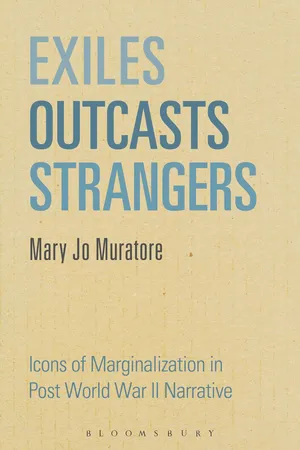
Exiles, Outcasts, Strangers
Icons of Marginalization in Post World War II Narrative
- 208 pages
- English
- ePUB (mobile friendly)
- Available on iOS & Android
eBook - ePub
About this book
Exiles, Outcasts, Strangers explores how nine different "outsider" authors treat the theme of alienation in one of their major works. All the novels under review were written in a limited time span (1942 to 1987, approximately 50 years), and all are structured around a hero or heroine who remains culturally, ethically or aesthetically distant from his/her narrative counterparts. Works discussed: Albert Camus' L'Etranger; Richard Wright's The Outsider; André Langevin's Poussière sur la ville; Ernesto Sábato's El túnel; V.S. Naipaul's Guerrillas; Elie Wiesel's Le Cinquième fils; Norbert Zongo's Le Parachutage; Gisèle Pineau's L'Exil selon Julia, and Jean Genet's Querelle de Brest.
Information
1.
Contagions of Conformity in Camus’ L’Étranger1
L’Étranger was published in France in 1942 during the German occupation.2 Consequently, it is not technically a post-war narrative, but the work offers nonetheless an ideal starting point for an examination into the evolving concept of “outsiderness.” Camus’ enigmatic protagonist has preoccupied readers for over a half a century, and there is little danger that critics will exhaust any time soon the interpretive possibilities that his narrative provides. Because of Camus’ pivotal role in the existentialist movement, L’Étranger is often read as a kind of philosophical Bildungsroman wherein the protagonist moves from a state of self-indulgent unawareness towards metaphysical lucidity as a result of his experiences. In such readings, Meursault’s detached egocentrism, so prominently in evidence in Part One, is supplanted by his discovery of an indifferent universe in Part Two. The problem with this reading is that it suggests that Meursault undergoes a fundamental intellectual shift, when, in truth, he simply confirms what he already suspected (“J’avais eu raison, j’avais encore raison, j’avais toujours raison” [1208]).3
One of Meursault’s metaphysical certainties is that the inevitability of death nullifies any sense of purpose in life, making it hardly worth living at all (“Mais tout le monde sait que la vie ne vaut pas la peine d’être vécue” [1204]). But this rather banal observation from a condemned man provides scant evidence of a metaphysical transformation. Indeed, its very lack of sophistication underscores the fact that neither Meursault nor his thought can be said to evolve much within the novel.4 Meursault’s fundamental intellectual perspective and his situational reality remain fairly static from beginning to end. We first see him within the prison-like setting of the retirement home wherein death stalks the residents, and we last see him on death row, awaiting execution. His dispassionate impartiality, his preoccupation with sensual gratification and his ineloquent and depersonalized narrative manner remain unaltered. Meursault in prison is very much the same character we saw at his mother’s funeral. He remains almost pathologically observant:
Malgré la chaleur (j’étais en manches de chemise), il avait un costume sombre, un col cassé et une cravate bizarre à grosses raies noires et blanches. (1170)
considerate of others:
J’ai trouvé qu’il était très commode que la justice se chargeât de ces détails. Je le lui ai dit. (1169)
brutally honest:
Il m’a demandé s’il pouvait dire que ce jour-là j’avais dominé mes sentiments naturels. Je lui ai dit: “Non, parce que c’est faux.” (1170)
J’ai réfléchi et j’ai dit que, plutôt que du regret véritable, j’éprouvais un certain ennui. (1174)
and frustratingly unengaged:
Au début, je ne l’ai pas pris au sérieux. (1169)
J’allais lui dire qu’il avait tort de s’obstiner: ce dernier point n’avait pas tellement d’importance. (1173)
Et même, dans un sens, cela m’intéressait de voir un procès. Je n’en avais jamais eu l’occasion dans ma vie. (1182)
More importantly, throughout the novel he maintains his defiance of authority and resists most of the attempts to encourage a change in him. When the chaplain enters his cell hoping to extract the conventional mea culpa from the repentant captive, Meursault very nearly strangles him.
The only slight change in Meursault’s behavior (although this is short-lived) is that his social life gains momentum just after he returns from his mother’s funeral. As the novel progresses, his social entanglements intensify, obliging him increasingly to mimic the behaviors and attitudes of those around him or face the social consequences (social exclusion) of his non-conformity. When he later tries to reclaim his individuality, however, he finds that he is no longer able to untangle his attitude from that of his friends, to separate his ideology from that of his counterparts. Torn between competing allegiances to self and others, he fatally wounds the Arab adversary of a friend, although this is a man with whom he has no personal quarrel whatsoever. Meursault’s temporary surrender to social conformity offers an example of the socially bred impulse to demonize those designated as “outsiders” by others in a position of some authority.5 Just as Meursault kills an Arab because Raymond dislikes him, so does the state execute Meursault on the strength of the manipulated and contorted testimony of the director of the retirement home and the corroborating accounts of impressionable elderly residents who are under his control.
During the course of the novel, Meursault makes two fatal errors. First, he audaciously breaches protocol at the retirement home. He then surrenders his individuality to the needs of the group when he kills Raymond’s enemy on the beach.
L’Étranger, then, can be read as a commentary on the totalitarian impulses of the time. Christopher C. Robinson notes, “Albert Camus saw and fulfilled a need to reconceptualize traditional philosophical activities—judging, moralizing, and theorizing, for example—to meet the unique conditions of his totalitarian and genocidal age.”6 In this novel, the primal need to align oneself with the views of the majority extorts the moral capitulation not only of the prejudiced, but of the ambivalent and fair-minded as well.7 L’Étranger thus exposes how the need to belong can corrupt the personal judgment of even those for whom impartiality constitutes a cherished and inviolable principle. These individuals include Meursault himself, who briefly surrenders his individuality in order to protect the interests of his group; his mother who, though not religious, insists on a church burial after being placed in the retirement home; and the supposedly impartial judges at Meursault’s trial who ultimately condemn him for behavioral non-conformity rather than for his crime. Yet what is even more striking is how the readers who are called upon to witness Meursault’s demonization actually participate in the process—a partisan reaction that reveals their own surrender to the power of presumed authority.
Although the title of the novel leads the reader to assume the hero is some sort of social misfit, the initial depiction of Meursault as an “outsider” derives primarily from his seemingly casual indifference to the news of his mother’s death and his awkward mannerisms and behavior during her funeral. However, Meursault’s odd behavior at the home does not accurately reflect his typical demeanor. Though the title predisposes the reader to anticipate atypical behavior on his part, Meursault is in fact quite ordinary. The death of his mother and his visit to the home are extremely uncharacteristic situations for Meursault, and the novel takes care to depict this entire episode as a disconcerting interlude in his otherwise uneventful existence.
In order to underscore the “foreignness” of the experience, the home is geographically displaced from Meursault’s home and comfort zone. This establishes Meursault as a geographical and cultural intruder in a foreign arena, with customs and rituals that are unfamiliar to him. Not surprisingly, Meursault seems woefully out of place immediately upon arrival. To begin with, his relative youth contrasts sharply with the grotesque tatters of human beings with whom he is called upon to interact. Moreover, Meursault’s fundamental ignorance of the home’s prevailing customs solidifies his outsider status (“J’ai voulu voir maman tout de suite. Mais le concierge m’a dit qu’il fallait que je rencontre le directeur” [1126]). All the routine protocols that the residents take for granted must be painstakingly explained to him, and this causes the elderly residents to view this uninformed intruder with unbridled suspicion (“Ils se taisaient quand nous passions. Et derrière nous, les conversations reprenaient” [1127]).
From Meursault’s perspective, everything in the home has a distorted, unfamiliar air about it. The nurse in charge is disfigured by disease, and her jerky movements are but a source of conjecture for the mystified Meursault (“Je ne voyais pas ce qu’elle faisait. Mais au mouvement de ses bras, je pouvais croire qu’elle tricotait” [1129]). His sense of alienation is augmented further by his inability to understand the language of the residents (“On aurait dit d’un jacassement assourdi de perruches” [1127]). He cannot even say with any degree of certainty whether they are making an attempt to communicate at all:
De temps en temps seulement, j’entendais un bruit singulier et je ne pouvais comprendre ce qu’il était. A la longue, j’ai fini par deviner que quelques-uns d’entre les vieillards suçaient l’intérieur de leurs joues et laissaient échapper ces clappements bizarres. (1130)
While, on the one hand, the residents of the home clearly view Meursault as an outsider in their midst, those in the home can hardly be seen as a cross section of mainstream humanity. Although they may constitute a clear majority inside the home, the residents appear to be quite eccentric, grotesque, even inhuman (“Pourtant je ne les entendais pas et j’avais peine à croire à leur réalité” [1129]). The alien portraits offered by Meursault seem to be expressly drawn to convey a sense of awe in the company of the elderly residents. Meursault’s descriptive accounts are brutal and devoid of any sympathetic nuances that might logically be attached to these pathetic creatures who are guilty of no other crime than having grown old:
Presque toutes les femmes portaient un tablier et le cordon qui les serrait à la taille faisait encore ressortir leur ventre bombé. Je n’avais encore jamais remarqué à quel point les vieilles femmes pouvaient avoir du ventre. Les hommes étaient presque tous très maigres et tenaient des cannes. Ce qui me frappait dans leurs visages, c’est que ne je ne voyais pas leurs yeux, mais seulement une lueur sans éclat au milieu d’un nid de rides. Lorsqu’ils se sont assis, la plupart m’ont regardé et ont hoché la tête avec gêne, les lèvres toutes mangées par leur bouche sans dents, sans que je puisse savoir s’ils me saluaient ou s’il s’agissait d’un tic. (1129–30)
Ses lèvres tremblaient au-dessous d’un nez truffé de points noirs. Ses cheveux blancs assez fins laissaient passer de curieuses oreilles ballantes et mal ourlées dont la couleur rouge sang dans ce visage blafard me frappa. (1133)
In fact, though the residents clearly view Meursault as an intruder, they, too, are depicted as inconsequential outsiders, unwanted beings exiled to the distant edge of their social reality. In many respects, the elderly residents in the home at Marengo seem no better off than prisoners. Involuntary detainees rather than welcome residents, they are under constant surveillance by officials who control all aspects of their daily lives. The soldier seated next to Meursault on the bus foreshadows this notion of forced internment (“Et quand je me suis réveillé j’étais tassé contre un militaire qui m’a souri et qui m’a demandé si je venais de loin” [1126])—a foreshadowing that is concretized by the structured and codified reality Meursault discovers within the home. A grim combination of suspicion, fear and discomfort prevails. At times, the elderly appear to be the vulnerable victims of sadistic and controlling administrators who program, monitor and control routine behaviors. Rituals at the home allow for no variation or exemption; every move is scripted with chronological exactitude.
Compliance with established protocols is enforced regardless of an individual’s preference on the matter. For example, inmates are permitted to attend the wake but not the burial when a fellow resident dies. Because Thomas Pérez has been granted special permission to attend the burial, he is therefore barred from keeping vigil over the body. Often, the conditions under which the residents and visitors are obliged to operate seem expressly designed to inflict pain, such as the grueling yet requisite vigil over the body (“… j’étais fatigué et les reins me faisaient mal” [1130]) and the arduous march to the distant graveside (“L’éclat du ciel était insoutenable” [1134]). Under these conditions, it is difficult to determine whether the perceived conformity of behavior is due to voluntary mimicry or brutal coercion. Small wonder that Meursault is eager to leave the home as quickly as possible.
Back home, Meursault resumes easily his normal routine. Aside from a few relatively minor eccentricities, the unremarkable Meursault seems hardly worthy of the title imposed upon him.8 In fact, the unassuming Meursault seems an unlikely candidate for distinctiveness of any kind. Passions and principles are ephemeral concepts to this anti-hero who lives life in the most minor of keys. Empathetic and sensitive, he is loathe to offend others and is therefore quick to acknowledge the validity of opposing viewpoints. Meursault is notably careful to avoid articulating extreme or oppositional views of any sort and is committed to living as frictionless an existence as possible. Even his sensual pleasures tend towards the mundane and the unspectacular: an occasional café au lait or bottle of wine, dry hand towels at work, a refreshing swim in the ocean, a sexual encounter with a pretty woman. He reveals no spectacular talents, no flamboyance of personality, no conversational brilliance, nothing that might serve to particularize him from anyone else.9
It bears noting also that Meursault is well liked by his co-workers and neighbors. Likewise, he makes a positive impression on those who meet him for the first time. Masson and his wife, for example, take an immediate liking to him, as does Marie. This indicates that, despite the titular designation, Meursault has excellent social skills. In fact, virtually everyone considers that he is charming and pleasant to be around. Even the juge d’instruction who initially decries his atheism is subsequently drawn to him (“le juge me reconduisait à la porte de son cabinet en me frappant sur l’épaule et en me disant d’un air cordial: ‘C’est fini pour aujourd’hui, monsieur l’Antéchrist’” [1174]). In prison, he quickly earns the sympathy of fellow Arab inmates, and even the gardien-chef.
Meursault’s most, if not his only, distinctive characteristic is his pathological impartiality, his unwillingness to condemn or even to judge others. A man of few words and fewer convictions, Meursault prefers to observe the world from his window rather than to engage with it directly.10 In striking contrast to his opinionated and occasionally prejudiced counterparts, Meursault is reluctant to accept even the most fundamental tenets of conventional wisdom. More moralist than moralizer, he is alone in refusing to condemn Salamano for beating his dog (“Céleste dit toujours que ‘c’est malheureux,’ mais au fond, personne ne peut savoir” [1142]). He also fraternizes openly with his neighbor Raymond who is reputed to be a pimp (“Je trouve que ce qu’il dit est intéressant. D’ailleurs, je n’ai aucune raison de ne pas lui parler” [1143]). When offered an opportunity for professional advancement, Meursault declines the offer, refusing to concede that Paris is in any way preferable to Algiers despite conventional assumptions (“C’est sale. Il y a des pigeons et des cours noires. Les gens ont la peau blanche” [1154]). He will not even articulate the meaningless and unbinding emotional clichés that serve to “legitimize” sexual relationships. Meursault seems in fact to support indiscriminately the cause of everyone he meets, refusing to privilege one position or person over any other, even on the emotional plane:
Elle voulait simplement savoir si j’aurais accepté la même proposition venant d’une autre femme, à qui je serais attaché de la même façon. J’ai dit: “Naturellement.” (1154)
Meursault’s narrative manner, like the man himself, is a rather drab conglomeration of impersonal nuances. The hero is not one to dominate by the frantic force of rhetoric. On the contrary, he offers neither linguistic enigmas to disentangle nor elliptical pronouncements to interpret. He is, in fact, so obsessed with narrative precision that he often corrects his own initial observations:
J’avais même l’impression que cette morte, couchée au milieu d’eux, ne signifiait rien à leurs yeux. Mais je crois maintenant que c’était une impression fausse. (1130)
J’ai eu l’impression que Raymond savait où il allait, mais c’était sans doute fa...
Table of contents
- Cover
- Title page
- Contents
- Credits/Acknowledgments
- Introduction
- Chapter 1: Contagions of Conformity in Camus' L'tranger
- Chapter 2: The Art of Betrayal in Sbato's El Tnel
- Chapter 3: Poeticizing Vice: Genet's Querelle de Brest
- Chapter 4: In the Shadows of Significance: The Dissolution of Character in Wright's The Outsider
- Chapter 5: The Exemplum of Empathy in Andr Langevin's Poussire sur la Ville
- Chapter 6: Miscast Utopia: Rewriting Cultural Paradigms in Pineau's L'Exil selon Julia
- Chapter 7: Habitat for Inhumanity: The Legacy of Conquest in Naipaul's Guerrillas
- Chapter 8: The Enemy Within: The Politics of Self-Destruction in Zongo's Le Parachutage
- Chapter 9: The Scattered Self: The Dislocation of Identity in Wiesel's Le Cinquime Fils
- Afterword
- Appendix: Translations to quotations from the primary sources
- Notes
- Bibliography of Works Cited
- eCopyright
Trusted by 375,005 students
Access to over 1.5 million titles for a fair monthly price.
Study more efficiently using our study tools.
Frequently asked questions
Yes, you can cancel anytime from the Subscription tab in your account settings on the Perlego website. Your subscription will stay active until the end of your current billing period. Learn how to cancel your subscription
No, books cannot be downloaded as external files, such as PDFs, for use outside of Perlego. However, you can download books within the Perlego app for offline reading on mobile or tablet. Learn how to download books offline
Perlego offers two plans: Essential and Complete
- Essential is ideal for learners and professionals who enjoy exploring a wide range of subjects. Access the Essential Library with 800,000+ trusted titles and best-sellers across business, personal growth, and the humanities. Includes unlimited reading time and Standard Read Aloud voice.
- Complete: Perfect for advanced learners and researchers needing full, unrestricted access. Unlock 1.5M+ books across hundreds of subjects, including academic and specialized titles. The Complete Plan also includes advanced features like Premium Read Aloud and Research Assistant.
We are an online textbook subscription service, where you can get access to an entire online library for less than the price of a single book per month. With over 1.5 million books across 990+ topics, we’ve got you covered! Learn about our mission
Look out for the read-aloud symbol on your next book to see if you can listen to it. The read-aloud tool reads text aloud for you, highlighting the text as it is being read. You can pause it, speed it up and slow it down. Learn more about Read Aloud
Yes! You can use the Perlego app on both iOS and Android devices to read anytime, anywhere — even offline. Perfect for commutes or when you’re on the go.
Please note we cannot support devices running on iOS 13 and Android 7 or earlier. Learn more about using the app
Please note we cannot support devices running on iOS 13 and Android 7 or earlier. Learn more about using the app
Yes, you can access Exiles, Outcasts, Strangers by Mary Jo Muratore in PDF and/or ePUB format, as well as other popular books in Literature & European Literary Criticism. We have over 1.5 million books available in our catalogue for you to explore.