- 296 pages
- English
- ePUB (mobile friendly)
- Available on iOS & Android
eBook - ePub
About this book
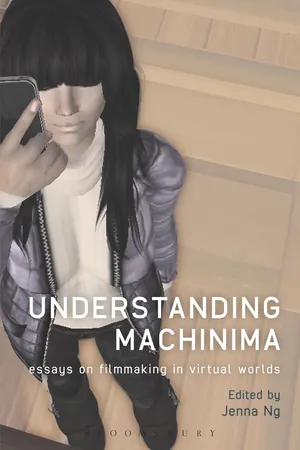
In this groundbreaking collection, Dr. Jenna Ng brings together academics and award-winning artists and machinima makers to explore the fascinating combination of cinema, animation and games in machinima (the use of computer game engines to produce animated films in cost- and time-efficient ways). Book-ended by a preface by Henry Lowood (curator for history of science and technology collections at Stanford University) and an interview with Isabelle Arvers (machinima artist, trainer, critic, and curator), the collection features wide-ranging discussions addressing machinima not only from diverse theoretical perspectives, but also in its many dimensions as game art, First Nations media art, documentary, and pedagogical tool. Making use of interactive multimedia to enhance the text, each chapter features a QR code which leads to a mobile website cross-referencing with its print text, integrating digital and print content while also taking into account the portability of digital devices in resonance with machinima's mobile digital forms. Exploring the many dimensions of machinima production and reception, Understanding Machinima extends machinima's critical scholarship and debate, underscoring the exciting potential of this emerging media form.
Information
PART ONE
Thinking machinima

http://m.understandingmachinima.com/chapter1/
1
Machinima
Cinema in a minor or multitudinous key?
Game engines and virtual worlds are often used for creating machinima, which predominantly are movies made by amateurs who lack the equipment and/or the professional skills required to create films or animations in the traditional sense. Although he acknowledges that barriers of entry remain relatively high for “machinimakers,” Robert F. Nideffer (2011) is also correct in suggesting that machinima can be used as a political tool. In this chapter we will develop a political consideration of machinima in relation to Gilles Deleuze’s concept of the “minor” as developed in Kafka: Toward a Minor Literature (Deleuze and Guattari 1986) and subsequently in Cinema 2: The Time-Image (Deleuze 2005, 207–15). We argue that machinima enables individuals without the means to become purveyors of official histories/memories to be what Deleuze terms “intercessors” (Deleuze 2005, 214), or storytellers who can challenge dominant myths. To this end, we examine the “minor” in relation to The French Democracy, a 2005 machinima made by Alex Chan (or Koulamata as he is sometimes known)A in response to civil unrest in France using Lionhead’s game The Movies, released in the same year.1
While we feel that Deleuze’s concept of the minor is a particularly useful one for helping to think through machinima in general and The French Democracy in particular, we should clarify that we do not see the “fit” between minor and machinima in general as being an exact one. Not all machinima need be “minor,” not least as it has come to be used in quite “major” films, as we shall see. But we do hold that machinima can help us to refine our understanding of the minor as much as the minor can help us to understand machinima. In order to explain more fully the mutual enrichment, or feedback, that we see between machinima and the minor, we shall first explain what the minor is, how the minor has been used to analyze certain kinds of cinema, and how it is useful for us to think about/through machinima in various ways. We then look at The French Democracy, which does indeed involve many ideas relating to the minor, but which also through its specific context and content can help us to rethink precisely what the minor is in audiovisual culture.
What is minor literature? What is minor cinema?
In their Kafka book, Deleuze and Guattari argue that a minor literature is one that is revolutionary because it “deterritorialises” the “major” language from within (Deleuze and Guattari 1986). To “deterritorialise” is to make the major language seem unfamiliar, or, as Dana Polan puts it in reference to other work by Deleuze, to make it “stutter” (Polan 1986, xxvii).2 For example, being a Czech Jew, Kafka’s decision to write in German (and not Czech or Yiddish), to construct stories with amorphous characters (K, Gregor Samsa), and to use language in not just representational but poetic ways unsettles German in the same way that a stutterer unsettles and makes us think directly about the nature of the language they are speaking (and which the non-stutterer deploys in an unthinking or automatic fashion). Thus, minor literature makes us both rethink how that major language operates and question its everyday usage by breaking down the easy flow with which language normally communicates.
Furthermore, according to Deleuze and Guattari, a “minor” literature produces solidarity, in that it “express[es] another possible community,” and it “forge[s] the means for another consciousness and another sensibility” (Deleuze and Guattari 1986, 17). In the case of Kafka, we can conceive of this as the construction of a Czech Jewish identity that exists perhaps at the margins of, but also definitely within, the major German-language community. The community of German speakers, then, is not uniform and homogeneous, but one that consists of many communities—both potential and actual—and to produce a work of minor literature is, sticking with the German example, to actualize one of these communities. As such, the concept of the minor is implicitly linked to the future: those people(s) who are to come.
With regard to cinema, the minor is also a means of challenging the dominant modes of representation of a people, and of challenging the tools used to dominate a people (see Deleuze 2005, 207–15). Rather than a monolithic conception of the people, the minor in cinema asks us to reconsider unthinking assumptions about the nature of a people (be it a nation, an ethnicity, a sexuality, or any other kind of group) in such a way that a people is potentially always being redefined/redefining itself, again bringing the notion of futurity to the fore. A minor cinema is thus also a cinema of a people yet to come.
In this way, minor cinema elides the distinction normally maintained between political and private actions. If humans typically understand their actions as individuals to be divorced from their place in society as a whole, this is not the case in minor cinema. Here, individual actions have political ramifications, while wider political trends are also manifested in the individual. For, if “major” cinema treats the people as a given/an a priori and reified thing, then in the minor, the “people” do not exist as such, not least because they have been dominated by the “major” people. Without a stable notion of “the people,” the distinction between the individual and the people, the private and the public, breaks down in the minor. Whereas the actions of a people working together for a shared cause are political, so too are the actions of the individual in minor cinemas, since the individual acts within certain socio-political conditions.
If the acts of characters in a minor cinema are both private and political, then the same holds for the minor work itself. That is, even though a work may have only one author, it still can be considered as a collective (but not unifying) enunciation. The author must debunk not only the myths created about a people by others, but also those myths created about and by the people(s) themselves (and since myths have their roots in the past, this furthers the future sense of a people to come). The author cannot do this by writing, say, an anthropological study of the people which “sets the record straight” in terms of how they are represented/dominated precisely by myths concerning them, but by allowing real characters and situations into a work in order, as Deleuze puts it, to fabulate, or tell stories—and not necessarily true stories—about the people to come. In other words, the boundary between fiction and reality might typically be blurred, and these real/fictional characters/people (or “intercessors”) bring themselves closer to the author as does the author take steps towards the characters. This “double becoming,” in which author and characters mutually approach each other, such that we are left unsure as to whether it is the author who creates the characters or whether the “real” characters are the author of the work, is what gives to the minor film its “collective” feel.
The minor work exists in an “in-between” state: the myths and clichés about a/the people are not accepted, be they imposed from without and/or maintained by the people themselves. The minor film therefore makes us question the boundary between reality and fiction, and as a result it troubles both the people’s own perception of self and how other people perceive them, as well as how intellectuals interpret them. In this sense, using the “major” language becomes important: a minor work is not simply an oppositional work created in a minor language (as one might expect); it is more unsettling than that. The major language is typically appropriated (at least in part) for the sake of what the people is/will become as opposed to enacting a “return” to some “originary” state by using the “old” language. Again, the “major” language is made to “stutter,” and a “foreign” language is thereby created within the major language, an act that helps to express the impossibility of living under domination.
The minor in film studies
While considering the work of Ousmane Sembène, especially Borom Sarret (1966), D. N. Rodowick makes clear how the minor does not necessarily relate to demographic minorities, but to the disempowered and the dominated (Rodowick 1997, 152). For this reason, Deleuze considers filmmakers like Sembène, Yilmaz Güney, Lino Brocka, Glauber Rocha, Pierre Perrault, Youssef Chahine, Haile Gerima, and Charles Burnett in his discussion of the minor in Cinema 2.
Furthermore, other scholars have begun to co-opt Deleuze’s concept of the minor as a means of conceptualizing various cinemas according to the “national” (Marshall 2001, 2008; Yau 2001; Martin-Jones 2004), gender (Butler 2002), queer (Martin-Jones 2008), and lesbian (White 2008) paradigms. Marshall, Yau, and Martin-Jones’s use of the term in relation to Québecois, Hong Kong, and Scottish “national” cinema respectively in particular has strengths, especially in upsetting what it means to be national at all (neither Québec, nor Hong Kong, nor Scotland are fully independent nations).
However, while relevant, this work may also have shortcomings that we shall explore in relation to The French Democracy, which from its title alone speaks of the national in a different way (France is a fully independent nation). Before turning our attention to The French Democracy, though, let us consider more generally what the minor might mean in relation to machinima. For machinima, being constructed using pre-existing tools from games and virtual worlds, is a form that arguably functions within and subverts the “major” “languages” of cinema, games, and virtual worlds, prior to any overtly political aspirations that an individual machinima may have. In other words, machinima perhaps constitutes a form that is minor by its very nature, and one that uniquely disrupts not one but, arguably, three “major” forms (cinema, games, virtual worlds). Furthermore, since these three major forms seem increasingly to be converging, as witnessed by the construction of animated films and games that use exactly the same engines, machinima truly does become a form that brings out, or helps us to analyze, the potential for political or future cinema in the contemporary era. This potential is only made clearer when we consider Lev Manovich’s argument that digital technology renders cinema a subset of animation as opposed to animation being a subset of cinema, such that the “minor” status of “conventional” animation within cinema is also troubled (see Manovich 2001, 302). As we move towards our analysis of The French Democracy, then, let us explore these issues.
Machinima as minor… games or cinema?
Patricia White draws a parallel between major/minor film discourses and the format/technology in which they are made. She writes: “If major is to minor as film is to video, feature to short, cinema to television, [and] fiction to documentary, women—and thus lesbians and often transpeople—tend to labour in the latter category of each of these pairs” (White 2008, 410). Replacing White’s women/lesbians/transpeople with machinima (and overlooking, for now, the way in which White perhaps draws too clear a distinction between fiction and documentary), we will explore the way in which the minor can be understood through its form, or the technology used to create a film.
First, we argue that, far from being a medium that is separate from film and gaming, machinima is inextricably intertwined with both of these media. Leaving aside virtual worlds for the sake of space, we argue that machinima involves what Jay David Bolter and Richard Grusin (2000) would term a remediation of film and computer games. Whether machinima is constructed in the demo or gameplay modes (that is, whether it is “live” recordings of real gameplay, or whether it is “shot” in the “safe” environment of a game’s demo mode), it explicitly refers back to (1) the older media of games and films in the sense that machinima is commonly built using pre-existing game engines (were they not, we would have to consider them as “pure” animations); and (2) cinema in that machinima commonly (if not always) resembles audiovisual narratives, perhaps most particularly when it involves multiple shots of sequential actions, characters, dialogue, and a plot that may or may not have much to do with the game world itself. In fact, this structure is often used for training purposes within a game: a would-be or actual player watches the “machinima” in order to pick up tips and techniques for better negotiating the game world.
As such, machinima is born from both games and films, but it does not conform neatly to either category. Machinima is different from games because, unlike a computer game, many machinima are “scripted” in the filmmaking sense: the players follow set instructions, be they carried out by individuals controlling each of the characters in the scene being shot, or be they carried out by pre-programmed virtual “actors.” While it may take several or many takes to get a scene “right,” all participants are striving to realize a particular and, importantly, pre-establishe...
Table of contents
- Cover
- Title Page
- Contents
- Acknowledgments
- Preface
- Introduction
- Part One: Thinking machinima
- Part Two: Using machinima
- Notes on contributors
- Glossary
- Index
- eCopyright
Trusted by 375,005 students
Access to over 1.5 million titles for a fair monthly price.
Study more efficiently using our study tools.
Frequently asked questions
Yes, you can cancel anytime from the Subscription tab in your account settings on the Perlego website. Your subscription will stay active until the end of your current billing period. Learn how to cancel your subscription
No, books cannot be downloaded as external files, such as PDFs, for use outside of Perlego. However, you can download books within the Perlego app for offline reading on mobile or tablet. Learn how to download books offline
Perlego offers two plans: Essential and Complete
- Essential is ideal for learners and professionals who enjoy exploring a wide range of subjects. Access the Essential Library with 800,000+ trusted titles and best-sellers across business, personal growth, and the humanities. Includes unlimited reading time and Standard Read Aloud voice.
- Complete: Perfect for advanced learners and researchers needing full, unrestricted access. Unlock 1.5M+ books across hundreds of subjects, including academic and specialized titles. The Complete Plan also includes advanced features like Premium Read Aloud and Research Assistant.
We are an online textbook subscription service, where you can get access to an entire online library for less than the price of a single book per month. With over 1.5 million books across 990+ topics, we’ve got you covered! Learn about our mission
Look out for the read-aloud symbol on your next book to see if you can listen to it. The read-aloud tool reads text aloud for you, highlighting the text as it is being read. You can pause it, speed it up and slow it down. Learn more about Read Aloud
Yes! You can use the Perlego app on both iOS and Android devices to read anytime, anywhere — even offline. Perfect for commutes or when you’re on the go.
Please note we cannot support devices running on iOS 13 and Android 7 or earlier. Learn more about using the app
Please note we cannot support devices running on iOS 13 and Android 7 or earlier. Learn more about using the app
Yes, you can access Understanding Machinima by Jenna Ng in PDF and/or ePUB format, as well as other popular books in Social Sciences & Film Direction & Production. We have over 1.5 million books available in our catalogue for you to explore.