eBook - ePub
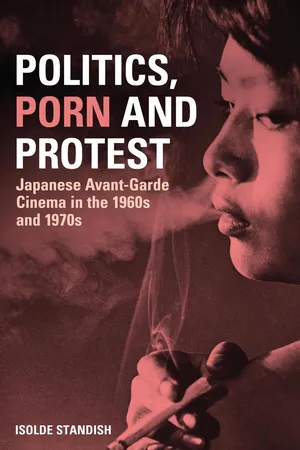
Politics, Porn and Protest
Japanese Avant-Garde Cinema in the 1960s and 1970s
- 216 pages
- English
- ePUB (mobile friendly)
- Available on iOS & Android
eBook - ePub
About this book
A superb new study of Japanese culture in the post-war period, focusing on a handful of filmmakers who created movies for a politically conscious audience.
Information
CHAPTER 1
Film and Philosophy: Towards a Cinema of Praxis
For us, doing reveals being. Each gesture traces out new forms on the earth. Each technique, each tool, is a way that opens upon the world; things have as many aspects as there are ways of using them. We are no longer with those who want to possess the world, but with those who want to change it, and it is to the very plan of changing it that it reveals the secrets of its being. (Sartre 2005: 183, emphasis in the original)
To our way of thinking, film is something with which you strike at society, it is something that has a tense relationship with society, in the sense that the subjective world of the filmmaker is pitted against society. However, society gets caught up in a way of thinking in which people want to recreate film as total reality and completely natural. There is an artistic conservatism and a political conservatism. We fight against this . . . because for us shooting a film is fighting. (Ōshima quoted in a combined interview with Yoshida in Best of Kinema Junpō vol. I, 1950–1966, 1994: 948)
If the founding of the distribution/production company ATG represented, at the institutional level, an attempt to bring Japanese film-viewing tastes into line with international trends, on another level, it was also an acknowledgement of the diversification of patterns of leisure and consumption within 1960s Japanese society. Furthermore, it was intimately linked to changing notions of ‘subjectivity’, manifest in popular culture in the ‘sun tribe’ (taiyōzoku) youth subculture among other things. The hedonistic ‘sun tribe’ generation represented a ‘nihilist’, anti-bourgeois rebellion against the wartime parent generation who, through concepts of post-war economic reconstruction, remained steeped in the cycles of the utilitarian work ethic of means and ends and ends and means. Middle-class youth of the post-defeat, occupation generation had, in contrast, by the late 1950s, learnt the art of self-definition through consumption based on desire and this was reflected on mainstream cinema screens in the star persona of Ishihara Yūjirō (1934–1987). The erotically charged ‘kiss’ scene between Ishihara and Kitahara Mie (1933–) in the 1956 film Crazed Fruit (Kurutta kajitsu) and the subsequent moral panic marked the historical moment.
In philosophical debates, Takakuwa Sumio argues that post-war political theories of ‘individual autonomy’ (shutaiseiron) were ‘products of the era of disintegration’. With defeat the ideologies of Imperial Japan collapsed resulting in an extreme disillusionment with the political and social systems upon which the populous had formerly relied. Sakaguchi Ango (1906–1955) with the publication of his influential essay ‘Discourse on Decadence’ (Darakuron) and the proponents of the ‘literature of the flesh’ school (nikutai bungaku), such as Tamura Taijirō (1911–1983) writing in the latter half of the 1940s, questioned all political beliefs and institutions looking for alternative ‘truths’ in the subjective spheres of bodily desire. In wartime, the individual had been compelled to suppress private desires in favour of the collective effort. The Special Attack Forces, formed in the last desperate months of the war and commonly known as the kamikaze forces, were the ultimate iconic expression of this conflation of public duty and the private through sacrifice. Their image was reinscribed into popular post-war discourses in the 1950s1 as emblematic of a consciousness in keeping with the imperatives of reconstruction. One outcome was a popular youth backlash through the ‘sun tribe’, while on another level, Japan’s post-war intellectual youth embraced Sartrean-derived existentialism as a philosophy through which to understand the relationship of the individual to the collective. As Koschmann explains:
After defeat, desire was widespread for the restoration of shutaisei, now understood as equivalent to jishusei, or autonomy. However, from the perspective of the individual, the wave of democratization that swept through postwar society amounted to merely another version of ‘socialization’ that had occurred before and during the war . . . Public priorities were dominant, and politics was so pervasive as to submerge the individual. As a result, the desperate urge to maintain personal integrity in opposition to social forces was expressed in the desire for shutaisei . . . [People] had come to hate all social forces and institutions, and this hatred became the basis for a negative concept of individuality. Here, then, was the social-psychological origin of the postwar move toward existentialism and the ideals of subjective freedom and autonomy. (Koschmann 1996: 137)
Within mainstream political discourse, conceptions of shutaisei were promoted through political engagement in democratic processes as the route to individuation, while in mainstream cinema, desire, expressed through romance and consumption, and from the 1960s through soft-core pornography, became the ultimate definition of the individual.2
Economic trends, within the film industry linked to this popular explosion in youth culture along with the cultural aspirations of ATG in the 1960s, combined to provide structural opportunities for the rapid promotion of young filmmakers to full directorial status. Historically, within the monopolistic society of the major studios a rigid hierarchical apprenticeship system had been observed. However, with the explosion of the Nikkatsu Studio’s hedonistic youth film genre based on the ‘sun tribe’ generation, so named after the title of the 1956 film Season of the Sun (Taiyō no kisetsu) which was based on the popular novel of the same title by Ishihara Shintarō (1932–), the Shōchiku Studio, in an attempt to capitalize on the phenomenon, broke with tradition and promoted the then youthful Ōshima Nagisa (1932–) and Yoshida (Kijū) Yoshishige (1933–) to full directorial status.
Despite ōshima’s ignominious departure from the studio after the acrimony over the withdrawal from Shōchiku cinemas of his 1960 film Night and Fog in Japan (Nihon no yoru to kiri), more opportunities for young filmmakers were increasingly opening up in the industry throughout the 1960s. Many of these filmmakers, themselves university graduates, had close links with left-wing student organizations and sought through cinema to challenge the politics of conservatism and the accepted grammar of ‘visual-style’ of the major studios. All of the main commercial studios, with the exception of the Tōei Studios, which began operations in the late 1940s being founded by filmmakers formerly employed by the Manchurian Motion Picture Association (Man’ei), had returned to prominence under the auspices of the US-led occupation forces.
In this sense, and to follow Bourdieu’s theoretical paradigm, this chapter focuses on filmmakers’ ‘dispositions’ as a dominant creative force within independent film production. This trend was reinforced by changing social, demographic and economic conditions capitalized on by ATG and other critical print media (Art Theatre and Film Art/Eiga Geijutsu) which advanced the concept of the auteur as a marketing strategy for ‘art house’ films. This chapter, drawing on the theoretical and critical writings of Yoshida Yoshishige and ōshima Nagisa, aims to reach an understanding of the politics, philosophies and aspirations that underpinned these filmmakers’ conceptions of ‘visual-style’ and narrative while placing them within a particular European-derived philosophical world-view with which they associated.
French intellectual thought offered the Japanese educated classes alternative political philosophies to the American-derived culture of consumption propagated by the major film studios in compliance with directives issued by the Civil Information Section (the propaganda wing of the US-led occupation forces controlling the media), while Italy, through the films of the neo-realist movement, offered the possibilities of alternative visual codes through which to re-present the new post-war experiential reality of people’s lives. As Yoshida explains, ‘Post-war Italian film, while rightly criticizing films made in the classical way, made rapid progress.’ He continues, the misery of the last war led to ‘the stripping away of the veil of affectation and the destruction of the classical image of man as perfect’ (Yoshida [1960] 2006: 49).
On a concrete level, the post-war austerities experienced by ordinary French and Italian people had resonances within Japan, as was the case with the inevitable burgeoning of a vibrant black market with all its connotations for the institutionalization of crime and corruption. Occupation by foreign forces provided another point of convergence as did the legacies associated with ideologically divided populations: in the French and Italian examples, divisions between those who supported the Resistance and those who supported Fascism, and in the Japanese example, those who supported the military government and left-leaning pacifist orientated factions, many of which had ties with the Communist Party. The international insecurity associated with US imperial ambitions in Korea, Vietnam and related to the Cold War also provided important points of empathy.
In the immediate post-defeat period, self-reflection and the race to institutionalize particular memories as official histories became part of the contested terrain of political discourse (both linguistic and visual) in all three countries. In Italy, Rossellini’s early films, Rome, Open City (Roma, città aperta) 1945 and Paisà 1946, performed an important role in cementing the legacies of the Italian Resistance and the Church as dominant anti-Fascist forces. Japanese directors, such as Kurosawa Akira (1910–1998), similarly sought cultural heroes of resistance upon which to base their characters. No Regrets for Our Youth (Waga seishun ni kuinashi) 1946 draws loosely on the biographical details of Ozaki Hotsumi (1901–1944), the China expert, suspected member of the Comintern and the only person to be executed in Japan for treason during the war, and Takikawa Yukitoki (1891–1962) the Kyoto University academic dismissed because of his political views. Marcel Ophuls’ ‘chronicle of a French city under German occupation and its aftermath’, The Sorrow and the Pity (Le chagrin et la pitié) 1969, is indicative of the French avant-garde’s attempts, post-May 1968, to rewrite the official historiography, first propagated under the post-war Gaullist regime. Similarly, a desire to challenge popular histories, as perpetuated through mainstream cinema’s adaptation of the social realist mise-en-scène and melodramatic narrative paradigms, formed one of the dominant planks of the 1960s Japanese avant-garde; Okamoto Kihachi’s Human Bullet (Nikudan) 1968 challenges the post-war iconographic image of the Special Attack Forces (kamikaze) and Yoshida Yoshishige’s Eros + Massacre (Erosu + gyakusatsu) 1970 rewrites the biography of the Taishō political anarchist ōsugi Sakae (1885–1923) in terms of contemporary 1960s concepts of free love.
Yoshida Yoshishige, writing of his early reminiscences of cinema as a boy in occupied Japan, contrasts the life styles depicted on cinema screens with the burnt-out buildings in which the makeshift cinemas were housed and concludes that the images of Rome depicted in Vittorio De Sica’s Shoeshine (Sciuscia) 1946 and Bicycle Thieves (Ladri di biciclette) 1948 were much closer to those of burnt-out Tokyo than the Hollywood films imported in great numbers by the occupation forces. Stating that most of the films he saw at that time were from Hollywood and, he recollects, starred Greer Garson and Ingrid Bergman, he continues:
When I think back on it now, these films formed one of the links in General Headquarter’s occupation policy, to this extent they were propaganda films (kokusaku eiga); for me, whose austere days passed in the thronging black-market and beneath gloomy lights, the things that appeared on the screen in front of me – the snow white walls, the thick garden lawns, chandeliers, electric refrigerators, and the abundance of food and canned goods – all of these things that engendered a comfortable daily life, it was the ultimate dream and as such I was happy. I did not just watch these films; inevitably, I envied the world the films reflected. (Yoshida 1971: 21)
Given the inappropriateness of the ‘dream-like’ quality of Hollywood’s glamour and romance to the experiential realities of post-defeat Japan, Europe, as Slaymaker suggests, offered alternative models for coming to terms ‘with the war years of complicity and weakness, of preserving the past while moving into the future’ (Slaymaker 2002: 4). Jean-Paul Sartre, who visited Japan in 1966 with Simone de Beauvoir and whose translated novel Nausea3 was in the Japanese top ten best-seller list for 1946, provided through existentialism a practical philosophy of action through which Japanese intellectuals could change society. In fact Yoshida cites the impact Sartre’s Nausea exerted on him as the reason for choosing French Studies as his major when he entered Tokyo University (Yoshida 2006: 423).4 In terms of many of the filmmakers associated with the cinematic avant-garde of the 1960s, existentialism fed into a notion of cinema as praxis.
In an interview with Yoshida and ōshima Nagisa published in a 1960 edition of the journal Kinema Junpō, when questioned on their motivation for entering the commercial world of film production, ōshima, who was a graduate from the Law Department of Kyoto University, responds:
In my case, to put it simply, it was by chance that I entered a film company. However, later when I thought about it, is it not the case that film as a medium is the best means to fill the gap between the populace (taishyū) and intellectual classes? We [ōshima and Yoshida] were both involved in the student movement, no matter how much time passes, our way of thinking will not fall into line with the thinking of society; we will always be angry . . . For us, making films is one form of action (hitotsu no kōi). It is not the case that we make a film out of something as a product. In the case of filmmaking, I think of it as a form of action for society. (Best of Kinema Junpō vol. I, 1950–1966, 1994: 948)5
From their writings, it is clear that ōshima and Yoshida saw cinema as part of a didactic project addressed to the post-defeat generation. Literature, in Sartre’s writing, but cinema in ōshima’s and Yoshida’s terms, should provoke people to change society. It should not act as palliative encouraging men in a sense of powerlessness. The theme of ‘victimization consciousness’ (higaisha ishiki), central to mainstream Japanese post-defeat war-retro genres, was to be challenged through the visual contextualization of the existential project. Ind...
Table of contents
- Cover
- Title
- Introduction
- 1 Film and Philosophy: Towards a Cinema of Praxis
- 2 The Art Theatre Guild: Theatres of Death and the Challenge of History
- 3 Overcoming History: Originary Societies, Pornography and Terrorism
- 4 Documentary and Performance
- Reflections
- Notes
- Filmography
- Bibliography
- Appendix: Historical Chronology
- Index
Trusted by 375,005 students
Access to over 1.5 million titles for a fair monthly price.
Study more efficiently using our study tools.
Frequently asked questions
Yes, you can cancel anytime from the Subscription tab in your account settings on the Perlego website. Your subscription will stay active until the end of your current billing period. Learn how to cancel your subscription
No, books cannot be downloaded as external files, such as PDFs, for use outside of Perlego. However, you can download books within the Perlego app for offline reading on mobile or tablet. Learn how to download books offline
Perlego offers two plans: Essential and Complete
- Essential is ideal for learners and professionals who enjoy exploring a wide range of subjects. Access the Essential Library with 800,000+ trusted titles and best-sellers across business, personal growth, and the humanities. Includes unlimited reading time and Standard Read Aloud voice.
- Complete: Perfect for advanced learners and researchers needing full, unrestricted access. Unlock 1.5M+ books across hundreds of subjects, including academic and specialized titles. The Complete Plan also includes advanced features like Premium Read Aloud and Research Assistant.
We are an online textbook subscription service, where you can get access to an entire online library for less than the price of a single book per month. With over 1.5 million books across 990+ topics, we’ve got you covered! Learn about our mission
Look out for the read-aloud symbol on your next book to see if you can listen to it. The read-aloud tool reads text aloud for you, highlighting the text as it is being read. You can pause it, speed it up and slow it down. Learn more about Read Aloud
Yes! You can use the Perlego app on both iOS and Android devices to read anytime, anywhere — even offline. Perfect for commutes or when you’re on the go.
Please note we cannot support devices running on iOS 13 and Android 7 or earlier. Learn more about using the app
Please note we cannot support devices running on iOS 13 and Android 7 or earlier. Learn more about using the app
Yes, you can access Politics, Porn and Protest by Isolde Standish in PDF and/or ePUB format, as well as other popular books in Media & Performing Arts & 20th Century History. We have over 1.5 million books available in our catalogue for you to explore.