What will it take for the American people to enact a more democratic version of themselves? How to better educate democratic minds and democratic hearts? In response to these crucial predicaments, this innovative book proposes that instead of ignoring or repressing the conflicted nature of American identity, these conflicts should be recognized as sites of pedagogical opportunity.
Kerry Burch revives eight fundamental pieces of political public rhetoric into living artifacts, into provocative instruments of democratic pedagogy. From "The Pursuit of Happiness" to "The Military-Industrial Complex," Burch invites readers to encounter the fertile contradictions pulsating at the core of American identity, transforming this conflicted symbolic terrain into a site of pedagogical analysis and development. The learning theory embodied in the structure of the book breaks new ground in terms of deepening and extending what it means to "teach the conflicts" and invites healthy reader participation with America's defining civic controversies. The result is a highly teachable book in the tradition of A People's History of the United States and Lies My Teacher Told Me.
eBook - ePub
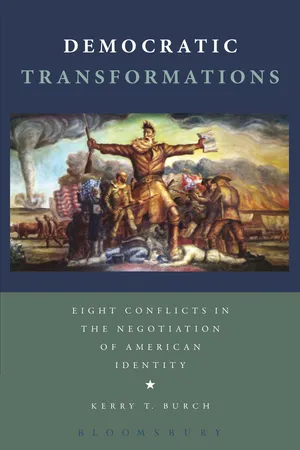
Democratic Transformations
Eight Conflicts in the Negotiation of American Identity
- 224 pages
- English
- ePUB (mobile friendly)
- Available on iOS & Android
eBook - ePub
About this book
Information
CHAPTER ONE
The pursuit of happiness
Transforming American scripture into a site of democratic pedagogy
Working in tandem with their cunning advertising strategists, corporations invest billions every year to persuade Americans to believe that they lack something vital to their “happiness.” This well-documented pattern makes advertising the most powerful educational force in America today.1 It is reasonable for us to assume that this power exercises a profound influence in shaping the nation’s image of the meaning of the pursuit of happiness2 clause, particularly among young Americans of recent generations who have been most decisively subjected to its unremitting influence. I want to suggest that there are steep democratic costs involved in continuing to privatize our conception of this crown jewel of American political rhetoric.
From a democratic perspective, for us to reduce what Pauline Maier called “American scripture” into something that has no more than a commercial or consumer meaning is both tragic and unjustified.3 It is tragic in that it robs the phrase of its democratic potential, and unjustified in that, during the eighteenth century at least, the phrase was seen to contain a crucial civic dimension. We need to remind ourselves that our conceptions of the meaning of the pursuit of happiness—especially its civic dimension which we’ve slowly forgotten over time—carry profound implications in terms of how we go about imagining our personal and national identities.
As critical educational theorists have cogently demonstrated, corporations have been predatorily taking advantage of the nation’s youth for decades in America’s schools. The accelerated pace of corporate influence in determining the direction of educational “reform” has had the cumulative effect not only of degrading the civic purposes of public education but also of undermining the very idea of public education itself. Today, an ever increasing number of students can now look forward to encountering TV advertising in schools, hallways adorned with glitzy advertising billboards, and curriculum packets sponsored by such renowned educational authorities as Pizza Hut, M & M’s, Hershey’s, Kellogg’s, and McDonald’s.4
Owing to the growing influence of corporate power within the schools, few can be shocked to learn that the meaning of the pursuit of happiness has devolved into a civically barren, utilitarian narrative of maximizing individual pleasure. The problem, as I have suggested, is that precious few Americans today realize that in the revolutionary period the pursuit of happiness was seen to contain a vital civic dimension as a condition of its own higher realization. To the extent the phrase is remembered at all today, its meaning is understood to be a wholly private, individualistic affair. With the extension of corporate power into the previously noncommercialized sphere of public education, corporate advertisers-turned-educators are increasingly in the position to educate youth desire within the schools by linking consumerism to the core meaning of human identity. In what can only be judged a remarkably successful effort to orchestrate human fantasy and desire—and thereby to corporatize selfhood—the titillating promise of infinite consumption now assumes the majestic heights of a transcendent ideal. Behold—Homo economicus!
Of course, the problem of Homo economicus has always been a factor in the negotiation of American identity. And for political theorists throughout the Western tradition, this species of character has consistently been perceived as a danger to both democratic and republican notions of selfhood, from ancient Greece and the Roman Empire up to the present moment. Since the pursuit of happiness has become yoked to consumption as an end-in-itself, today’s hegemonic interpretation of the phrase’s meaning poses a threat not only to American citizenship and democracy but also to the ecological health of the planet. It is my contention that in forgetting the civic and spiritual basis of this defining moral principle—or in not knowing or caring about its original conception—we unwittingly squander opportunities to revitalize the democratic project.
To redress this cultural forgetting, teachers need to develop critical pedagogies capable of engaging in what might be called the “politics of happiness.” Such an approach would mine the contradictory dimensions of the phrase with a focus on rearticulating its public resonances. Hannah Arendt, in her On Revolution, talked about the need to recover what she called the phrase’s intended “two-fold meaning” (i.e. the harmonization of its private and public dimensions). To resist the wholesale privatization of this vital strand of public rhetoric, I explore how a recovered public conception of the phrase’s meaning can be deployed to restore a more robust sense of civic purpose to the nation’s schools. What follows, then, is a conceptual road map for showing how the meaning of the phrase might be “turned around” from its present consumer focus on external material objects toward an alternative focus on a renewed democratic moral vision of the nation’s future.
Some readers will be skeptical about the possibility of turning around or modifying the meanings we attach to the pursuit of happiness. Indeed, such attitudes are quite understandable yet they are also symptomatic of a much larger problem—the erosion of our capacity for political imagination. But even as we acknowledge the odds stacked against the possibility of transforming public opinion regarding the meaning of the phrase, we would be remiss not to acknowledge that, in the United States many social movements in the past have coalesced around politically inventive rereadings of the Declaration of Independence. Such episodes of moral renovation represent the symbolic axes upon which American identity has historically been democratized. Conversely, the most antidemocratic phases in US history have been those in which the memory of the values enshrined in the Declaration have been subject to historical amnesia. Prominent historians of the Declaration demonstrate that changing interpretations of the document’s moral content, namely, questions about what exactly equality, self-determination, right to revolution, and pursuit of happiness mean at different points in the nation’s history, have always been sites of contestation perpetually “under construction.”5
To briefly illustrate: the first political party to emerge in the United States once the Constitution was ratified—the Federalists—had little interest in acknowledging much less venerating the democratic and egalitarian values of the Declaration. For decades, the volcanic political potential of the Declaration lay dormant as the Federalists succeeded in representing the text as nothing more than an expedient vehicle to announce independence. In the Federalist view, once the war against England was over, so, too, was the Declaration’s usefulness. Its potential to continue shaping the national identity was effectively tamed—at least for a couple decades.
In the 1820s, however, newly assertive labor and abolitionist movements revived its public memory and civic meaning. The Declaration’s forgotten egalitarian principles were imaginatively reclaimed and its meaning transformed into something democratic, future-directed and transcendent. Historian Alfred F. Young captures the transformation in American identity that emerged from this momentous rediscovery of the Declaration: “The Fourth of July, to conservatives never more than the anniversary of independence, to others had become a symbol of liberation.”6
What occurred within these individuals, and within these larger political bodies, so that abstractions written on paper were transformed into emotionally powerful symbols of liberation? Was the value of equality reawakened as a force in the contest over the meaning of the national identity? Did many begin to realize that their own personal happiness was incomplete apart from their engaged participation in building a “more perfect union”? Whatever the ideas motivating these visionaries, their examples provide ample testimony to the fact that the most democratic phases in American history have come about as a consequence of citizens undergoing an intensified encounter with the democratic moral ideals embodied in the Declaration. Whether in reference to the abolitionists, to the trade unionists, to the suffragettes, or to the twentieth century civic rights advocates, a clear pattern emerges: The meanings we attach to the Declaration, and to the pursuit of happiness in particular, may be more fluid and susceptible to re-conceptualization than we are taught to think.
The public dimensions of the pursuit of happiness, at least within the American context, are rooted in the writings of Thomas Jefferson, George Mason and James Otis. These figures in turn were indebted to the leading thinkers of the Scottish Enlightenment. But the kernel of the idea of public happiness is also traced to Platonic, Aristotelian, Stoic and Epicurean conceptions of happiness and the social conditions that these traditions believed necessary to bring this desirable state into being. In order to recover a fuller meaning of the pursuit of happiness, then, the first step will be to establish the continuity between the civic humanism of antiquity and aspects of the American enlightenment whose ethos Jefferson so paradoxically personifies.
Citizens and idiots: An ancient Greek and Roman snapshot of human happiness
The classical Greek word for happiness is “eudaimonia,” which means “to have a good daimon.”7 As Socrates describes it, a daimon represents an interior space coded mythically as a “third term” intermediary; this third term was named eros by Plato as a form of love which was seen to bind the divine realm to the human realm. Socrates describes his daimon as an “inner voice” that came to him only to advise what actions he should not take. In the Socratic tradition, we see human happiness imagined as an internal moral orientation to the self and world. Socrates claimed that this orientation could only be achieved by “taking care of the soul.” In The Apology we observe Socrates on trial for allegedly “corrupting” Athenian youth, no doubt because he was urging them to question popular images of happiness and to take care of their souls. He defends himself by lambasting those who would reduce happiness to the pursuit of wealth:
My very good friend, you are an Athenian and belong to a city which is the greatest and most famous in the world for its wisdom and strength. Are you not ashamed that you give your attention to acquiring as much money as possible, and similarly with reputation and honor, and give no attention or thought to truth and understanding and the perfection of your soul?8
There is a sense in which Socrates inaugurates the tradition of critical pedagogy by engaging in the “politics of happiness,” an effort to identify the contradictions embedded within the Athenian self-conception. Later, Aristotle would continue the Socratic ethos of critically reflective citizenship by defining the most elevated form of happiness as intellectual contemplation, the vita contemplativa.9 In the Stoic and Epicurean traditions, whose leading figures worked very much within the then dominant Socratic/Platonic paradigm, happiness results from the harmonious life, whereby the conflicting parts of the psyche are brought into conscious awareness through the cultivation of one’s critical reason.
As is well known, one of the guiding assumptions of Aristotle’s philosophy is that human beings are innately political creatures (zoon politikon).10 For Aristotle, then, the condition of happiness could only come into existence within a social context, within a political order where the civic or social dimensions of being are explicitly acknowledged, valued and consciously developed. Because our sociability defines us as humans, the prospect of being self-regarding and other-regarding in a virtuous manner could only be realized through sustained civic engagement.
The idea that human beings were essentially “political animals” was so crucial to Greek democratic political culture that the term “idiot” (idios) was invented to describe those who could legally participate in the polis or political community, but instead chose to live a private existence. Idiotes is defined as “a purely private person.”11 In his oft-noted funeral oration, Pericles boasts that in democratic Athens those who took no part in civic affairs were considered to be “useless.” Unlike democratic characters, they could not judge, choose, deliberate about public affairs, or become indignant at the sight of injustice. Within the democratic social imaginary, then, privately isolated indiv...
Table of contents
- Cover-Page
- Half-Title
- Title
- Dedication
- Contents
- Prologue
- 1 The pursuit of happiness
- 2 The tyranny of the majority
- 3 Four score and seven years ago
- 4 Forty acres and a mule
- 5 The moral equivalent of war
- 6 The business of America is business
- 7 The military-industrial complex
- 8 The personal is political
- Epilogue
- Acknowledgments
- Further Reading
- Index
- Copyright
Trusted by 375,005 students
Access to over 1.5 million titles for a fair monthly price.
Study more efficiently using our study tools.
Frequently asked questions
Yes, you can cancel anytime from the Subscription tab in your account settings on the Perlego website. Your subscription will stay active until the end of your current billing period. Learn how to cancel your subscription
No, books cannot be downloaded as external files, such as PDFs, for use outside of Perlego. However, you can download books within the Perlego app for offline reading on mobile or tablet. Learn how to download books offline
Perlego offers two plans: Essential and Complete
- Essential is ideal for learners and professionals who enjoy exploring a wide range of subjects. Access the Essential Library with 800,000+ trusted titles and best-sellers across business, personal growth, and the humanities. Includes unlimited reading time and Standard Read Aloud voice.
- Complete: Perfect for advanced learners and researchers needing full, unrestricted access. Unlock 1.5M+ books across hundreds of subjects, including academic and specialized titles. The Complete Plan also includes advanced features like Premium Read Aloud and Research Assistant.
We are an online textbook subscription service, where you can get access to an entire online library for less than the price of a single book per month. With over 1.5 million books across 990+ topics, we’ve got you covered! Learn about our mission
Look out for the read-aloud symbol on your next book to see if you can listen to it. The read-aloud tool reads text aloud for you, highlighting the text as it is being read. You can pause it, speed it up and slow it down. Learn more about Read Aloud
Yes! You can use the Perlego app on both iOS and Android devices to read anytime, anywhere — even offline. Perfect for commutes or when you’re on the go.
Please note we cannot support devices running on iOS 13 and Android 7 or earlier. Learn more about using the app
Please note we cannot support devices running on iOS 13 and Android 7 or earlier. Learn more about using the app
Yes, you can access Democratic Transformations by Kerry T. Burch in PDF and/or ePUB format, as well as other popular books in Education & Education Theory & Practice. We have over 1.5 million books available in our catalogue for you to explore.