The idea of the "outside" as a space of freedom has always been central in the literature of the United States. This concept still remains active in contemporary American fiction; however, its function is being significantly changed. Outside, America argues that, among contemporary American novelists, a shift of focus to the temporal dimension is taking place. No longer a spatial movement, the quest for the outside now seeks to reach the idea of time as a force of difference, a la Deleuze, by which the current subjectivity is transformed. In other words, the concept is taking a "temporal turn."
Discussing eight novelists, including Don DeLillo, Richard Powers, Paul Theroux, and Annie Proulx, each of whose works describe forces of given identities-masculine identity, historical temporality, and power, etc.-which block quests for the outside, Fujii shows how the outside in these texts ceases to be a spatial idea. With due attention to critical and social contexts, the book aims to reveal a profound shift in contemporary American fiction.
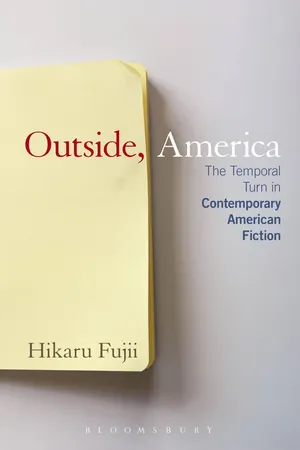
- 160 pages
- English
- ePUB (mobile friendly)
- Available on iOS & Android
eBook - ePub
About this book
Information
Part One
Vanishing Space
Journey to the space outside, which goes hand in hand with the discovery of authentic self, has occupied a crucial place in American imagination. As Alexandra Ganser aptly argues that “geographical mobility, tied to social ascent, has always had a high symbolic value, shaping distinctly American idea(l) of freedom and national identity,”1 the road as the promise of new self appears repeatedly in American literature, from Walt Whitman’s “Song of the Open Road” to Jack Kerouac’s On the Road.2 This basic idea of the westward movement as a quest for American identity also survives in contemporary literature, typically in the motif of the road.
Contemporary writers, on the other hand, share a critical attitude toward the traditional road motifs. Especially the 1990s saw a number of “anti-road” novels that subverted the conventions of the genre.3 Among them, Annie Proulx’s fist novel, Postcards, stands out with its relentless interrogation of American road experience in its central idea of space and freedom. The 1992 novel subverts the westward movement of American self by describing the lifelong journey of Loyal Blood, a Vermont-born farmer, who eventually turns into an aimless wanderer in the West. Through “a broad East-West survey of American life during the 20th century,”4 Proulx’s novel undermines the promise of individual freedom in open space.
In 1944, a Vermont farmer kills his girlfriend, hides her body, and runs away from his home. The opening lines of the novel depict the moment after the act of murder that launches Loyal Blood’s lifelong journey:
Even before he got up he knew he was on his way. Even in the midst of the involuntary orgasmic jerking he knew. Knew she was dead, knew he was on his way. . . . he knew that everything he had done or thought in his life had to be started over again. Even if he got away.5
Having impulsively killed Billy, Loyal realizes he cannot continue his life on the farm. The typical road motif of “starting over” is replaced by the sudden feeling that “the route of his life veered away from the main line,”6 and the violent act would haunt him no matter how far he traveled.
After disposing off her body, Loyal returns to his house, where he tells his family he is going away to start a new life with Billy and simply drives away from his farm. Another reversal of the road narrative convention is seen here: the hero’s journey is not an autonomous decision of the individual but an unhoped-for reaction to the thoughtless act. While Billy used to insist that “I’m not getting caught. I’m getting out of here and I’m going to be somebody,”7 repeating the typical American faith in the future that lies ahead, now the farmer finds himself on the run. There is no individual choice in the novel; with the event that has already happened, the journey begins even before Loyal understands the reason: “Billy, always yapping about moving away, getting out, making a new start, was staying on the farm. He, who’d never thought beyond the farm, never wanted anything but the farm, was on his way. Clenching the wheel.”8 Thus the reluctant traveler goes on the road in 1944.
The year 1944 is significant in the sociohistorical context of the state: World War II and the highway planning. “‘There’s a War on, in case you forget,’” Mink tells his son; “‘Farm work is essential work. Forget out west.’”9 The descriptions of the Blood farm are consistently accompanied by references to the war. There is also a prospect of job at wartime factories, once Loyal leaves Vermont—this is the promise of a new life Billy dreamed of. Moreover, the same year saw the announcement of the plans for Interregional Highways. According to David W. Jones, the 1944 plan “was proposing an extraordinarily ambitious agenda for future highway construction both within and between U.S. metropolitan areas.”10 When Loyal declares his departure, the route to the West is not so much a figment as a concrete possibility that the national project has laid ground for.
The ex-farmer on the road thus drives westward, at first following Billy’s plan: “He’d drive west, but keep to the border. Those cities she’d named, South Bend, Detroit, Gary, Chicago, those were the places.”11 These cities form a straight westward line from Vermont, loyal to the promise of the road: “West, that was the direction.”12 However, he gradually realizes the impossibility of shedding away his past self; glancing at the farmlands stretching beside the road, or looking down at the plain from a window, Loyal is reminded of his connection to the Vermont farm:
His blood, urine, feces and semen, the tears, strands of hair, vomit, flakes of skin, his infant and childhood teeth, the clippings of finger and toenails, all the effluvia of his body were in that soil, part of that place.13
Kent C. Ryden is right in stating that in “Loyal’s remembering, the farm and he are one and the same.”14 This fact is further highlighted by the word “effluvia,” which refers to Loyal’s bodily particles connected to the farmland. The use of the word demonstrates that the self, connected to the soil and the past in its molecular level, cannot be entirely free from the land; the essential components of Loyal’s subjectivity do not change even after getting away from his home. While movement in the road narrative is essentially an opportunity to rediscover oneself as a free individual, Loyal Blood, with his effluvia bound to the earth, finds himself in an opposite condition: loyal to his blood.
The narrative follows Loyal’s cross-continental journey and describes the sociopolitical forces in the post-World War II America, which denies his attempts to reach free, open space. Loyal goes through and glimpses every kind of space in the West, only to realize none of them provides him a possibility of freedom—it has already evaporated in the Cold War state. Four decades after he departs from Vermont, the traveler is left with a sense of exhaustion and aging.
In 1951, after being robbed of all the money he has earned in factories, he begins to work in a uranium mine called Mary Mugg. This downward movement logically follows his inability to escape from the haunting land-farm-self connection: when the space on the surface could not offer him any possibility of freedom, he goes underground. This space in the West, however, does not lead to any sense of autonomy. As Michael A. Amundson points out, “the growing insecurity of the Cold War led the Atomic Energy Commission (AEC) to launch a massive uranium hunt to find domestic sources for atomic bombs”15 after the legislation of the Atomic Energy Act in 1946, five years before Loyal comes to the mine. The space beneath the ground is thoroughly seized by the force of the state, now engaged in the Cold War.
Loyal’s days in Mary Mugg end with an abrupt collapse of the mine. He gives up mining and finds a new job as a fossil hunter in the West. But again, these open fields are not an untouched space; on the contrary, they are connected to the “archeologists and paleontologists from museums and universities back east”16 as the end-buyer of his fossils. Loyal, the fossil hunter, becomes increasingly weary of this fact and finally quits the job.
With the open ground and underground space devoid of the possibility of freedom, Loyal’s eyes turn upward: he begins to work as assistant to an amateur astronomer in New Mexico in 1966; this time, too, it becomes clear that outer space is not a free area. “‘I do not get time at a big telescope!’” the astronomer complains to Loyal. “‘My amateur status bars me from the big ones! (The academics stand in line for years to use them.) . . . We are losing the sky, we have lost it.’”17 Even though he claims that “‘Nothing is impossible in space,’”18 the space is closed for amateurs like him; it was the late 1960s, in the middle of the development of the Apollo Program that has appropriated outer space as part of the national strategy. Space cannot be Loyal’s New Frontier.
Thus the possibility of freedom in every kind of space is exhausted; the promise of the road—a fresh start in a no-man’s land—is completely removed from the protagonist’s meandering. Instead, the sense of being trapped and growing old begins to dominate the whole text: “He had it straight now; there were special roads and paths across the country that he could travel,...
Table of contents
- Cover
- Title
- Introduction
- Part One Vanishing Space
- Part Two Time Will Tell
- Conclusion
- Works Cited
- Index
Trusted by 375,005 students
Access to over 1.5 million titles for a fair monthly price.
Study more efficiently using our study tools.
Frequently asked questions
Yes, you can cancel anytime from the Subscription tab in your account settings on the Perlego website. Your subscription will stay active until the end of your current billing period. Learn how to cancel your subscription
No, books cannot be downloaded as external files, such as PDFs, for use outside of Perlego. However, you can download books within the Perlego app for offline reading on mobile or tablet. Learn how to download books offline
Perlego offers two plans: Essential and Complete
- Essential is ideal for learners and professionals who enjoy exploring a wide range of subjects. Access the Essential Library with 800,000+ trusted titles and best-sellers across business, personal growth, and the humanities. Includes unlimited reading time and Standard Read Aloud voice.
- Complete: Perfect for advanced learners and researchers needing full, unrestricted access. Unlock 1.5M+ books across hundreds of subjects, including academic and specialized titles. The Complete Plan also includes advanced features like Premium Read Aloud and Research Assistant.
We are an online textbook subscription service, where you can get access to an entire online library for less than the price of a single book per month. With over 1.5 million books across 990+ topics, we’ve got you covered! Learn about our mission
Look out for the read-aloud symbol on your next book to see if you can listen to it. The read-aloud tool reads text aloud for you, highlighting the text as it is being read. You can pause it, speed it up and slow it down. Learn more about Read Aloud
Yes! You can use the Perlego app on both iOS and Android devices to read anytime, anywhere — even offline. Perfect for commutes or when you’re on the go.
Please note we cannot support devices running on iOS 13 and Android 7 or earlier. Learn more about using the app
Please note we cannot support devices running on iOS 13 and Android 7 or earlier. Learn more about using the app
Yes, you can access Outside, America by Hikaru Fujii in PDF and/or ePUB format, as well as other popular books in Literature & Literary Criticism. We have over 1.5 million books available in our catalogue for you to explore.