In order to be able to communicate and engage with each other via new communicative spaces such as Google Earth, we need to understand as much as possible about how they work as cultural texts: how and why we make them and how we respond to them.
Launched in 2005, Google Earth is a virtual globe, map and geographical information program, mapping the Earth by the superimposition of images obtained from satellite imagery and aerial photography. By addressing the sociopolitical issues at stake in society's use of social websites, the author provides the first ever extended close reading of Google Earth as a powerful player in the communication realm of social media.
By grounding the context of its military pre-history, its construction, its links to other similar world-making sites such as Google Maps and how it is perceived critically by social scientists, it is imperative to understand how social networking and information sites work in socio and geo-political contexts if society is to use these sites effectively and for the public good.
- 208 pages
- English
- ePUB (mobile friendly)
- Available on iOS & Android
eBook - ePub
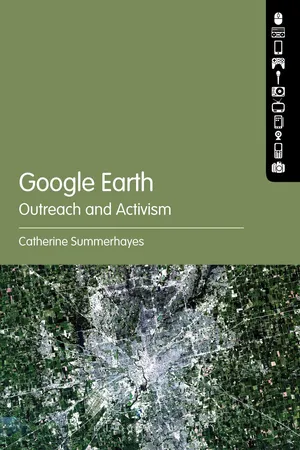
Google Earth: Outreach and Activism
About this book
Information
1
An Introduction
Gulliver or Alice would say: ‘I’ve been changed several times.’ But for Alice the visible world does not run up against the screen of the mirror; the luminous reflective is not a limit but a point of passage.
Paul Virilio1
One of the major challenges that society faces at this current historical moment is to understand how we embody our perception of the world via digital technologies. Actual people and places populate this world that is represented to us as existing in a new kind of communicative space. We are faced with the question of how we are developing a new kind of social intelligence that incorporates the information we gain through the mediated yet always ‘real’ spaces available to us via digital media platforms that are created from corporately owned software networks and systems. Many of these software systems have till now only been minimally critiqued for their social implications. The first tenet that underlies the argument in this book is that there is an imperative to understand how social networking and information websites work in socio- and geopolitical contexts, if society is to use these sites effectively and for the public good.2 The second tenet is that Google Earth can be considered one of these massively social media platforms. The third tenet is one that has been and continues to be debated in both the scholarly and public sphere: that digital technologies have affected human sociality – how we as humans relate to each other, to our communication technologies and to the rest of our environment. In Sherry Turkle’s words:
We are witnessing a new form of sociality in which the isolation of our physical bodies does not indicate our state of connectedness but may be its precondition.3
Such a ‘new form of sociality’ suggests that we must once again deal with questions about meaning and interpretation that arise from collisions between textual representations and the actual worlds they indicate, in other words and once again, the problematic of what is conceptualized as indexicality. Do we still read texts as if they point directly to or are transparent renditions of the actual world? How much can we rely on previous regimes of interpretation as ways into understanding digitally produced images and dialogues? Nowhere are these questions more relevant and perhaps even urgent as when they are introduced into the context of interactive surveillance software platforms such as Google Earth. At stake are the subjective states of real people: the relationships between us (the viewers/users) and those we connect with via digital technologies. How do we, how can we now include our acts of communication in these spaces as fields of actual engagement, affect and effect in the world as we experience it?
CONNECTION with (nearly) anyone at any time: Web 2.0
The most significant and easily understood recent stage in digitally enabled communications arrived with the emergence of what became known as Web 2.0. This term is associated with peer-to-peer interactivity and user participation in data creation. It heralded a new era of the web use ‘by the people for the people’. Coined by Darcy Dinucci in 1999, Web 2.0 referred to interactive software platforms and their application to create massive interactive communication sites now known as social media websites. The term was popularized by Tim O’Reilly at the O’Reilly Media Conference in 2004. In a paper published in 2007, O’Reilly defined Web 2.0 as a development of the overall architecture of the World Wide Web (WWW):
Web 2.0 applications are those that make the most of the intrinsic advantages of that platform: delivering software as a continually-updated service that gets better the more people use it, consuming and remixing data from multiple sources, including individual users, while providing their own data and services in a form that allows remixing by others, creating network effects through an architecture of participation, and going beyond the page metaphor of Web 1.0 to deliver rich user experiences.4
Principal architect of the WWW in 1991, Tim Berners-Lee took exception to this definition. He maintained that the WWW was always a ‘two-way medium’, a platform for interconnectivity and that the term was simply jargon and did not signal a ‘reorientation’ at all.5 Nevertheless, the term ‘Web 2.0’ has become a marker to denote massively popular social media sites in the West such as Facebook and YouTube, the Chinese microblogging site Sina Weibo and the Chinese social networking site Renren. We now expect to be able to contact anyone anywhere in the world at any time, no matter where we are and no matter the inconvenience of different time zones. We expect this kind of connectivity to be easily accessible via our personal computing technologies and that other people will make themselves available for connection with us. And we expect this technology to be easy to use, to be seamlessly able to transport and link us via our comments, concerns, questions and desires, to any database that seems useful to us.
Along the continuing cyber highway of Web 2.0, the makers, the coders, the hackers and the watchers in business and government have inevitably created huge databases of information about people, what they like, what they look like and what they have done. Although the popular press at the time of writing is beginning to talk about ‘the right to anonymity’, Web 2.0 with its inherent cultural counterpart that van Dijck calls ‘the culture of connectivity’ nevertheless demands varying levels of surrender of personal privacy. It is very difficult to envision a cultural shift from this current imperative to connect freely and randomly with each other online. An obvious consequence is the use of Web 2.0 for identity theft, fraud and many levels of warfare. The ongoing surge of cybercrime is resulting in a running ‘game of tag’ between corporations and governments and cyber criminals, with new forms of security and encryption becoming highly prized forms of currency in the domains of business and government. This desperate quest to secure portals to the WWW against subversion and surveillance is not just a by-product of Web 2.0: it is an inherent characteristic. Such characteristics can be seen as flaws in the utopia of peer-to-peer engagement on the WWW, but they can also be understood to be the parameters of usefulness and capacity through which software creators need to push and extend the programs associated with Web 2.0, if this current culture of connectivity is to continue and to evolve.
Although O’Reilly defined Web 2.0 in the context of business models, what we now understand to be Web 2.0 are all those software applications and platforms that allow us to interact with each other online. O’Reilly writes that a company that promotes itself as using Web 2.0 needs to address the following benchmarks:
• services, not packaged software, with cost-effective scalability
• control over unique, hard-to-recreate data sources that get richer as more people use them
• trusting users as co-developers, harnessing collective intelligence
• leveraging the long tail through customer self-service, software above the level of a single device
• lightweight user interfaces, development models and business models6
His second and third points are the most interesting insights in relation to social media sites and are highly significant for thinking about and analysing Google Earth and carefully produced interactive databases such as Wikipedia. This book proposes that Google Earth most certainly is a site that is ‘harnessing collective intelligence’. Google Earth also demonstrates how difficult it is to maintain ‘control over unique, hard-to-recreate data sources that get richer as more people use them’ whilst at the same time offering a format for information and dialogue, which is clear and easily accessible to all users. As described in Chapter 2, this challenge has led to some recent developments in the organization of Google Earth layers and its incorporation of Google Maps. With Google Earth, Google has created a giant platform for connecting people and information. Harnessing resulting data to the needs of users and of its own business model requires constant modifications and updates that defy any sense of permanence and stasis.
A numinous virtually real world
Google Earth was launched by google.com in June 2005, towards the end of a digital media culture that commonly described communication undertaken via the web as happening in ‘virtual space’. Prior to the emergence and social dominance of Web 2.0 with the introduction of the major social networking sites Facebook and YouTube (also launched in 2005), virtual space held the same kind of numinosity as William Gibson’s ‘cyberspace’7 – an alternate reality. This earlier and increasingly irrelevant meaning of the word ‘virtual’ implied a separate space of existence which was more related to imagined worlds than the live ‘meat’ worlds of mundane human existence.
Challenging the somewhat wishful thinking by some people even now that there is virtual space which is separate from the rest of existence, new media theorist Anna Munster re-conceptualized the virtual, soon after the introduction of Web 2.0, as a ‘set of potential movements produced by forces that differentially work through matter, resulting in the actualization of that matter under local conditions’.8 The general, and unfortunately, belated public realization has grown over the last five years or so, that virtual spaces not only are imagined to be real but also have real-life consequences. For example, the problem of material posted on Facebook sabotaging relationships and employment opportunities is now well known. Media theorist Sean Cubitt well describes the not so obvious characteristic of cyberspace as a space of possibilities and responsibilities rather than a simplistic vehicle for ‘play acting’; he describes how this digitally created space of communication is one of process rather than an encapsulated space with little or no relation to the actual world:
In this region of cyberspace (which, like deep space, is lumpy), the real has not faded. It has been registered in the raster of the accountable future, not yet an object of knowledge but for which a place of reckoning has been prepared.9
It is interesting that while Facebook claims ownership of all images posted on its site,10 it has now announced that users can take down, ‘delete’ their site, although it also says that information may still exist on backup files of Facebook.11 The introduction of this facility to delete your files illustrates well the current growing demand for mutability and agency by users of social media. Our many human endeavours in the actual, whether they are individual or group based, social, commercial, activist, altruistic or in the realm of the perceived ‘good’ of nation states all still depend on how we perceive our actions in what used to be (and often still is) called virtual space or cyberspace: that realm of communicative texts and processes enabled by the Internet and the WWW.
Be it a reference to the magical, the terrible, the criminal, altruistic or simple escapism, I propose that the meaning of the word ‘virtual’ is still relevant however, in our quest to find out more about the ever-shifting limen between how we can use and understand more about what we do ‘on the web’, and how that ‘doing’ simultaneously occurs in the actual world. Since 2005 the term ‘magical’ perhaps has become a relevant descriptor for the virtual as people immerse themselves in the WWW via social media platforms (Facebook and YouTube being the dominant players at this current time) and many complex world-creating online games and spaces such as World of Warcraft and Second Life, although, as noted earlier, escapist ideas about abandoning the ‘real world’ for the virtual still allow an elusive yet obstinate illusion that people can be anyone or anything they like in virtual space, and that actions in this sp...
Table of contents
- Cover
- Halftitle Page
- Title Page
- Contents
- Acknowledgements
- 1. An Introduction
- 2. ‘What Is Google Earth?’
- 3. Using Google Earth – Who, How and Why
- 4. ‘Crisis in Darfur’: A Google Earth Outreach Case Study in Affect and Compassion
- 5. Human Rights Activism via Remote Sensing – An Extended Case Study of Activism in ‘Crisis in Darfur’
- 6. In Conclusion: Humanist Trajectories in Google Earth
- References
- Index
- Imprint
Trusted by 375,005 students
Access to over 1.5 million titles for a fair monthly price.
Study more efficiently using our study tools.
Frequently asked questions
Yes, you can cancel anytime from the Subscription tab in your account settings on the Perlego website. Your subscription will stay active until the end of your current billing period. Learn how to cancel your subscription
No, books cannot be downloaded as external files, such as PDFs, for use outside of Perlego. However, you can download books within the Perlego app for offline reading on mobile or tablet. Learn how to download books offline
Perlego offers two plans: Essential and Complete
- Essential is ideal for learners and professionals who enjoy exploring a wide range of subjects. Access the Essential Library with 800,000+ trusted titles and best-sellers across business, personal growth, and the humanities. Includes unlimited reading time and Standard Read Aloud voice.
- Complete: Perfect for advanced learners and researchers needing full, unrestricted access. Unlock 1.5M+ books across hundreds of subjects, including academic and specialized titles. The Complete Plan also includes advanced features like Premium Read Aloud and Research Assistant.
We are an online textbook subscription service, where you can get access to an entire online library for less than the price of a single book per month. With over 1.5 million books across 990+ topics, we’ve got you covered! Learn about our mission
Look out for the read-aloud symbol on your next book to see if you can listen to it. The read-aloud tool reads text aloud for you, highlighting the text as it is being read. You can pause it, speed it up and slow it down. Learn more about Read Aloud
Yes! You can use the Perlego app on both iOS and Android devices to read anytime, anywhere — even offline. Perfect for commutes or when you’re on the go.
Please note we cannot support devices running on iOS 13 and Android 7 or earlier. Learn more about using the app
Please note we cannot support devices running on iOS 13 and Android 7 or earlier. Learn more about using the app
Yes, you can access Google Earth: Outreach and Activism by Catherine Summerhayes in PDF and/or ePUB format, as well as other popular books in Social Sciences & Media Studies. We have over 1.5 million books available in our catalogue for you to explore.