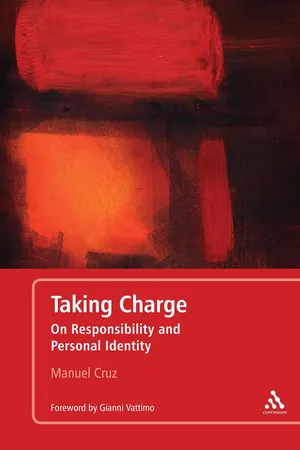
The book deals with key ethico-political issues of modernity, that of responsibility and of the subject(s) that can assume it. Today, new realities, from global political issues to economic crises and lack of confidence in governments, show that there is no authority, institution, or public organism capable of "taking charge." In fact, people find themselves less responsible than ever before.
Available for the first time in English, this text by one of the leading European intellectuals explores why we need to return to a full personal responsibility. This entails a revisiting of such concepts as personal identity, tolerance, and action -all essential components of responsibility. Featuring a preface by Gianni Vattimo, the book not only analyzes the problem of responsibility from various perspectives (including Nietzsche, Weber, Arendt, Sartre), but also confronts today's realities and challenges. As Cruz puts it, "Until now, men attempted to describe the world; the moment has arrived for them to take it on."
- 144 pages
- English
- ePUB (mobile friendly)
- Available on iOS & Android
eBook - ePub
About this book
Trusted by 375,005 students
Access to over 1.5 million titles for a fair monthly price.
Study more efficiently using our study tools.
Information
Chapter 1
The Problem that Concerns Us: Responsibility and Identity
For some time we have known that philosophy is lagging behind the world. But we sometimes forget that philosophy can also lag behind itself. That is what happens when certain issues like the return of the subject or the need for a fresh look at individualism — which seem to suggest a pendular, if not a directly random, conception of the history of ideas — are raised as items on the agenda. If we are to stay with those labels, the first thing to be aware of is their extreme antiquity. We need only remember Riesman, Sennett or the Popperian debate on methodological individualism. It therefore seems that we must modify the approach. The (twofold) question we should face is, first, what is new in thought so that we can be sure we are not dealing with the same thing and, second, to what extent the reality our schemas are supposed to apply themselves to is also the same. But while we could answer the first one by saying that the axis of the debate may have shifted from the methodological individualism / methodological holism antagonism to the methodological monism / methodological pluralism opposition (the latter represented by those who defend fusions of paradigm and the like), in the case of the second we would have to begin by acknowledging that it is fundamentally the changes in the plane of reality that authorize us to think about certain issues in a different way. The concepts of progress and backwardness seem to have lost much of their usefulness. There is no precise criterion for discerning when the philosopher is acting as a mere apologist or ideologist and when he is being a forerunner. The shadow of Hegel’s owl stretches too long at dawn. Perhaps we can only say that philosophical discourse, which had analyzed the theoretical conditions of possibility of some categories and discourses, has found that their material conditions of possibility have occurred,1 and that in the confrontation between them there has not always been agreement. But while that disagreement may be valued as a sign of the obsolescence or the error of the categories, in the opposite case it would be best to say that the intuitions or anticipations in question have reached their truth. This idea would serve to introduce the meaning of the new direction discourse should take. The point, of course, is not to fall back into the typical ideas of the last decade of the kind propounded by Ferry, Renaut and so many others that they could all be included under the heading crisis of the subject and postmodernity. At least we should speak now of two new factors that oblige us to look at this issue of the individual/subjectivity in new terms: first, the apparently definitive failure of a model of society, with its enormous economic, social, political and ideological repercussions, and, second, the crisis of the welfare state that has been occurring in developed European countries. Evidently both factors are deeply connected, but we are going to tug the end of the second one to try to unravel the theoretical ball of wool we have proposed.
A second observation, derived directly from the previous one: in the matters we are going to refer to, the distinction between micro and macro levels may not be very useful. The new problems people are facing today transcend both political frontiers and theoretical demarcation lines. AIDS, drug addiction, world famine or the destruction of the ozone layer are global, planetary situations, to a large extent new ones — “challenges” they are called in a somewhat more emphatic language — that seem to generate a kind of specific perplexity. The inertia of so many years invited us to think (or, rather, to believe without thinking) that some authority, institution or public organism should take charge of them because — the argument ran — it is in the nature of (social) things that each problem has an appointed negotiator for its solution. But these situations have demolished the schema. First, because their magnitude goes far beyond the real possibilities of any state (however much it may be disposed to be a benefactor); second, because in the face of them the inevitable question arises: is anyone responsible for them?
And so, since we are asking, is what is happening here very different in the case of individual problems? In this other case, starting from an apparently different (and sometimes opposite) situation we come to a similar conclusion, to wit, in this sphere too individuals are less and less faced with their responsibility. The administration and public services frequently take on their obligations through documents, time limits, requests, forwarding. The legal institutions split, the law becomes bureaucratic and in ten years nobody remembers what actually happened, the reason why someone was sanctioned. We could say that infringements become virtual. Just think of what happened in France in the 1990s with the case of the contaminated blood, or in Spain in the 1980s with the massive poisoning caused by the sale of industrial-grade rapeseed oil for human consumption. It is not a matter of talking about punishment.2 Something similar has happened with political corruption and financial speculation: the newspapers regularly tell us about the speculative practices of people who buy companies and obtain profits from the capital without having any money (or at least without risking their own). Property, financial or spiritual, has to a large extent become a fraud. It is no longer necessary to invest in order to produce. Or, returning to the general, it is no longer necessary to commit oneself physically or affectively in order to think or decide personally about any event. So that seems to be the sign of the times: it is increasingly difficult, on whatever the level, to impute anything to anybody, but at the same time there is usually agreement (which is a good thing) that the evils caused should be put right.
These statements are no more than an initial layout, a quick sketch, about which some questions should be raised. Such as, what does the concept of responsibility commit one to? What are its theoretical costs? Is it, as we believe, a central concept for an understanding of our reality or, on the contrary, as other people think,3 should its persistence be interpreted as a mere remnant of the old discourses, a categorical imaginary that refuses to disappear? There is, why hide it, a merely theoretical, generalist approach to this question, which eludes subjectifying the material conditions of existence of subjects and the ways they have changed in recent times. This is the gnoseological approach, which focuses on an examination of the exclusively discursive nature of the category, its similarities to and differences from other apparently close ones, and so forth. This approach is not lacking in interest, which means we shall have to say something about it later, albeit in passing. Among other reasons, it may provide us with elements to answer the first two questions. But answering the third, let us anticipate this now, will force us to complete the perspective with other approaches in which what is happening has been examined from a point of view I am not sure whether to call sociological, ethical or directly historical …
The best thing would be to begin with a strong statement: none of the foregoing considerations are really useful without an open affirmation of the central place — with regard to the meaning of the action — occupied by the identity of the agent. This is not an attempt to dismiss a highly complex issue with a programmatic stroke of the pen, since it involves arguments that are far from being settled (such as the theoretical validity of determinism or how the requirement of being a person, which some demand to allocate the authorship of an action, is met). But it does pinpoint the roads we know lead nowhere. For example, does the supposedly modern (very 1970s, to be exact) idea according to which the subject and his corresponding identity are no more than a construction, the result of a series of processes of social interaction, have anything to add to the debate? What else could they be once we have renounced nativism or any other variant of Cartesian essentialism?
A trivial example may allow us to intuitively catch the meaning of this. For there to be a film image, 18 frames per second are required, as I understand it. There is a necessary, but in no way sufficient, condition here. For once we have established the materiality of the image, we have to say that behind that number there is only celluloid, a mere physical support. The discourse, the story, the poetics or even the semiotics of film appear as soon as that natural requirement has been fulfilled. Likewise, it could be said, the question is not — we should even ask ourselves was it ever? — the materials the subject is made of, but the nature of the product once constituted, its features, its possible autonomy, the real importance of its intervention in the medium, and so forth. Or, better still, the proof a contrario: what degree of intelligibility (or unintelligibility) do human behaviors reach when we give up thinking in terms of subjectivity?
One particular form of that renunciation is the one we find widespread in many supposedly social discourses these days. Enzensberger has criticized it harshly in his latest book. In his opinion, developed European countries are witnessing a curious historical phenomenon: “in the twilight of social democracy, Rousseau has triumphed again.” It is not the means of production that have been nationalized, but therapy. In Civil War Enzensberger proposes to confront the rhetoric that systematically exculpates the criminal by passing on the responsibility to his home or the absence of one, to his father’s strictness or his weakness, to an excess or lack of love, to the authoritarianism or antiauthoritarianism of his teachers, or to the consumer society or bad audiovisual examples, and the full panoply of lazy, contradictory justifications to exonerate the person from any commitment to his own life. The degree of exculpation has become so mechanical and grotesque that Enzensberger wonders ironically whether criminals from the extermination camps such as Höss or Mengele would now be defenseless victims “in need of sympathy and perhaps psychotherapeutic treatment paid for by the social security.” The quotation ends thus: “Following that logic, only therapists could raise moral doubts about it, since they are the only ones capable of understanding the situation. And since everyone else is not responsible for anything, far less for their own acts, they no longer exist as people, just as beneficiaries of social security.”4 Here is a particular new example of Ortega’s “barbarism of specialization” that we have reached, not through the development of technology, but paradoxically through a largely speculative process of gutting the idea of identity.
But it must be said, to avoid any misunderstandings, that the way of renouncing subjectivity (and therefore removing responsibility) pointed out by Enzensberger is just one of the many that are characteristic of our time. To insist too much on that could lead to confusing valuations, such as interpreting that the serious aspect of this process is the extent to which it is the end of a period when justice was still a desirable horizon, when attempts were made to have good prevail over evil and it was believed that the crime would receive its punishment in the end. But all this, as we know all too well, was only a white lie (when it was not an organized deceit) for which we should feel no nostalgia whatever. It is therefore not appropriate to reproach this argument with being conservative. What we are talking about now is a process of a general order, which almost constitutes the social.
In fact, we would have to argue that the abandonment of subjectivity is one of the most typical characteristics of the world today, and especially of the way in which people live their participation in it. It is true that our modern permissive societies say that they are striving to achieve the free development of the individual, but what we should ask is why, despite the emphasis in the statement, they do not seem to be even approaching that goal. The answer we propose is implicit in all we have said so far. There is no possibility of access to the goals this society proclaims from the subjective conditions the same society promotes. The individuals of the permissive era see how from the mass media — and especially through advertising — all the preconceived models of person are being destroyed. The market needs consumers with maximum plasticity, ready to bow to the changing plans of an advertising system that unbalances and multiplies desire, makes it unstable and fleeting.5 Weak subjects, in short, incapable of setting targets for which they would need a strong identity.
A true indicator of their weakness is the banality of the gestures asked of them to cooperate on the solution of problems of undoubted seriousness. The red ribbon is the extent of their solidarity with AIDS sufferers, the badge on the lapel with the relevant slogan constitutes their contribution to the struggle against racism and attendance at the concert given by their favorite rock group (whom they would have gone to see in any case) proclaims to all and sundry their support for a good cause. They are all light rituals that remove responsibility: ways of everyday self-exculpation that do not require the slightest sacrifice. We do not intend to hint at, or much less reintroduce, an opposition between hedonism and self-denial (which would have unmistakably Christian resonances), simply to put on record the way in which a certain discourse tries to resolve or evade crucial difficulties, the way in which, specifically, it tackles those major problems for any ethics that are natural evil and (possibly) social evil. It is obvious that the individual’s right to his own happiness could not be postulated without restrictions.
But what needs emphasizing now is that there is nothing more operative, more functional in this context, than an individual who gives up any expectation of shaping his own identity. We should even add that there is nothing easier: a host of discourses would come to his aid. Let us also think of the postmodernists of different feathers, the authors with an analytical training (the controversial Derek Parfit6 would be the outstanding exponent) who reject the idea of the permanent, continuous, stable I and propose in its place a multiple, discontinuous, heterogeneous I who is under no obligation to recognize himself in that agent of the past to whom third parties attribute a particular behavior. There is no reason to reconstruct a whole controversy that is certainly complex. To our way of thinking, the fundamental question is this: is this testimony of this individual, estranged from his past I, irrefutable proof that we really have no right to speak of the same person? Irrefutable, of course not. Because, for whatever reason, that plurality of Is should be defensible in any contexts. And it is curious that what seems to function (better or worse) for the past does not do so at all for the future. When, for instance, our expectations are threatened, few of us find relief in the thought that “the future I will be another one.” Or even more, that plurality of...
Table of contents
- Cover
- Title
- Copyright Page
- Contents
- Foreword
- Preface
- Introduction
- Chapter 1: The Problem that Concerns Us: Responsibility and Identity
- Chapter 2: Toward an Innocent Responsibility
- Chapter 3: Nostalgia for the Horizon
- Chapter 4: An Opportunity for a Different Identity (More on Tolerance)
- Epilogue: The Insomniac's Meditation
Frequently asked questions
Yes, you can cancel anytime from the Subscription tab in your account settings on the Perlego website. Your subscription will stay active until the end of your current billing period. Learn how to cancel your subscription
No, books cannot be downloaded as external files, such as PDFs, for use outside of Perlego. However, you can download books within the Perlego app for offline reading on mobile or tablet. Learn how to download books offline
Perlego offers two plans: Essential and Complete
- Essential is ideal for learners and professionals who enjoy exploring a wide range of subjects. Access the Essential Library with 800,000+ trusted titles and best-sellers across business, personal growth, and the humanities. Includes unlimited reading time and Standard Read Aloud voice.
- Complete: Perfect for advanced learners and researchers needing full, unrestricted access. Unlock 1.5M+ books across hundreds of subjects, including academic and specialized titles. The Complete Plan also includes advanced features like Premium Read Aloud and Research Assistant.
We are an online textbook subscription service, where you can get access to an entire online library for less than the price of a single book per month. With over 1.5 million books across 990+ topics, we’ve got you covered! Learn about our mission
Look out for the read-aloud symbol on your next book to see if you can listen to it. The read-aloud tool reads text aloud for you, highlighting the text as it is being read. You can pause it, speed it up and slow it down. Learn more about Read Aloud
Yes! You can use the Perlego app on both iOS and Android devices to read anytime, anywhere — even offline. Perfect for commutes or when you’re on the go.
Please note we cannot support devices running on iOS 13 and Android 7 or earlier. Learn more about using the app
Please note we cannot support devices running on iOS 13 and Android 7 or earlier. Learn more about using the app
Yes, you can access Taking Charge by Manuel Cruz in PDF and/or ePUB format, as well as other popular books in Politics & International Relations & Political Philosophy. We have over 1.5 million books available in our catalogue for you to explore.