This book is available as open access through the Bloomsbury Open Access programme and is available on www.bloomsburycollections.com.
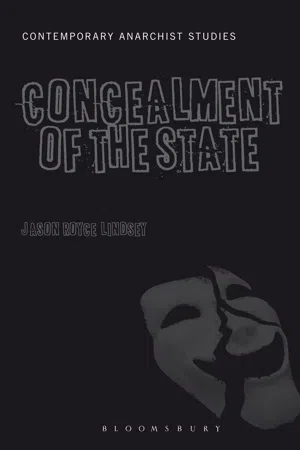
Concealing the state frees us from admitting the unpleasant truth-in today's world we are utterly dependent upon the state's increasingly frantic efforts to control risk. To this end, states have created systems of coercion and surveillance that are difficult to reconcile with our theories of political legitimacy. The dominant ideology of contemporary politics has become the concealment of the state's overwhelming power and role in daily life. We prefer the comfortable illusion that we are autonomous individuals pursuing our plans in a free market. If we hold fast to that idea, then our distance from policy makers and dwindling political influence seems less important. Nonetheless, this book draws upon the anarchist tradition and a wide range of accessible policy examples (ranging from military organization and environmental regulations to scientific investment and education) to reveal the active role of contemporary states behind this ideological screen. Lindsey argues that we need a new politics that focuses on exposing and challenging the contemporary state's hidden agency. Otherwise, how can we democratically control the state when it denies, from the outset, having the ability to meet our demands?
- 192 pages
- English
- ePUB (mobile friendly)
- Available on iOS & Android
eBook - ePub
The Concealment of the State
About this book
Information
1
The concealment of the state
Our contemporary political discourse is dominated by the economic logic of capitalism. This growing monopoly over our political imaginations seems inevitable as the lessons of capitalism are applied to more and more areas of human life. This attempt to expand the use of economic “science” includes popular books that “explore the hidden side of everything,” because “if morality represents how people would like the world to work, then economics shows how it actually does work.”1 The mechanics of the market are so familiar that many of us assume it is “natural,” and we attempt to study it as we would study physics or chemistry. This iron-clad conception of reality also pushes for the privatization of traditional state services in the name of efficiency.
Thanks to this worldview, the inevitable political question that follows all government activity today is whether the market could provide the service or good more effectively. The story of how corporations have provided human beings with new methods for exploiting natural, financial, and human capital has become more familiar to us than the state’s provision of public goods. Indeed, in the United States, the importance of the corporation has been enshrined by the Supreme Court’s decision to expand the historical (and individual) “freedom of speech” protection to corporations engaged in political lobbying.2 As a result of this intellectual trend, the state has been diminished in our political consciousness. Increasingly, the state is characterized as the less nimble, antiquated player in comparison to the dynamic free market.
However, states have not gone away, and, without them, the economic system we know would disappear. Much of the research investment underlying impressive new technologies, medical treatments, and the continued development of the fine arts is dependent upon state financial support. On a deeper level, the legal framework for corporations and the initial guarantee underpinning most transactions and agreements originate with the state’s sovereignty. All of us routinely sign contracts and agreements ranging from consumer purchases to health insurance. In the most developed countries, we confidently agree to pay for services from faceless entities we know only as a brand. Yet, we feel comfortable engaging in such trust because we know that our legal systems are the ultimate arbiter of any potential disputes. In this sense, the state is the “unmoved mover” of our modern social world; the state’s sovereignty is the first guarantee that anchors all others.
In addition, states are arguably the most important consumer in the market. Among the OECD states, government spending accounts on average for just over 19 percent of all economic activity.3 The privatization of services is at its core, resulting in the transfer of taxpayer monies, collected by the state, to corporations and firms. The contracts for private companies to provide services ranging from garbage collection and education to policing and space travel are awarded by states and paid for by the public. What is the difference from public provision? The garbage collectors, space engineers, security guards, and their managers are technically not government employees, though the public is paying them one step removed. Indeed, the state’s sovereignty underlies much of our daily consumer activity. The state regulates our work environment and may even pay our salary. However, the championing of contemporary economic thinking has slowly displaced our awareness of this fact.
Nonetheless, the state continues to play an enormous role in our lives. This has been a fact of human existence for centuries. States are arguably the most important of all human inventions since they mark a turning point in our evolution. Using the state, we harnessed the physical strength, intellectual creativity, and other talents of our populations for unprecedented economic growth and resource extraction. States provided society with the organization necessary to alleviate poverty, create educational institutions, and promote universal literacy. We have used the governing capacity of states to create a global market, as well as redistribute domestic resources. Of course, states have also exploited the scientific potential of societies to develop increasingly lethal military technologies. States also presided over industrial policies that have left us with permanent ecological damage. States brought a powerful new form of organization to human society, and we have used it for both good and ill, as with any other human invention.
Thinking about the state as a human invention can help us to better understand its overwhelming influence on history. However, the nation state differs from other inventions on one important point: it contains and is dependent on an enormous amount of human agency. It consists of institutions that are staffed by human beings who decide and implement the state’s actions. The power these individuals wield through the state raises profoundly difficult moral questions. Why do they have the authority to act on behalf of others? What are the moral limits of the coercive power they exercise? How can human beings keep the state accountable, rather than falling into subservience to it?
These philosophical questions have accompanied the development of the state from its earliest inception. The results of this line of classical inquiry are various theories of political legitimacy. We can map this intellectual journey from the early, supernatural justifications of monarchical rule in Egypt and Mesopotamia, through the Greek’s justifications and rankings of poleis, to contemporary theories about improving democracy. The increasing sophistication of these theories parallels the evolution of state structures. Yet, even in those political systems that strive for transparency and democratic accountability, the question of who is doing what, where, and why looms large. As nation states have taken on additional responsibilities, made use of increasingly sophisticated technology, and grown to govern millions of citizens, this thread of human agency becomes difficult to follow.
In contemporary times, another level of complexity further obscures the human agency of the state. The phenomenon labeled by the catchall term “globalization” has pushed accountability ever more toward the horizon. Today, when we attempt to unravel who owns some of our local businesses, we are confronted with chains of capital that are transnational. When we demand accountability or action from our local state authorities, they often patiently explain to us how the free market works. Citizens worried about a local impact, such as the zoning of a new superstore, the environmental consequences of development, or the threat to local employment due to outsourcing, are told that little can be done. Free trade agreements that allow capital to flow across borders and rules of private investment that trump the commons hinder action on local community concerns.
What is the primary motivation for states to participate in this system of global capitalism? Isn’t it paradoxical for nation states to jealously assert their sovereignty vis-à-vis other states while allowing global capitalism to whittle away their authority? In the case of democratic political systems, it seems illogical for the state to allow democratic control to wither locally for the sake of foreign capital. Why do contemporary nation states participate in an economic system that undermines their sovereignty?
It is in fact the state’s goal of maintaining sovereignty that forces very different political regimes from around the planet to pursue globalization. Power in the international system is intertwined with economic competitiveness. Only states with a highly productive economy can develop the technology that lies behind modern military might. Only states with large economies influence multinational meetings like the G20. Thus, the state’s raison d’être, its sovereignty, compels it to participate in the global economy, even though that participation is at odds with the immediate interests of much of the population.
For example, political groups advocating increased taxes to fund community assistance, education, or health care provisions are warned that this is either impossible or unrealistic since it would undermine the national economy’s competitiveness. How can the state take the risk of investing in such concerns if other states ignore them? Instead, the state must channel its efforts into fostering immediate economic growth or risk falling behind those powers that do. This competition leads the state to demand many sacrifices from its population. The power of the state could be harnessed to provide additional social benefits, but it would be at a cost to economic performance. This stark choice creates a political dilemma for contemporary nation states.
Globalization rewards states that integrate into the international economic regime. However, the citizenry of these states demand a set of conflicting responses. Some economic elites support this vision of autonomous markets. For this interest group, the continued existence of sovereign states is an ongoing interference into the “natural” activity of global markets; the state is too sovereign. From another quarter, much of the citizenry demands policies that run counter to the free-market orthodoxy of globalization. For this interest group, the sovereign state is failing to mitigate the problems created by globalization; the state is not sovereign enough.
States augment their power, and thus their capacities to exercise coercion and guarantee their sovereignty, through economic success. Yet, contemporary economic health is linked with integration into a global capitalist economy that appears to ignore sovereign borders. How can the state maintain its usefulness if its sovereignty is eroded? If states are no longer sovereign, then why should we support them? On the other hand, how can a contemporary state guarantee its sovereignty in the world other than by joining the economic competition of globalization? This paradox explains the contemporary difficulty of legitimizing state power within a context of globalizing capitalism.
The ideological solution for contemporary states is to maintain their sovereign agency while insisting that they have given much of it up to the new rules of global capitalism. Today, the state claims that its creation, the market, has become even more autonomous than in the past and stands as an alternate entity to the state. The state can then retreat behind the screen of the “free” market to answer both camps in contemporary society. For the winners of globalization, the state appears to get out of the way of market innovation and productivity. For the citizenry alarmed at globalization’s outcomes, the state claims to be powerless against the inevitable. Contemporary states put forward this position despite the fact that they provide the regulatory infrastructure the market relies upon and the sovereign guarantee necessary to underpin all other agreements, including transnational free trade agreements. States will also violate all the usual “rules” and intervene into the market when necessary to prevent its collapse.
However, state sovereignty, by its very nature, is a competition with other states. This competition requires participation in the global economy in a race to stay ahead of other states. The importance of this fact, and the bearing it has on the continued existence of the state, trumps popular concerns with globalization’s effects. Thus, there is a common interest in maintaining the useful fiction of an inevitable and autonomous global capitalism. For many economic elites, this belief reinforces their class interests. For political elites, this ideology is important because of the power it confers on the state. For many inside and outside of our ruling elite, this ideology reflects a certainty that seems so obvious it is unquestioned.
Nonetheless, there is an obvious contradiction in this ideology. The state cannot strengthen its sovereignty by participating in a regime that undermines it. Yet, contemporary states that are well integrated into the global economic system seem to be the most powerful of all. This paradox dissolves once we realize that states have turned to the ideology of concealing their agency. This concealment relies in part on the diversion of political demands into the closed ideological system of free-market orthodoxy.
The politics of concealment
Increasingly, politicians and policy makers from across the political spectrum insist that the market is an immovable force that constrains their ability to act. To maintain this facade, contemporary states have bifurcated their functions into two broad areas: the deep and shallow state. The shallow state has been freed from much of the policy formulation and implementation that is truly constrained by the needs of state sovereignty. Instead, this important function now rests with the less visible deep state. By compartmentalizing many responsibilities to the deep state, the shallow state can proclaim the limitations of state action imposed by the market, despite the implausible contradictions of this claim.
Although this ideological turn allows contemporary states to dissolve the immediate tensions of globalization, it is also transforming traditional political dynamics. By bifurcating politics into a deep and shallow state, contemporary states hide their ability to act, but at a cost. Political actors in the shallow state are left to visibly debate policies, which, from the outset, have been closely circumscribed by the actions of the deep state. This shift of responsibility allows politicians in the shallow state to pursue votes with popular, or populist, policies that ignore increasingly hard economic and ecological constraints. To some extent, politicians must engage with their constituents (and with each other) in this circumscribed, populist arena because so many issues of substance have been removed from their sphere of influence.
While the state has traditionally had to maintain secrecy in some areas (e.g. defense, intelligence, or the all-pervasive category of “security”), we now see a shift of even mundane policy decisions to less visible agencies in the deep state. Examples include budget recommendations, environmental regulations, consumer and workplace safety, scientific investment, transportation planning, and educational policies. Thus, elected officials can grandstand on what issues are left in this hollowed out, shallow arena of politics. With substantive (and often unpopular) policy made and implemented in the deep state, we see the remains of politics in the shallows. Here the focus is increasingly on national identity, cultural controversy, consumer frustrations, and symbolic acts of solidarity with constituents. Politicians in the shallow state have come to rely on the quiet competence of the deep state and have little incentive to engage publicly with the difficult policy choices facing society.
This book maps the ideological and functional logic that makes this behavior seem “natural” to the human actors who are, collectively, the state. As I show in the subsequent chapters, political actors within both the deep and shallow state, despite still having sharp disputes on many topics, have come to accept the concealment of the state as a background assumption to contemporary politics. I do not argue that this acceptance is necessarily a conscious one for most political actors and state functionaries. Instead, this behavior can be thought of as agents within the state following an...
Table of contents
- Cover
- Half Title
- Series Page
- Title Page
- Imprint
- Dedication
- Contents
- Acknowledgement
- 1. The concealment of the state
- 2. Deep and shallow state
- 3. Theories of the state
- 4. Engines of oppression
- 5. A postindustrial peasantry?
- 6. Conclusion
- Bibliography
- Index
Trusted by 375,005 students
Access to over 1.5 million titles for a fair monthly price.
Study more efficiently using our study tools.
Frequently asked questions
Yes, you can cancel anytime from the Subscription tab in your account settings on the Perlego website. Your subscription will stay active until the end of your current billing period. Learn how to cancel your subscription
No, books cannot be downloaded as external files, such as PDFs, for use outside of Perlego. However, you can download books within the Perlego app for offline reading on mobile or tablet. Learn how to download books offline
Perlego offers two plans: Essential and Complete
- Essential is ideal for learners and professionals who enjoy exploring a wide range of subjects. Access the Essential Library with 800,000+ trusted titles and best-sellers across business, personal growth, and the humanities. Includes unlimited reading time and Standard Read Aloud voice.
- Complete: Perfect for advanced learners and researchers needing full, unrestricted access. Unlock 1.5M+ books across hundreds of subjects, including academic and specialized titles. The Complete Plan also includes advanced features like Premium Read Aloud and Research Assistant.
We are an online textbook subscription service, where you can get access to an entire online library for less than the price of a single book per month. With over 1.5 million books across 990+ topics, we’ve got you covered! Learn about our mission
Look out for the read-aloud symbol on your next book to see if you can listen to it. The read-aloud tool reads text aloud for you, highlighting the text as it is being read. You can pause it, speed it up and slow it down. Learn more about Read Aloud
Yes! You can use the Perlego app on both iOS and Android devices to read anytime, anywhere — even offline. Perfect for commutes or when you’re on the go.
Please note we cannot support devices running on iOS 13 and Android 7 or earlier. Learn more about using the app
Please note we cannot support devices running on iOS 13 and Android 7 or earlier. Learn more about using the app
Yes, you can access The Concealment of the State by Jason Royce Lindsey in PDF and/or ePUB format, as well as other popular books in Politica e relazioni internazionali & Anarchismo. We have over 1.5 million books available in our catalogue for you to explore.