Released in 1979, AC/DC's Highway To Hell was the infamous last album recorded with singer Bon Scott, who died of alcohol poisoning in London in February of 1980. Officially chalked up to "Death by Misadventure," Scott's demise has forever secured the album's reputation as a partying primer and a bible for lethal behavior, branding the album with the fun chaos of alcoholic excess and its flip side, early death. The best songs on Highway To Hell achieve Sonic Platonism, translating rock & roll's transcendent ideals in stomping, dual-guitar and eighth-note bass riffing, a Paleolithic drum bed, and insanely, recklessly odd but fun vocals.
Joe Bonomo strikes a three-chord essay on the power of adolescence, the durability of rock & roll fandom, and the transformative properties of memory. Why does Highway To Hell matter to anyone beyond non-ironic teenagers? Blending interviews, analysis, and memoir with a fan's perspective, Highway To Hell dramatizes and celebrates a timeless album that one critic said makes "disaster sound like the best fun in the world."
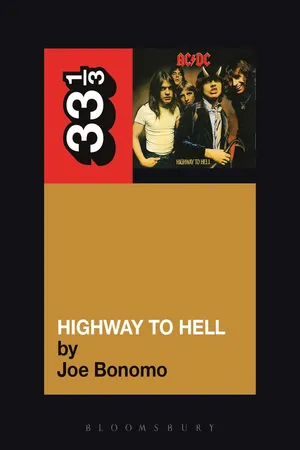
- 144 pages
- English
- ePUB (mobile friendly)
- Available on iOS & Android
eBook - ePub
AC DC's Highway To Hell
About this book
Information

A gray October late-morning. Wheaton, Maryland. On the playground at St. Andrew Apostle School, Billy’s holding forth before a rapt audience of thirteen year olds. I’m one of them.
“Hey guys, my brother and I saw AC/DC,” he tells us. “I met Bon Scott.”
We know that the band will come to town again soon to rock Capital Centre, out in Largo. And we wonder: since Billy’s already shaving once a week and has an older brother who brings him along to rock concerts, will a backstage pass to one of the great party bands come next in the inevitable, lucky scheme of things? In our freshly minted teenage naiveté we can virtually inhale the sweat and the reefer as Billy talks to us. It feels as if we’re in the presence of divine fortune here, on the blacktop next to the dodge ball court and the basketball hoops and the swing sets, just feet away from the rectory where the priests live and write the sermons to which we’ll mentally undress the girls. Will Billy get to hang out in a smoky backstage, feel up the groupies, drink beer with Bon Scott?
As the Seventies came to a close, AC/DC was not yet a sonic institution firing oversized cannons from vast stages into seas of millions. The band’s seams were showing. They’d formed in Sydney, Australia, in late 1973, when twenty-year-old, Scottish-born guitarist Malcolm Young aborted an earlier band and roped in his kid brother Angus on lead guitar to round out a new lineup featuring Colin Burgess on drums, Larry Van Kriedt on bass, and singer Dave Evans. They debuted on New Year’s Eve at the Chequers Club in Sydney. Maneuvering among band defections, they ducked into EMI Studios and recorded their debut single “Can I Sit Next To You, Girl?,” and spent the remainder of the year raising their profile, gigging tirelessly, and enduring various rhythm section lineups with feet firmly planted on a bedrock of Chuck Berry, the Rolling Stones, and loud, electric blues. At older sister Margaret’s cheeky suggestion, Angus donned a schoolboy uniform onstage in April of 1974, and in between tours and one-off shows taking them from divey gay bars and provincial dance halls to the Sydney Opera House (where they opened for Australian legend Stevie Wright), the band signed with Albert Productions, benefiting happily from record distribution through the mammoth institution of EMI. Their first single charted in Perth, in Western Australia. AC/DC were hungry.
In August, a wiry, affable hood tattooed with a risky past caught an AC/DC show in Adelaide in southern Australia, and he dug what he saw. Ronald “Bon” Belford Scott was like the Young brothers, a transplanted Scotsman, but a bit older and a little wilder, and already a veteran singer in several bands (the Valentines, Fraternity). In the midst of a brief stint as a driver, handyman, and general gofer for an old bandmate, Scott was asked to audition to replace Evans, with whom Malcolm and Angus had grown unhappy; he joined in September. In November, after relocating southwest to Melbourne, AC/DC swiftly cut their debut album, High Voltage; their second, T.N.T., was recorded eight months later. Melbourne local Phil Rudd stepped in as drummer, and over the next several years the band committed themselves to a Herculean diet of gigs, drinking, and writing and recording: Dirty Deeds Done Dirt Cheap was released in 1976; Let There Be Rock in 1977. By 1978, with English-born bassist Cliff Williams in the band and the classic lineup intact, they were reaping the benefits of their driven work ethic. Though essentially ignored in America, AC/DC was hugely popular in Australia, where their concerts had grown in size and intensity as their albums went gold. They’d made exploratory inroads throughout Europe and in England, and were boozily, noisily heading west.
When they assembled in London in March of 1979 to commence recording what would be their sixth album, AC/DC’s collective body bore signs of the long road. They’d already jettisoned a producer and a batch of hasty demos. For a band driven by unyielding self-assurance and a clear sense of purpose, they were feeling unusual anxiety. Disco, and soft, AOR pop dominated the radio airwaves, angular New Wave songs threw elbows in the mix, and in America pressure was on from Atlantic Records to produce a radio hit and an album that would move quickly and decisively from the stores. The new AC/DC record had to be big.
So Malcolm and Angus did what they do best: they shut the door, pulled up a couple of chairs, and went simple.
Angus! Angus! Angus! …
I remember hearing a frenzied version of “Whole Lotta Rosie,” borne aloft by this raucous chant, on DC101-FM, in Washington D.C., where I grew up in the suburbs. It must’ve been a personal favorite of the staff because the single had stiffed on the charts, unable even in its substantial wattage to overwhelm Nick Gilder’s “Hot Child In The City” or Boston’s “Don’t Look Back.” The song appeared on If You Want Blood You’ve Got It, a live album recorded largely at the Apollo Theater in Glasgow, Scotland, and that album, too, had performed poorly in the United States, peaking at 113 on Billboard. Powerage, a studio album released in the Spring of 1978, had fared even worse in the U.S., topping out at 133 on the charts, barely touching the shores before the wake imposed by Wings’ London Town, Chuck Mangione’s Feels So Good, and the unflagging Saturday Night Fever soundtrack washed it unceremoniously back to the world of wonder. In England, AC/DC was doing a bit better: Powerage had nearly cracked the Top 25 albums chart, and If You Want Blood made it as high as 13.
But the band wanted to succeed in the U.S., the vast hometown of blues and rock & roll, the mythic source of their noisy, stomping sound. Though their records weren’t doing much to pry open Yankee wallets, AC/DC knew American geography pretty well by 1979, having worked their way through big cities and small burgs following several years of punishing Eastern European and U.K. tours. Supporting Let There Be Rock, they made their first appearance in the U.S. on July 27, 1977, opening for Moxy in Austin, Texas. Over the next two months, they wound their way through the steamy and alien South, hitting Florida and a solid if small base of fans, and up into the expansive Midwest, playing Illinois and Ohio for the first time. Angus remembers nonstop highways in a cramped station wagon, sitting shoulder-to-shoulder and sock-to-sock with his mates, pulling up to venues as the opening band, their gear dwarfed by REO Speedwagon’s or KISS’ mammoth equipment and their outsized, radio-delivered mythologies.
“And here we were — five migrants, little micro-people,” Angus remembers. “It was tough to even get into the show with that little station wagon.”
At WTAC-AM in Flint, Michigan, DJ Peter C. Cavanaugh heard advance presses of AC/DC’s albums sent to him by a friendly A&R man at Atlantic Records. He loved the band’s raw, direct, basic sound — an ethos that much of the Midwest historically found hospitable, particularly grimy Detroit with its Mitch Ryder/Stooges heritage. In December of 1977, as AC/DC were winding their way through the second leg of their initial U.S. tour, Cavanaugh invited them to play the Capitol Theatre in Flint. WTAC had been the first station in the country to play AC/DC, and as a consequence the band sold better in Michigan than in any other region. Thinking shrewdly along the lines of a “best of the old with the best of the new” promotional angle, Cavanaugh contacted members of the locally infamous and recently reunited MC5, who agreed to open up the show.
Cavanaugh met AC/DC at the airport on December 5. “No sooner had they all piled in my car, than someone fired-up something in the back seat,” Cavanaugh recalls. Wrinkling his nose, expecting a heady waft of rock star marijuana, Cavanaugh discovered that pot is not the band’s vice of choice. Weed only slows things down for the fellas: they were smoking harmless cigarettes, voraciously. “These were boys from Australia,” Cavanaugh says. “To them, an American cigarette was something to be shared. I took a hit and passed it back.” Cavanaugh drove the car through the increasingly snow-clogged streets, the bitter weather and the group’s low-light status ensuring a less-than-packed Capitol Theatre. “Who cared? I knew the night would be historic,” Cavanaugh says now. They arrived safely at the theater, and soon after, the MC5 tore through a charged fifty-minute set, vibing on their legacy and the native goodwill. AC/DC watched from the wings with not a little admiration, sensing kinship in the sonic mayhem of Detroit’s sons.
After a break between sets, AC/DC walked onstage and plugged in. The venue was thrown into darkness, and Cliff Williams wrapped the rope tightly with the ominous opening riff of “Live Wire,” the band’s longstanding starter. Cavanaugh remembers: “Four spotlights instantly flooded the stage, all focused on and following a remarkably strange, rapidly moving, seemingly possessed apparition. He wore knickers. He was dressed as a proper English schoolboy with necktie and knapsack. His head bounced as though about to become disengaged. He ran back and forth in circles around the other players, the intensity building and volume rising with every stroke of the guitar. He was barely out of his teens.” Though some in the small crowd had rocked to AC/DC on the radio, no one had seen the band in person yet. And the sight of Angus Young, and of Bon Scott — chest bared, jeans painted on, tattoos glaring, his finger-pointing pseudo-menace both fun and scary — was eye-popping.
After the deafening show, Cavanaugh paid the exhausted band a thousand bucks cash for the night. They thanked him, shrugged their collective shoulder, glanced around for girls: they’d gone to work, that’s all, and it was another triumphant night. “The group was, and is, simply incredible,” Cavanaugh marvels more than three decades later. “Absolutely perfect, tight, hard, fast, furious rock & roll with unmatched, unrestrained, pulsating purity.” He recalls an endearing moment near the end of the long day. “They wanted to try some Arby’s Roast Beef,” Cavanaugh smiles, “so we stopped at the nearest location, still open despite horrible weather. They bought packs of cigarettes by the dozen and emptied-out several brands from a machine. They loved the Arby’s sandwiches, both for food and as projectiles. Since we were the only patrons and had tipped heavily, there was no hassle. I dropped them off at their hotel and extended sincere thanks.”
He adds, “They had enough American cigarettes for weeks to come, no matter what.”
The pairing of the MC5 and AC/DC might have been little more than a regional twining of coincidence and opportunity, but the tandem makes sense. Although Angus and company were always hesitant to sing directly about counter-cultural politics, celebrating hedonism rather than revolution, both AC/DC and the MC5 met at a ground floor: raw-throated singing, humongous guitar riffs, and rowdy noise.
AC/DC was a difficult band to categorize. Over the decades, they’ve consistently bristled at the Heavy Metal tag, Angus in particular assuring anyone who’ll listen that the band is simply rechanneling Chuck Berry circa 1955, only a lot louder. Among the labels they’d come to wear in the late Seventies was Punk. In the heady spring and summer of 1976, AC/DC played London venues Red Cow, the Nashville, and the Marquee several times, rocking out at Ground Zero of the Sex Pistols/Clash U.K. transformation. And they were a good draw, packing massive crowds into the Marquee, the heat so overwhelming that sweat condensed on the ceiling and dripped down on the roiled-up crowd in anointment. Over the coming years, while generally disparaging the violence and abrasive politics of the movement, they’d remind critics that AC/DC was there, right at the start of punk, dodging spitballs and sanctifying minimalism with the best of them. They certainly had the snot, attitude-wise, and literally, in the case of an overexcited Angus whose runny nose onstage often required dry-cleaning bills that the band could ill-afford.
AC/DC made it to New York City in 1977, opening for the Dictators and the Michael Stanley Band on August 24, at the Palladium, the original “Academy of Music,” a converted movie house that provided touring and local bands with a venue-size between a small club and a large arena. Located on East Fourteenth Street in a neighborhood bordering scruffy, downtown mania, the Palladium was an exciting place to play, and a baptism by urban fire for AC/DC. Two days after the show, John Rockwell in The New York Times described the night as “a deliberate attempt to bring punk rock to a major concert hall” before admitting that the bill “wasn’t actually quite a punk night, after all.” AC/DC, he noted, “was the closest thing to the punk norm” even as they exhibited “showbiz pretension” — i.e. “Mr. Young” prancing about the stage like a manic, drooling child. Lamented Rockwell: “the band is tight but the singer is undistinguished and the songs rarely ride above the puerile-provocative.” One man’s infantilism is another’s statement-of-purpose. AC/DC would commemorate this dynamic for their entire career.
Andy Shernoff, founder of the Dictators, remembers the show and the Aussies well. “They were great, very friendly,” Shernoff says. “They were not superstars yet, they were easy to hang out with, no pretension, no attitude.” He adds, laughing, “Angus is a midget! Bon Scott was small, too. It’s amazing. How can short guys make a sound like that? It’s almost technically impossible.” Angus is five-foot three, his band members only a couple inches taller; watching from the wings, aware that his own group wasn’t delivering onstage as they could, or should, Shernoff was knocked out. “They had killer live songs, better than on the studio albums. People loved them. They were fantastic, no bullshit.” Shernoff watched Angus fearlessly head out into the sold-out crowd of 3,400, a tiny, guitar-shredding kid riding the shoulders of a burly roadie, possessed and obviously getting off on the air-punching excitement.
Following the show, AC/DC decided on their version of an after-hours party: they toweled off, climbed into the tour van, and headed downtown. Their destination was a mile away, but felt mythically distanced from the cultural boundary of Fourteenth Street. In the sticky and steamy summer of 1977, New York City was a simmering stew of social unease. David Berkowitz — aka “Son of Sam” — had been arrested two weeks before AC/DC arrived in Manhattan, the killer’s year-long span of murders mercifully ended. The city was reckless, loud, anxious, and brimming with a downtown-bred music revolution, and on a dilapidated avenue a derelict bar became the epicenter of no-frills, streetwise rock & roll. CBGB had opened to little fanfare several years earlier, but by the time AC/DC brashly pulled up to the tattered awning in August, the club was national news. Punk Rock had a name, and fervent disciples. John Holmstrom and Legs McNeil co-founded PUNK magazine in 1975; the magazine’s cartoons, maverick writing, and sensibility was shaped during many late hours on the Lower East Side, and became in large part the movement’s standard bearer. Fresh from the co-bill with the Dictators, a major-label band associated with the punk movement, and curious about CBGB and its risky vibe, AC/DC were eager to play for as many folks as possible, whether they were raising fists in arenas or threatening fists in dive bars.
An hour after the Palladium show, the guys surprised CBGB management by showing up uninvited. (The lead band on the bill that evening was Marbles.) AC/DC plugged in and hastily played a handful of songs, including “Live Wire” and “She’s Got Balls,” each clocking in at over seven minutes with long guitar solos pushing the limits of the edgy punk ethos. Bon Scott was wearing his standard stage attire (he’d probably just wrung it out after the Palladium show): crotch-choking jeans and a sleeveless denim vest, soon removed to give his chest hair and medallion more exposure. His hair was shaggy and shoulder-length. He was covered in ink. And the band was loud.
“AC/DC were marketed as a punk band around that time,” Holmstrom remembers. “CBS bought ads for them in PUNK, we interviewed them for PUNK.” Holmstrom’s riotous dialogue with Angus and Bon Scott ranged in subjects from herpes, the band’s “favorite disease,” to taste in literature. Bon’s most recently devoured book was a collection of eighteenth-century erotica, what Angus happily called “about the filthiest book I ever read.” Characteristically, AC/DC shrugged their collective shoulder at the punk tag. “We just call ourselves a rock band,” Angus said at the time. “We don’t like being classified as a ‘punk rock’ band. Not everyone can be punk rock. It’s great that there are new bands, fresh faces and all that, but there are good bands and bad bands within that punk rock.” He considered for a moment, adding, “Actually the punk thing is pretty cool in America. It’s not like England where it’s a very political thing — a dole queue type thing. There’s too much money over here to classify all the punk bands as dole queues and dropouts. It’s just a young thing — a new breed type thing.”
What Holmstrom remembers of AC/DC is the band’s bone-simple, timeless approach. “They certainly weren’t your traditional heavy metal band,” he notes. “The heavy metal of the mid-70s was a ponderous, bombastic, slow music. They were a high-energy rock & roll band and, before the Sex Pistols changed the image of punk rock from faster and louder to a more political and anthemic music, AC/DC could be classified as punk.” Holmstrom continues, “Then again, so were the Bay City Rollers, Alice Cooper, the Stooges, the New York Dolls, Eddie and the Hot Rods, and hundreds more bands. AC/DC were a great rock & roll band, and that’s basically what punk rock was before things went nuts in 1977.” A few months after the Palladium show, New York Rocker writer Howie Klein put it this way: “AC/DC doesn’t use safety pins, never went to art school, and they sure don’t limit themselves to 2 or 3 chords, but if new wave is a reaffirmation of rock & roll’s traditional values, this band is an important part of it.”
The detonation at CBGB, witnessed by a small crowd on a muggy Wednesday night, has been widely bootlegged, archivists digging the idea of AC/DC playing an infamous club during an epochal year. (My favorite moment: some unknown fan, between beers, idly curious about this little band, is caught on-mike asking, “Isn’t Angus the name of the monster in Lost in Space?”) In the crowd at CBGB that night was Robert Francos, who at the time was editing and publishing the New York rock & roll zine Ffanzeen as he explored the street-rock scene. Francos remembers the band’s impromptu appearance: “As Marbles’ set was ending, suddenly there was a commotion at the back of the club and I figured, Oh, I bet some drunk was getting tossed. Then I noticed part of the crowd moving toward the stage, surrounding a cluster of people. That’s when they announced the next band to play over the speaker, and it was not one who was scheduled. One of the group of people had long-hair, muscles and a grainy face; the one behind him was diminutive, wearing short pants that looked like part of a school uniform, and was carrying a guitar case.
“At one point, Angus switched guitars that either had a remote or a really long cord (I can’t remember which). He then made his way through the crowd, while playing wild solo licks, and went outside. So, there was little Angus, while still playing, talking to the transient gents from the Palace Hotel milling outside CBGB.”
America, welcome to AC/DC.
Elvis Presley died one week and a day before AC/DC arrived on the Bowery. The darkness left behind was liberating to the scruffy, avant-garde artists toiling within it, gloomy for those celebrating Presley as the originator. Longtime music observer and critic Phil Sutcliffe remembers the transitional pains that England was suffering during the punk movement of ‘76, which had coincided with AC/DC’s arrival. Sutcliffe witnessed a telling scene at Sounds magazine after his editors there had thought to place a photo of the Moody Blues on the cover. “We had the paper in the office, and we looked at the cover, and the editor said, ‘Fuckin’ hell, they’re a bunch of hairdressers, aren’t they!’ And that was the end of it, as far as we were concerned. ‘Sorry, wrong era.’ But some bands still passed the cool test that goes on with any era. And AC/DC did.”
As Sutcliffe sees it, many of the U.K. punks were too young to discredit and demolish the sources fueling AC/DC. “They didn’t look back that far,” he observes. “They didn’t have Chuck Berry or Little...
Table of contents
- Cover Page
- Title Page
- Contents
- Dedication
- Acknowledgments
- Photo credits
- First chord
- Second chord
- Third chord
- Sources
- Copyright Page
Trusted by 375,005 students
Access to over 1.5 million titles for a fair monthly price.
Study more efficiently using our study tools.
Frequently asked questions
Yes, you can cancel anytime from the Subscription tab in your account settings on the Perlego website. Your subscription will stay active until the end of your current billing period. Learn how to cancel your subscription
No, books cannot be downloaded as external files, such as PDFs, for use outside of Perlego. However, you can download books within the Perlego app for offline reading on mobile or tablet. Learn how to download books offline
Perlego offers two plans: Essential and Complete
- Essential is ideal for learners and professionals who enjoy exploring a wide range of subjects. Access the Essential Library with 800,000+ trusted titles and best-sellers across business, personal growth, and the humanities. Includes unlimited reading time and Standard Read Aloud voice.
- Complete: Perfect for advanced learners and researchers needing full, unrestricted access. Unlock 1.5M+ books across hundreds of subjects, including academic and specialized titles. The Complete Plan also includes advanced features like Premium Read Aloud and Research Assistant.
We are an online textbook subscription service, where you can get access to an entire online library for less than the price of a single book per month. With over 1.5 million books across 990+ topics, we’ve got you covered! Learn about our mission
Look out for the read-aloud symbol on your next book to see if you can listen to it. The read-aloud tool reads text aloud for you, highlighting the text as it is being read. You can pause it, speed it up and slow it down. Learn more about Read Aloud
Yes! You can use the Perlego app on both iOS and Android devices to read anytime, anywhere — even offline. Perfect for commutes or when you’re on the go.
Please note we cannot support devices running on iOS 13 and Android 7 or earlier. Learn more about using the app
Please note we cannot support devices running on iOS 13 and Android 7 or earlier. Learn more about using the app
Yes, you can access AC DC's Highway To Hell by Joe Bonomo in PDF and/or ePUB format, as well as other popular books in Media & Performing Arts & Music. We have over 1.5 million books available in our catalogue for you to explore.