In this, his final book, noted philosopher Ilham Dilman offers sharp critiques of his major contemporaries.
Ilham Dilman (1930-2003) was Professor Emeritus and Honorary Fellow, Department of Philosophy, University of Wales Swansea. He was perhaps most well known for his contributions to moral philosophy and psychology, and in particular on the works of Wittgenstein and Freud. His publications include Wittgenstein's Copernican Revolution (Palgrave, 2002), Free Will: A Historical and Philosophical Introduction (Routledge, 1999), Existential Critiques of Cartesianism (Macmillan, 1993), and Freud and Human Nature (Blackwell, 1983).
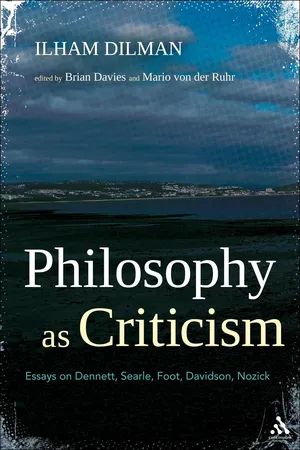
eBook - ePub
Philosophy as Criticism
Essays on Dennett, Searle, Foot, Davidson, Nozick
- 176 pages
- English
- ePUB (mobile friendly)
- Available on iOS & Android
eBook - ePub
Philosophy as Criticism
Essays on Dennett, Searle, Foot, Davidson, Nozick
About this book
Information
1
Dennett’s Explanation of Consciousness
1. Dennett’s Book Consciousness Explained
In the introductory chapter of the book, Section 4, Dennett says that he will ‘attempt to explain consciousness’: ‘I will explain the various phenomena that compose what we call consciousness, showing how they are all physical effects of the brain’s activities …’1 By ‘phenomena of consciousness’ he means such things as ‘seeing things’ and ‘feeling pain’, including ‘having hallucinations’. Thus, very briefly, when light from an object stimulates our optic nerve, the impulse along the nerve produces some electric activity in the brain, and it is this activity that makes us see – a causal account. If these particular nerves entering the brain could be stimulated artificially, we would see the same thing in the absence of the object seen. This would constitute an hallucination. Both would be the same phenomena of consciousness.
The suggestion is that brain activity produces or causes vision or pain in some ways like electricity attached to a bulb produces light – light rays or waves to be emitted – except for the fact that light waves are physical phenomena, like the flow of electrons that causes these. By contrast, the phenomena of consciousness are not physical phenomena like the electrical activity in the brain which Dennett claims are causing them. But, writes Dennett, ‘the principle of the conservation of energy’ is violated by such dualism. ‘This confrontation between quite standard physics and dualism has been endlessly discussed since Descartes’ own day, and is widely regarded as the inescapable and fatal flaw of dualism.’2
So, what does Dennett do? He reduces consciousness to brain activity – materialism. He admits that ‘it is very hard to imagine how your mind could be your brain’ but, he adds, ‘not impossible’.3 ‘In order to imagine this, you really have to know a lot of what science has discovered about how brains work.’ 4 Dennett goes on,
but much more important, you have to learn new ways of thinking. Adding facts helps you imagine new possibilities, but the discoveries of neuroscience are not enough – even neuroscientists are often baffled by consciousness. In order to stretch your imagination, I will provide, along with the relevant scientific facts, a series of stories, analogies, thought experiments, and other devices designed to give you new perspectives, break old habits of thought, and help you organize the facts into a single, coherent vision strikingly different from the traditional view of consciousness we tend to trust.5
Dennett points out, quite rightly, that again and again the progress of science involves conceptual innovations which wean us from what we have come to regard as obvious. However, if I may speak for myself, there is a difference between accepting a conceptual innovation and coming out of a conceptual confusion. Dennett rightly finds fault with Cartesian dualism and wishes to turn his back on it. However, he wrongly identifies it with what has come to be called ‘folk psychology’, and so finds fault with the everyday concepts in which we think of human life and behaviour, and wishes to replace them. In his commitment to find a scientific explanation of consciousness he shows little understanding of ‘folk psychology’, treating its concepts in a very cavalier fashion. What he needs is a clarification of the concept of consciousness, instead of an explanation of it along scientific lines.
Paradoxically, he has more in common with Cartesian metaphysics than folk psychology, which is in fact innocent of it. Thus, for instance, Descartes argued that he was a res cogitans – a thinking thing, a mind, and that he had a body which he could exist without. Similarly, on the materialistic side, Dennett finds nothing wrong with the idea that he is a brain and that, as such, he could exist in a vat without the rest of his body, while retaining his identity in the course of hallucinatory experiences, this body of his being a phantom body on the model of a phantom limb.
Let me put it this way. There is, of course, a science of neurophysiology, but you cannot get to an understanding of either consciousness or what makes a human being a human being from such a science, just as you cannot reach such an understanding if you start from a Cartesian mind identified as being separate from a flesh-and-blood human being. As Sartre puts it: ‘Once the body has been separated from consciousness, no links will be able to rejoin it with consciousness’.6 For such a separation turns it into a thing – and how can a thing have consciousness?7 Once we separate the two, we are left with the idea of a person’s body as a thing. It is not surprising that Dennett often refers to a human being as an ‘entity’ or a ‘living body’ – in other words, the body of physiology in function. That is not the human body which Wittgenstein referred to as ‘the best picture of the human soul’.8
As for what Dennett refers to as ‘the various phenomena that compose what we call consciousness’ – a great motley which he lumps together, calling them ‘states’ and ‘processes’ – they are not something ‘internal’ or ‘inner’. Consciousness is originally something external and as such ‘visible to other people’. For its only expressions in the first place are the person’s responses or reactions to what goes on around him. Only when the possibility of reflection brings these acts under his voluntary control does his consciousness – for instance his anger at having been insulted – acquire the possibility of existing apart from these acts, so that it can become something internal; that is, something he can keep to himself if he so chooses. I shall return to this in the last section of this chapter.
Dennett starts by emphasizing, again and again, the mystery of consciousness. This is the big philosophical puzzle or problem central to his book that he wishes to resolve.
What could be more obvious or certain to each of us than that he or she is a conscious subject or experience, an enjoyer of perceptions or sensations, a sufferer of pain, an entertainer of ideas, and a conscious deliberator? That seems undeniable, but what in the world can consciousness itself be? How can living physical bodies in the physical world produce such phenomena? That is the mystery.9
He continues:
My conscious thinking, and especially the enjoyment I felt in the combination of sunny light, sunny Vivaldi violins, rippling branches – plus the pleasure I took in just thinking about it all – how could all that be just something physical in my brain? How could any combination of electrochemical happenings in my brain somehow add up to the delightful way hundreds of twigs genuflected in time with the music? …10
Dennett is right, of course: ‘How can living physical bodies [that is anatomical, physiological bodies] produce such phenomena?’ They cannot. He considers ‘the attractions of mind stuff’: ‘So we have discovered two sorts of things one might want to make out of mind stuff: the purple cow [the mental image] that isn’t in the brain, and the thing that does the thinking. But there are still special powers we might want to attribute to mind stuff’.11 He summarizes the ‘four reasons for believing in mind stuff’:
The conscious mind, it seems, cannot just be the brain … because nothing in the brain could
be the medium in which the purple cow is rendered;
be the thinking thing – the I;
appreciate wine, … love someone …;
act with moral responsibility.12
However, Dennett in the end goes along with science and its stuff, matter, its organization into structures, the functions they have within these organizations, and what these functions are capable of producing. He moves slowly, he doesn’t jump, he tries to enlist the support of scientific work in neurophysiology:
According to the various ideologies grouped under the label of functionalism, if you reproduced the entire ‘functional structure’ of the human wine taster’s cognitive system …, you would thereby reproduce all the mental properties as well, including the enjoyment … If all the control functions of a human wine taster’s brain can be reproduced in silicon chips, the enjoyment will ipso facto be reproduced as well.13
Dennett doesn’t hurry: on the one hand, he doesn’t make light of the difficulty he has been stressing all along, and on the other hand, he wishes to remain true to the scientific spirit of caution and thorough investigation and evidence:
Some brand of functionalism may triumph in the end (in fact this book will defend a version of functionalism), but it seems outrageous at first blush. It seems that no mere machine, no matter how accurately it mimicked the brain processes of the human wine taster, would be capable of appreciating a wine, or a Beethoven sonata …14
Dennett thus finds himself between the devil and the deep blue sea.
The idea of mind as distinct in this way from the brain, composed not of ordinary matter but of some other, special kind of stuff, is dualism, and it is deservedly in disrepute today … The prevailing wisdom … is materialism: there is only one sort of stuff, namely matter – the physical stuff of physics, chemistry, and physiology – and the mind is ...
Table of contents
- Cover
- Title
- Copyright Page
- Contents
- Editorial Preface
- Introduction
- 1: Dennett's Explanation of Consciousness
- 2: John Searle's Defence of Realism
- 3: A Critical Examination of Philippa Foot's Recent Account of Moral Judgement
- 4: Donald Davidson I: Human Agency, Action and Intention
- 5: Donald Davidson II: A Philosophy of Psychology, the Mental and the Physical
- 6: Robert Nozick's Philosophical Meditations
- Closing Remarks
- Bibliography
Trusted by 375,005 students
Access to over 1.5 million titles for a fair monthly price.
Study more efficiently using our study tools.
Frequently asked questions
Yes, you can cancel anytime from the Subscription tab in your account settings on the Perlego website. Your subscription will stay active until the end of your current billing period. Learn how to cancel your subscription
No, books cannot be downloaded as external files, such as PDFs, for use outside of Perlego. However, you can download books within the Perlego app for offline reading on mobile or tablet. Learn how to download books offline
Perlego offers two plans: Essential and Complete
- Essential is ideal for learners and professionals who enjoy exploring a wide range of subjects. Access the Essential Library with 800,000+ trusted titles and best-sellers across business, personal growth, and the humanities. Includes unlimited reading time and Standard Read Aloud voice.
- Complete: Perfect for advanced learners and researchers needing full, unrestricted access. Unlock 1.5M+ books across hundreds of subjects, including academic and specialized titles. The Complete Plan also includes advanced features like Premium Read Aloud and Research Assistant.
We are an online textbook subscription service, where you can get access to an entire online library for less than the price of a single book per month. With over 1.5 million books across 990+ topics, we’ve got you covered! Learn about our mission
Look out for the read-aloud symbol on your next book to see if you can listen to it. The read-aloud tool reads text aloud for you, highlighting the text as it is being read. You can pause it, speed it up and slow it down. Learn more about Read Aloud
Yes! You can use the Perlego app on both iOS and Android devices to read anytime, anywhere — even offline. Perfect for commutes or when you’re on the go.
Please note we cannot support devices running on iOS 13 and Android 7 or earlier. Learn more about using the app
Please note we cannot support devices running on iOS 13 and Android 7 or earlier. Learn more about using the app
Yes, you can access Philosophy as Criticism by Ilham Dilman, Brian Davies,Mario von der Ruhr, Brian Davies, Mario von der Ruhr in PDF and/or ePUB format, as well as other popular books in Philosophy & Ethics & Moral Philosophy. We have over 1.5 million books available in our catalogue for you to explore.