![]()
Chapter 1
Bay Limbeaux, Florida
What’s so foreign about the past? I speak the language. I know the music. Its rituals are my own, and I am never confused by the street signs. When it leads me astray and steals my few remaining precious possessions, I understand that betrayal. I forgive the past. It’s the now that is hostile and alien, and never more so than a morning like this. When I hung up the phone just now, I felt myself thrust out of time, a stowaway in my own life, a fraud behind my own smile, a child hidden in my own darkness.
Here I am already lost and confused and wracked with self-doubt, your faithless guide through these pages.
I should apologize for starting like this. You don’t care about my fragility or the symbolism I see all about me. Why should you? You’re not here for that story. You want the story of the album that changed my life and the story of the man with the life that ought to be mine. I’m talking about Richard Thompson, and I’m talking about Shoot Out the Lights. This is that story, not my own. Just to be clear.
It’s important that you understand I never intended to guide you through this album in such a state. Before the phone call this morning, I had reached equilibrium. I had made peace with my lost dreams. I rarely wake up hating myself and burning with jealousy over a man I don’t even know. Then the phone call, and a quarter-century of peace slipped away. I tremble at the merest mention of her.
No, that’s quite enough of me. On to the story now. Let’s open with Richard Thompson, the greatest guitarist of his generation, a songwriter of unique ability to balance the encroaching darkness with moments of tender truth and astonishing beauty, a good man, a man of strong morals and conviction, and yet in our story, he has gone astray on his life’s journey. He had set out with his eyes steady on his target, his feet sure upon his narrow path. But where we open, he has found himself in a time and place that are strange and foreign, his goals obscured by darkness overhead, as if he’d wandered into a forest without noticing how or why, and every step carried him deeper into error.
This was 1981. Richard had been married for nearly a decade to Linda, who sang his songs with empathy and clarity, and who, moreover, put up with his quest for truth and self-knowledge, and bore his children, and loved him throughout. And yet, she was no longer the love of his life. Richard’s career was older than his marriage. But the previous three albums he had made were muddled. Two had sold poorly, leading to his record label dropping him. His last one had never been released. He was thirty-two and had no record contract. His career appeared to be in a long slide toward oblivion.
The choices Thompson faced were nothing short of Hell. So he cut Shoot Out the Lights, an album about his own little Inferno.
His previous album-the unreleased one-was a version of Shoot Out the Lights, but it lacked the burn and scar of the real one. The earlier version barely smoldered. It was an act of desperation. Thompson had turned over control of the album to the man bankrolling it, flash-in-the-pan popster Gerry Rafferty. Rafferty had been half of Stealers Wheel, the “Stuck in the Middle with You” guys, but by the end of the 70s, he produced a couple of wildly popular solo albums, City to City and Night Owl. You listen to those solo albums now, and they sound like a leisure suit skidding into a cocaine-fueled car wreck, but back then, they sounded like folding money.
So, anyway, Richard had played on Night Owl, and Rafferty had learned that Richard and Linda had lost their label contract. Rafferty proposed that the Thompsons make an album with him at his expense. His plan was to shop it around to labels afterward. Rafferty and his recording partner Hugh Murphy, however, loved making glossy productions with layer upon layer of instrumentation. They weren’t interested in input from Richard or any of the musicians involved, and ended up forcing everyone to record take after take in their quest for perfect sound. The result was a slick mess. When Rafferty failed to find a home for their album, it must have felt like a coffin nail.
That brings us back to the real Shoot Out the Lights album—the later one, recorded with the legendary Joe Boyd. When you listen to it, you hear and feel an outlook that is, in turns, ominous, bewildered, lost, angry, and afraid. It is a walk through Hell, not as metaphor or metaphysic, but an actual knowable Hell of this world: the Hell of someone beloved becoming distant, the Hell of the center failing to hold. Shoot Out the Lights drives forward as if predators stalk its every step.
Joe Boyd achieved this sense of dread and drive by letting Richard record the album nearly live with minimal overdubs. They were trying to save money to finance a short club tour. Unfortunately, as cheap as Shoot Out the Lights was intended to be, Linda was having trouble with her singing, and recording her turned out to be relatively costly. She was in the throes of a difficult pregnancy, her third child with Richard, and she was suffering from shortness of breath compounded by the onset of hysterical dysphonia, the psychological inability to sing. Her dysphonia would later slice a seventeen-year gap into her career, neat as a razor. On Shoot Out the Lights, Richard ended up singing some of the songs that he had intended for her. On the songs she did sing, her vocal lines had to be rerecorded several times, and sometimes edited together line by line from different takes.
Different circumstances marked the two versions of the album as well. During the recording of the earlier one, the Thompsons were undergoing a bad time in their lives. During the later one, the Thompsons were at the peak of unprecedented tumult in their marriage and careers. Prior to the first one, they were trying to get their careers back on track after a five-year slide, with two years spent in refuge from the world on a Sufi commune and three years of trying to restart their careers with albums that were both commercial and faithful to their love of the stories and music of Islam. When they created the second one, the slide had stretched from five years to seven. Nothing had changed, except that their most naked stab at commercialism (I’m referring to the first version of the album here, for those of you following along at home) had failed to find a single record company willing to support it.
That had to hurt. Their previous two albums, First Light and Sunnyvista, had barely made a dent in the market. When they made the first version of Shoot Out the Lights with Gerry Rafferty (from here on out, we’ll call it Rafferty’s Folly, which is the shorter name of the two bootlegs on which it appears), it was reasonable for them to assume that they needed to produce something commercially viable or accept that their slide was carrying them into obscurity. When no one was interested in Rafferty’s Folly, 1981 became the perfect staging ground for their little Inferno.
Then their old friend Joe Boyd gave them the chance to rerecord Shoot Out the Lights for his fledgling record company, Hannibal. Since they weren’t stark raving insane or ready to go gentle in that good night or however you want to phrase it, they jumped on it. Rafferty’s Folly had been desperate, but this one was raw. Where Rafferty’s Folly was ornate, this one was bare. Where Rafferty’s Folly was an attempt to salvage something, this one tore everything into strips and started over.
And on top of their careers’ last gasp, their union was rotten. They hadn’t broken up yet, but Richard had already met the woman who would later become his second wife, and Shoot Out the Lights—at least, the first side of Shoot Out the Lights—was a sober examination of why relationships fail. It’s true that three of the four songs on the first side were written more than a year before Richard met Nancy, but the versions they recorded with Joe Boyd burn with a heartfelt intensity lacking in the prior tracks. The songs were no longer character sketches. Richard and Linda lived in that place, and that place was Hell.
This may not seem controversial, but it is among Thompson’s fans. Many casual listeners, upon hearing the album and learning of its proximity to the Thompsons’ divorce, have believed Shoot Out the Lights to be a straightforward example of confessional songwriting. But there’s a contingent of Thompson’s fans who maintain that the connection is spurious. They argue that the timeline doesn’t work, that the songs, at least most of them, were written and even recorded (on Rafferty’s Folly) long before Richard left Linda. Richard himself says that the songs on Shoot Out the Lights are fictions, wholly separate from the reality of the Thompsons’ situation.
But is it possible that two artists so near to a falling-out could create a document of pain that is based on something other than their own?
I’ll bite: This timeline argument is unconvincing. If I write a series of short stories about people who are robbing banks, describing in detail how the robbery would take place, and then, a year or two later, when (ok, if) those short stories are being published, I just happen to find myself pulling a bank heist, I think most people would agree that the short stories had something to do with my mental state. Most songwriters don’t write about bank robbery, though, but they do often write about relationships. But let’s say that even if, by his word, Richard did not intend to leave Linda when he wrote the songs on Shoot Out the Lights, he certainly called up an emotion that he couldn’t put down.
Some Thompson fans have pointed out that the material is not that different from the darkness he’d explored in prior songs. This is simply untrue. The songs on Shoot Out the Lights conceive and explore a very specific kind of darkness. They take place right at the event horizon of the end of the relationship, much closer to the why and how of a broken bond than Thompson had dared to approach before. What prior Thompson songs deal with broken relationships quite so closely? There’s a reason why playing with fire is a bad idea, unless you subconsciously know that you need to burn down the house.
Of course, no right-minded person can blame Thompson for scouring his emotions for material. This is the man who, when only twenty-four, wrote the best song ever written about possession by one’s muse, “The Calvary Cross.” Over three chords (F Am G, guitar heroes!), Thompson sang (in the words of his pale-faced lady with one green eye),
Now you can make believe on your tin whistle
And you can be my broom-boy.
Scrub me ’til I shine in the dark
I’ll be your light ’til doomsday.
It’s a black cat cross your path
And why don’t you follow?
My claw’s in you and my light’s in you;
This is your first day of sorrow.
That’s what owns his talent. That’s what inspires him. Claws and lights until doomsday.
We all experience music in ways confounding and transcendent, sometimes simultaneously. When I approach music, my first impressions are all surface. I imagine the song as a locked box. The outside of the box is well within my grasp: the beat, the melody, a few snatches of words. I tap my foot, hum a bit, sing the words I know, and that’s all the understanding I require of the song, presuming I like it.
My favorite songs are cryptic, though. The outside of the box is covered with lovely and distracting designs, but it is locked. Anyone could settle for the outside, but if I love the song, I look for a key. And that’s what this book is about: my keys to the songs on Shoot Out the Lights. It’s alright if your key is different. We’re driving in my car right now.
As we go forward, we’ll talk about each song: what makes it unique, how it differs from the version from the Rafferty sessions, the performance, the stark beauty. We’ll talk about the Thompsons, how their story together led to Shoot Out the Lights, how in 1981 and 1982 the dam broke. I have an enormous amount of respect for each of them, so don’t expect any Rumours-like acrimony and finger-pointing. This is a 33 1/3 book, not an embittered exposé.
Well, it’s an embittered exposé, but not about the Thompsons. No, it’s my own. As I lead you through the hellish truths of Shoot Out the Lights, I cannot resist mentioning the parallels to my own hellish truths. See, another thing happened in 1982: my wife left me.
You may be asking why I am back in this story. I’m your guide. Trust me. You need to hear this. I need to share how to open this box and drive this car and torture these analogies. You need to understand how I am like Richard Thompson to appreciate my unique insight into Shoot Out the Lights.
Let’s go back to 1982. It wasn’t long after Bonny had left me. I was at my friend Jason’s place, and we were talking about our exes, and we were messed up on something. He said that I had to hear this album. Better than Blood on the Tracks, he said. Those were some heady words, so I was prepared to be underwhelmed. I jabbered through the first song, paying half or no attention. Then the second song started, and my guts turned to ice. Frozen tears chopped at the corners of my eyes by the third refrain. I knew this music like I knew the sound of my own skull. The pain that was so naked and so open, this was pain I recognized. I fed that pain every night with whatever drugs and booze I could get my hands on.
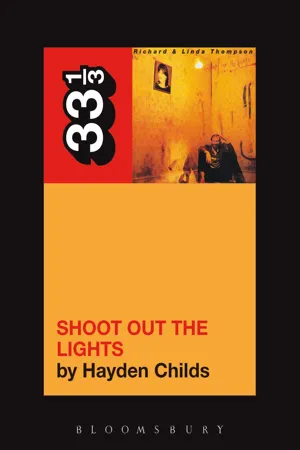
I was reeling, but I pulled myself up and walked over to the turntable. The back of the album was up, and the picture on that side was blurry—even blurrier than reality, the way I remember it. I turned the sleeve over, and there’s this evil picture, all red and yellow and torn. A woman’s picture hung on the wall fixed on me with a merciless gaze. And a man sat there. I looked at Richard Thompson and realized that his face was my own.
It was a freak occurrence. It was miraculous. We were like carbon copies, perhaps a bit imperfect to the expert eye, but close enough to fool the layman.
The next day I went to the library to find out everything I could about my doppelganger. Our lives had always stretched across parallel lines. I was born on the same day as Richard, the 3rd of April, 1949. My band Sgt. Greenleaf (anyone from LA remember us?) put out our first album in 1968. His band Fairport Convention put out their first album the same year. In 1971, I quit Sgt. Greenleaf. Richard left Fairport the same year. My first solo album, Two-Lip Lock, came out the next year. He released Henry the Human Fly on the same day. Some joker in Rolling Stone wrote that Henry the Humany Fly was the worst-selling album in Warner Bros. history. I can assure you it vastly outsold Two-Lip Lock. My mother didn’t even buy one.
So then I married Bonny in 1972, shortly after the album came out. That same year he married Linda. Then the 70s came on strong. Bonny and I put out a few little obscure albums over the next three years. And so did the Thompsons! We quit in the mid-70s to explore our newfound spiritual beliefs. And so did the Thompsons! And last, but definitely nowhere close to least, our marriage and our partnership fell apart on the verge of greater success in 1982.
Of course, he went on to cult stardom. I never released another album. He lives in Los Angeles with his wife and kid, and he tours frequently. I live alone on a houseboat in Bay Limbeaux, Florida, and I haven’t left town in nearly five years. I teach World Literature to bored students at Sarasota Community College who can barely be bothered to slough through the sublime John Ciardi translation of The Divine Comedy. I tend to drink too much and only rarely drag my sorry ass to meetings. I know just enough about quantum physics and Plato to figure out why I could never get my life back on track.
It starts with the undeniable truth that Nature is lazy. You see it in how people are. There are not that many types of people, really, just variations on a few types. Smart guys like Plato and Descartes and Kant looked around them and saw shadows of an untouchable perfect reality. And because they could see these patterns repeated ad infinitum, they figured that all of us copies must be copies of something, right?
Well, I figured out how to tell the more imperfect copies from the more perfect ones. All these imperfect copies are full of potential. All the potential energy in the world, and it passes between us copies, back and forth. Sometimes it has the easy give-and-take flow of the tides, but sometimes it’s just chunks of potential energy claimed by one copy and denied to all others.
What I know about quantum physics is this: Sometimes matter is made of waves and sometimes matter is made of particles. Scientists know this, but they also know that when they measure it by looking for waves or particles, they find one or the other but never both. Richard Thompson and I, we were sharing a lot of potential energy. When I found out about him in 1982, I screwed up. I collapsed the waveform. Our parallel lines diverged. He kept all that potential, and I am forever a shadow.
Thanks to that phone call, my plans for this week have changed. I was going to hole up in my office over at the college and bang this story out. There’s a major tropical system bearing down on the East Coast, and I live on a boat. Last night’s storm was bad enough to make me feel like a bruised ghost. My office seemed like a safe place to hide from the roiling waves and connect to the dark heart of Shoot Out the Lights. But that’s no longer an option. Tomorrow I have a lot of ground to cover, so instead of moving into my office, I’m going to drag myself to a meeting tonight. I will stand before them, as I’ve done many times before, and I will once again tell them my story.
My name is Virgil Schlage. I grew up in Tennessee and have lived in New York, Los Angeles, Seattle, Athens (Georgia), Aust...