"To explain more is to understand better". This is the mantra by which French philosopher Paul Ricoeur lived and worked, establishing himself as one of the twentieth century's most lucid and broad-ranging critical thinkers. A prisoner of war at 27, Ricoeur was also Dean of Paris X Nanterre during the student disturbances of 1968. In later years he became an outspoken champion of social justice. In work as in life, Ricoeur was committed to the challenges of conflict and the prospect of authentic resolution. Deeply indebted to phenomenology and the hermeneutical tradition of Heidegger and Gadamer, Ricoeur was also an advocate of structural linguistics, of psychoanalysis, and a rare conversant with the Anglo-American analytic tradition.
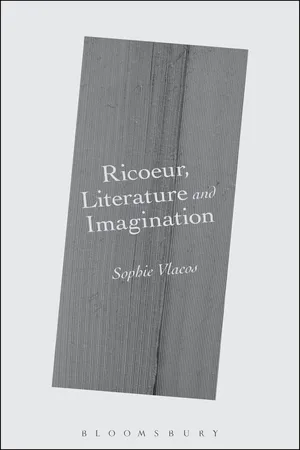
This volume explores how literature and the conflicts of literary-theoretical debate inform Ricoeur's theory of imagination and understanding, and how Ricoeur's unique mode of literary reflection resolves the conflicts of literature's theoretical heyday, presaging a new direction for literary studies.
- 248 pages
- English
- ePUB (mobile friendly)
- Available on iOS & Android
eBook - ePub
Ricoeur, Literature and Imagination
About this book
Information
1
Ricoeur at Nanterre
1.1 Introduction
In the spring of 1967 Paul Ricoeur reneged his professorship at the Sorbonne. His career so far was already one of prodigious merit. Incarcerated as a prisoner of war for five years, he had worked to translate Husserl’s Ideen into French, and co-authored a work of commentary with fellow prisoner Mikel Dufrenne on the existentialism of Karl Jaspers. This had been followed in 1948 with the publication of a comparative study of Jaspers and Gabriel Marcel, and in 1950 with the first volume of Ricoeur’s tripartite Philosophy (or Phenomenology) of the Will, Le Voluntaire et l’involuntaire.1 The text’s critical commitment to phenomenological ideas testified to the discipline’s predominance in French thought at the time, but it also prefigured its eventual decline and the distinct path Ricoeur’s own thinking was to take in a post-Husserlian and post-existential era. An implicit rejection of Sartre’s intractably individualistic freedom, Ricoeur’s text promotes a conditioned freedom (such as Merleau-Ponty had signalled with the notion of embodiment) consonant with the dialectical potentialities of both a renewed and, in Ricoeur’s case, a transformed hermeneutic consciousness and the predominant socio-ideological paradigms of the 1950s and 1960s. Just as the hermeneutic consciousness consolidated by Dilthey, Heidegger and Gadamer took the constraints of its own ontology – its historicality, its situatedness and hence finitude – to be the negative condition of its very possibility, so Marxist-inspired theory of the time was obliged to reject Sartrean individualism in favour of the historically and politically constrained freedom of the communal realm, the freedom of individuality being a notion proper to the bourgeois realm of self-reflection.2
The dawn of a new theoretical anti-humanism sought to countenance the promises of the rationalist and speculative traditions and expose the philosophical edifice as just another ideology of mastery. Of course this drive towards epistemological neutrality was itself inherently ideological, arising within the context of a broader social foment, when populist notions of existential liberty and the Subject’s rights still mixed freely with the generalized anti-establishment sentiments promulgated in the name of the new theoretical sciences. The student riots of May 1968 and 1969 were a symptom of just such transitional ambiguity and excitement, reinvigorating the existential edict to act (both on campus and in the unions) and reinvesting philosophy and politics with exhilarating immediacy and consequence whilst drawing upon the new theoretical scepticisms for academic integrity. Ricoeur had himself warned the authorities of the potential for unrest within the universities. His decision to remove from the Sorbonne’s esteemed environment signified the culmination of a prolonged and public critique of the French university system, as well as being an expression of his own professed desire to teach unfettered by certain institutional conventions. Essentially, it was a move to match his commitment to university reform. And yet with his deferral and election to the new and more egalitarian site of Paris X at Nanterre, Ricoeur was to become a symbol of precisely those constrictions he had chosen to abandon. Despite his own critical essays and the decision to act in accordance, Ricoeur’s position as Doyen meant that his own role as a public and official figure was automatically associated with the authoritarian rigidity which Parisian students were increasingly beginning to attack along with other disclaimers of the de Gaulle era. To Left-wing sympathizers, the university was perceived as an instrument of State rule in which academic integrity was sacrificed to hegemonic interests. These sentiments were compounded by the epistemological re-evaluation taking place within the university, in the form of a broadly conceived ‘legitimation crisis’.
Of course, the critical atmosphere of the 1960s was one of ingenious innovation and exploration, but like any time of intense partisanship, it was also a time of crass polemic and oversimplified polarities. At Nanterre subtlety was sacrificed to enthusiasm when the campus became a battleground between the university’s own faculties, the Faculty of Letters, where Ricoeur was elected Dean, and the Faculty of Law. According to Charles E. Reagan, both friend and biographer of Ricoeur, the colleges were politically divided between affluent middle-class law students and the Letters faculty’s more working-class Leftist sympathizers. Further internal divisions involved the competing and retrospectively insular conflagrations of Maoist and communist students, involving what were often violent assertions of control over the campus. In hindsight such details of the student revolt can seem insignificant, especially within the wider context of national and global unrest. And yet, by this interpretation at least, they provide a salient focal point from which to assess the fate of hermeneutics, both then and now.
Just as his transition from Sorbonne Professor to Dean of Nanterre was both a move befitting the era of democratic change and a step up the prevailing order’s regimental ladder, so Ricoeur’s intellectual developments proved to be of antinomian significance in this partisan era. Within this context Ricoeurian hermeneutics and hermeneutics in general were to suffer an overhasty opposition to the idiom of crisis and radical questioning, becoming all too easily sidelined as a humanist alternative to formalism in a post-phenomenological and purportedly anti-idealist age. Latterly, Ricoeur expressed reservations as to the true political import of the May ‘events’, unsure as to whether they were something of ‘profound cultural significance’ or merely ‘a great waking, playful dream’.3 For Ricoeur personally, they ended in resignation and a three-year leave from the French university system; but political dream or not, it is fair to say that intellectually Ricoeur’s hermeneutic philosophy only gains its true distinction amid the conflict to which he was once so curiously central and peripheral.
1.2 The decline of existentialism
Had politics and academia not entwined themselves so intimately, existentialism may not have sunk so swiftly. Yet an appeal to chance neglects the compelling circumstances which conspired to make Sartre’s fall from favour more than a mere accident in the revolutions of intellectual fashion. Indeed, Sartre’s fate cannot be disentangled from the fate that beset millions caught between the political extremities of Left and Right in the first half of the twentieth century. But there was also a much narrower history, pertaining to French culture and the organization of its academic offices, which had its part to play. The importance of these practical accidents is numerously attested to in the accounts of French academic historians and French philosophers of this period. By way of introduction to Modern French Philosophy, Vincent Descombes writes of the university system and its procedures of recruitment in terms of a process of assimilation, in which applicants are groomed into ‘civic-minded State missionaries’, in an environment where academic focus and favour devolve to the bias of a select committee. He plants the seeds of an explanation for the birth of French irrationalism in the origins of the Third State. Keen to establish its legitimacy through the doctrines of positivism and neo-Kantian rationalism, the State entrusted philosophy teachers with a role closer to that of the civil servant than the independent intellectual. Philosophy was to propound the progressivist, scientific principles of the State’s own self-perceptions and a wholly rational and optimistic view of human progress. But of course the philosopher’s need to break these bonds was compounded all too violently by the retrograde savagery of war; ‘for the generation of 1930, the starting point was a desire to escape from this optimistic view of history’.4
It is not for poignancy alone that the historian François Dosse opens his capacious History of Structuralism with a heroic epithet for Sartre, whom he treats as quite possibly the last in a long tradition of French men of letters. ‘The law of tragedy requires a death before a new hero can come onstage’, he writes, and there is no doubt that Sartre’s prestige had once been of heroic proportions.5 But poignancy aside, it was the ramifications of Sartre’s politics, and the politics of a literary and humanist establishment figure, which in their utterly French contexts (Rousseau, republicanism, le Parti Communiste Francais, the highly influential journals Les Temps modernes and Tel Quel) made Sartre not merely old-hat but tragically dead in intellectual circles even whilst he retained populist appeal with the general public. Individualism makes for an unlikely politics or ethics, but the continuity invested in French politics and philosophy compelled Sartre to provide a social framework for the existential ego. Despite his intellectual superfluity Sartre remained an all-round cultural figure or ‘voice of a generation’ for the French public, and they demanded an example of commitment from him in a time of raised social and political conscience. Compelled to break with his habit of political non-intervention, Sartre committed his voice to a political stance, but this was not without problems. Having failed to protest against Nazism during the war, Sartre later joined the French Communist Party in an attempt to appease his critics, and yet he did so precisely when the atrocities of Stalinism began to emerge during the Cold War, when the majority of French intellectuals were rapidly rejecting this affiliation. Sartre was to endure increasing isolation as former colleagues at Les Temps modernes, including Merleau-Ponty, Camus and Claude Lefort, left the review. Merleau-Ponty – once Sartre’s closest friend and intellectual kin – published a sharp denunciation of Sartre’s alliance to Bolshevism soon ...
Table of contents
- Cover
- Halftitle Page
- Title Page
- Dedication Page
- Contents
- Preface
- Introduction: Moderation, Mediation, Bias
- 1. Ricoeur at Nanterre
- 2. Hermeneutics and the Romantic Prejudice
- 3. Hermeneutics and Ontology
- 4. The Poetry of Reason: Ricoeur and the Theoretical Imagination
- 5. The Ethics of Imagination
- Bibliography
- Index
- Imprint
Trusted by 375,005 students
Access to over 1.5 million titles for a fair monthly price.
Study more efficiently using our study tools.
Frequently asked questions
Yes, you can cancel anytime from the Subscription tab in your account settings on the Perlego website. Your subscription will stay active until the end of your current billing period. Learn how to cancel your subscription
No, books cannot be downloaded as external files, such as PDFs, for use outside of Perlego. However, you can download books within the Perlego app for offline reading on mobile or tablet. Learn how to download books offline
Perlego offers two plans: Essential and Complete
- Essential is ideal for learners and professionals who enjoy exploring a wide range of subjects. Access the Essential Library with 800,000+ trusted titles and best-sellers across business, personal growth, and the humanities. Includes unlimited reading time and Standard Read Aloud voice.
- Complete: Perfect for advanced learners and researchers needing full, unrestricted access. Unlock 1.5M+ books across hundreds of subjects, including academic and specialized titles. The Complete Plan also includes advanced features like Premium Read Aloud and Research Assistant.
We are an online textbook subscription service, where you can get access to an entire online library for less than the price of a single book per month. With over 1.5 million books across 990+ topics, we’ve got you covered! Learn about our mission
Look out for the read-aloud symbol on your next book to see if you can listen to it. The read-aloud tool reads text aloud for you, highlighting the text as it is being read. You can pause it, speed it up and slow it down. Learn more about Read Aloud
Yes! You can use the Perlego app on both iOS and Android devices to read anytime, anywhere — even offline. Perfect for commutes or when you’re on the go.
Please note we cannot support devices running on iOS 13 and Android 7 or earlier. Learn more about using the app
Please note we cannot support devices running on iOS 13 and Android 7 or earlier. Learn more about using the app
Yes, you can access Ricoeur, Literature and Imagination by Sophie Vlacos in PDF and/or ePUB format, as well as other popular books in Literature & Literary Criticism Theory. We have over 1.5 million books available in our catalogue for you to explore.