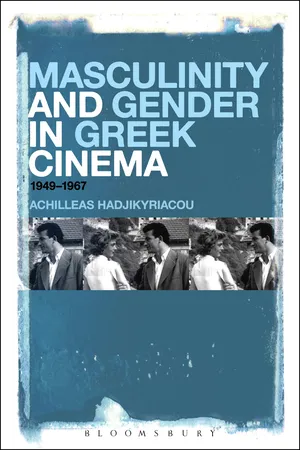
Between the end of the Civil War (1949) and the colonels' military coup (1967) Greece underwent tremendous political, economic, and social transformations which influenced gender identities and relations. During the same period, Greece also witnessed an unparalleled bloom in cinema productions. Based on the recently established paradigm that cinema and popular culture viewed as social institutions can inform a historical study, Masculinity and Gender in Greek Cinema explores the relationship between Greek cinema and the society within which it was created and viewed.
The book's double analytical perspective on cinema and masculinity advances both the study of cinema and popular culture as historical sources, and of masculinity and gender relations as valid categories of historical analysis. Cinema as a medium of representation, not only managed to reflect on these issues, it also provided a whole new field for their interpretation. This is the first study to explore the dramatic transformation of masculinity and gender roles, as represented in Greek cinema during the turbulent 1950s and 1960s.
- 328 pages
- English
- ePUB (mobile friendly)
- Available on iOS & Android
eBook - ePub
About this book
Information
1
Masculinity and Gender Relations in Greece: 1949–67
The purpose of this chapter is to outline a socio-historical context within which the films selected were produced. In order to gain an understanding of representations of gender in films, it is necessary to form an understanding of the society in which the films were created and viewed. To this end, a study of the available literature from the fields of social anthropology, sociology and social history as well as any available records and statistical data (about legislation, demography, employment, education etc.) allows us to form an outline of Greek society during the period in question. The chapter begins by critically reviewing the anthropological literature on the issue of gender. It then investigates Greek society of the 1950s and 1960s in terms of social change and modernization.
Greece as presented by social anthropologists
In modern Greece the field of gender studies has attracted little historical interest. However, work on the question of gender, originating mainly from the field of social anthropology, has managed to draw a preliminary picture of the traditional Greek family and gender roles in various rural societies. From the 1950s until the mid-1980s, when approaching issues of gender in Greece and other Mediterranean societies, a series of Anglo-American anthropologists tended to draw upon common concepts, such as honour, shame, virginity, patriarchy, public vs private sphere, to categorize their findings.1
It could be generally argued that anthropologists working in post-World War II Greece laid their research on the common basis that the traditional Greek family was decidedly patriarchal. A man had to prove himself by being first a good son and later an ideal husband, father and provider. In this way, he gained timi [honour], a very important masculine virtue for Mediterranean societies in general. Anthropologists focusing on Greece describe variant values and behaviours that men had to incorporate in their lifestyle in order to prove themselves honourable and thus gain and maintain the respect of each micro-society. Despite differences in the anthropologists’ reports, the values of manliness shared the same orientation: to guard the virtue of women and the honour of the house in both economic and moral terms.2 The constant ambition of a man to keep his timi or augment it through the respect and admiration of the community was called philotimo. Philotimo was a way to lead a virile life and to acquire strong self-esteem, by fulfilling all the obligations towards the family and especially towards its female members.3 Thus, a man should always prove himself ‘energetic’, as eneryia [energy] was a principle of masculinity and domination. In addition to being philotimos [having philotimo], a man had to believe in his superiority as an independent male, a kind of self-respect and pride synonymous with egoism [egoismos] in the sense of being the head of a collective, a kin group, a village, a region or a country. Often this egoism engaged men in ‘a constant struggle to gain precarious and transitory advantage over each other’.4
Due to a man’s economic responsibilities as the head of the house, boys enjoyed educational advantages. A future father had to know how to read and count in order to practice a trade successfully, so primary school was considered necessary for boys while girls were deprived, at least prior to the 1950s, of any ‘unnecessary’ knowledge.5 Furthermore, if a male acquired higher education he gained the respect of the community. He was considered capable of pursuing much more prestigious occupations than farming or even of leaving the village to work in a town.6 Nonetheless, even if a man left the village to live in the city he was expected to maintain the rural prototypes of masculinity. For example, while an urban wife might or might not be able to manage the house, the husband was still expected to provide for it.7
A man in rural Greece had to prove himself not only in labour but also during his leisure time. Anthropologists who have studied different Greek societies agree that the kafeneion [coffee house] was a forum in which: ‘manhood is expressed, reputations are negotiated, and social relationships are enlivened through endless card-playing, political debate, competitive talk, and reciprocal hospitality’.8 It is worth mentioning that, according to anthropologists, the kafeneion remained an entirely male arena at least until the mid-1980s. Despite the significant changes in social values during this period, if not restricted from entering a kafeneion, women still felt very embarrassed or ashamed to do so. Thus, with very rare exceptions, women showed very little desire to enter this male space which they continued to regard as a symbol of men’s freedom for socialization in the public sphere.9
Another place closely associated with masculinity was the plateia [public square]. Normally, women and especially young girls were not allowed to go to the plateia except when festivities were held. Even then, they were allowed only if escorted by their husbands. In everyday life, the plateia remained a male domain were men could socialize with other men.10 In the plateia, kafeneion or in any other place of socialization or fiestas, the character of masculine behaviour was shaped by two main values: kerasma and kefi. Kerasma was the action of ‘treating’ a newcomer in the company or of buying a round of drinks for all those present. This action was very important as it embodied the value of a gift and the male principle of hospitality.11 However, extremes were to be avoided. A tight-fisted man was considered as dishonourable as a wasteful spender who entertained his friends without a sense of responsibility towards his family.12 Kefi describes a state of pleasure, delight, humour as well as a slight intoxication. Kefi can be determined as the main purpose of socialization in male domains such as plateia and kafeneion, which eventually became a symbol of masculinity.13
The observations of anthropologists have shown that male and female spheres were both cooperative and oppositional. According to Boulay, who conducted fieldwork from the mid-1960s until the early 1970s in the village Ambeli in Evoia, despite their antithetic natures, men and women respected one another’s roles. They connected the image of Jesus Christ with that of the man of the house and the image of Holy Mary with that of the wife.14 A happy family was a way for both husband and wife to acquire pride, honour and self-esteem. A man should constantly prove his manliness by combining characteristics such as courage, a quick temper and sexual potency in his role as a husband-father-provider. Most importantly, he could gain honour and public recognition only if he proved able to protect the virtue of his female kin and support the house in both economic and moral terms.15 Thus, the subordination of the wife to her husband was a means of demonstrating before society that a successful provider had control of the family and was able to offer security to all its members.16 On this, Boulay states: ‘while woman’s character is forged by the demands of the heroic code of self sacrifice and obedience to man, man’s character is tempered by an unremitting and often tyrannous service to the house’.17 Only in this way, could the husband and the wife enjoy the respect of the others and be recognized as noikokiris and noikokira [successful householder, male and female]. The important role of the wife in the constitution of a successful household is unquestionable. In fact a corporate, self-sufficient, family-based household could offer to women equal or even greater public prestige than that of their husbands.18
In general terms, it could be suggested that according to social anthropologists, the division of labour in Greek villages appeared to follow a simple sexual symbolism. Tasks which required organization and strength were considered as men’s work while women dealt with everything relevant to nurturing and care. Consequently, men had nothing to do with the domestic work, the carrying of the water, for example, which would have been dishonouring.19 Nevertheless, if, for any reason, the sexual separation of tasks had to break, this had to be done in secret to avoid negative gossip and mockery. Since masculinity is largely defined, experienced, proved and accepted not individually but within social groups, a man seen to break the ‘masculine code’ by tiding up or sweeping would suffer a series of jokes by his peers.20
During his fieldwork in a Cretan mountain village, Herzfeld observed that food was also ca...
Table of contents
- Contents
- Acknowledgements
- Notes for the Reader
- Prologue
- 1 Masculinity and Gender Relations in Greece: 1949–67
- 2 Greek Cinema: 1949–67
- 3 Masculinity and Locality: Rural vs Urban Gender Identities
- 4 Money, Pride or Both? Masculinity and Class
- 5 Modern Men: Masculinity and the Challenges of a New Age
- Epilogue
- Appendix
- Primary Sources
- Bibliography
- Index
Trusted by 375,005 students
Access to over 1.5 million titles for a fair monthly price.
Study more efficiently using our study tools.
Frequently asked questions
Yes, you can cancel anytime from the Subscription tab in your account settings on the Perlego website. Your subscription will stay active until the end of your current billing period. Learn how to cancel your subscription
No, books cannot be downloaded as external files, such as PDFs, for use outside of Perlego. However, you can download books within the Perlego app for offline reading on mobile or tablet. Learn how to download books offline
Perlego offers two plans: Essential and Complete
- Essential is ideal for learners and professionals who enjoy exploring a wide range of subjects. Access the Essential Library with 800,000+ trusted titles and best-sellers across business, personal growth, and the humanities. Includes unlimited reading time and Standard Read Aloud voice.
- Complete: Perfect for advanced learners and researchers needing full, unrestricted access. Unlock 1.5M+ books across hundreds of subjects, including academic and specialized titles. The Complete Plan also includes advanced features like Premium Read Aloud and Research Assistant.
We are an online textbook subscription service, where you can get access to an entire online library for less than the price of a single book per month. With over 1.5 million books across 990+ topics, we’ve got you covered! Learn about our mission
Look out for the read-aloud symbol on your next book to see if you can listen to it. The read-aloud tool reads text aloud for you, highlighting the text as it is being read. You can pause it, speed it up and slow it down. Learn more about Read Aloud
Yes! You can use the Perlego app on both iOS and Android devices to read anytime, anywhere — even offline. Perfect for commutes or when you’re on the go.
Please note we cannot support devices running on iOS 13 and Android 7 or earlier. Learn more about using the app
Please note we cannot support devices running on iOS 13 and Android 7 or earlier. Learn more about using the app
Yes, you can access Masculinity and Gender in Greek Cinema by Achilleas Hadjikyriacou in PDF and/or ePUB format, as well as other popular books in Media & Performing Arts & European History. We have over 1.5 million books available in our catalogue for you to explore.