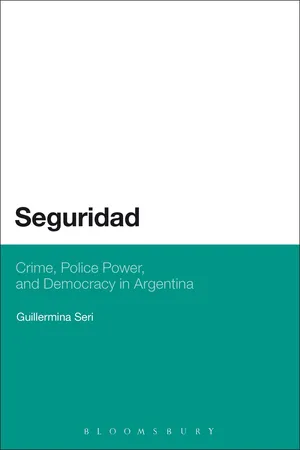
This study of police governance draws on over ninety interviews conducted with Argentine police officers. In Argentina, a rising fear of crime has led to the politics of Seguridad, a concept that amalgamates personal safety with state security. As a new governing rationale, Seguridad is strengthening forms of police intervention that weaken the democracy. As they target crime, the police have the power to deny rights, deciding whether an individual is a citizen or a criminal suspect - the latter often being attributed to members of vulnerable groups.
This study brings together key issues of governance that involve the police, democracy, and the quality of citizenship. It sheds light on how the police act as gatekeepers of citizenship and administrators of rights and law. Here, the rhetoric of Seguridad is seen as an ideological framework that masks inequality and unites "good" citizens.
Seguridad shows how police practices should be part of our understanding of regimes and will appeal to anyone concerned with security forces, as well as researchers in democratic theory and Latin American politics.
- 248 pages
- English
- ePUB (mobile friendly)
- Available on iOS & Android
eBook - ePub
About this book
Information
Chapter 1
Policing Inseguridad
‘We are 50,000, right? All of us with guns. All of us armed. In the street, you are lord and master of your actions… Do you understand? How can you control 50,000 lone men, 50,000 officers in the streets with a gun doing really whatever they want?’ so reflected my interviewee, a member of the Police of the Province of Buenos Aires, often referred to as bonaerenses.1 These words could be those of police anywhere. They expose the police’s governing role. Government, which Michel Foucault defines as the ‘conduct of conduct’,2 is about guiding and giving shape to individual and collective behaviour. Policing involves direct, even coercive governance on behalf of the community.3 With authority to guide and regulate people’s actions and interactions, in modern societies uniformed police officers epitomize this major, if mostly unacknowledged dimension of government. Addressing its pervasiveness, this book approaches the police as governing authorities, scrutinizes police governance on the ground, and interrogates its links to the government and its political regime.
Broadly defined, a regime consists of the procedures, principles and rules organizing a field of activity. When it comes to governing, alternative rules and institutions define typical forms of political regime. Accompanying the expansion of democratization, the study of regimes has developed into a subfield of increasing methodological sophistication. While the focus of comparativists, which I revisit in Chapter 5, continues to be placed on formal political institutions, a different perspective opened by the work of Michel Foucault prioritizes the role of governing practices, intertwined with but irreducible to the institutions and ideas linked to them. Studying how governments work, especially at the interface between policing and governance, requires considering both formal and informal rules, institutions and patterns of practices. Or to borrow from Foucault, to identify ‘regimes of practices’ and the relations between them in governing society.4
Taking life, the traditional kingly prerogative lies these days most often in the hands of the police. Nobody governs us as the police do. As one of my bonaerense interviewees stressed, thanks to their unique powers of arrest, search and the use of force, police officers can do ‘everything that a civilian cannot’, becoming true arbiters of our fate. Police officers can intervene in the most diverse circumstances to enforce laws and regulations and to restore order if they judge it to have been disrupted. Unlike other public officials, in their encounters with citizens they can use force. Police agents can shape our behaviour, restrain our movements, touch our bodies, decide whether to guarantee, restrict, or deny our rights and liberties, legitimately override written rules and even inflict wounds or death. Appeals to protecting life in danger or to gathering criminal evidence often make police breaches of laws and constitutional guarantees justifiable in the eyes of judges. Indeed, what Leonard Feldman calls the ‘prosaic politics of emergency’5 embedded in routine policing may illuminate discussions of emergency powers in constitutional democracies better than traditional debates.
The police have an impressive symbolic power. Through the descriptions and narratives framing police reports, those basic building blocks most of the time uncontested in the legal process, they also shape their surrounding world.6 By representing reality – for example, by characterizing a woman as a young lady or a prostitute, or by stating that some specific breach of the law has taken place, police reports generate events and identities and frequently define the fate of those involved. As if this were not enough, the police often serve as the sole source for news crime reports.7
On the scale of a whole nation, police agents seem insignificant, but the power they exercise in the streets exposes core state traits. If, as political theorist Kathleen Arnold observes, ‘it is really the subjects of prerogative who are the litmus test of democracy’,8 the power in the hands of the police calls for scrutiny. They are the state’s capillary arms, its tiny tentacles, preserving and helping to determine its social order, mores and values. Their bodies trace a decisive first line trench of governance at the bottom of the state apparatus. ‘We are the showcase of the state’, an officer from the Federal Police noted, ‘we are the first step that people meet in relation to the state’, he continued, conveying self-awareness of his position on the outer surface, at the bottom of a state that he imagines as a ladder. Also showing self-awareness, a detective from Rosario stressed that ‘we are in charge of the first contact. The first hours are ours.’ Without this swarm of agents of order intervening in interpersonal conflicts, discouraging people from engaging in certain behaviours and enforcing laws and norms, our modern states would collapse. At the same time, police power poses a serious challenge to democracy, as it too often undermines its preconditions, the equal access to and exercise of rights and citizenship.
As a society with a pronounced fear of crime, where in recent years crime consistently ranked as the most important problem in public opinion surveys, Argentina offers an appropriate setting to explore the governing aspects of policing.9 Moreover, it represents regional trends, since Latin Americans first identified crime as the major problem in their countries, as did Latinobarómetro survey respondents in 2008 and 2010. Millions of Argentines seem sick from inseguridad, experiencing what the traditional newspaper La Nación characterizes as ‘general unprotectedness’.10 People elsewhere may worry about wars or terrorism, but what Argentines fear the most is themselves. It is the threat of becoming the victim of a violent crime that people call inseguridad. In turn, demands for seguridad conflate meanings of personal safety and security.11
Seguridad talk is powerful, it asserts that we should pay attention to what really matters: Things are bad; violent crime is rampant, criminals are out of control, waiting out there ready to kill us; things could not be any worse – and yet they are heading downhill. Things are always at their worst in hellish Argentina. Whether in its higher or lower tide, like a broken thermometer always giving the same torrid reading, such a catastrophist storyline has taken over the lives of many, unable to acknowledge relative improvements or local variations.
Nations are always also communities of fear, with a sovereign dimension and a quest for limits, based on the promise to protect those recognized as members from whatever and whoever does not belong to them. Strong, organic links connect ‘an imagined national identity and an imagined national (in)security’, as Mark Neocleous points out.12 Such traits reach especial saliency in 2011 Argentina, where no influential voice challenges the assumption that more seguridad is better. Identifying seguridad as ‘the main preoccupation of our people’, the governor of Buenos Aires Daniel Scioli identified it as his government’s priority.13 Moreover, with the creation of the national Ministerio de Seguridad in December 2010, on Human Rights Day, expressing that ‘human rights and seguridad are the terms of a same equation’, President Cristina Fernández de Kirchner boldly embraced the agenda.14 Consolidated as a central policy item by the media and political debates, in a democracy that has come to stay, seguridad has entered the puzzle of governance.
This book scrutinizes life under conditions in which demands for seguridad take over the public arena. The book has a double purpose. First, by tracking the rise of a political agenda based on the fear of crime, it maps the formation of a governmental dispositif in democratic Argentina since the mid-1990s.
Drawing on Michel Foucault, by dispositif – often translated into English as ‘apparatus’ – I understand a loose, but covering, far-reaching governing net made of dissimilar elements that comes together in response to a social need perceived as urgent.15 In this case, in the Argentina of seguridad, the need demanding a solution appears as violent crime gone wild. As Foucault describes it, through the confluence, only in part deliberate, of discourses, policies, practices, knowledge and institutions, but also of ‘architectural forms, regulatory decisions, laws, administrative measures, scientific statements, philosophical, moral and philantrophic propositions’, a dispositif appears as the web, network, reseau, or ‘system of relations’ articulating such diverse elements.16
Dispositifs may involve the education of children, taming the working class or the poor, responding to a rise in crime, or neutralizing the disorderly to make things functional. Dispositifs arise at different scales, we all participate in dispositifs and are captured by some of them. In his recent revisitation of the concept, Giorgio Agamben judges dispositifs the most encompassing concept, the equivalent of the universal, in Foucault’s thought.
In the case of Argentina, with cyclical virulence, seguridad breaks society into two antagonistic groups, gente versus delincuentes, ‘the people’ versus ‘criminals’. As inseguridad heightens, voices call for legalizing the death penalty, passing harsher criminal laws for teenagers and children, and arming oneself against ‘criminals’, even implying the legitimacy of death squad-like summary executions.17 Such complaints have permeated the media, the internet, newspaper letters, conversations and political campaigns.
It was not always this way. One can certainly trace back stories and arguments centred on the prevalence of bloody homicides and the fear of crime in the yellow press and the crime sections of major newspapers. But the generalization of seguridad as the main concern of so many in the country is new. It was only since the mid-1990s that pleas for protection, linked to a seeming rise in common crime and interpersonal violence gained political momentum. After 11 September 2001, the sharp rise in international security measures gave this local dynamic a boost.
Seguridad calls for policing, and policing evokes the universe of seguridad. ‘Everybody comes to complain to us, everybody comes to ask us for seguridad.’ As an officer from the Federal Police noted, the agenda increases police protagonism. Treating police officers as governing authorities, this book’s second purpose is to examine the government in light of police power, an endeavour that is both theoretical and empirical. Through the prism of the Argentine police, drawing on a large collection of first-hand accounts of police voices, different chapters illuminate seguridad’s and police’s governing puzzles. To the extent that, as political theorist Mladek notes, politicians move to ‘govern largely through crime and security – that is, through the police’, the police themselves come to the forefront as the ‘street-corner politicians’ first identified by William Muir.18
Now, if in Argentina police forces have existed for almost a century and a half, and fear of crime, which translates locally as sensación de inseguridad or ‘feelings of insecurity‘, may be as old as the nation, why talk about a new dispositif ? The assemblage of security with democracy under a neoliberal framework defines the new governmental pattern, I contend. In Argentine history, as Ernesto Laclau helps us to remember, ‘democracy and liberalism were opposed to each other’. Having emerged in Europe in the struggle against feudalism, liberalism became the ideology of Argentine landed, patrimonial elites, who also embraced ‘Europeanism’ against local, popular traditions. Organized in the late 1800s, Argentina’s modern state at once celebrated liberal ideas and dismissed the democratic demands of the masses. By 1945, with the rise of Peronism, tension peaked in such a way that ‘Liberalism and democracy ceased to be articulated’, Laclau explains.19
Things got even worse in the following decades as military dictatorships combined liberal economic policies with endless brutality to subject and silence the people. In 1976, joining Chilean Augusto Pinochet, the Argentine military Juntas threw the nation on the path of neoliberalism in part as a way to destroy popular organizations. After the coup of 24 March, millions of Argentines found themselves caught up in a political and personal nightmare. Burnt libraries, hundreds of concentration camps, death squads, state terror and tens of thousands of ‘disappearances’ of those labelled as ‘subversives’, including their babies, were carried out by the state in the name of protecting the nation’s Christian and Western values. Security, and liberal and neoliberal policies became associated with the most violent authoritarian rule. Police forces played a clear supporting role in the countless atrocities committed by the dictatorship, with police stations serving as clandestine detention centres and the police providing the largest number of perpetrators after the army. ‘The historical truth,’ a detective from Rosario acknowledged, ‘the question of “disappearances”… that it was a police responsibility to a great extent is totally known, it is all documented. There is no way back.’ More than three decades later, hundreds of missing children, now adults, continue to be tracked, and perpetrators are still being brought to justice.
In part because of the scope of the violence of El Proceso, it took some time after the restoration of democracy to identify patterns of authoritarian and violent policing not directly attributable to it. Over time, as in other so-called ‘new democracies’, it became clear that policing posed obstacles of its own to the expansion of the democratic polity and the extension of citizenship. The police became a distinct subject of research for established human rights organizations such as the Center for Legal and Social Studies (CELS), and the organizing agenda item for new groups such as CORREPI, the Coordinator against Police and Institutional Repression. Police and public security reforms gained salience as a ...
Table of contents
- Cover Page
- Title
- Contents
- List of Figures and Tables
- Dedication
- Preface and Acknowledgements
- Chapter 1. Policing Inseguridad
- Chapter 2. Inseguridad: How We Experience It
- Chapter 3. Seguridad, a Governmental Dispositif
- Chapter 4. Police Governance, Gente and Delincuentes
- Chapter 5. Democracy? The Police, the State and their Regimes
- Chapter 6. A Sovereign's Multiple Heads
- Conclusion: (Un)Protecting Lives
- Notes
- Index
- Copyright
Trusted by 375,005 students
Access to over 1.5 million titles for a fair monthly price.
Study more efficiently using our study tools.
Frequently asked questions
Yes, you can cancel anytime from the Subscription tab in your account settings on the Perlego website. Your subscription will stay active until the end of your current billing period. Learn how to cancel your subscription
No, books cannot be downloaded as external files, such as PDFs, for use outside of Perlego. However, you can download books within the Perlego app for offline reading on mobile or tablet. Learn how to download books offline
Perlego offers two plans: Essential and Complete
- Essential is ideal for learners and professionals who enjoy exploring a wide range of subjects. Access the Essential Library with 800,000+ trusted titles and best-sellers across business, personal growth, and the humanities. Includes unlimited reading time and Standard Read Aloud voice.
- Complete: Perfect for advanced learners and researchers needing full, unrestricted access. Unlock 1.5M+ books across hundreds of subjects, including academic and specialized titles. The Complete Plan also includes advanced features like Premium Read Aloud and Research Assistant.
We are an online textbook subscription service, where you can get access to an entire online library for less than the price of a single book per month. With over 1.5 million books across 990+ topics, we’ve got you covered! Learn about our mission
Look out for the read-aloud symbol on your next book to see if you can listen to it. The read-aloud tool reads text aloud for you, highlighting the text as it is being read. You can pause it, speed it up and slow it down. Learn more about Read Aloud
Yes! You can use the Perlego app on both iOS and Android devices to read anytime, anywhere — even offline. Perfect for commutes or when you’re on the go.
Please note we cannot support devices running on iOS 13 and Android 7 or earlier. Learn more about using the app
Please note we cannot support devices running on iOS 13 and Android 7 or earlier. Learn more about using the app
Yes, you can access Seguridad by Guillermina Seri in PDF and/or ePUB format, as well as other popular books in Política y relaciones internacionales & Política comparada. We have over 1.5 million books available in our catalogue for you to explore.