Kristeva stresses that cinema has the power to bestow desiring subjectivity as a way of resisting the society of the spectacle through the specular. Through analyses of complex films such as Streitfeld's Female Perversions, Lynch's Mulholland Drive, Almodóvar's Volver, and Haneke's Caché, The Blue Box: Kristevan/Lacanian Readings of Contemporary Film demonstrates Julia Kristeva's concept of the "thought specular," from her fascinating chapter "Fantasy and Cinema" in Intimate Revolt. Kristeva deserves our full attention as a film theorist.
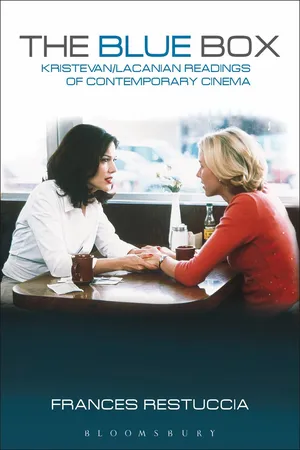
- 192 pages
- English
- ePUB (mobile friendly)
- Available on iOS & Android
eBook - ePub
About this book
Informed by the theory of Julia Kristeva, Frances Restuccia analyzes a variety of contemporary films replete with psychoanalytic subject matter and styles. She examines films that present elaborate fantasies and, through them, prompt the viewer to cut across a crippling fundamental fantasy-by enabling a mapping of his or her private fantasy onto the one being played out on the screen. Such absorption is a function of the semiotic dimension of the film, which offers the spectator an experience of intimacy, negativity, the gaze, and death.
Information
1
Introduction: intimate film in revolt
If we are to construct a civilization that is not solely one of production and commercial trade, we must redefine what we understand by ‘freedom.’ The freedom that we have to recon-struct together should be an autocommencement, to be sure, but with the other, and this not in order to produce the best causes for the best effects, but to share the power of beginning oneself anew with the other. The freedom of desire that is the desire for objects, knowledge, and production, joined with the freedom to withdraw into intimacy and mystical participation, are the two indissociable variants of European freedom. Because they have been separated, each of the two parts of the schism is vulnerable to impasses: the unbridled pursuit of objects of desire, even false ones; the stupidity of the media; the robotization of production; atomization; social insecurity; and the ‘new maladies of the soul’ on the one side; and the immobilization in painful narcissism; the hellish complacency outside of time; social amoralism; and pauperization on the other. Is a revision possible?
JULIA KRISTEVA, CRISIS OF THE EURO/PEAN SUBJECT
Informed by the theory of Julia Kristeva, The Blue Box analyzes a variety of contemporary films replete with psychoanalytic subject matter and styles—by Almodóvar, Haneke, Kieslowski, Lynch, Shainberg, Streitfeld, and von Trier. Lacanian theory also substantially supports this study, and the early as well as late work of Gilles Deleuze plays a part, but theoretically The Blue Box engages mainly Kristeva’s Black Sun: Depression and Melancholia (1989) and Intimate Revolt: The Powers and Limits of Psychoanalysis (2002) as well as her newly translated Hatred and Forgiveness (2010).
The absence at the core of all the films taken up, with its potential to effect psychic reconfiguration—the transformation of psychic trouble to desiring subjectivity—is the book’s fundamental unifying concept. Each film analysis in The Blue Box brings to light a darkness, the (Heideggerian) Nothing, an abyssal site of the Lacanian gaze, Kristevan “negativity,” the “motor,” as she calls it, “of psychical life” (Kristeva, 2010, 183). Hence the book’s metaphoric title—The Blue Box—which signifies in David Lynch’s Mulholland Drive both the bottomless site of the Lacanian Real and a crucial escape hatch, enabling release from debilitating fixations. The opening chapters locate what Kristeva calls “new maladies of the soul”—contemporary variations on melancholia, hysteria, obsessional neurosis, perversion, and psychosis—in recent films as well as in Hitchcock’s Psycho (on both diegetic and non-diegetic levels) to show how a cinematic metamorphosis of such maladies can occur through an exposure of that abyss. And insofar as the early chapters focus on the capacity of film to access the space of the Nothing as an antidote to psychic disturbances, the film analyses in the first part of the book prepare for a more direct and detailed demonstration of films that snugly fit Kristeva’s category of the “thought specular.” That is: gradually, in the course of this study, a shift in emphasis takes place from psychoanalytic components within film to the spectator’s psychoanalytic experience with film. In roughly the second half of The Blue Box, Kristeva’s concept of the thought specular, from her fascinating chapter “Fantasy and Cinema” in Intimate Revolt, is elaborated and illustrated.
Kristeva’s film theory is sparse; but what she has produced is revolutionary. Julia Kristeva deserves our full attention as a film theorist, as her work elucidates the capacity of thought-specular film to offer the spectator intense psychoanalytic experience that she calls “intimate revolt.” This psychic rollercoaster ride has the ability to plunge into the abject to convert it to Nothing, thereby traversing fundamental fantasy, and to transport timeless trauma into time, ultimately to effect psychic reconfiguration.1 The Blue Box looks at films that present elaborate fantasies and, through them, prompt the viewer to cut across a crippling fundamental fantasy—by enabling a mapping of his/her private fantasy onto the one being played out on the screen. Such absorption is a function of the semiotic dimension of the film, which offers the spectator an experience of intimacy, negativity, the gaze, and death. Thought-specular films have the capacity to absorb the spectator’s traumatic psychic material, allowing desubjectification through filmic experience and a subsequent discovery of the drive, for the sake of its eventual transformation into desire.
What renders Kristeva’s intimate revolt even more valuable is that this remarkable, cinematically induced transformation is set, in Kristeva’s conception, within the context of the society of the spectacle (as defined by Guy Debord in his book of that title). In Intimate Revolt, the thought specular is perceived and privileged as a way of turning back the tide of our current dependency on tawdry, glossy images, the consumption of things, as well as speed and cold, technological efficiency. Ironically, the plethora of images that bombard us today within our society of the spectacle not only fails to liberate us but also deprives us of productive fantasy spaces. (Popular images may even be said to generate new maladies of the soul, which in turn require a curative fantasy space.) Nevertheless, Kristeva stresses that the visible is the port of registry of the drive and that cinema that celebrates our identity uncertainties has the potential to transform aggression to filmic seduction, to help us locate the drive and fold it into desire. Despite modern man’s abuse of it, the specular is “the most advanced medium for the inscription of the drive” (Kristeva, 2002, 72). Kristeva’s film theory, like The Blue Box, attempts to restore psychic life to the human subject, to remove its painful obstacles and unveil its riches, through an emphasis on the alluring cinematic semiotic, the gaze, and representation of the death drive—without which we are apt to impose our unconscious aggression on vulnerable human subjects. Opening up psychic life by restoring or inciting desire, therefore, has huge political significance.
Avowing maternal loss
The Blue Box commences with an examination of Krzysztof Kieslowski’s Blue, a melancholic film that promotes staying connected to blueness and thus keeping the corpse of maternal memory warm. But eventually, as Chapter 2, “Black and Blue: Kieslowski’s melancholia,” argues, even the film Blue (exquisitely soaked in melancholia) transforms the reminder of loss, emblematized unforgettably by a fetishistic lamp of dazzling blue glass beads, into a remainder that carves out a lack, a space of Nothing crucial in psychoanalysis to discovery of the drive and the ensuing potential for desire. Kristeva’s and Kieslowski’s emphasis, however, is that such an emptiness—a lack/desire—bears an integral tie to the originally lost maternal object or maternal Thing. One’s initial loss of the mOther, in fact, can only be experienced psychically through one’s attempt to re-locate and thereby sustain the lost object in language. Our experience of loss/lack is necessarily paradoxical, then, insofar as our loss/lack constitutes a link with the lost object—and to refuse to acknowledge that lifeline is to miss out on an essential catalyst for desiring subjectivity. We re-encounter the maternal object through words and other forms of creativity in becoming desiring subjects. Desire depends on an active avowal of the lost mother.
The experience of the loss of the maternal object through the simultaneous carving out of a lack produces, what I will loosely call, a craving for something we assume and hope will be ultimately satisfying, our missing piece, Lacan’s objet a, the cause of our desire. The very chiseling out of lack (enabling our experience of the loss of the lost object and in this way maintaining a delicate bridge to that loss or lost object) produces a desire for enjoyment or jouissance. Desire is therefore dependent on one’s sense of loss and inheres in one’s psychic effort to retrieve, in some Symbolic form, the lost object. Putting this idea in terms of signification or linguistic desire, we might claim that naming produces a wound, for which it simultaneously compensates us. The corpse of the lost object, the maternal object, the Thing (das Ding) therefore must be kept at a warm temperature, not of course at home, where Norman Bates in Psycho hoards his mother’s literal corpse unburied and overheated, but at a sweet distance, in art and other forms of sublimation. Black, in other words, is ideally fringed with blue.
As Eastern Europeans, Kristeva and Kieslowski agree as well that this thread connecting us to the suffering maternal body ought to be maintained in the political arena, developed “in the domain of thought,” to retard if not wipe out the society of the spectacle with its fixation on cheap images, consumerism, and “thought-as-calculation” that ultimately threaten the existence of psychic life altogether, as the human subject each day becomes more robotized (Kristeva, 2010, 19). In Hatred and Forgiveness, Kristeva poses vital questions that we ignore at the risk of the atrophying of our souls and the suffering of our bodies:
modern man’s psychical life seems to have been taken hostage between somatic symptoms (illness and the hospital) and the placing into images of his desires (reverie in front of the TV). No more psychical life then. Does this prefigure a new humanity that has gone beyond metaphysical inquietude and concern for the meaning of being, with psychological complacency? Isn’t it wonderful that a person can be satisfied with a pill and a screen?
(Kristeva, 2010, 157)
Framed by Julie, in Blue, who rediscovers her lost objects through classical music composed to celebrate the European Union, and Raimunda, in Almodóvar’s Volver, who reunites with her lost maternal object through public song, discussion of the semiotic in The Blue Box insists on it in both the personal and socio-political spheres. Globalization would do well to acknowledge the Real maternal corpse in order to achieve an experience of Nothing for the sake of restoring desire to subjects who now docilely accept generic fantasies imposed on them by capitalism out to grab its profits. The films of The Blue Box all demonstrate that desire emerges through the representation of singular, rather than mass-produced, fantasies that equip the subject to traverse misery-producing attachments, locate the drive, and transport the timeless encrustations of trauma into time. All the films of this collection celebrate “moments of grace” (Kristeva’s concept) in which jouissance is experienced at the intersection of atemporality and temporality, serving as a platform for desiring subjectivity. In this way desiring subjectivity is achieved through a kind of Eastern Orthodox mystical freedom—one that exceeds conventional boundaries by privileging the endless delights of silence, tenderness, beauty, passion, lament, and death. Kristeva persuades us to embrace Eastern Orthodox “intimacy and mystical participation” (Kristeva, 2000, 159–60).
A strain of mysticism certainly inheres in Kristeva’s writing. Yet such mysticism never precludes or even overshadows, but instead complements, a political concern with the reduction of Others—e.g., Arabs, Jews, blacks, women, gays, etc.—relegated to the space of Nothing, excluded/included as homines sacri. In arguing for the dissolution of the fetish plugging that void, The Blue Box simultaneously advocates the removal of such Others from that space. Alterity within the subject must be recognized in its own right, to prevent its channeling of aggression toward the Other. Exposing that space as what it is—empty—rather than filled by the Imaginary Other, is central to this project. Unlike the obtuse Georges in Michael Haneke’s Caché, we need to confront what Majid showcases—the vacant site of the drive—rather than inflict our unrepresented drive on the Majids of the world. Once trauma is articulated as constitutive of Being itself, racism and social conflict will no longer have to bear the burden of the trauma underlying history. Hanging on to the source of melancholia ensures that the basis of trauma stays located in the subject’s relation to the maternal Thing rather than in a targeted ethnic or racial Other. The Blue Box promotes a cinematic encounter with one’s constitutive lack, for the sake of an ensuing traversal of psychically crippling fundamental fantasies, and representation of the death drive, resulting in a healthy infusion of jouissance into the Symbolic—both on the personal and socio-political levels, the latter being absolutely contingent on the former.
New maladies of the soul
The early chapters of The Blue Box thus stake out particular psychic structures by locating them in films where they are put into relation with loss, lack, and Love—myriad forms of the Nothing. Chapter 3, “’The void of another enjoyment’: Breaking the Waves,” zeroes in on hysteria, which flirts with the desubjectification of Love. Chapter 4, “The use of perversion: Secretary or The Piano Teacher?” examines the therapeutic usefulness of perversion in escorting the subject to a zero-degree state. Propelled by fear of aphanisis (the eclipsing of the subject), obsessional neurosis is fleshed out in Chapter 5, “Unveiling fetishism in the society of the spectacle: White, Female Perversions, Mulholland Drive.” And in Chapter 6, “Psycho: the ultimate seduction,” psychosis is treated in a new Deleuzean reading of Hitchcock’s most famous film, in which abjection leads homeopathically to a liberating dissolution. While Kristeva offers a profound theory of melancholia, we turn to Lacan for theory of the psychic structures—hysteria, obsessional neurosis, perversion—as well as for his notion of Love, given that psychoanalytic psychic configurations tend to define themselves in relation to that concept. The melancholic, for example, dodges Eros, whereas the hysteric charges up the amorous realm by insisting on her role as the object cause of desire or objet a. The obsessional neurotic wrestles with an impossible desire: fear of losing his boundaries, and collapsing into the cavernous maternal hole through Love, governs every move of his narcissistic romantic life. The pervert, on the other hand, longs to be the object of the Other’s jouissance and so can abide a masochistic Love in this role of crucifixion.
“’The void of another enjoyment’” (Chapter 3), on Lars von Trier’s Breaking the Waves, explores the capacity of film to exceed the limits of signification in its presentation of the desubjectification of Love. Propelled by the drive, Love would seem to be at home in contemporary film. In “Fantasy and Cinema,” Kristeva offers an explanation for why: the visible or the specular, she theorizes, lends itself to “a primary and fragile synthesis of drives, to more supple, less controlled, riskier representability of instinctual dramas, the games of Eros and Thanatos” (Kristeva, 2002, 69). Is film, then, the place where Lacanian Love—that cannot stop not being written (to use a Lacanian formulation)—can be conveyed? And is the hysteria that leads to the hysteric’s overstepping of the boundary between herself and her phallic master, whose desire she pretends to want to satisfy, equally at home in film, as the hysteric falls into the abyss of Love? A Woman beyond phallic language and law would seem to thrive in cinema—both the hysteric who coalesces with objet a and the Woman in Love situated in Lacan’s infinite realm of not-all. In the form of Kristeva’s endless delights, mysticism weaves its way through Breaking the Waves, where the hysteric, the Woman in Love and the mystic flourish, as Stephen Heath puts it, in “the void of another enjoyment” (Heath, 1998, 105). And (most importantly for the psychoanalytic purposes of this book) that film has the capacity to convey that void, especially as it stands i...
Table of contents
- Cover
- Title
- Dedication
- Contents
- Acknowledgments
- 1 Introduction: intimate film in revolt
- 2 Black and Blue: Kieslowski's melancholia
- 3 "The void of another enjoyment": Breaking the Waves
- 4 The use of perversion: Secretary or The Piano Teacher?
- 5 Unveiling fetishism in the society of the spectacle: White, Female Perversions, Mulholland Drive
- 6 Psycho: the ultimate seduction
- 7 Intimate Volver
- 8 The virtue of blushing: turning anxiety into shame in Haneke's Caché
- Bibliography
- Index
- Copyright Page
Trusted by 375,005 students
Access to over 1.5 million titles for a fair monthly price.
Study more efficiently using our study tools.
Frequently asked questions
Yes, you can cancel anytime from the Subscription tab in your account settings on the Perlego website. Your subscription will stay active until the end of your current billing period. Learn how to cancel your subscription
No, books cannot be downloaded as external files, such as PDFs, for use outside of Perlego. However, you can download books within the Perlego app for offline reading on mobile or tablet. Learn how to download books offline
Perlego offers two plans: Essential and Complete
- Essential is ideal for learners and professionals who enjoy exploring a wide range of subjects. Access the Essential Library with 800,000+ trusted titles and best-sellers across business, personal growth, and the humanities. Includes unlimited reading time and Standard Read Aloud voice.
- Complete: Perfect for advanced learners and researchers needing full, unrestricted access. Unlock 1.5M+ books across hundreds of subjects, including academic and specialized titles. The Complete Plan also includes advanced features like Premium Read Aloud and Research Assistant.
We are an online textbook subscription service, where you can get access to an entire online library for less than the price of a single book per month. With over 1.5 million books across 990+ topics, we’ve got you covered! Learn about our mission
Look out for the read-aloud symbol on your next book to see if you can listen to it. The read-aloud tool reads text aloud for you, highlighting the text as it is being read. You can pause it, speed it up and slow it down. Learn more about Read Aloud
Yes! You can use the Perlego app on both iOS and Android devices to read anytime, anywhere — even offline. Perfect for commutes or when you’re on the go.
Please note we cannot support devices running on iOS 13 and Android 7 or earlier. Learn more about using the app
Please note we cannot support devices running on iOS 13 and Android 7 or earlier. Learn more about using the app
Yes, you can access The Blue Box by Frances Restuccia in PDF and/or ePUB format, as well as other popular books in Media & Performing Arts & Film & Video. We have over 1.5 million books available in our catalogue for you to explore.