- 208 pages
- English
- ePUB (mobile friendly)
- Available on iOS & Android
eBook - ePub
Dissident Irish Republicanism
About this book
This collection of papers examines the current rise in violence by Dissident Irish Republicans and its impact on the Northern Ireland Peace Process. The work will address advanced undergraduate and graduate students in Terrorism Studies, Irish Politics, Political Violence, and Conflict Studies.
Information
Chapter 1
Introduction
Max Taylor University of St Andrews
L’homme, l’homme, l’homme armé, L’homme armé L’homme armé doibt on doubter, doibt on doubter …
The man, the man, the armed man, The armed man The armed man should be feared, should be feared …
The first three lines of this medieval French song capture the sense of terror felt then and now by communities faced by armed men.1 The song is known to have existed in the fifteenth century, and contemporary scholarship suggests it may have a dual meaning – beware the armed men (soldiers) of the State, or those claiming to represent the State, but also beware the reciprocal of that, an armed citizenry2 (which in medieval France might have been effectively the same thing). Armed citizenry, whether in the form of conscripted local militias, or in the form of a more distributed sense of armed individuals acting to a purpose, captures an important sense of what we might recognize in the contemporary world as terrorism, and as Burk notes, our modern day fears associated with terrorism echo those associated with the medieval ‘l’homme armé’.
Ireland has, over the past few centuries, had more reason than many European countries to fear ‘l’homme armé’. The violence associated with armed citizenry, whether armed by the State or by other forces, have been an inescapable quality of Irish community life. In more recent times, that violence has taken the form of sustained terrorist campaigns resulting in civilian casualties that have included all the communities of Ireland. Latterly, however, the pessimism of ‘l’homme armé’ has been replaced by a more optimistic sense of peaceful change. A complex and faltering process towards peace that has lasted for 20 or more years has finally resulted in both loyalist and republican paramilitary organizations declaring a ceasefire, and engaging in power sharing initiatives. The 2006 St Andrews Agreement recognized and enabled that process to be expressed in political terms, through the creation of the Northern Ireland Assembly, devolution of power and the creation and filling of the Offices of First and Deputy First Ministers. Decommissioning of weapons seemed to offer at last the prospects of an Ireland no longer at the mercy of ‘l’homme armé’.
But perhaps it’s in the nature of ‘l’homme armé’ that as one expression of it reduces, another rises, and so it seems to be the case in Ireland at the moment. What might be termed the mainstream paramilitary groups (Provisional IRA, UDA, UVF) may have declared ceasefires, and may have either fully or partially decommissioned weapons; but rising to take on the mantle of ‘l’homme armé’ are what have been termed ‘dissident republican groups’. The series of papers in this book, which have their origins in a workshop held in the University of St Andrews by the Centre for the Study of Terrorism and Political Violence (CSTPV), explore what this rise in dissident activity is, and what it might mean for both Ireland and the UK.
Some Initial Contextual Comments on Dissident Republicans
As a number of contributors to this volume point out, the emergence of dissident groups, generally related to principled ideological disputes, is not in historical terms unusual in Irish politics. Brendan Behan allegedly quipped that the first item on the agenda of any republican group was ‘the split’. However, it is worth noting that, in fact the principal republican terrorist group, the Provisional IRA, has been very resistant to disunity since its emergence in 1969, and indeed the broad republican paramilitary front remained strikingly coherent until the mid 1990s, when strong voices emerged dissenting from the 1994 ceasefire, and the subsequent stumbling steps towards a peace strategy. At least initially, even the emergence of the Continuity IRA in 1986 (around the ideologically and historically significant issue of abstention) failed to make much impact on broader republican unity. It is quite clear, however, that these dissenting voices became more evident and more significant towards the end of the 1990s and have continued to the present.
Events in Northern Ireland do not exist in isolation, and the broader UK context to political violence in which the Irish peace process developed is worth briefly exploring further. A number of authors in this volume emphasize the long timescale over which patient and detailed negotiations took place that eventually emerged in both the Good Friday Agreement, and subsequently the St Andrews Agreement. Indeed, the complex processes of discussion, negotiation and compromise between State and non-State actors that have characterized the changes brought about in Northern Ireland might be offered as a more general blueprint for conflict management and resolution. Yet alongside this detailed process of negotiation, the events of 9/11 occurred, which for many people has been heralded as a ‘new’ form of terrorism. The events of 9/11 precipitated the UK New Labour Government of the time into what has been described as a frenzy of activity that took a quite different shape from the response to Irish terrorism:
New Labour’s response to 9/11 contrasted with the way UK legislation and policy developed when faced with Northern Irish terrorism. Then, responses had been slower and more thoughtful, and there was much more careful working out of consequences (as illustrated in the patient and detailed negotiations associated with the implementation of the 1998 Belfast Agreement). The frenetic activity following 9/11 was thus something out of the ordinary. For example in the period immediately after the New York attacks, Blair held meetings with 54 foreign leaders and is thought to have travelled more than 40,000 miles on some 31 separate flights. Ironically, this was also the period when careful and detailed negotiations about the future of Northern Ireland were being conducted.3
UK experience of terrorism related to Northern Ireland had, of course, in the current wave of violence developed over a period of 30 or more years, and clearly defined patterns of behaviour had emerged (and perhaps even become institutionalized). Of critical significance in this regard, and in contrast to the situation faced by the UK government after 9/11 and radical Islamic terrorism, Irish terrorism tended on the whole to be very focused, very constrained and with limited goals. This is not to diminish its significance or the personal and property damage produced by it. However, in the main, the violence of Northern Irish terrorism tended to be graded, proportionate and ‘knowable’ in the sense that because it was enduring, there was always a context. Furthermore, there was the capacity within government to either make direct contact in some sense with the terrorist organizations or to use informants to find out what lay behind the action – a means of contact and sometimes even negotiation might therefore be assumed.4 This ‘knowable’ quality of terrorism in Northern Ireland was of particular importance, in that it gave policymakers a clearer sense of the broad historical context, likely outcomes and the options available to them, and also offered the opportunity, however deniably at arm’s length or secret, of negotiation. No equivalent knowledge or route appeared to be available after 9/11 to contact al-Qaeda, and in any event, it seems that from the very beginning, contextual knowledge of al-Qaeda was lacking and the possibility of negotiation was not recognized as a viable option. Perhaps also of significance is that the response to 9/11 was largely driven by the US, with a distinctive and critical UK perspective being largely absent. In contrast, whatever role the US might have played in the negotiations leading to the reduction of terrorism in Ireland, it has to a large extent been a UK-dominated and structured process addressing UK and Irish interests rather than those of any other state.
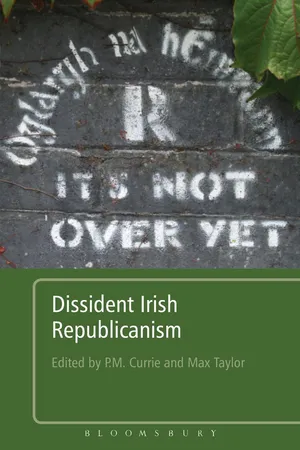
However, what this also seems to point to is a disjunction or divergence in UK policy towards terrorism in general as exemplified on the one hand by the events of 9/11, and on the other Irish terrorism. There seems to almost be a sense in the years following 9/11 that the Irish experience of terrorism was regarded as sui generis – perhaps both different from other forms of terrorism – but also after the Good Friday Agreement, essentially a problem solved in principle. But there is a paradox here that contributors to this volume have pointed out: to observers even in 2001, the threat of future dissident violence in some form was clear. This can be illustrated by the short but prescient article published in 2001 in the Irish Independent by John A. Murphy, a distinguished Irish historian, and reproduced as Appendix 1 to this chapter. While pointing out the violence (at that time) associated with what even then was termed dissident groups, Murphy draws attention to the phrase ‘it’s not over yet’5 on wall paintings located at the entrance to the Republican Plot in St Finbarr’s Cemetery in Cork. As Murphy points out, the wall painting also has the ‘Óglaigh na hÉireann’ phrase and a large capital R. The front cover to this book illustrates a similar wall painting (again from Cork, but a different location) taken in August 2010 suggesting a continuity between, at least, 2001 and now of symbols, aspiration and, given the growing violence in Ireland, commitment.
Óglaigh na hÉireann is the official Irish language title for the Irish Defence Forces. But it has also been a term used by a number of republican paramilitary organizations and offshoots at various times6 (a problem of naming Irish paramilitary groupings is their fluidity and multiple use of names). In the past it is a name that has been associated with an element of the Real IRA, and most recently it seems to be associated with a dissident faction of ex-Provisional IRA members in Belfast and South Armagh. It is one of the dissident groups that this volume is concerned with; others include the Continuity IRA and the Irish National Liberation Army (INLA). A brief synopsis of the current dissident groups is given in Appendix 2 to this Chapter.7 All of these groups exist within a broader framework of community-level violence and intimidation that has continued despite the ceasefires and decommissioning of weapons, and in which the various dissident groups seem to be involved, and from which they draw.
Was the apparent disjunction in UK policy towards terrorism noted above appropriate and did it matter? And indeed, is Irish terrorism in general, and the dissident republican violence we are concerned with here, something unlike that which we currently experience from al-Qaeda, and is it in this sense sui generis? Certainly Irish terrorism has on the whole lacked a strong international character, in contrast to al-Qaeda, and its focus relates to a limited geographical nationalist aspiration. It is often asserted that Provisional IRA violence was controlled and did not seek the mass casualties that seems to characterize the current radical Islamic threat; there are, however, sufficient and extensive examples (the Omagh bombing being one notable example) to suggest this is untrue for both the Provisional IRA and the current dissident republican groups. On the other hand, Irish republican terrorism has shown itself to be at least at times ideologically driven in ways that might, for example, suggest parallels between al-Qaeda suicide bombings and the republican hunger strikes of the 1980s. A number of the contributors to this volume have also identified ideology as a critical factor behind the rise in dissident violence. Whatever other differences there may be between radical Islamic terrorism and Irish republicanism, the sense of underlying ideological commitment might seem to be a shared quality. Our knowledge of the relationship between ideology and violence is unclear, but at least in this respect, the parallels between Irish terrorism and al-Qaeda may be greater than initially might be imagined. A further point of similarity may lie in the unattainability of their respective alleged goals by means of violence. Although this book is a testament to the continued political violence in Ireland, such violence is not remotely at previous levels, and there can be no question that negotiation rather than violence yielded the benefits of peace. And that became possible when politics rather than violence became an element in the equation.
Did the disjunction between the way the UK government responded to 9/11 and its response to Irish terrorism matter? From the Irish perspective it seems the answer to that is likely to be no. The peace process was well developed by 9/11, and as contributors to this volume note, it had acquired such political momentum within both UK and Irish contexts that to derail that process was politically unthinkable. The other important factor was, of course, that there was no suggestion of any Irish involvement in 9/11; however, had there been, we may well have seen very different responses.
An alternative perspective on the rise of dissident republican violence (which does not necessarily contradict the discussion presented above) might be that such violence is perhaps an expected, even maybe necessary, feature of post–peace settlement conditions, as past activists adjust to both ideological compromises brought by peace, and to changing lifestyles; Tonge alludes to this in Chapter 5. Border, Darby and McEvoy-Levy identify a series of conditions that might be associated with why peace agreements fail, and why violence continues.8 These are:
- The process or agreement was flawed
- Failure to carry supporters past the agreement
- Failure to implement the agreement
- Economic failure
- Security unrest
- Failure to deal with past violence
- Failure to inspire or pacify the next generation.
It...
Table of contents
- Cover
- Title Page
- Contents
- Chapter 1: Introduction
- Appendix 1
- Appendix 2
- Chapter 2: Why do People Become Dissident Irish Republicans?
- Chapter 3: Who Are the Dissidents? An Introduction to the ICST Violent Dissident Republican Project
- Chapter 4: Beyond the `Micro Group': The Dissident Republican Challenge
- Chapter 5: An Enduring Tradition or the Last Gasp of Physical Force Republicanism? `Dissident' Republican Violence in Northern Ireland
- Chapter 6: Radicalization and Internet Propaganda by Dissident Republican Groups in Northern Ireland since 2008
- Chapter 7: `Not Like in the Past': Irish Republican Dissidents and the Ulster Loyalist Response
- Chapter 8: Conclusion
- Bibliography
- eCopyright
Trusted by 375,005 students
Access to over 1.5 million titles for a fair monthly price.
Study more efficiently using our study tools.
Frequently asked questions
Yes, you can cancel anytime from the Subscription tab in your account settings on the Perlego website. Your subscription will stay active until the end of your current billing period. Learn how to cancel your subscription
No, books cannot be downloaded as external files, such as PDFs, for use outside of Perlego. However, you can download books within the Perlego app for offline reading on mobile or tablet. Learn how to download books offline
Perlego offers two plans: Essential and Complete
- Essential is ideal for learners and professionals who enjoy exploring a wide range of subjects. Access the Essential Library with 800,000+ trusted titles and best-sellers across business, personal growth, and the humanities. Includes unlimited reading time and Standard Read Aloud voice.
- Complete: Perfect for advanced learners and researchers needing full, unrestricted access. Unlock 1.5M+ books across hundreds of subjects, including academic and specialized titles. The Complete Plan also includes advanced features like Premium Read Aloud and Research Assistant.
We are an online textbook subscription service, where you can get access to an entire online library for less than the price of a single book per month. With over 1.5 million books across 990+ topics, we’ve got you covered! Learn about our mission
Look out for the read-aloud symbol on your next book to see if you can listen to it. The read-aloud tool reads text aloud for you, highlighting the text as it is being read. You can pause it, speed it up and slow it down. Learn more about Read Aloud
Yes! You can use the Perlego app on both iOS and Android devices to read anytime, anywhere — even offline. Perfect for commutes or when you’re on the go.
Please note we cannot support devices running on iOS 13 and Android 7 or earlier. Learn more about using the app
Please note we cannot support devices running on iOS 13 and Android 7 or earlier. Learn more about using the app
Yes, you can access Dissident Irish Republicanism by Max Taylor, P.M. Currie, Max Taylor,P.M. Currie in PDF and/or ePUB format, as well as other popular books in Politics & International Relations & Comparative Politics. We have over 1.5 million books available in our catalogue for you to explore.