eBook - ePub
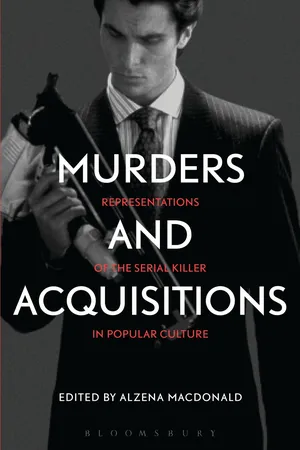
Murders and Acquisitions
Representations of the Serial Killer in Popular Culture
- 272 pages
- English
- ePUB (mobile friendly)
- Available on iOS & Android
eBook - ePub
About this book
The 'serial killer' has become increasingly prevalent in popular culture since the term was coined by Robert Ressler at the FBI in the mid-1970s. Murders and Acquisitions explores the social and political implications of this cultural figure. The collection argues that the often blood-chilling representations of the serial killer and serial killing offered in TV series, films, novels and fan productions function to address contemporary concerns and preoccupations. Focusing on well-known popular culture texts, such as The Wire, Kiss the Girls, Monster, the Saw series, American Psycho, The Strangers, CSI and Dexter, this eclectic anthology engages with a broad spectrum of cultural theory and performs critical textual analysis to examine the sophisticated ways the serial killer is deployed to mediate and/or work through cultural anxieties and fears.
Information
1
Dissecting the “Dark Passenger”: Reading Representations of the Serial Killer
Alzena MacDonald
Serial killers are so common . . . that you can’t swing a dead cat without hitting one.
ADAM BUCKMAN, 2008
It seems a truth universally acknowledged that the serial killer has achieved an overwhelming ubiquity in popular culture. In 1978, John Carpenter’s Halloween seduced cinema-goers with menacing images of a knife-crazed, masked villain, Michael Myers, stalking and, then, one-by-one, brutally hacking his teenage victims to their direful deaths. Myer’s harrowing chaos awakened the small, sleepy town of Haddonfield, Illinois, and transformed it into a murderer’s playground. Peter Hutchings (1996, 90, 92) notes that the despotic nature of Halloween “has been seen by many critics as inaugurating a new type of horror”; a horror that gave birth to reinvigorated “‘killing machines’” now known as serial killers. Following Halloween’s positive reception, serial killing became a recurrent narrative theme, and myriad representations of the acts and the people who perform them became increasingly pervasive in the news media, literature, television, and film.
The growth and popularization of representations of the serial killer in the late 1970s and throughout the 1980s can be attributed to the discursive construction of serial killing in the mid-1970s. The discourse emerged around the time that Robert Ressler, the cofounder of the Federal Bureau of Investigation’s renowned Behavioral Science Unit at Quantico, coined the term ‘serial killer’ in what he refers to as a “‘naming event’” (Seltzer 1998, 16). The serial killer, however, “is not a single deliberate act of invention, but a complex process of accumulation of ideas and representations” (Warwick 2006, 554). The serial killer, then, is a discursive construct; a figure that has been reified in popular culture. As this collection showcases, it is appropriated in various ways to articulate anxieties—spoken and unspoken—and to make “certain acts . . . intelligible and meaningful for us” (Cameron 1994, 151). The numerous earlier portrayals of serial killers (‘true crime’ accounts and fictional) are strongly informed by the reported detestable and bewildering behaviors of real-life criminals. Serial killers such as John Wayne Gacy (‘Killer Clown’), Ted Bundy, and David Berkowitz (‘Son of Sam’) had become household names and widely infamous by the end of the 1970s, specifically in the United States where they were ‘active’. Their repugnant rape and abuse of women and children were reviled by society. It is unsurprising, then, the serial killer became “the 1980s movie monster par excellence” (Hutchings 1996, 91) with prominent exemplar films including Calendar Girl Murders (1984), Nightmare on Elm Street (1984–91), The Deliberate Stranger (1986), Manhunter (1986), Henry: Portrait of a Serial Killer (1986), The Case of the Hillside Stranglers (1989), and, of course, the expansion of the Halloween franchise (parts II–V) throughout the decade.
Undoubtedly, serial killing received its most unforgettable exhibition in Jonathan Demme’s The Silence of the Lambs (1991) which became “a central point of reference in the renewed concern with serial homicide” (Jenkins 1994, 75). The film enjoyed massive critical and box-office success, and its winning three Academy Awards signaled an official acceptance of ‘serial killer’ films. In “The Serial Killer in Cinema,” Kimberley Tyrrell (2001, 274) identifies that “the representation of the serial killer fluctuates across films, from hero to monster, from inevitable by-product of culture to an explicable force of nature, from irredeemable to pitiable.” We are often positioned ambivalently viz-à-viz the serial killer who, traversing a spectrum of character forms, is embodied diversely. We may find ourselves confronted with a loathsome, well-styled narcissist—like Patrick Bateman who has a postmodern penchant for consumption—or we may be charmed by a crime-crusader—like Dexter Morgan who is romanticized as a ‘knight with knives’. In the last two decades, the serial killer and serial killing has featured heavily in films including, but not limited to, To Catch a Killer (1991), Natural Born Killers (1994), Se7en (1995), Copycat (1995), Fallen (1998), Summer of Sam (1999), The Bone Collector (1999), American Psycho (2000), Taking Lives (2004), Disturbia (2007), Funny Games and its remake (1997 and 2007 respectively), The Killer Inside Me (2010), The Call (2013), and the Scream (1996–2011) and Saw (2004–) franchises; television series such as the Law and Order (1990–) and CSI (2000–) franchises, NCIS (2003–), Criminal Minds (2005–), Bones (2005–), Dexter (2006–), The Following (2013–), and Hannibal (2013–); and novels such as The Lovely Bones (2002), as well as being the subject of a plethora of ‘true crime’ books focusing on the lives and exploits of real-life serial killers.
Multiple murder, however, is not a new ‘activity’ in the social. In Serial Murder: An Elusive Phenomenon, Steven A. Egger (1990, 29) contends that historical research “refutes the notion that serial murder is a contemporary phenomenon.” He argues that individuals who are responsible for the murders of many people have probably always been among us in the ‘real’ world, even if not cinematically. Taking a sociological approach, Elliot Leyton (1986, 269) claims that multiple murderers are “very much men of their time,” whose individual histories are enmeshed with social histories. For example, the preindustrial multiple murderer was most often an aristocrat, who murdered members of the ‘rebellious’ peasantry that threatened to usurp his authority (Leyton 1986, 273). In the industrial era, the major trend was the ‘new bourgeois’ who, operating as a ‘middle-class’ functionary, murdered social ‘deviants’ in an attempt to enforce a conservative “moral order” (Leyton 1986, 276). In the mature industrial era (post-World War Two) the multiple murderer is most often a failed middle-class subject who, feeling excluded from the normative social, wreaks “vengeance on the symbol and source of his excommunication” (Leyton 1986, 287–8). Given that there exists a social typography to multiple murder, and in light of the prevalence of serial killer representations, it seems reasonable to claim that the serial killer has achieved ‘popular’ status as a (western) “culture industry.”
While the experience of sequential killings is not particular to late capitalist society, its representation is. Although serial killers and serial killing now feature in almost every aspect of contemporary media, until relatively recently no terminology or discourse was available to articulate its practice, and hence there existed no language to adequately speak its representation. Prior to the invocation of the term ‘serial killer’, labels such a ‘repeat killer’ or ‘stranger killer’ were employed to refer to a person who committed murder repeatedly. The concurrent use of various terms indicates an epistemological struggle to delineate a definition. This was a result of an ongoing cultural angst to come to terms with performances of cruelty that fall under the rubric of ‘incomprehensible’ and ‘irrational’. The need for a unanimously employed label for menacing behavior underscores the desire to disarm serial killing as a source of cultural anxiety—for “that which is named is robbed of the power to threaten” (Hutchinson 1974, 46). The word “serial” seems most appropriate as it signifies the episodic pattern in which each instance of violence climaxes in murder while also connoting the anticipation of an offence or offences to follow. In terms of its representation, this label seems apt in a “mass culture [that] offers us a tradition of seriality in literature, film and television” (Coughlin 2000, 104).
Conceptualizations of serial killing have historically been in flux too. Egger (1990) claims that there are very few empirically determined definitions as most literature assumes that the terms “serial murder” and “serial murderer” are well understood within the culture. His seminal explanation, devised in 1983, reads as follows:
Serial murder occurs when one or more individuals—in most known cases, male—commit a second murder and/or subsequent murder; is relationshipless (victim and attacker are strangers); occurs at a different time and has no connection to the initial (and subsequent) murder; and is frequently committed in a different geographic location. (Egger 1990, 4)
Robert Ressler, however, describes serial killing as “murder of separate victims with time breaks between victims, as minimal as two days to weeks or months. These time breaks are referred to as a ‘cooling off period’” (quoted in Egger 1990, 5). Both these definitions focus on behavioral pattern, however Levin and Fox (1985) regard the serial killer as an individual who searches for and preys upon victims “whom he can rape and sodomize, torture and dismember, stab and strangle” (quoted in Egger 1990, 5). This latter definition understands serial killing as imbricated with acts of violence imposed on bodies, prior to murder itself, which has become a taken-for-granted aspect of serial killing tableaus. Our familiarity with the serial killer’s domain of violence is an effect of a steady flow of representations generated by mass media (Egger 1998, 85). If the genre so crudely highlights our corporeality by confronting us with images of torn-open bodies and ritualistic viciousness imposed on people, especially women, the question begs: why is gratuitous assault so popular in our culture?
In The Killers Among Us: An Examination of Serial Murder and its Investigation, Egger (1998) argues that serial killing is spectacularized by the mass media in its discursive production of a genre that satisfies the culture’s obsessions with violence. Violence is not a recent site of cultural consumption, entertainment or artistic muse. In The Aesthetics of Murder Joel Black (1991, 3) recounts Edmund Burke’s interest in the enthusiasm of an eighteenth-century public who had gathered to witness the execution of Lord Lovat. Burke had pondered: “What work of art could compete with the reality of such a spectacle?” The mass media’s gratuitous depictions of corporeal afflictions is indicative of the “effacement of the boundary between art and everyday life, the collapse of the distinction between high art and mass/popular culture” (Featherstone 2007, 64) that is characteristic of postmodernism. As murder is experienced aesthetically via mass media representation, the serial killer, despite his unsavoury activities, can be regarded as an artist—“a performance artist or anti-artist whose specialty is not creation but destruction” (Black 1991, 14). The aestheticization of serial killing provides a space where private desire and public fantasy converge to an extent that the culture’s appetite for violence may be sated via the positioning of the viewer to read the shocking realism as if it were “an art form” (Egger 1998, 90).
Serial killing is discursively produced by and within a media-managed culture that is simultaneously hyperreal and aesthetic. Black (1991, 9) argues that while the mass media exposes us to “artistic presentations of violence,” its mediation of actual events such as murder transgresses the lucidity of ‘reality’ to enter the domain of the “quasi-fictional” (Black 1991, 10). In Using Murder Philip Jenkins (1994, 81) remarks that, “in coverage of serial murder, the boundaries between fiction and real life were often blurred to the point of non-existence.” Similarly, Egger proposes that, in the processes of informing the public, the media does not relay accurate reports but, rather, offers audience-fabricated accounts that construct a reality that effectively perpetuates a generic myth about serial killers and their ‘work’. Egger (1998, 88) notes that central to these portrayals is the notion of the profile—a summary of the offender’s “criminal background, his motivation, the type of victim he selects, and how the police will eventually catch him.” Depictions of the Federal Bureau of Investigation as “experts on the phenomenon of serial killing,” and responsible for the creation of the profile, function to validate the purported authenticity of these accounts (Egger 1998, 89).
The serial killing genre, in its enduring propagation by the film industry (primarily Hollywood), has become synonymous with uninhibited slaughter and a style of murder that is articulated in fine detail, often involving the playing out of a repertoire of sadistic games performed on vulnerable bodies that showcase the nightmares of our imaginations. The generic history of this cultural figure is located in the Jack the Ripper murders (Stratton 1996, 92) that took place in lower socioeconomic areas of Whitechapel in Autumn 1888. The five crimes attributed to the never-identified ‘Jack’ have been immortalized via a plethora of blood-curdling recollections of the bodies of female prostitutes found lying in slums—their abdomens ripped open from breastbone to pelvis, intestines thrown over the shoulders. The gruesome representation of the ‘Ripper’ murders has informed the mythology of the serial killer as an intelligent male, elusive, and obsessed with ‘doing things’ to and with bodies.
In postmodern culture, the body has become the pre-eminent site of spectacle or representation, “most insistently, as spectacle or representation of crisis, disaster, or atrocity” (Seltzer 1995, 130). This is realized nowhere more fully than in the discourse of serial killing, as serial killers, in both their generic construction and practice, take pleasure in violating bodies: rape, dissection, and cannibalism. Ed Gein, who terrorized Wisconsin in the 1950s, engaged in grave-robbing, murder, flaying, and cannibalism (Stratton 1996, 92). In the 1960s case of Albert Henry DeSalvo (the ‘Boston Strangler’), it was reported that “[e]leven of his victims had been sexually assaulted; most died by strangulation, and their bodies had been desecrated and placed in bizarre positions after they were slain” (Kelleher and Kelleher 1998, ix). In searching the home of Jeffrey Dahmer, who targeted homosexual men in the Milwaukee area in the years 1978–91, police discovered hacked-off male genitalia in kettles and metal drums. With the fury of media attention serial killers receive, they shift instantly from obscurity to infamous icon, despite apparent public and legal condemnation. In 1992 public interest in Dahmer’s trial, and more probably his savage...
Table of contents
- Cover
- Title
- 1 Dissecting the “Dark Passenger”: Reading Representations of the Serial Killer
- 2 ‘Made-up and Made-over’: Faking the Serial Killer and the Serial Killer Fake
- 3 Serial Killing, Surveillance, and the State
- 4 Forced Entry: Serial Killer Pornography as a Patriarchal Paradox
- 5 Defining Deviance: The Rearticulation of Aileen Wuornos in Monster
- 6 “LOOK AT ME”: Serial Killing, Whiteness, and (In)visibility in the Saw Series
- 7 Shopping and Slaying, Fucking and Flaying: Serial Consumption in American Psycho
- 8 ‘Slash Production’: Objectifying the Serial “ Kiler” in Euro-Cult Cinema Fan Production
- 9 Do Serial Killers Have Good Taste?
- 10 Defacing the Acquisitions: A Museal-Analysis of Serial Killing Horror in Cinema
- 11 “There’s Blood on the Walls”: Serial Killing as Post-9/11 Terror in The Strangers
- 12 Hunting Minds, Hunting Genes: From Profiling to Forensics in TV Serial Killer Narratives
- 13 Homme Fatal: Illegitimate Pleasures in Darkly Dreaming Dexter
- List of Contributors
- Index
Trusted by 375,005 students
Access to over 1.5 million titles for a fair monthly price.
Study more efficiently using our study tools.
Frequently asked questions
Yes, you can cancel anytime from the Subscription tab in your account settings on the Perlego website. Your subscription will stay active until the end of your current billing period. Learn how to cancel your subscription
No, books cannot be downloaded as external files, such as PDFs, for use outside of Perlego. However, you can download books within the Perlego app for offline reading on mobile or tablet. Learn how to download books offline
Perlego offers two plans: Essential and Complete
- Essential is ideal for learners and professionals who enjoy exploring a wide range of subjects. Access the Essential Library with 800,000+ trusted titles and best-sellers across business, personal growth, and the humanities. Includes unlimited reading time and Standard Read Aloud voice.
- Complete: Perfect for advanced learners and researchers needing full, unrestricted access. Unlock 1.5M+ books across hundreds of subjects, including academic and specialized titles. The Complete Plan also includes advanced features like Premium Read Aloud and Research Assistant.
We are an online textbook subscription service, where you can get access to an entire online library for less than the price of a single book per month. With over 1.5 million books across 990+ topics, we’ve got you covered! Learn about our mission
Look out for the read-aloud symbol on your next book to see if you can listen to it. The read-aloud tool reads text aloud for you, highlighting the text as it is being read. You can pause it, speed it up and slow it down. Learn more about Read Aloud
Yes! You can use the Perlego app on both iOS and Android devices to read anytime, anywhere — even offline. Perfect for commutes or when you’re on the go.
Please note we cannot support devices running on iOS 13 and Android 7 or earlier. Learn more about using the app
Please note we cannot support devices running on iOS 13 and Android 7 or earlier. Learn more about using the app
Yes, you can access Murders and Acquisitions by Alzena MacDonald in PDF and/or ePUB format, as well as other popular books in Social Sciences & Media Studies. We have over 1.5 million books available in our catalogue for you to explore.