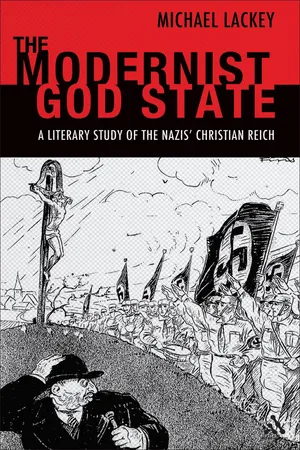
The Modernist God State seeks to overturn the traditional secularization approach to intellectual and political history and to replace it with a fuller understanding of the religious basis of modernist political movements. Lackey demonstrates that Christianity, instead of fading after the Enlightenment, actually increased its power by becoming embedded within the concept of what was considered the legitimate nation state, thus determining the political agendas of prominent political leaders from King Leopold II to Hitler.
Lackey first argues that novelists can represent intellectual and political history in a way that no other intellectual can. Specifically, they can picture a subconscious ideology, which often conflicts with consciously held systems of belief, short-circuiting straight into political action, an idea articulated by E.M. Forster. Second, in contrast to many literary scholars who discuss Hitler and the Nazis without studying and quoting their texts, Lackey draws his conclusions from close readings of their writings. In doing so, he shows that one cannot understand the Nazis without taking into account the specific version of Christianity underwriting their political agenda.
- 368 pages
- English
- ePUB (mobile friendly)
- Available on iOS & Android
eBook - ePub
About this book
Information
PART TWO
The Theology of the Modernist God State
3
“In-depth Christianization”: E. M. Forster and the modernist “religious sense”
I foreground Foucault’s work on in-depth Christianization in this chapter in order to expose some of the limitations of those approaches that are currently reworking and reassessing the secularization hypothesis. The first approach holds that the seemingly secular West, whether it recognizes it or not, is very much indebted to religious ways of thinking. Tracy Fessenden develops this approach in Culture and Redemption: Religion, the Secular, and American Literature by using race theory to demonstrate that a white=Christian=American formulation was the implicit basis of identity in the United States from the time of the Pilgrims. This discourse enabled early Americans to configure minorities, especially Indians, “as the unregenerate Other to the Puritans’ salvific Word.”1 After the United States seemingly underwent a process of secularization, Fessenden argues, the “Protestant discourse of religious otherness [morphed] into a secular discourse of racial otherness,”2 thus establishing a clear continuity rather than a decisive rupture between America’s religious conception of subjectivity and its secular correlative. In Secularization and Cultural Criticism: Religion, Nation, & Modernity, Vincent Pecora focuses on modern philosophy and social theory to demonstrate that Western secularization, instead of having effectively overcome or supplanted religion, is for the most part a sublimation and/or distortion of a theological mindset and sensibility. Therefore, “what we complacently understand as ‘secular,’” Pecora argues, “comes with certain historical and religious strings attached.”3 According to this approach, writers with a secular bent might have been indifferent or even hostile to religion, but their “secular” models are rooted in a theological way of thinking nonetheless.
The second approach holds that most post-Enlightenment writers were not very hostile to religion, and as a consequence, their “secular” works, instead of trying to eliminate religion, were merely trying to redefine religion’s role within the modern polity. For instance, Pericles Lewis argues that the “sheer abundance of churchgoing scenes in the modernist novel suggests the need to rethink the secularization hypothesis.”4 Within Lewis’s framework, what we witness during the modernist period is not Weberian disenchantment, but a shift “of the forces of enchantment from the public forum of churches to the private world of individual experience.”5 Put differently, there was neither hostility towards nor an attempt to eliminate religion among modernists. Rather, there was simply a need and desire to relocate it. As Michael Allen Gillespie claims in The Theological Origins of Modernity: “from the very beginning modernity sought not to eliminate religion but to support and develop a new view of religion and its place in human life, and […] it did so not out of hostility to religion but in order to sustain certain religious beliefs.”6 More specifically, Gillespie argues that what we actually witness in modernity is “the gradual transference of divine attributes to human beings (an infinite human will), the natural world (universal mechanical causality), social forces (the general will, the hidden hand), and history (the idea of progress, dialectical development, the cunning of reason).”7 According to this second approach, both philosophical and literary modernists were never that hostile to religion, nor were they trying to eliminate it. Rather, they were merely trying to redefine and relocate it within the society and the mind.
Foucault has a very different approach to the shifts in religion’s role in the West, but it is not so much because he deploys an alternative model of secularization but because he has a very different starting point for analysis. In essence, Foucault shifts the focus from secularizationists and their seemingly religion-destroying frameworks to the religious and their updated Christian paradigms. Put differently, rather than treating religion as a passive and stable conceptual system that will slowly but surely be supplanted by secular modernists, Foucault considers it an ever-evolving and ever-adapting system that will remake itself in relation to emerging political and conceptual realities. For Foucault, the idea that Enlightenment and post-Enlightenment theories of knowledge could supersede faith and religion is premised on a superficial understanding of and approach to religion. Indeed, Foucault argues that the Enlightenment, instead of setting into motion a theory of knowledge that would eventually and inevitably supplant religion, actually created the conditions for religion to substantially increase its power over individuals.
In this chapter, I use and expand on Foucault’s theory of “in-depth Christianization” in order to clarify not only how but also the degree to which Christianity exerted, at the level of the subconscious, an overwhelming power to shape everyday people’s political views and to determine their behavior in the early to mid-twentieth century. When I say subconscious, I do not mean something that was occurring at a psychological level too profound for anyone to comprehend. Quite the contrary, I mean a strategic agenda, which was crafted by a religiously committed segment of the society, to Christianize people in the West at the level of the subconscious. We see this specific approach to Christianizing the West most clearly in the secret and just recently published writings of the Moot, an organization of prominent intellectuals, including T. S. Eliot, Karl Mannheim, John Middleton Murry, and Christopher Dawson, who met regularly from 1938 until 1947.8 These papers are extremely valuable, for the members, who would normally be much more judicious and guarded in their public writings, are extremely frank and candid in expressing their views and objectives in these private meetings. The Moot’s agenda was to initiate a massive movement to re-Christianize the West. Indeed, J. H. Oldham, a former Scottish missionary and a founder of the group, outlines its ambitious objectives in one of its agenda-setting documents, which is titled: “A Reborn Christianity”: “If we are serious in speaking of a re-born Christendom, we can only mean something which, if it were to come to pass, the historian of the future would regard as having comparable historical significance with the new social doctrines and systems which have emerged in our time.”9 The “social doctrines” of their time were Communism and Fascism, and the members of the Moot compared their movement to these two on a regular basis. For members of the Moot, given the separation of church and state in the West, it was no longer possible to deploy or re-establish the traditional Christian model in which the church would have an equal say with, if not a greater say than, the state in determining the nature and agenda of the Western polity, which is why the Moot made a plea for “a new Christendom,” one that would “call into existence a body of people convinced in the depths of their being that the hope of the world lies in the recovery of the Christian heritage, not in the sense of merely going back to the past, but of rediscovering in the central Christian affirmations new sources of spiritual energy to regenerate society.”10
If Christianity is going to recover its power and authority, it would have to find a new strategy for determining the nature and agenda of the Western polity, and one strategy was to structure the subconscious of the “ordinary man.” Oldham formulates one version of this subconscious approach when he articulates what is of ultimate epistemological importance with regard to the Christianization of the West:
A political faith expressing itself in a definite social philosophy is not the same thing as the political programme of a parliamentary party. What is meant is a body of assumptions, purposes and ways of behavior which are shared by the great majority of the people and are the common foundation of different party programmes and varying intellectual formulations.11
Not the conscious and rational declarations of an official document such as a party program, but the unstated assumptions of the people is what really matters, so if the Moot were to “christianise the State and society,”12 as Eliot defines the objective, then it would have to focus primarily on “the substratum of collective temperament, ways of behaviour and unconscious values.”13 What twentieth-century intellectuals as varied as Eliot (and the Moot) and Forster realize is that clearly formulated agendas in documents such as party programs are really of secondary importance to the unconscious, subconscious, or sub-textual ideologies that determine one’s epistemological orientation. Eliot’s ideas about Christianizing the state at the level of the subconscious proved decisive for members of the Moot, but striking is the degree to which Forster suggests that many of the Moot’s strategies were already in operation 25 years before its first meeting. Therefore, instead of claiming that Eliot and the Moot were the sole or even primary originators of a comprehensive philosophy to Christianize the state and society at the level of the subconscious, I will argue that it makes more sense to see them as the most articulate spokespeople for a new Christianizing strategy that was taking decisive shape throughout the West in the late nineteenth and early twentieth centuries. Indeed, John Robert Seeley, Regius Professor of Modern History at Cambridge and author of the groundbreaking 1883 study The Expansion of England, formulated in the nineteenth century a modernist version of the Christian nation state that would become dominant in the first half of the twentieth century.
As I mentioned in Chapter 2, it was when Forster wrote his overtly homosexual novel Maurice (1913–1914) that he started to reject the traditional secularization hypothesis. Moreover, it was at this time that he started to understand the degree to which a version of in-depth Christianization was at work within the culture, which in part explains Forster’s rejection of the secularization hypothesis. Worth noting are the stunning parallels between the themes in Forster’s Maurice and the ideas in Foucault’s 1974–1975 course Abnormal: Lectures at the College de France. Both works examine the construction of the normal/abnormal in relation to sexuality, interrogate the role in-depth Christianity plays in normativizing discourse about sexuality, and explore how Christianity’s normativized discourses ultimately shape the political agenda. It is my contention that Forster’s novel intelligently defines one of the new approaches Christians were using to Christianize people, society, and the political, and it was his understanding of the primacy of the subconscious that makes his work so prescient.
I
The fifteenth and sixteenth centuries mark, Foucault claims in Abnormal, the beginning not of de-Christianization but of a new wave of Christianization. The first manifestation of the new wave was the Spanish Inquisition, which used physical and legal methods to coerce individuals into belief and/or to expel non-believers from the body politic. One of the many unfortunate consequences of the Inquisition was the violent persecutions of witches. Within Foucault’s framework, witchcraft is significant because it allows the Church to wield excessive authority in the realms of the legal and the political. For example, the Christian community defines the witch as a being in league with the devil, and as such, he or she can be legally punished: “Witchcraft is then codified, captured, judged, repressed, burned, and destroyed by the mechanisms of the Inquisition. Witchcraft, then, is caught up within the process of Christianization.”14 In the end, however, the witch symbolizes the failure of the Inquisition and its techniques, for by the seventeenth century, Inquisition methods were exposed as barbaric and uncivilized, thus undermining Church authority while simultaneously strengthening state claims to power.
The failures of Inquisition approaches led sixteenth- and seventeenth-century church leaders to develop more subtle techniques of control, what Foucault refers to as “in-depth Christianization,” which explains the rise of confession and spiritual direction during the Reformation and the Counter-Reformation. By shifting the locus of authority from the established Church to the individual conscience, it would seem that Reformation Protestants activated the autonomous faculty of reason while they simultaneously liberated individuals from dogmatic and homogenous systems of belief. But what actually occurred was that Protestant churches increased their power by evolving extremely sophisticated techniques of examination and mechanisms of control. Through the “practice of confession-examination of conscience and spiritual direction,”15 Protestants were able to structure and discipline people into a belief that was considered inevitable and inviolable. For instance, “we see,” Foucault argues, “the emergence in English Puritan circles of the practice of permanent autobiography in which each individual recounts his own life to himself...
Table of contents
- Cover
- The Modernist God State
- Dedication
- Contents
- Acknowledgments
- Debunking the Secularization Hypothesis
- The Theology of the Modernist God State
- The Nazis’ Christian Reich
- Conclusion The theological origins of Hitler and the Nazis: a question of method
- Bibliography
- Index
- Copyright
Trusted by 375,005 students
Access to over 1.5 million titles for a fair monthly price.
Study more efficiently using our study tools.
Frequently asked questions
Yes, you can cancel anytime from the Subscription tab in your account settings on the Perlego website. Your subscription will stay active until the end of your current billing period. Learn how to cancel your subscription
No, books cannot be downloaded as external files, such as PDFs, for use outside of Perlego. However, you can download books within the Perlego app for offline reading on mobile or tablet. Learn how to download books offline
Perlego offers two plans: Essential and Complete
- Essential is ideal for learners and professionals who enjoy exploring a wide range of subjects. Access the Essential Library with 800,000+ trusted titles and best-sellers across business, personal growth, and the humanities. Includes unlimited reading time and Standard Read Aloud voice.
- Complete: Perfect for advanced learners and researchers needing full, unrestricted access. Unlock 1.5M+ books across hundreds of subjects, including academic and specialized titles. The Complete Plan also includes advanced features like Premium Read Aloud and Research Assistant.
We are an online textbook subscription service, where you can get access to an entire online library for less than the price of a single book per month. With over 1.5 million books across 990+ topics, we’ve got you covered! Learn about our mission
Look out for the read-aloud symbol on your next book to see if you can listen to it. The read-aloud tool reads text aloud for you, highlighting the text as it is being read. You can pause it, speed it up and slow it down. Learn more about Read Aloud
Yes! You can use the Perlego app on both iOS and Android devices to read anytime, anywhere — even offline. Perfect for commutes or when you’re on the go.
Please note we cannot support devices running on iOS 13 and Android 7 or earlier. Learn more about using the app
Please note we cannot support devices running on iOS 13 and Android 7 or earlier. Learn more about using the app
Yes, you can access The Modernist God State by Michael Lackey in PDF and/or ePUB format, as well as other popular books in Literature & Literary Criticism. We have over 1.5 million books available in our catalogue for you to explore.