- 232 pages
- English
- ePUB (mobile friendly)
- Available on iOS & Android
eBook - ePub
About this book
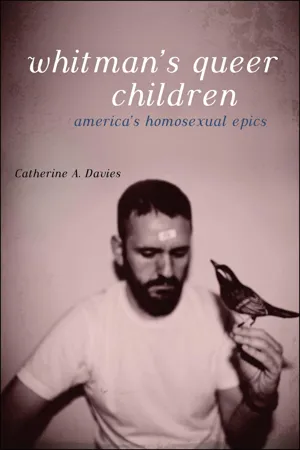
Davies examines the work of four of the most important twentieth-century poets who have explored the epic tradition. Some of the poems display an explicit concern with ideas of American nationhood, while others emulate the formal ambitions and encyclopaedic scope of the epic poem. The study undertakes extensive close readings of Hart Crane's The Bridge (1930), Allen Ginsberg's ?Howl? (1956) and The Fall of America: Poems of These States 1965-71 (1972), James Merrill's The Changing Light at Sandover (1982), and John Ashbery's Flow Chart (1991). Although not primarily an account of a Whitmanian lineage, this book considers Whitman's renegotiation of the dialectic between the public and the private as a context for the project of the homosexual epic, arguing for the existence of a genealogy of epic poems that rethink the relationship between these two spheres. If, as Bakhtin suggests, the job of epic is to ?accomplish the task of cultural, national, and political centralization of the verbal-ideological world,? the idea of the ?homosexual epic? fundamentally problematizes the traditional aims of the genre.
Information
Chapter 1
‘Stranger in America’: Hart Crane’s Homosexual Epic
(i) The Bridge
This chapter explores the challenges involved in writing an epic poem by looking at the example of Hart Crane’s The Bridge (1930). In the course of exploring the poem’s genesis and production, I propose that there is a strong case for moving beyond pathological readings of the work, taking it out of its critical isolation as an example of a ‘failed modernist project’ and placing the poem within a broader tradition of, what I have termed, the homosexual epic. While Crane’s homosexuality marginalized him during his lifetime, he has come to stand, if only posthumously, at the very centre of the tradition discussed here.1 Within this pantheon, Crane is uniquely situated, writing with greater anxiety about his sexuality than his predecessors did, or successors would. In this way, The Bridge offers unique insight into the historical contingencies of writing an epic at a time when homosexuality was becoming increasingly visible, but was not yet visibly politicized.
As Christopher Nealon has argued, Crane is positioned at an important frontier in the history of homosexual writers. As a ‘foundling’ of American literature, Nealon argues that texts such as The Bridge express what he calls ‘foundling’ issues by focusing on issues of exile from traditional families, while simultaneously longing for nation and history.2 Crane’s poem stands as an important example in the history of homosexual writers, as a record of the poet’s struggle to mediate between his poetic ambitions and the expression of his sexuality. Writing at a moment in history when the anxiety of revelation was a possibility that had not been available to Whitman (and would eventually, after a period of intensified persecution, dissipate significantly during the times of his successors), Crane’s position in the homosexual epic tradition is unique.
Following Jared Gardner’s reading of The Bridge through discourses of racial and sexual identity,3 I address the position of Crane as a homosexual man in 1920s America by looking at contemporary discourses of citizenship and how these are reflected in, for example, the ways in which The Bridge imagines the narrative union of the poet with the Native American. I begin by looking at the dominant critical interpretations of Crane’s poetry before moving on to consider the distinctive nature of the American epic, in relation to its European precedents. The second half of this chapter considers the ideological problems involved in writing a homosexual epic, exploring Whitman’s legacy for Crane. Finally, I will undertake some close readings of sections from ‘The Dance’ section of The Bridge to illustrate the way Crane’s poetic strategies seek to imagine the homosexual as the emblematic American citizen.
(ii) ‘Stranger in America’4
The body of commentary that surrounds Crane’s work has generally presented him as a figure of disappointment, occasionally casting this failure as ‘important’5 or even, paradoxically as ‘splendid’.6 Yvor Winters and Allen Tate were the first to propose these kinds of readings of Crane’s work, which strongly partake of nineteenth-century medical constructions of homosexuality, linking Crane’s suicide and poetic failure to a neurosis that is seen as symptomatic of his sexuality.7 These critical constructions perpetuate the myth of the homosexual thanatos, where same-sex desire is conflated with the desire (to paraphrase Thom Gunn) for one’s own annihilation.8
After Leo Bersani’s essay of 1987, ‘Is the Rectum a Grave?’, which firmly established queer theory’s fascination with ‘self-shattering’, Crane became somewhat of a paradigm for what Michael Snediker calls ‘queer self-dissolution’, spawning a proliferation of narratives of self-destructive jouissance.9 This tendency to turn to psychopathological readings of Crane’s biography has given rise to the rather schizophrenic appearance of what we might call ‘Crane studies’. Where once it had been occluded,10 homosexuality has found its way to the centre of many of the most recent critical appraisals of Crane’s work.11 This critical emphasis on the Dionysian spectacle of Crane’s conflicts in his romantic and creative life began with Yvor Winters’ comments on the ‘wreckage’ of The Bridge in his review of the poem,12 and is encapsulated in the title of Edward Brunner’s 1985 study of Crane, Splendid Failure: Hart Crane and the Making of The Bridge.
While other modernist epics, such as Pound’s Cantos, have received similar critical attention in terms of the emphasis upon their incoherencies and failings, The Bridge is unique in that its formal and thematic shortcomings are often cast as a symptom of Crane’s sexuality, rather than attributed to his inability to achieve a successful poetic synthesis of his impulses towards the Modernist and the Whitmanian. However, if The Bridge’s final incoherencies are to be read in part as the product of the ideological impossibility of a homosexually authored epic (as Thomas Yingling has persuasively argued),13 then Crane’s poem makes a fine starting point for my discussion of the ways in which homosexuality has renegotiated its exclusion from the epic project of telling ‘the tale of tribe’.
From Crane’s conception in 1923 of a poem that would express the ‘mystical synthesis of “America” ’,14 to its publication in 1930, The Bridge became the means through which Crane could attempt not only to re-conceive of what a truly modern epic might be, but, in doing so, also to rethink his sense of self, as both poet and American citizen.15 By utilizing contemporary citizenship discourses, Crane transformed himself from a ‘stranger in America’ into an emblematic American citizen and epic hero.
Robert Lowell’s peculiar elegy, ‘Words for Hart Crane’ (1959), introduces Crane as a biographical sketch – an approach that is typical of the critical treatment received by the poet since his suicidal leap into the Gulf of Mexico. In the inverted sonnet, Lowell sketches Crane ‘stalking sailors’ ‘by the Place de la Concorde’, ‘wolfing the stray lambs’,16 echoing this image of Crane as a stereotypically tragic figure of predatory homosexuality who fulfilled the destiny of his alcoholic life and failed poetic ambitions by jumping from the deck of the OrizabaI in 1932.17 Reading somewhat like a potted biography, the poem can do much to introduce the uninitiated reader to the main plot-points of Crane’s short existence. While Lowell’s poem is complicit with much of the critical sensationalism surrounding Crane in placing much of its emphasis upon sexual exploits, in recognizing the performativity of Crane’s homosexuality as a ‘role’ of expectation to be played (‘I used to play my role/of homosexual, wolfing the stray lambs’), Lowell goes someway beyond the critics and friends (such as Allen Tate) who saw Crane’s homosexuality as something fatal to his poetic ambitions.18
Born in Garrettsville, Ohio, in 1899, Crane left for New York City at the age of 17 with the intention of preparing to enter college. His formal education, however, was never to be resumed, and the poet spent the next 7 years drifting from job to job and residence to residence, as the friends who generously offered up their hospitality quickly, and almost inevitably, grew tired of Crane’s drinking and erratic behaviour.19 His already desperate financial situation was not helped by his refusal to deviate for too long from his chosen vocation. As Lowell frames it, Crane’s ‘profit’ for following his poetic vision was often a ‘pocket with a hole’, leaving the young poet looking for ‘bed and board’ with friends and fellow writers in a bid not to have to return to the stifling fold of his father’s successful confectionery business in Ohio.
This constant sense of displacement is figured from the outset of The Bridge. Its opening epigraph, taken from the Book of Job, echoes Crane’s own sense of unrelenting motion, through Satan’s account of his restless wanderings ‘going to and fro in the earth,/and from walking up and down in it’ (CPHC, 41). Crane found himself journeying from his father’s factory in Cleveland, Ohio, to New York, Paterson, the Isle of Pines, Hollywood, Europe, and finally to Mexi...
Table of contents
- Cover
- Half-Title
- Title
- Contents
- List of Abbreviations
- Acknowledgements
- Introduction
- Chapter 1: ‘Stranger in America’: Hart Crane’s Homosexual Epic
- Chapter 2: ‘It occurs to me that I am America’: Ginsberg’s Queer Shoulder
- Chapter 3: ‘Narcissus bent/Above the gene pool’: James Merrill’s Epic of Childlessness
- Chapter 4: ‘The natural noise of the present’: John Ashbery’s Flow Chart
- Postscript
- Bibliography
- Index
- Copyright
Trusted by 375,005 students
Access to over 1.5 million titles for a fair monthly price.
Study more efficiently using our study tools.
Frequently asked questions
Yes, you can cancel anytime from the Subscription tab in your account settings on the Perlego website. Your subscription will stay active until the end of your current billing period. Learn how to cancel your subscription
No, books cannot be downloaded as external files, such as PDFs, for use outside of Perlego. However, you can download books within the Perlego app for offline reading on mobile or tablet. Learn how to download books offline
Perlego offers two plans: Essential and Complete
- Essential is ideal for learners and professionals who enjoy exploring a wide range of subjects. Access the Essential Library with 800,000+ trusted titles and best-sellers across business, personal growth, and the humanities. Includes unlimited reading time and Standard Read Aloud voice.
- Complete: Perfect for advanced learners and researchers needing full, unrestricted access. Unlock 1.5M+ books across hundreds of subjects, including academic and specialized titles. The Complete Plan also includes advanced features like Premium Read Aloud and Research Assistant.
We are an online textbook subscription service, where you can get access to an entire online library for less than the price of a single book per month. With over 1.5 million books across 990+ topics, we’ve got you covered! Learn about our mission
Look out for the read-aloud symbol on your next book to see if you can listen to it. The read-aloud tool reads text aloud for you, highlighting the text as it is being read. You can pause it, speed it up and slow it down. Learn more about Read Aloud
Yes! You can use the Perlego app on both iOS and Android devices to read anytime, anywhere — even offline. Perfect for commutes or when you’re on the go.
Please note we cannot support devices running on iOS 13 and Android 7 or earlier. Learn more about using the app
Please note we cannot support devices running on iOS 13 and Android 7 or earlier. Learn more about using the app
Yes, you can access Whitman's Queer Children by Catherine A. Davies in PDF and/or ePUB format, as well as other popular books in Literature & Literary Criticism in Poetry. We have over 1.5 million books available in our catalogue for you to explore.