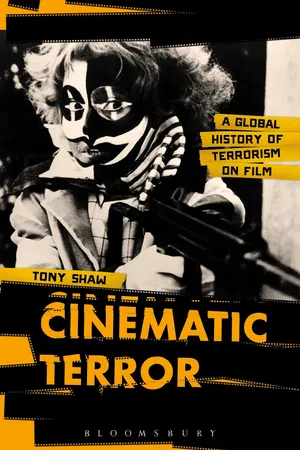
Cinematic Terror takes a uniquely long view of filmmakers' depiction of terrorism, examining how cinema has been a site of intense conflict between paramilitaries, state authorities and censors for well over a century. In the process, it takes us on a journey from the first Age of Terror that helped trigger World War One to the Global War on Terror that divides countries and families today.
Tony Shaw looks beyond Hollywood to pinpoint important trends in the ways that film industries across Europe, North and South America, Asia, Africa and the Middle East have defined terrorism down the decades. Drawing on a vast array of studio archives, government documentation, personal interviews and box office records, Shaw examines the mechanics of cinematic terrorism and challenges assumptions about the links between political violence and propaganda.
- 328 pages
- English
- ePUB (mobile friendly)
- Available on iOS & Android
eBook - ePub
About this book
Information
CHAPTER 1
SILENT REVOLUTIONARIES

It’s difficult to make anything out at first, partly because the film is so grainy and judders so much. When a steam train pans into view, moving left to right, things start to become clearer. We are looking, from the outside, at the high, forbidding walls of a prison in upstate New York. Inside the train – though we don’t yet see him – is the world’s most notorious ‘terrorist’, Leon Czolgosz. Three months earlier, in September 1901, in nearby Buffalo, Czolgosz assassinated the president of the United States, William McKinley. Now, the self-proclaimed anarchist has his own appointment with death – and we are about to witness it.
Dissolve to the inside of the prison, later the same day. Tighter shots accentuate the tense, claustrophobic atmosphere. Four uniformed officers fetch Czolgosz from a cell in murderer’s row and bring the prisoner into the execution chamber. Czolgosz is quickly strapped into an electric chair, in the middle of the frame, and stares straight ahead, as if he is meeting eyes with the cinema audience. A crude metal dish, with wires attached, is fixed to his skull; one of his trouser legs is pulled up to the knee, exposing his skin to the imminent voltage surge. The State Electrician, a busy little man with an efficient manner, checks that everything is ready – and pulls the switch.
Three bursts of electricity, each lasting about four seconds long, shoot through Czolgosz’s veins. Because the film is silent we cannot hear any cries of pain but we do see Czolgosz’s body dramatically spasm and lift off the seat, showing us how powerful each surge is. The terrorist heaves so violently it looks as though the straps will break. He drops prone after the current is turned off. Czolgosz will have been ‘fried alive’, as the watching journalists put it.
Moments later, two doctors unbutton Czolgosz’s shirt and check he is no longer breathing. When the physicians nod to the warden and stand back, thereby allowing us to see the body unencumbered, we know it is all over. No words are spoken, no inter-titles are necessary. Czolgosz and the film are at an end.
Owing to a paucity of archival records, it is impossible to get a complete picture of how cinema dealt with the subject of terrorism during the medium’s formative decades. This is particularly the case for the early silent era, when most films were made on highly flammable nitrate and the majority of films about terrorism, because they usually related to topical, day-to-day news items, were deemed to be of little permanent value. Enough material survives, however, especially in American and British archives, to suggest that film-makers fell in love with terrorism – if not terrorists themselves – immediately.
That cinema should develop a special relationship with terrorism begins to make sense once we realize that the two were effectively born simultaneously. When the Lumière Brothers publicly exhibited their first films in Paris in 1895, famously changing the face of modern media history, Europe and the United States were in the throes of what many now call the first Age of Terror. Though the roots of modern-day terrorism might be said to lie in the Jacobins’ Reign of Terror following the 1789 French Revolution – when the government in Paris proclaimed that a systematic campaign of violence and intimidation was necessary to create a democracy – it took another century before the word ‘terrorist’ really captured the public’s imagination.1 It was then, in the late nineteenth and early twentieth centuries, that revolutionary terrorism first began to be used as a coherent strategy and, just as importantly, when mass communications existed to carry its threat far and wide.
The decades preceding the First World War were a time of profound economic, technological, social and cultural change in large parts of the industrialized world. Movements calling for political ‘progress’, even revolution, followed alongside. Most people involved in these movements, including many anarchists and nihilists opposed to all state power, campaigned peacefully. However, encouraged by, among other things, the recent invention of dynamite and a communications revolution that included mass-circulation newspapers and the cinema, small groups of bomb-wielding, gun-toting anarchists and nihilists declared war on the political establishment in Europe and the United States. Central to their strategy was what they termed the ‘propaganda of the deed’, high-profile actions designed to attract the maximum publicity for their cause using the newly emerging media as vehicles of mass dissemination.2
With the benefit of hindsight, we can now see that many of these groups’ political objectives and motives for using violence varied wildly. Their actions, designed though they were to speak louder than words, also killed relatively few people; some historians have calculated, for instance, that anarchists killed little more than a hundred people between 1880 and 1912.3 This was not how things seemed at the time, however, mainly because it was less an issue of how many people the self-proclaimed terrorists were killing and more who their victims were. During that same period, anarchists murdered six heads of state, including the king of Italy and the president of the United States. As a result, fears of impending doom grew widespread. Politicians and the new popular press in particular gave the impression that civilization itself was in jeopardy, threatened by an orchestrated international conspiracy intent on chaos and destruction.4
No entertainment medium could pass up the opportunity afforded by stories of politically inspired murder and mayhem. For a medium, like film, that was just finding its feet during this era and could uniquely claim to be able to ‘capture’ these stories in moving images, terrorism was a godsend. Most film-makers eagerly capitalized on the drama, excitement and fear generated by revolutionary terrorism. It didn’t bother them at all if they were disfiguring its objectives or exaggerating its threat, nor if they faced accusations of plagiarism. Most borrowed heavily from the newspapers and lurid potboilers of their age, a characteristic shared, as we shall see, with many film-makers who engaged with terrorism much later. Like the journalists and novelists of the age, many a middle-class film-maker leading an ordered lifestyle possibly found the idea of turbulence and disarray faintly intriguing.
The more sophisticated film technology grew, the more ‘life-like’ the film-makers claimed their images of terrorism were. At the same time, the more that film-making shifted from being centred on small-scale local studios around 1905 to fully industrialized international ‘dream factories’ owned by a wealthy elite by the end of the silent era in the late 1920s, the less open cinema’s treatment of terrorism in fact became. This conservatism was strengthened by systems of government censorship and industry self-regulation. At first, film censorship by local and municipal authorities in many countries was a haphazard process, allowing for the rare film championing organized political violence to slip through the net. However, by 1920 most countries had enacted censorship legislation, often with the support of the film industries’ leaders. Even in liberal democracies, movies that might ‘excite class feeling’ or ‘discredit the agencies of the government’ were to all intents and purposes banned.5
During cinema’s first two decades, American film-makers appear to have taken a particularly keen interest in the terrorist surge. There are commercial and political reasons for this. Beginning in earnest with Edwin S. Porter’s seminal 1903 Western The Great Train Robbery, armed outlaws and bandits of one sort or another played a prominent role in exciting crime dramas and ‘chase’ films made in the United States. From a different perspective, President William McKinley’s assassination in 1901 must have come as a frightening portent to many Americans, a clear indication that no one, not even the best-protected man in the country, was safe from anarchist terrorism. US film-makers likely saw McKinley’s killing in the state of New York as all the more sensational, given that this was where many of them worked before relocating to Hollywood in the 1910s.6
Execution of Czolgosz, with Panorama of Auburn Prison, which was outlined in detail at the head of this chapter, is among the very earliest surviving examples of how the US film industry framed anarchist terrorism. The four-minute-long film, comprising four self-contained individual shots, was made in late 1901 by the aforementioned movie pioneer Edwin S. Porter. Execution of Czolgosz was not only one of the first celluloid comments on real-life terrorism anywhere in the world but also one of the rare multi-shot narratives of the earliest period of cinema. It was a refined piece of work for its time, in other words, one that combined a purposeful elaboration of plot with changes of scene, focus and tone. It was also, to quote industry parlance, a sure-fire money earner. Executions were a macabrely popular subject during the very earliest, novelty phase of cinema and few murderers had greater pulling power than Leon Czolgosz.
More importantly for us, Execution of Czolgosz is also a very early example of the seamless fusion of documentary and fictional material that would come to characterize so much of cinematic terrorism in the decades ahead. The initial, grainy shots of Auburn Prison’s exteriors are genuine but the rest of the film, which is set mainly inside the prison’s execution chamber and has Czolgosz played by an actor, is faked. So cleverly are the gruesomely re-enacted scenes of Czolgosz’s electrocution folded into the piece, however, there is no way viewers could tell the difference between which parts of the film were fact and which were fiction. Presumably, Porter’s sleight-of-hand was intended to give audiences a vicarious thrill at being able to watch a hated man whose actions had inspired mass hysteria die or even to fulfil an eager public’s communal sadism. But the docu-drama also served as a warning to any watching would-be terrorists. Like the majority of this period’s so-called ‘anarchist films’, made in the United States and elsewhere, the lesson from Execution of Czolgosz was clear – conduct terrorism at your peril!7
Soon after Execution of Czolgosz appeared, terrorists entered the fictional mainstream of American film. Building on hysterical novels from the 1890s that warned of malignant terrorist conspiracies,8 melodramas lasting approximately ten to fifteen minutes – the mainstay of film production before the First World War – showed violent fanatics plotting to destabilize the United States. Few such films purported to explain the terrorists’ behaviour. Why should they when most people viewed cinema as a form of entertainment rather than education and when, by necessity, actions, not words or exposition, drove silent cinema? The minority of films that did delve into the causes of terrorism invariably put it down to jealousy, degeneracy, criminality or plain insanity. Like the blending of fact and fiction, this de-politicization of political violence would, as we shall see, come to form another key ingredient of cinematic terrorism in the years ahead.
So, too, would xenophobia. In turn-of-the-century America, politicians and newspapers were quick to link terrorism to the recent arrival of a new generation of immigrants from politically troubled parts of the world, even when no such link existed. Highlighting Leon Czolgosz’s Polish parentage, for instance, hid the fact that the assassin had been born in the United States and led many people to believe that the United States was slowly being invaded by a revolutionary fifth column. Many American film-makers were happy to jump on this bandwagon though others were not, mainly because they feared it might hit their bottom line. Illiterate, non-English-speaking immigrants formed a disproportionately large part of the film-going audience in the United States during this period.9
The earliest surviving film dealing with the perceived threat to the American Way of Life posed by immigrant terrorist cells is The Voice of the Violin. Directed for the Biograph Company in 1909 by none other than D. W. Griffith, the legendary ‘Shakespeare of the screen’, The Voice of the Violin was a sixteen-minute melodrama made and set in New York. The Voice of the Violin was by no means a major project. Griffith dashed off some 450 films for Biograph between 1908 and 1913, more than one a week on average, across a range of genres that included contemporary street dramas and Westerns.10 Working at such speed required a film-maker to tell a story quickly and neatly, which more often than not meant fusing high drama with extreme stereotypes, and it is these aspects of The Voice of the Violin that make it so compellingly typical of the era.
Herr Von Schmitt (played by Arthur Johnson), a poor, young music teacher who has recently moved to New York from Germany, is in love with one of his students, Helen (Marion Leonard). During a lesson in his tiny apartment one day, Von Schmitt tells Marion how he feels about her but learns that her father, a capitalist snob, won’t countenance his daughter marrying below her station. Angry and upset, Von Schmitt joins a group of anarchists – mostly fellow German immigrants – who espouse equality. When lots are drawn at his first meeting with the group, Von Schmitt finds he has volunteered to blow up a Manhattan businessman’s mansion. Von Schmitt is appalled but trapped into carrying out the bombing, not least because he has taken the group’s peculiar oath of allegiance.
Later that day, Von Schmitt and his co-conspirator break in...
Table of contents
- Cover
- Halftitle Page
- Title Page
- Dedication Page
- Contents
- Acknowledgements
- Introduction
- 1. Silent Revolutionaries
- 2. Agents of Suspense
- 3. Symbols of Resistance
- 4. Epic Freedom Fighters
- 5. Newsreel Guerrillas
- 6. Docu-death Squads
- 7. Schlock and Awe
- 8. Avant-garde Narcissists
- 9. Serial Killers
- 10. Bollywood’s Communalists
- 11. Biopics for Peace
- 12. Networked Jihadists
- 13. Suicide Victims in Close-up
- 14. YouTube Monsters
- Conclusion
- Bibliography
- Select Filmography
- Film Index
- General Index
- Imprint
Trusted by 375,005 students
Access to over 1.5 million titles for a fair monthly price.
Study more efficiently using our study tools.
Frequently asked questions
Yes, you can cancel anytime from the Subscription tab in your account settings on the Perlego website. Your subscription will stay active until the end of your current billing period. Learn how to cancel your subscription
No, books cannot be downloaded as external files, such as PDFs, for use outside of Perlego. However, you can download books within the Perlego app for offline reading on mobile or tablet. Learn how to download books offline
Perlego offers two plans: Essential and Complete
- Essential is ideal for learners and professionals who enjoy exploring a wide range of subjects. Access the Essential Library with 800,000+ trusted titles and best-sellers across business, personal growth, and the humanities. Includes unlimited reading time and Standard Read Aloud voice.
- Complete: Perfect for advanced learners and researchers needing full, unrestricted access. Unlock 1.5M+ books across hundreds of subjects, including academic and specialized titles. The Complete Plan also includes advanced features like Premium Read Aloud and Research Assistant.
We are an online textbook subscription service, where you can get access to an entire online library for less than the price of a single book per month. With over 1.5 million books across 990+ topics, we’ve got you covered! Learn about our mission
Look out for the read-aloud symbol on your next book to see if you can listen to it. The read-aloud tool reads text aloud for you, highlighting the text as it is being read. You can pause it, speed it up and slow it down. Learn more about Read Aloud
Yes! You can use the Perlego app on both iOS and Android devices to read anytime, anywhere — even offline. Perfect for commutes or when you’re on the go.
Please note we cannot support devices running on iOS 13 and Android 7 or earlier. Learn more about using the app
Please note we cannot support devices running on iOS 13 and Android 7 or earlier. Learn more about using the app
Yes, you can access Cinematic Terror by Tony Shaw in PDF and/or ePUB format, as well as other popular books in Médias et arts de la scène & Histoire et critique du cinéma. We have over 1.5 million books available in our catalogue for you to explore.