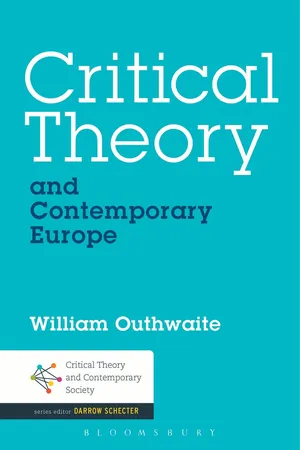
Critical Theory and Contemporary Europe introduces the major contributions critical theorists made to the study of Europe, from the interwar years to the present time.
The work begins with theorists such as Adorno who addressed Nazism and the Holocaust, then moves on to discuss the postwar affluence of capitalist Europe. It proceeds to examine how critical theorists provided much of the analysis that motivated the student and youth movements of 1968 and subsequent alternative social movements. Lastly, it relates the development of a critical theory of state socialism, looking at the works of thinkers such as Arato, Offe, and Habermas and how critical theory is now addressing social issues such as European xenophobia and the future of Europe.
This new volume in the Critical Theory and Contemporary Society series brings together critical theory and European studies in a clear, accessible manner and shows the relevance of critical theory to practical political issues.
- 184 pages
- English
- ePUB (mobile friendly)
- Available on iOS & Android
eBook - ePub
Critical Theory and Contemporary Europe
About this book
Information
1
Theorizing the European crisis of 1914–45
Although the Institute for Social Research had been founded in 1923 and officially inaugurated as an independent research institute attached to the University of Frankfurt in 1924, it was only in 1930, when Max Horkheimer became Director, that what we now know as critical theory became its dominant approach. The early orientation of the Institute had been solidly Marxist (there was initial discussion of calling it an ‘Institute for Marxism’) and its founding members were all close to the German Communist Party. The Institute’s first director, Carl Grünberg, identified himself and the Institute at the opening ceremony with ‘the view . . . that we are in the midst of the transition from capitalism to socialism’ (Dubiel, 1994: 5; see also Jay, 1973; Bottomore, 1984). While the economists and economic historians Henryk Grossmann, Karl-August Wittfogel and Friedrich Pollock remained from the earlier period, under Horkheimer’s directorship the Institute’s centre of gravity shifted from economics to a broader interdisciplinary approach, inspired by a similarly broad conception of philosophy focussed on the understanding of the contemporary world.
By now, as well as the unexpected and ambiguous success of the Bolsheviks in Russia and the failure of revolutionary Marxism to take root elsewhere in Europe, the contemporary scene was marked by two other phenomena: the economic crisis of 1929, and the strength of the German form of fascism (national socialism). The Institute members began an empirical investigation of workers’ consciousness in 1929 directed by Erich Fromm. Its initial results contributed to their awareness of the gravity of the situation, which in turn saved them and the Institute itself when the Nazis came to power.1 Fromm’s study may have been inspired in part by a contemporaneous ethnographic inquiry into white collar workers in Berlin by Adorno’s close friend Siegfried Kracauer, later famous for his book on German cinema ‘From Caligari to Hitler’. Although Fromm’s material was not published as a book until 1980, it fed into the Institute’s Studien über Autorität und Familie of 1936.2 The focus on authoritarianism was continued in the US study of The Authoritarian Personality by Adorno and others,3 unpublished studies of anti-Semitism towards the end of the War4 and the post-war German Gruppenexperiment (1955).5 These related projects, briefly discussed below, pick up from earlier work on the German working class6 and combine a neo-Marxist approach with an attention to psychological dynamics.
In Kracauer’s brilliant study he repeatedly distances himself from ‘vulgar-Marxist’ categories of class and ideology, a ‘roof nowadays riddled with holes’.7 Anti-capitalist intellectuals, he complains, concentrate only on manifest outrages and neglect the misery of everyday life. ‘How is everyday life to change, if even those whose vocation is to stir it up pay it no attention?’8 Walter Benjamin, in an enthusiastic response, described Kracauer as a ‘rag-picker at daybreak’.9 ‘And it is not as an orthodox Marxist, still less as a practical agitator, that he dialectically penetrates the existence of employees, but because to penetrate dialectically means: to expose.’10
Kracauer wrote in April 1930 to Adorno:
The situation in Germany is more than serious . . . We are going to have three or four million unemployed and I can see no way out. A disaster is hanging over this country and I am convinced that it is not just capitalism. That capitalism may become bestial is not due to the economy alone.11
Although Fromm, in his retrospective introduction to his own study, is rather dismissive of Kracauer’s,12 the two can be seen as complementary. Fromm and his associates used a (rather over-long) questionnaire, submitting the responses however to a qualitative and, to use a later term, ‘symptomatic’ reading.
. . . we relied on the basic rule in psychological work that the individual’s statements about their thoughts and feelings, however subjectively honest, can not be taken literally but need to be interpreted. Or to put it more exactly: it is not what someone says which is important but why he says it.13
It is worth noting here that this interpretative approach to empirical research is continued in all the Institute’s subsequent work.
Of the nearly 600 respondents, roughly two-thirds were manual workers and the rest mostly white-collar employees, drawn from urban centres in and south of Frankfurt and northwards to Berlin and the Rhineland. They were mostly communist, left socialist Unabhangige Sozialdemokratische Partei Deutschlands (USPD) or social democrat supporters, with 7 per cent supporting the bourgeois centre and right parties and only 3 per cent the Nazis, a third of them white-collar workers. Despite this strong support for the political left and centre-left, broadly representative of the country as a whole,14 Fromm was concerned about the weakness of many respondents’ political beliefs and the inconsistency between their formal political responses, reflecting the line of the respective parties, and other attitudes to authority in the family, gender issues etc. A simple contrast between conservative authoritarians and leftist ‘liberals’, as we would now say in America, was not sustained, nor was there much of a link between these two positions and a petty-bourgeois or proletarian class position respectively.
Although the Left had the political loyalty and votes of the great majority of workers, it had largely not succeeded in changing the personality structure of its adherents in such a way that they could be relied upon in critical situations. (Fromm, 1984: 228)
Even more worryingly, a significant proportion of socialists, and a somewhat smaller (p. 230) proportion of communists, displayed authoritarian attitudes:
These people were filled with hate and anger against everyone who had money and who appeared to enjoy life. That part of the socialist platform which aimed at the overthrow of the propertied classes appealed to them. On the other hand, items such as freedom and equality had not the slightest attraction for them, since they willingly obeyed every powerful authority they admired; they liked to control others in so far as they had the power to do so. Their unreliability finally came into the open at the point where a programme such as that of the National Socialists was offered to them. This programme not only corresponded with the feelings which had made the Socialist programme attractive but also appealed to that side of their nature which Socialism had not satisfied or had unconsciously opposed. In such cases they were transformed from unreliable leftists into convinced National Socialists. (Fromm, 1984: 43)
This is a retrospective judgement, probably made in 1937–38, but it is complemented by the analysis of the handful of Nazi respondents in the study. Their preferred reading matter was not, as one might have expected, nationalist or militarist literature but rather leftist social criticism, reflecting the populist emphasis of Nazism before it attained power (Fromm, 1984: 139).
The pessimistic nature of this analysis may explain the Institute’s hesitancy to publish in the late 1930s what material had been successfully rescued from Germany. Some of it appears however in Fromm’s contribution to Studien über Autorität und Familie (1936). Horkheimer, increasingly under Adorno’s influence, fell out with Fromm, who was eased out of the Institute in 1939, taking the materials with him (Bonss, 1984: 2). Most of the Institute members’ analyses of the crisis were in fact completed in exile or after the return of the Institute to Frankfurt in 1950; it remains of course a major topic of critical theory up to the present.
Herbert Marcuse, who had been part of the Institute since 1932 and worked in its Geneva office, relocating to New York in 1934, was not so much eased out as kept at arm’s length for over two decades by Horkheimer, again under Adorno’s influence.15 Marcuse published in 1934 one of the Institute’s earliest analyses of totalitarianism and other articles in the Zeitschrift, and contributed to Studien über Autorität und Familie. Horkheimer, having invited him to join him in California in 1941 to work on a project on dialectics later encouraged him to seek other work; he joined the Office of Strategic Services in Washington in 1942 and worked there for the rest of the War.
The dialectics project continued with Adorno
It was in fact people associated more with the Institute than with the critical theory project in a narrower sense who were most active in the analysis of fascism and Nazism in the early stages. The Sinologist Karl August Wittfogel, who had joined the Institute in 1925 and was its only active Communist, abandoned a planned trip to China in order to work instead on fascism and Nazism. From 1931 until his arrest in 1933 he published a massive flow of articles in the communist press and completed a lost book on Nazism.16 Of the articles reprinted by the Kommunistischer Bund in 1973, one is a crude expression of the Kommunistische Partei Deutschlands’ (KPD’s) ‘social-fascism’ line,17 but the next, under the pseudonym Hans Petersen, emphasizes the origin of Nazism in ‘petty bourgeois political activists rather than capitalist interests.18 Wittfogel also secured a scoop by getting hold of an early programme of the Italian fascists which had immediately been suppressed.19
Having rejoined his Institute colleagues in New York in 1934 and working at the Institute of Pacific Relations th...
Table of contents
- Cover
- Half-Title
- 1 Theorizing the European crisis of 1914–45
- 2 ‘Late’ capitalism, from the post-war boom to the crises of the 1970s: the 1968 years and the Tendenzwende
- 3 State socialism and its crises
- 4 Critical theory and post-communist transition
- 5 Critical theory at the turn of the twenty-first century
- 6 Critical theory and the European Union
- 7 Conclusion: critical theory in Germany, Europe and North America: its continuing relevance
- Bibliography
- Index
- Copyright
Trusted by 375,005 students
Access to over 1.5 million titles for a fair monthly price.
Study more efficiently using our study tools.
Frequently asked questions
Yes, you can cancel anytime from the Subscription tab in your account settings on the Perlego website. Your subscription will stay active until the end of your current billing period. Learn how to cancel your subscription
No, books cannot be downloaded as external files, such as PDFs, for use outside of Perlego. However, you can download books within the Perlego app for offline reading on mobile or tablet. Learn how to download books offline
Perlego offers two plans: Essential and Complete
- Essential is ideal for learners and professionals who enjoy exploring a wide range of subjects. Access the Essential Library with 800,000+ trusted titles and best-sellers across business, personal growth, and the humanities. Includes unlimited reading time and Standard Read Aloud voice.
- Complete: Perfect for advanced learners and researchers needing full, unrestricted access. Unlock 1.5M+ books across hundreds of subjects, including academic and specialized titles. The Complete Plan also includes advanced features like Premium Read Aloud and Research Assistant.
We are an online textbook subscription service, where you can get access to an entire online library for less than the price of a single book per month. With over 1.5 million books across 990+ topics, we’ve got you covered! Learn about our mission
Look out for the read-aloud symbol on your next book to see if you can listen to it. The read-aloud tool reads text aloud for you, highlighting the text as it is being read. You can pause it, speed it up and slow it down. Learn more about Read Aloud
Yes! You can use the Perlego app on both iOS and Android devices to read anytime, anywhere — even offline. Perfect for commutes or when you’re on the go.
Please note we cannot support devices running on iOS 13 and Android 7 or earlier. Learn more about using the app
Please note we cannot support devices running on iOS 13 and Android 7 or earlier. Learn more about using the app
Yes, you can access Critical Theory and Contemporary Europe by William Outhwaite in PDF and/or ePUB format, as well as other popular books in Politics & International Relations & Political History & Theory. We have over 1.5 million books available in our catalogue for you to explore.