This challenging and provocative book reimagines the justification, substance, process, and study of education in open, pluralistic, liberal democratic societies.
Hanan Alexander argues that educators need to enable students to embark on a quest for intelligent spirituality, while paying heed to a pedagogy of difference. Through close analysis of the work of such thinkers as William James, Charles Taylor, Elliot Eisner, Michael Oakeshott, Isaiah Berlin, Martin Buber, Michael Apple and Terrence McLaughlin, Reimagining Liberal Education offers an account of school curriculum and moral and religious instruction that throws new light on the possibilities of a nuanced, rounded education for citizenship.
Divided into three parts – Transcendental Pragmatism in Educational Research, Pedagogy of Difference and the Other Face of Liberalism, and Intelligent Spirituality in the Curriculum, this is a thrilling work of philosophy that builds upon the author's award-winning text Reclaiming Goodness: Education and the Spiritual Quest.
eBook - ePub
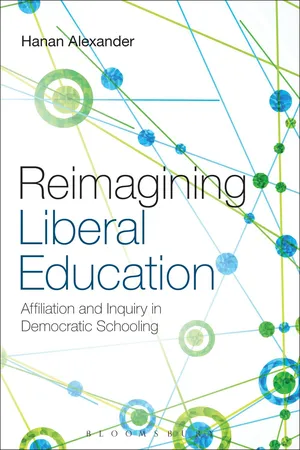
Reimagining Liberal Education
Affiliation and Inquiry in Democratic Schooling
- 288 pages
- English
- ePUB (mobile friendly)
- Available on iOS & Android
eBook - ePub
About this book
Information
PART ONE
Prologue
The first chapter of this volume, unlike those that follow, was written long before the publication of Reclaiming Goodness. In fact, it is an updated version of an essay that was my first published article. I include it here because in many respects that early publication set the stage for the intellectual project that followed, of which Reclaiming Goodness was but a way station, albeit an important one. The chapter argues that human beings are endowed with a need and propensity to organize their lives around working assumptions preserved and transmitted across the generations in the form of liberating myths. I call this propensity the transcendental imagination and the forms in which we seek to express this imagination the spiritual quest. When left unexercised, I argue, this imagination can have serious negative consequences for schooling in open, pluralistic, liberal democratic societies. This is too often the case in today’s schools, which is why I propose that we reimagine the study, practice, and content of education for those societies.
This chapter also illustrates William James’s extraordinary influence on my work, a fact of which I was more or less unaware until my friend and colleague, sociologist Philip Wexler, pointed this out to me a few years ago when I described to him my transcendental interpretation of pragmatism. I had read James as an undergraduate while I was a visiting student at the Hebrew University of Jerusalem, and I recall how impressed I was at the time by the clarity of his prose and the cogency of his arguments, especially as regards matters of faith. But I lost sight of him by the time I got to graduate school, probably due to John Dewey’s dominance in American philosophy of education and the impact on my thinking of my doctoral mentor Denis Phillips, who saw a great affinity between Dewey’s philosophy of science and that of the British postpositivist Karl Popper. I have even referred to myself from time to time as a pragmatist with stronger religious sentiments who is less suspicious of tradition than is Dewey, not paying attention to the fact that this position quite nicely describes James as well; and I wrote Reclaiming Goodness in part as a corrective to ambivalence toward religion and spirituality among educational philosophers of a pragmatic and postpositivist bent. At Wexler’s urging I reread James, only to discover not only the lingering impact of his thought on mine, in particular on what I have come to call the transcendental imagination, but also on my concern with the primacy of ethics and teleology over epistemology, what James called “last” instead of “first” things, and on the form of dialectic reasoning I so often employ in seeking a middle course between tough- and tender-mindedness.
Due to its early composition, some of the references in the chapter may appear a bit dated, being from the middle of the last century, although their continued relevance today never fails to impress me. Additionally, the argument may occasionally suffer from the exuberance of youth. I wrote the piece soon after the Jonestown massacre in 1978, in which a cult leader brought about a mass suicide of 918 of his followers. I had moved to New York from San Francisco at the time to begin rabbinic studies and was haunted by the symbolism of the fact that, prior to its move to Guyana, the People’s Temple founded by cult leader Jim Jones had taken up residence in what was once a beautiful San Francisco synagogue. Nevertheless, in this new version I have endeavored to moderate and strengthen the argument, recapture James’s influence, and add additional references that set the stage for the chapters that follow.
CHAPTER ONE
Schools Without Faith
Introduction
Many liberal societies today appear ambivalent about the importance of human spirituality and transcendent goodness, offering too little guidance to the young (and old) as to how to direct the powerful inner passions of humankind toward a meaningful and valuable life. These societies seem concerned more with the makeup than with the meaning of reality, with appearance above ethical substance, with cause and effect before significance and purpose, with validity of arguments prior to their moral consequences. Although the empirical turn so crucial to democracy has doubtless led to many important scientific discoveries, it may have also brought in its wake a loss of faith in the possibility of higher values to guide our actions and lofty ideals to pass along to our children, at least according to one narrow interpretation of this turn.
This chapter explores the role of faith in the schools of open, pluralistic, liberal democratic societies. It is divided into five sections. In the first section, I explore the human need and propensity to order life in terms of transcendental ideals often expressed in terms of liberating myths. I call this the transcendental imagination. In the second section, I discuss how this need has been systematically excluded from the development and curriculum of modern schooling. The third section considers the assumptions that have led to this exclusion, and the fourth section addresses the consequences of these assumptions for the spiritual lives of students. The fifth and final section reiterates the central challenge of this book in response to this spiritual malaise: What would it mean to reimagine liberal education so as to engage rather than avoid this transcendental imagination?
I argue that we have succeeded so well in diminishing the influence of particular transcendent beliefs and spiritual practices from modern schooling, especially in the common schools of liberal democracies, in providing a “dispassionate,” “objective,” “scientific,” “value-free” education, that our success is contributing to our demise. This trend is as evident in the prevailing methodologies of educational research as it is in civic education and curriculum thought. But when put into practice, dispassionate neutrality too often comes to mean that no institution is worth defending and no idea of ultimate significance. With no conception of things sacred, we can communicate neither a social vision nor a sense of purpose to our youth. If education is to accomplish anything, it must accomplish this; and although schools should not be blamed for social ills that stem from far beyond their walls, they can often play an important role in addressing those ills.
The transcendental imagination
In order to understand the role of faith and in turn values in the school, we must first deal with their roles in human life more generally.
People need order to live. Without it, the world is nothing but meaningless particles of sense perception, chaos. We must overcome chaos if we are to think, learn, remember, eat—indeed, if we are to be at all. We achieve order by organizing or interpreting our perceptions. That is, we sense which perceptions are most striking, vivid, real, or important and accept that they are truly real by virtue of their vividness or obviousness. Students of religion refer to experiences of such vividness as hierophany, or manifestations of the sacred.1 William James called these faith assumptions genuine hypotheses, options that are live as opposed to dead, forced instead of avoidable, and momentous rather than trivial.2 We make our way through the “whirling snow and blinding mist” of life by choosing assumptions of this kind, argued James, establishing norms and practices that provide social stability, physical safety, and answers to basic questions of existence: Why am I here? What am I to live for? How ought I to live?3
Historically, people have tended to express that which they perceive as ultimately important or truly real in religious terms. Our fundamental presumptions become sacred. This is especially pronounced in archaic or traditional societies. Ancient gods always have to do with creating realities with which people must live. The order constructed from our perceptions of the sacred is often expressed in terms of myth. Myths relate sacred history. They tell how things began; how, through the intervention of trans-human powers, reality came into existence, be it the whole of reality, the cosmos, or only fragments of reality—an island, a species of plant, a particular kind of human behavior, an institution. As depictions of the source of reality, myths become paradigmatic or exemplary. We attempt to repeat them and live according to their basic messages. They express the norms that govern our lives.4
Though especially prevalent among traditional societies, the appeal to the sacred and the propensity for myth is also found in our own age.5 Thomas Jefferson’s conviction that we have a divinely ordained right to life, liberty, and the pursuit of happiness, for example, though penned over two hundred years ago to justify among the most significant political revolutions of modern times, still rings true for many of us today. Consider also how the Exodus narrative became a model for so many modern struggles for political liberty and social equality.6 Even the basic principle of science that states that one event may be caused by another is, according to the philosopher David Hume, a culturally engrained assumption that we make out of psychological necessity.7
Humankind is endowed, in other words, with what Richard Rubenstein called a religious imagination, with the ability of self-orientation not by merely accepting that which is perceived, but by molding the environment according to what we accept as essential, fundamental, ultimately significant.8 Given that this imagination may not necessarily be tethered to a particular religious tradition, indeed some interpretations of religion can even hamper this process, I have taken to calling this propensity for self-orientation a transcendental rather than merely a religious imagination, and the yearning for narratives, myths, and customs to express it, a spiritual quest.9 Contemporary curriculum theorist Dwayne Huebner called it “the lure of the transcendent.”10 And political theorist Alexis de Tocqueville already noted in his nineteenth-century observations on American democracy that this “taste for the infinite and love of what is immortal” is not “the offspring of some caprice of the will,” but “embedded” in human nature.11 It is through the transcendental imagination, through myth, that we orient ourselves in a disordered world to live meaningful lives grounded in values that we can discuss with one another and pass along to our children.
James described this phenomenon as follows in his pioneering study, Varieties of Religious Experience:
The individual, so far as he suffers from his wrongness and criticizes it … identifies his real being with the … higher part of himself … . He becomes conscious that this higher part is coterminous and continuous with a MORE of this same quality, which is operative in the universe outside of him … .
Is such a “more” merely our own notion, or does it really exist? If so, in what shape does it exist?
It is in answering these questions that the various theologies perform their theoretical work … . They all agree that the “more” really exists; though some of them hold it to exist in the shape of a personal god or gods, while others are satisfied to conceive it as a stream of ideal tendency embedded in the eternal structure of the world. They all agree, moreover, that it acts as well as exists and that something really is effected for the better when you throw your life into its hands.12
According to religion scholar Kees Bolle, this need and propensity for transcendence has a liberating quality. In his study of myth and mysticism, The Freedom of Man in Myth, Bolle discussed how myth frees humankind by ordering and reordering existence. Just as the artist requires the structure of tradition to free talents in order to reach beyond the creations of the past, humans need such a structure to free talents for living meaningfully in a potentially painful and chaotic world. Properly conceived, the transcendental experience is a liberating one—liberation from chaos to order, from the uncivilized to the cultured.13 James concurred:
If religion is to mean anything definite for us, it seems to me that we ought to take its meaning as this added dimension of emotion, this enthusiastic temper of espousal, in regard where morality strictly so called can at best bow its head and acquiesce. It ought to mean nothing short of this new reach for freedom for us, with the struggle over, the keynote of the universe sounding in our ears and everlasting possession spread before our eyes.14
The transcendental imagination not only liberates us to create meaningful order out of a chaotic environment; it also contributes to the ways in which we think about that order. In the spirit of Lev Vygotsky, who explored the relation between culture and the physiology of the brain, educational psychologists Manuel Ramirez and Alfredo Castaneda examined the relation between cultural context and cognitive styles. According to Ramirez and Castaneda, industrial and postindustrial societies prefer an analytic style of thought focused on the incontrovertible conclusions of necessary logic, whereas traditional societies prefer an existential style of thought attuned to human relations.15 In a well-known distinction, sociologist Ferdinand Tonnies referred to these contemporary industrial and postindustrial societies as “Gesellschaften” and to traditional communities as “Gemeinschaften”; Emile Durkheim called them “mechanical versus organic communities.”16 If our experience of the ultimately important is at the heart of social order, the transcendental imagination is a deciding factor in cognitive style. We apparently need myth not only to live meaningfully, but also to think sensibly in ways that tie our ability to reason to our very humanity.
Additionally, psychotherapist and Holocaust survivor Victor Frankl argued that the sort of purpose and meaning inherent in this transcendental capacity are essential to a normal or balanced psychological makeup. It was because of such a sense of purpose that he and many cohorts survived the atrocities of Auschwitz without succumbing to emotional imbalance, and it was for lack of a clear conception of purpose that many of his disturbed patients found their way to emotional disorder.17 Lacking this sense of self-orientation within what James called a “healthy minded” attitude that provides purpose and direction to life, we can come to suffer from a certain “sickness of the soul,” according to which “back of everything there is the great specter of universal death,” and which engenders the question: “Can things whose end is always dust and disappointment be the real goods which our souls require?”18
What happens, then, to a society that has become ambivalent about, sometimes even resistant to, transcendence? What becomes of generations educated in schools that are uncomfortable with any reference to things sacred or spiritual? Might they come to suffer from such a sickness of the soul? In his essay, “The Impoverished Mind,” Elliot Eisner argued that if we can speak of the human mind as composed of a multiplicity of potentialities, and if the aim of education is to provide opportunities to develop them, then any available potential left untouched can be compared to a muscle left to atrophy.19 If myth lies at the root of the human culture, then the atrophy of the transcendental imagination in the hearts and minds of our youth may be serious indeed. For lack of spiritual sophistication could lead to a decline in social cohesion, a social pathology brought about by a lessening of ability to think and communicate about human values, indeed about our shared humanity altogether. The mass suicide at Jonestown in 1978 was an early hint of such a problem. The rise of radical Islamic fundamentalism around the world over the past several decades, even among the best educated Muslims, may constitute a more recent and pressing examp...
Table of contents
- Cover
- Halftitle Page
- Title Page
- Dedication Page
- Contents
- Acknowledgments
- Introduction
- Part One: Prologue
- Part Two: Transcendental Pragmatism in Educational Research
- Part Three: Pedagogy of Difference and the Other Face of Liberalism
- Part Four: Intelligent Spirituality in the Curriculum
- Part Five: Epilogue
- Notes
- Bibliography
- Index
- Imprint
Trusted by 375,005 students
Access to over 1.5 million titles for a fair monthly price.
Study more efficiently using our study tools.
Frequently asked questions
Yes, you can cancel anytime from the Subscription tab in your account settings on the Perlego website. Your subscription will stay active until the end of your current billing period. Learn how to cancel your subscription
No, books cannot be downloaded as external files, such as PDFs, for use outside of Perlego. However, you can download books within the Perlego app for offline reading on mobile or tablet. Learn how to download books offline
Perlego offers two plans: Essential and Complete
- Essential is ideal for learners and professionals who enjoy exploring a wide range of subjects. Access the Essential Library with 800,000+ trusted titles and best-sellers across business, personal growth, and the humanities. Includes unlimited reading time and Standard Read Aloud voice.
- Complete: Perfect for advanced learners and researchers needing full, unrestricted access. Unlock 1.5M+ books across hundreds of subjects, including academic and specialized titles. The Complete Plan also includes advanced features like Premium Read Aloud and Research Assistant.
We are an online textbook subscription service, where you can get access to an entire online library for less than the price of a single book per month. With over 1.5 million books across 990+ topics, we’ve got you covered! Learn about our mission
Look out for the read-aloud symbol on your next book to see if you can listen to it. The read-aloud tool reads text aloud for you, highlighting the text as it is being read. You can pause it, speed it up and slow it down. Learn more about Read Aloud
Yes! You can use the Perlego app on both iOS and Android devices to read anytime, anywhere — even offline. Perfect for commutes or when you’re on the go.
Please note we cannot support devices running on iOS 13 and Android 7 or earlier. Learn more about using the app
Please note we cannot support devices running on iOS 13 and Android 7 or earlier. Learn more about using the app
Yes, you can access Reimagining Liberal Education by Hanan Alexander in PDF and/or ePUB format, as well as other popular books in Education & Education General. We have over 1.5 million books available in our catalogue for you to explore.