Whatever people think about Kubrick's work, most would agree that there is something distinctive, even unique, about the films he made: a coolness, an intellectual clarity, a critical edginess, and finally an intractable ambiguity. In an attempt to isolate the Kubrick difference, this book treats Kubrick's films to a conceptual and formal analysis rather than a biographical and chronological survey.
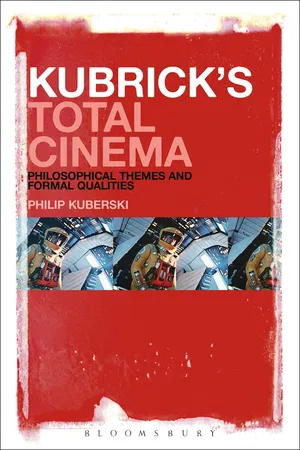
As Kubrick's cinema moves between the possibilities of human transcendence dramatized in 2001: A Space Odyssey and the dismal limitations of human nature exhibited in A Clockwork Orange, the filmmaker's style "de-realizes" cinematic realism while, paradoxically, achieving an unprecedented frankness of vision and documentary and technical richness. The result is a kind of vertigo: the audience is made aware of both the de-realized and the realized nature of cinema. As opposed to the usual studies providing a summary and commentary of individual films, this will be the first to provide an analysis of the "elements" of Kubrick's total cinema.
- 208 pages
- English
- ePUB (mobile friendly)
- Available on iOS & Android
eBook - ePub
About this book
Information
1
Thinking
Can the cinema think? This study proposes that it can—but that it rarely does, less out of incapacity than inclination. It proposes, moreover, that the distinguishing characteristic of Stanley Kubrick’s cinema is that it thinks. I do not mean that it offers views, opinions, messages, or arguments. I mean that it searches through the media of sound and light, words, music, and image to find insight and illumination. Much in traditional cinema, even of so-called classic cinema, has stood in the way of thinking: sentimentality, patriotism, complacency, actors, prudery, didacticism, and a nearly concealed contempt for the audience. Kubrick cuts through these obstacles, making way for a cinema that discovers unprecedented and challenging combinations of beauty and knowledge, satirical critique and visionary possibility.
Critics have realized for some time that one of the distinctive qualities of Kubrick’s cinema is its intellectual and conceptual coherence. Alexander Walker points to intellectual coherence as one of Kubrick’s distinctive characteristics: “Only a few film directors possess a conceptual talent—that is, a talent to crystallize every film into a cinematic concept.”1 Walker pinpoints this conceptual focus: “a persistent interest in the symbolic analysis of society through its enduring myths and fables.”2 For Kent Jones, Kubrick is “a metaphysical story-teller,” a filmmaker capable not only of moving his audience but evoking and meditating on the great questions.3 Thomas Allen Nelson claims that “Kubrick’s conceptual universe” is informed by a pervasive
awareness of contingency [which] arises whenever there is a loss of faith in teleological explanations, in the received or discovered validity of meaning in the rational structures of nature or the signifying power of mind and language. Once meaning has lost the authority of teleology we then perceive how many different ways there are to create meaning through the expressive extensions of language and form.4
In their seminal works, Walker and Nelson firmly establish the relationship between Kubrick’s deconstructive vision of modern life and his formal inventiveness and brilliance.
If Walker and Nelson see Kubrick as a kind of cinematic deconstructor of “pieties” and “teleology,” James Naremore sees him as a satirist whose subject is human folly and barbarism; in the interest of satire, he is drawn to a family of “estranging effects—the grotesquely mistaken, the uncanny, the fantastic, the Kafkaesque—and he repeatedly conjoins methodical orderliness and horrific absurdity.”5 Penetrating as his assessment is, Naremore leaves out two essential elements of Kubrick’s cinema: the visionary and the beautiful. Satire, even when practiced by masters like Swift or Kafka, has a fantastic aspect that distorts the world in order to expose its absurdity. The formal beauties and complexities of Kubrick’s cinema go beyond caustic critique to potential transformation.
Kubrick told Alexander Walker, “Naturalism finally does not elicit the more mysterious echoes contained in myths and fables; these resonances are far better suited to film than any other art form. People in the twentieth century are increasingly occupied with magic, mystical experience, transcendental urges . . .”6 In this sense, the surreal or hyperreal aspect of Kubrick’s films is less satirical, per se, than a response to cinematic traditions of realism or naturalism that reflect and attempt to enforce cultural norms of family and nation.
A thinking cinema is something less and more than a conceptual or a satirical cinema—it is a cinema constantly alive to possibilities of representation and vision. It is less concerned with contingency, per se, as it is with the ways in which cinematic reality can be an ongoing criticism and revelation of material reality. Although governed by narrative, character, and theme, it is at the same time—and more importantly for some—a material thinking, a thinking that transcends words, themes, and concepts and enters the delightful realm of the ineffable and endlessly interesting. In a way, Kubrick was able to fuse the cinema’s power of enchantment with the power of relentless investigation and exhibition, continual critique, and surprising revelation. For this reason, Kubrick’s cinema invites thinking through that draws out an implicit phenomenology of its strikingly original formal qualities. It also merits a conceptual analysis that treats its concerns as more than merely thematic. This study thus approaches Kubrick’s cinema through philosophical categories (corporeality, technology, war, eros, and transcendence) and formal qualities (time, light, music, speech, and poiesis). In turning away from a chronological, film-by-film analysis, we can perhaps establish the distinctive and coherent nature of Kubrick’s cinema.
The Search for Illumination
Kubrick’s films were made through a process of search and discovery: they were not produced so much as they were expressed through the long process of scripting, set and costume design, casting, filming, improvisation (especially Peter Sellers’s performances in Lolita and Dr. Strangelove or: How I Learned to Stop Worrying and Love the Bomb), editing, and scoring. As Saul Bass observed,
Stanley is very monastic. He’s a great beard scratcher. He thinks; he rubs his beard. He expresses himself quietly. I can’t say he’s reasonable . . . There has to be a certain unreasonableness in any serious creative work.7
Kubrick taught others this art of thinking and brooding, of beard scratching and chess-playing, of sudden shifts of course and rewritten dialogue. This made for long shoots, countless takes, and surprises. The thinking never stopped, and this thinking is reflected in the ineffable and the willing collusion of media that a film is or ought to be. It was all in the service of the film’s mysterious heart, less an intention or a point of view than a commitment to illumination. During the writing of Eyes Wide Shut, his last film, this consummate aim was represented for Kubrick by Arthur Schnitzler, the author of Traumnovelle, upon which the film was to be based. In adapting the novel to cinema and translating it from Vienna to New York, much had to be discovered. In practice, Schnitzler became the oracle who provided directions for the making of the film. It was an oracle that only Kubrick could understand. He called him, simply enough, “Arthur.” His hired screenwriter, Frederic Raphael, wrote in his notebook on May 31, 1995: “[Kubrick] has convinced himself that our salvation lies in keeping to Schnitzler’s ‘beats’; if anything goes wrong, deviation from ‘Arthur’ has to be the reason for it.”8
For Kubrick, films begin with questions he could not begin to formulate. Making a film was a process of embodied thinking, thinking toward a mystery that could not initially be framed. In a sense, the thinking was not directed at the solution of a mystery: it was directed toward that mystery’s cinematic realization.
This kind of esthetic search is complemented by Kubrick’s conception of cinema as a spiritual instrument. In his article “Words and Movies” (1961), Kubrick argues that action in a film must act as an “objective correlative” of the source novel’s “psychological content.” Drawing on T. S. Eliot’s famous argument from his essay “Hamlet and His Problems” (1919), Kubrick’s article is a modernist and formalist defense of the work of art: “For a movie or a play to say anything really truthful about life, it has to do so very obliquely.”9 Where Eliot argued that poetry had to be “difficult” if it were to dislocate language into meaning, Kubrick believes that a film needs to remain remote from explicit statement and rely on the medium:
You use the audience’s thrill of surprise and discovery to reinforce your ideas, rather than reinforce them artificially through plot points or phony drama or phony stage dynamics.10
Thus, in defending his choice to adapt a highly verbal novel like Lolita, Kubrick argues that a film, like a novel, discovers its own style as a manifestation of its thematic concerns. “Style,” he writes, “is what an artist uses to fascinate the beholder in order to convey to him his feelings and emotions and thoughts.”11 The style realized in the making of a film may begin in service to a novel, but it cannot be confined to that sense of commitment:
Any art form properly practiced involves a to and fro between conception and execution, the original intention being constantly modified as one tries to give it objective realization. In painting a picture this goes on between the artist and his canvas; in making a movie it goes on between people.12
Kubrick’s statements about his films fall into the tradition of esthetic formalism dominant in academic literary criticism at mid-century which was largely devised to justify the difficulties of modernist literature: If his films violated genre expectations, that was because they were poetic and resistant to summary and explanation. As James Naremore has pointed out, Kubrick’s cinema is “modernist” or “late modernist” in orientation and esthetic: We note an authorial detachment, a cool mode of presentation, and a formal ineffability.13 Likewise, T. Pipolo has argued that Kubrick was “an important modernist artist” whose films are characterized by a “perplexing conflation of aesthetics, technology, and narrative.”14 These qualities in modernist writers had inspired New Critics such as Cleanth Brooks and W. C. Wimsatt to speak of the literary texts in spatial terms such as a well-wrought urn and a verbal icon.15 Similarly, Kubrick claimed that “it is . . . misleading to try to sum up the meaning of a film verbally.”16
Like paintings, his films cannot, he maintained, be understood in terms of explanation. Leonardo did not provide an interpretation of La Giaconda, and neither will he provide an interpretation of his works. Although such an esthetic was largely prompted by 2001: A Space Odyssey, Kubrick invoked the same formalism to characterize Full Metal Jacket 20 years later:
Truth is too multifaceted to be contained in a five-line summary. If the work is good, what you say about it is usually irrelevant . . . The work is bigger than one’s capacity to describe it.17
Any attempt to summarize a real work of art is “hateful conceptualizing.”18 In 2001, Kubrick did not attempt ambiguity for its own sake; “it was inevitable.” “A certain degree of ambiguity is valuable” because it allows the viewer his own “visual experience.”19 Rather than a verbal art that is susceptible to summary interpretation, the film
operates on a level much closer to music and to painting than to the printed word . . . The basic purpose of a film is one of illumination, of showing the viewer something he can’t see any other way.20
Thus, like a true modernist, Kubrick denies that art has a social responsibility: “I don’t think that any work of art has a responsibility to be anything but a work of art.”21 Kubrick’s esthetics recognize the intrinsic complexity of an art form that combines a simultaneous juxtaposition of music, image, and speech. The distinctively stimulating and pleasurable qualities of Kubrick’s are the product of an intensification of this complexity.
The “illumination” that Kubrick believes to be the “basic purpose of a film” may be interpreted in many ways. My own approach will be to explore the ways in which Kubrick’s art illumines the visible world but also, and equally important, what lies behind and within it—culture, psychology, philosophy, and ideology. His work, even as it avoids conceptual intentionality, is deeply conceptual, philosophical, and analytical in nature. Kubrick was a popular film director who was also an intellectual, an exile (though he denied it), and a technical artist. Kubrick’s own ambitions and accomplishments are admirably suggested in his praise for two fellow filmmakers:
I am always reluctant to single out some particular feature of the work of a major filmmaker because it tends inevitably to simplify and reduce the work. But in this book of screenplays by Krzysztof Kieslowski and his co-author, Krzysztof Piesiewicz, it should not be out of place to observe that they have the very rare ability to dramatize their ideas rather than just talking about them. By making their points through the dramatic action of the story they gain the added power of allowing the audience to discover what’s really going on rather than being told. They do this with such dazzling skill, you never see the ideas coming and don’t realize until much later how profoundly they have reached your heart.22
For cinema to have such purchase on the imagination it has to be living, unpretentious, and yet somehow suggestive of something eternal or primordial, something “archetypal” in the terminology of C. G. Jung. In a way, Kubrick was able to join the heightened or exaggerated aspect of satire to the profounder aspect of the archetype. Sergeant Hartman in Full Metal Jacket is a satirical caricature, but more importantly he is an archetype—the Ogre or the murdering Father. Humbert Humbert in Lolita is a caricature of a scheming pedophile, but more importantly he is an archetype—the impassioned lover of courtly romances. Kubrick’s central and enduring works are, at the same time, transgressive and archetypal, satirical and visionary.
The form of enigma
This point of ineffability indicates another quality of Kubrick’s films—an irreducible ambiguity or, more grandly, an undeniable mysteriousness. This is certainly true for 2001, and also for The Shining, Full Metal Jacket, and Eyes Wide Shut. And this quality points to—and accounts for—another characteristic of the films: Their reputations continue to grow and deepen with time. 2001 mystified and frightened MGM executives and the New York City newspaper critics, but connected with audiences—and yet not even a loose consensus has ever emerged about what its conclusion “is,” let alone what it means. One observes, then, a two-part invention in Kubrick’s major films: a risky devotion to a project not easily assimilable through generic expectation and closure and a slowly accruing cultural reception and recognition.
While 2001 triumphed not only in spite of but also because of its apocalyptic mysteriousness and grandeur, The Shining proved an especially bitter pill for many of Kubrick’s admirers at the time of its release in 1980. To them the film seemed, on first viewing, to be an overacted, confusing pastiche of horror films from the seventies such as The Exorcist (1973), The Omen (1976), and Carrie (1976). Thirty years later, it is one of his most popular and critical successes. Full Metal Jacket, constructed in two discrete sections at Parris Island and South Vietnam, refuses to answer to standard expectations for artistic closure, and yet continues to grow in esteem, outstripping the reputation of earlier Vietnam War films such as The Deer Hunter (1978), Apocalypse Now (1979), and Platoon (1987). And both films, despite these difficulties, are firmly lodged in collective popular memory and speech. Eyes Wide Shut, his last film, was a financial and a critical failure in 1999. By 2002 it was the subject of a monograph by Michel Chion in the British Film Institute’s Modern Classics Series and has gone on to stimulate dozens of critical studies. Following his death just before the release of Eyes Wide Shut, it became clear that Kubrick’s canon was a uniquely rich and rewarding subject of continuing scholarly inquiry and popular interest.
The mysterious or enigmatic aspect of Kubrick’s films derives from a certain obliqueness of presentation and a corresponding trust in the ability of mass audiences to experience and accept ambiguity. Kubrick told Alexander Walker: “I’m sure that there’s something in the human personality which resents things that are clear, and, conversely, something which is attracted to puzzles, enigmas, and allegories...
Table of contents
- Cover
- Half-Title
- 1 Thinking
- 2 Corporeality
- 3 Time
- 4 War
- 5 Light
- 6 Eros
- 7 Music
- 8 Technology
- 9 Speech
- 10 Poiesis
- 11 Transcendence
- Feature films directed by Stanley Kubrick
- Notes
- Bibliography
- Index
- Copyright
Trusted by 375,005 students
Access to over 1.5 million titles for a fair monthly price.
Study more efficiently using our study tools.
Frequently asked questions
Yes, you can cancel anytime from the Subscription tab in your account settings on the Perlego website. Your subscription will stay active until the end of your current billing period. Learn how to cancel your subscription
No, books cannot be downloaded as external files, such as PDFs, for use outside of Perlego. However, you can download books within the Perlego app for offline reading on mobile or tablet. Learn how to download books offline
Perlego offers two plans: Essential and Complete
- Essential is ideal for learners and professionals who enjoy exploring a wide range of subjects. Access the Essential Library with 800,000+ trusted titles and best-sellers across business, personal growth, and the humanities. Includes unlimited reading time and Standard Read Aloud voice.
- Complete: Perfect for advanced learners and researchers needing full, unrestricted access. Unlock 1.5M+ books across hundreds of subjects, including academic and specialized titles. The Complete Plan also includes advanced features like Premium Read Aloud and Research Assistant.
We are an online textbook subscription service, where you can get access to an entire online library for less than the price of a single book per month. With over 1.5 million books across 990+ topics, we’ve got you covered! Learn about our mission
Look out for the read-aloud symbol on your next book to see if you can listen to it. The read-aloud tool reads text aloud for you, highlighting the text as it is being read. You can pause it, speed it up and slow it down. Learn more about Read Aloud
Yes! You can use the Perlego app on both iOS and Android devices to read anytime, anywhere — even offline. Perfect for commutes or when you’re on the go.
Please note we cannot support devices running on iOS 13 and Android 7 or earlier. Learn more about using the app
Please note we cannot support devices running on iOS 13 and Android 7 or earlier. Learn more about using the app
Yes, you can access Kubrick's Total Cinema by Philip Kuberski in PDF and/or ePUB format, as well as other popular books in Media & Performing Arts & Film Direction & Production. We have over 1.5 million books available in our catalogue for you to explore.