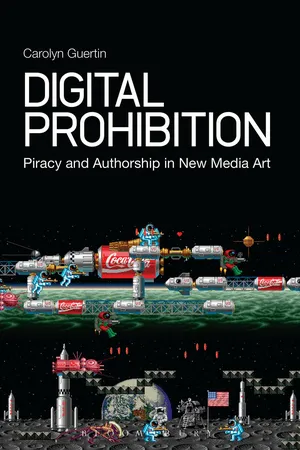
Contrasting Western models with issues of piracy as practiced in Asia, Digital Prohibition explores the concept of authorship as a capitalist institution and posits the Marxist idea of the multitude (à la Antonio Negri and Michael Hardt, and Paulo Virno) as a new collaborative model for creation in the digital age. Looking at how digital culture has transformed unitary authorship from its book-bound parameters into a collective and dispersed endeavor, Dr. Guertin examines process-based forms as diverse as blogs, Facebook, Twitter, performance art, immersive environments, smart mobs, hacktivism, tactical media, machinima, generative computer games (like Spore and The Sims) and augmented reality.
- 304 pages
- English
- ePUB (mobile friendly)
- Available on iOS & Android
eBook - ePub
About this book
The act of creation requires us to remix existing cultural content and yet recent sweeping changes to copyright laws have criminalized the creative act as a violation of corporate rights in a commodified world. Copyright was originally designed to protect publishers, not authors, and has now gained a stranglehold on our ability to transport, read, write, teach and publish digital materials.
Information
PART ONE
The aesthetics of appropriation
Creativity is dead
Creativity as we have known it in modern times is dead. The creative process, however, is alive and well. The art of appropriation and appropriation art are part of a long-standing critique of representation and are cornerstones of the creative process. All work builds on its predecessors. Appropriation art and its practice has gone by many names: collage, bricolage, ready-made, found-footage, merz, remix, mashup, sampling, homage, intertext, paratext, postproduction, and on and on. This process of combining old and new materials is not something unique to visual media either. From William Shakespeare’s free-flying adaptations to Herman Melville’s mashups to Jorge Luis Borges’ “Pierre Menard, The Author of Quixote,” the tale of a perfect re-creation of Don Quixote that bore no resemblance to the original, to Helene Hegemann’s remixed social media content novel Aoxlatl Roadkill, it was another writer, Oscar Wilde, who famously summed up the process as “talent borrows, genius steals.” Movies also follow this template. Some decades ago Dorothy Parker reflected on the shallow nature of the Hollywood dream factory by quipping that “the only ism Hollywood believes in is plagiarism.” As I have previously stated, the most successful corporate media empire, Disney, is built on a foundation of reworked material. But times and the law have changed. Ironically, as Disney Corporation fought so hard to prevent Mickey Mouse from going out of copyright by continually having the duration of copyright extended (hence the name, The Mickey Mouse Act), it also kept at bay its own access to Walt Disney’s own animated character, Oswald, The Lucky Rabbit. Oswald had initially been far more successful than Mickey Mouse was, but when Disney asked his employers for more money and more staff to make more Oswald shorts they shut down his studio and stonewalled him from using the character again because they owned the rights. Oswald became the model for all later animated rabbits, but Walt Disney literally went back to the drawing-board and started drawing mice – or two particular mice at least – instead. Disney Corporation has now reintroduced Oswald back into its empire (in the game Epic Mickey), but while Oswald is ostensibly public domain now, I guarantee you that if anyone except Disney tries to use his image for their own ends Disney will prosecute them.
It was with the advent of video and video recorders that what we think of as the contemporary remix was born, although the practice as a creative technique is clearly as old as both music and storytelling. We think sonically in phrases and visually in images, metaphors, and symbols, and more and more we ‘talk’ and ‘talk back’ in this mode too. Video – or digital video more precisely – has become a vernacular and, being a vernacular, it is never single-channeled. It is participatory and complex. While this language of digital imagery had its roots in time-based cinematic mode (which remains consistent at 24 or 30 frames per second), like other code-based modes it is spatial rather that visual. Its layers are a surface graphic and often metaphorical interface (think desktop) that the user interacts with and a skeletal structure made up of code or scripting languages. In fact, Christine Paul deems the digital image “not visual” at all on account of those layers of bitmapped and spatialized attributes (Paul, 2008, 68). Digital images are dynamic (even still ones) and have layers and abilities analog images never dreamt of. Digital video is indexable, searchable, networked, embedded, and available by subscription. Out of that fertile participatory ground the remix springs. Visual blogs, veracular video, vlogs, YouTube, Vimeo, and UStream are becoming the way in which a large percentage of ordinary people publish and distribute to their similarly networked peers. Of the great revolutions in communication technology, where the alphabet (and ultimately movable type) supplanted orality and shifted our primary sense to the eye, the telegraph and electric technologies supplanted print, retribalizing us (McLuhan would say) and restoring the balance of our senses; now, binary code, and networked and distributed technologies have supplanted the electric technologies and are extending our consciousness. Code may form the underlying bones of our visual and distributed cultural nodes, but culture is always participatory and interactive. The creative act itself, as inflected and informed by digital technologies, is undergoing a metamorphosis. The older media and modes of discourse – print, painting, cinema, television, etc. – are still with us and remediate new technologies’ looks and methods, if not their highly political intent. Medium specificity, however, is gradually being pushed aside or rendered irrelevant as all media are becoming digitized. According to Alan Kaye, the designer of the first graphic user interface, the computer is the first “meta-medium” and, as such, it emulates all other media. Emulating, however, is not the same as being, and digging deeper reveals the very profound differences that exist between the surface similarities of traditional media and the digital. Way back in 1962, Marshall McLuhan wrote,
The next medium, whatever it is – it may be the extension of consciousness – will include television as its content, not as its environment. A computer as a research and communication instrument could enhance retrieval, obsolesce mass library organisation, retrieve the individual’s encyclopedic function and flip it into a private line to speedily tailored data of a saleable kind (McLuhan, 1995, 210).
So if the future primary media is to be located in the participatory space of networked information retrieval (and I will discuss the act of searching and Google’s engine at length later in this book), then the act of searching for materials becomes a primary part of our acts of creation and consumption of digital media. What we ‘own’ in the act is the process not the content. Searching and the subsequent creative remixing of existing content has become the dominant mode of talking back to television, music, and networked culture.
Born-digital art forms are largely what I will be concerned with in these pages and they have their own unique grammar as a part of their creative aesthetic processes. In fact, in a digital age, we might begin to question whether creation even remains a useful category. In a time when we have (theoretically at least) all recorded information in the history of the world at our fingertips, creation becomes irrelevant. It becomes irrelevant because there is literally nothing new under the sun. Newness instead is now born of creative combinations that merge body, environment, and technology within generative structures – what Bill Seaman calls recombinant poetics (Seaman, 2004). In the same way that the medieval definition of genius – someone who could perform unrivaled feats of memory – was replaced by the Eighteenth-century measure of genius as someone capable of great feats of the creative imagination, so now creative genius is being replaced by acts of remixing media and ideas that produce new insights and deep critique. To reiterate then, the pinnacle acts of creative virtuosity today are in the political expression of resistance to the spectacle of consumer culture via the innovative reuse of existing materials. These new creative critiques are aesthetic and atactical (à la Giorgio Agamben),1 and fall into three categories:
1 Interruption, which includes stoppage and repetition.
2 Disturbance, the marriage of action and event.
3 Capture/leakage, which comprises performance and documentation.
Interruption is neither visual nor verbal, but instead revisits old logics to find new answers. Like the collage, it promotes a loss of visual coherence at the same time as the logic of the verbal relinquishes hierarchy in favor of pattern recognition and parataxical architectures (Joris, 2011, 185–6). The second method, disturbance, is the only political, aesthetic alternative left for free expression in a surveillance culture in which all desire for resistance threatens to be drowned by consumerism. Combining rhetoric and aesthetics, disturbance is where action meets the critique and the event. Ephemeral, disturbances make the politics of events and actions visible. The third method, capture/leakage, is a process that is performed and later recorded via its documentation. Documentation is the closest thing to an art object that exists in remix culture because remixing is primarily process- not product-oriented. Often the domain of hacktivists, documentation is what survives after the event. Real power exists these days in the power to suppress, to be silent, to escape detection. Hacktivists seek to make the invisible visible again. The process of capture/leakage is informational and dynamic and performed in opposition to prevailing power structures. As the explication of the event or as the road-map through the newly visible information, the only remaining proof of the process is the documentation. Always surreptitious, if not sufficiently delocalized, the process of capture/leakage often results in capture and suppression of its information flows, sources, and people. All of these approaches – interruption, disturbance, and capture/leakage – are nonvisual, dynamic, interactive, and participatory. These methods of re-engagement are tied to political action, not critique. This is not the first time these modes of action have been theorized, although digital media alter both actions and their results. Poet, playwright, director, and actor Antonin Artaud wrote of the Theatre of Cruelty, a violent physical determination to shatter the illusions that imprison our senses. Media guru Marshall McLuhan used probes, nonbinary rhetorical constructions that were not easily unraveled. Similarly French philosopher and Situationist Guy Debord said, “All forms of expression are … reduced to self-parody…. We find ourselves confronted with both the urgent necessity and near impossibility of bringing together and carrying out a totally innovative collective action” (Debord, 1981, 55–6). I will discuss these methods of engagement, protest, and action at length in the coming sections, along with different modes of participation.
Within participatory culture, the structures of the architectures of participation have five forms, according to Casey Reas. They are repetition, transformation, parameterization, visualization, and simulation. Repetition and transformation are integral to the process of remixing itself, while the other three are required for the creation of mediated disturbances, which include identifying problems, devising strategies of action, pattern recognition, and the ability to make sense of large quantities of data. These last three are increasingly becoming criminalized, as arrests of Julian Assange of WikiLeaks and Aaron Schwartz at MIT (arrested for downloading too many articles from JSTOR, the academic database) attest. Before I discuss these tactical aesthetics at length, first a discussion of the creative act itself is necessary.
Long live the reflexive remix
Celebrated French filmmaker Chris Marker is one of the most inventive and creative minds of our time. To mark the centenary of film, Marker produced a work called Silent Movie (2005). It comprises five stacked televisions – with the center one, “Captions,” playing 94 silent movie intertitles from unknown or imaginary films. The other four televisions play videos simultaneously with four visual themes: “The Journey,” “The Face,” The Gesture,” and “The Waltz.” The ‘data’ or content are drawn randomly from five laser disc players, which hold 20 minutes of video each, shot in the style of silent film, and a computer interface connects it all together and randomizes the clips. The installation is complemented by 18 black and white video stills, 10 film posters and a silent movie soundtrack of solo piano pieces that play throughout for a total of 59 minutes and 32 seconds. Marker’s work is a simulacra emulating the aesthetic of silent film with his own shot footage of actress Catherine Belkhodja. By splitting it up on to multiple screens or ‘channels’ he spatializes the work and makes apparent the fragmentation that was in montage-rich, narrative film all along. The actual remixed content is in the music and posters that surround the installation of televisions. The soundtrack, “The Perfect Tapeur,” is a medly of solo piano pieces drawn from the compositions of silent film composers, “Bill Evans, Alexander Scriabin, Billy Strayhorn and Nino Rota” (Seid, 1995). The music lends emotional fixity to the jumble of random images that are generated by the computer program. The posters too are a simulacra of sorts. They are posters in the style of silent films for films that might have (should have) existed, including:
A silent version of Hiroshima, Mon Amour starring Greta Garbo and Sessue Hayakawa; Ernst Lubitsch’s Remembrance of Things Past starring Gloria Swanson, John Barrymore and Roman Navarro (“The first movie where the captions take more space than the image”); and Oliver Stone, Sr.’s It’s a Mad Mad Mad Dog make up just part of Marker’s alternative cinema history (Sied, 1995).
Marker describes the work as the “pre-historic state of film memory” (Sied, 1995). This is what film remembers of its old life as a silent form.
Despite all of the remixed and derivative material, it is easier to see the originality of Marker’s resituation, reinterpretation and revisioning of a bygone form in Silent Movie than it is in Wilhelm Susnal’s Untitled (Elvis) (2003), but there is common ground in their works. Susnal’s Untitled (Elvis) is in three parts. The video begins with a collage of Elvis clips playing on a computer. The computer itself is spinning on a turntable around a dangling microphone, in front of a window. Not only is this montage a series of stitched-together jump cuts of “Tell Me Why” from different concerts in Elvis’s early career, but our act of seeing it is constantly interrupted as the turntable spins. The second part shows Elvis at his last concert singing Unchained Melody (1977). Susnal keeps the online browser interface in the frame with identifying account names – it might be a YouTube URL – and other information ‘censored’ with thick black lines. The camera slowly zooms in on the image and we watch the remainder of the song without commentary, but with the browser window still visible. The third part of the film cuts to filmed footage of another Web posting, this one of an older Daniel Johnston, the Austin outsider artist-singer who has spent so much of his life struggling with bipolar-related issues, performing his “Caspar The Friendly Ghost” song. The first two parts are connected by the continuity of Elvis material. The third part is only tangentially linked by the theme of fan footage of a sweaty, aging, overweight singer. Like Elvis at his last concert, Johnston is past his prime and trapped within the perils and pitfalls of a celebrity culture that consumes the most talented. With Susnal’s film as a critique on continuity and performance, we look and look again. Like Marker’s work, it is multichanneled and requires our interpretation in space to make sense of the modular parts.
The difference between the Disneys on the one hand and the Markers’ and the Susnals’ remix techniques on the other is that, unlike artists, Hollywood absolutely plagiarizes. It plagiarizes itself. The machinery of Tinseltown produces versions of the same film over and over and over again. Celebrating the genre, pastiche, and imitative style as creative techniques, the large Hollywood studios cultivate a viewing public that is hungry for particular types of films or franchises. Remakes and sequels and tried-and-tested formulaic recipes abound. In his article “Innovation and Repetition: Between Modern and Post-Modern Aesthetics,” Umberto Eco lays out a formula for explaining the formulaic nature of Hollywood film where, he says, “iteration and repetition seem to dominate the whole world of artistic creativity” (Eco, 1985, 166). For Eco, mass media were built on the devices of “repetition, iteration, obedience to a pre-established schema, and redundancy (as opposed to information)” (1985, 162). The device of iteration is a kind of formula that guarantees the delivery of a punch line, as in Sherlock Holmes’s trademark unraveling and explication of a mystery in the final scene. Under postmodern aesthetics, Eco’s modes of imitative creation include the retake, the remake, and the series, and among different kinds of series are the flashback, the loop, the spiral (strips), the saga, and intertextual dialogue. The series, for instance, revolves around a cluster of fixed characters and a schema for the story that is predictable, like The Terminator series. The flashback is a little different; it creates a space for character development rather than plot advancement as in the ever more complicated series Lost. The spiral is a model most often used in comic strips where nothing ever changes and characters never age or grow up. The most successful mass media forms establish a dialectic between new and old material and set out an interplay between form and content with which the reader/viewer is already familiar. Once these two conditions are met, the greater the aesthetic value of the work. The sophisticated reader or viewer of such works develops a sort of double vision, Eco maintains, reading for plot on one level and for aesthetic merit on another; the former enjoys the formula and the latter the differences.
H...
Table of contents
- Cover
- Title Page
- Contents
- Acknowledgments
- Introduction: Ambivalence and authorship
- The third space of authorship
- The new Prohibition
- Part One The aesthetics of appropriation
- Interruption (stoppage + repetition)
- Disturbance (action + event)
- Capture/leakage (performance + documentation)
- Dynamic data and augmented bodies
- Part Two Authorship
- From karaoke culture to vernacular video
- ‘Aberrant decoding’ and atactical aesthetics
- Google Empire: smart art, intelligent agents
- Real time
- Part Three Creative cannibalism and digital anthropophagy
- Digital anthropophagy
- Translation: performing the in between
- ‘Productive mistranslation’ (China and Pakistan)
- Conclusion
- Notes
- Bibliography
- Index
- eCopyright
Trusted by 375,005 students
Access to over 1.5 million titles for a fair monthly price.
Study more efficiently using our study tools.
Frequently asked questions
Yes, you can cancel anytime from the Subscription tab in your account settings on the Perlego website. Your subscription will stay active until the end of your current billing period. Learn how to cancel your subscription
No, books cannot be downloaded as external files, such as PDFs, for use outside of Perlego. However, you can download books within the Perlego app for offline reading on mobile or tablet. Learn how to download books offline
Perlego offers two plans: Essential and Complete
- Essential is ideal for learners and professionals who enjoy exploring a wide range of subjects. Access the Essential Library with 800,000+ trusted titles and best-sellers across business, personal growth, and the humanities. Includes unlimited reading time and Standard Read Aloud voice.
- Complete: Perfect for advanced learners and researchers needing full, unrestricted access. Unlock 1.5M+ books across hundreds of subjects, including academic and specialized titles. The Complete Plan also includes advanced features like Premium Read Aloud and Research Assistant.
We are an online textbook subscription service, where you can get access to an entire online library for less than the price of a single book per month. With over 1.5 million books across 990+ topics, we’ve got you covered! Learn about our mission
Look out for the read-aloud symbol on your next book to see if you can listen to it. The read-aloud tool reads text aloud for you, highlighting the text as it is being read. You can pause it, speed it up and slow it down. Learn more about Read Aloud
Yes! You can use the Perlego app on both iOS and Android devices to read anytime, anywhere — even offline. Perfect for commutes or when you’re on the go.
Please note we cannot support devices running on iOS 13 and Android 7 or earlier. Learn more about using the app
Please note we cannot support devices running on iOS 13 and Android 7 or earlier. Learn more about using the app
Yes, you can access Digital Prohibition by Carolyn Guertin in PDF and/or ePUB format, as well as other popular books in Scienze sociali & Scienze della comunicazione. We have over 1.5 million books available in our catalogue for you to explore.