eBook - ePub
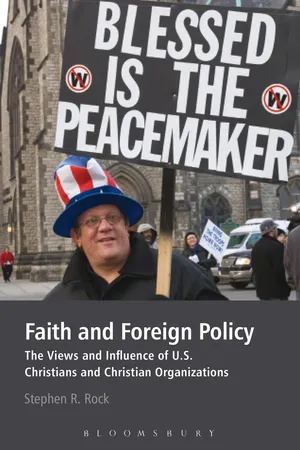
Faith and Foreign Policy
The Views and Influence of U.S. Christians and Christian Organizations
- 232 pages
- English
- ePUB (mobile friendly)
- Available on iOS & Android
eBook - ePub
Faith and Foreign Policy
The Views and Influence of U.S. Christians and Christian Organizations
About this book
The work examines how the attitudes and preferences of various Christian groups in the United States can influence U.S. foreign policy with specific examples.
Information
CHAPTER 1
Faith and Foreign Policy: An Introduction
I base a lot of my foreign policy decisions on some things that I think are true. One, I believe there’s an Almighty. And, secondly, I believe one of the great gifts of the Almighty is the desire in everybody’s soul, regardless of what you look like or where you live, to be free.
George W. Bush1
Religion shapes the nation’s character, helps form Americans’ ideas about the world, and influences the ways Americans respond to events beyond their borders. Religion explains both Americans’ sense of themselves as a chosen people and their belief that they have a duty to spread their values throughout the world. Of course, not all Americans believe such things—and those who do often bitterly disagree over exactly what they mean. But enough believe them that the ideas exercise profound influence over the country’s behavior abroad.
Walter Russell Mead2
U.S. Christians and the War in Iraq
On March 20, 2003, military forces of the United States and other members of a multinational coalition invaded Iraq. The outbreak of war came as no surprise. For months, the U.S. government had sought to obtain a United Nations Security Council Resolution authorizing the use of force against the government of Saddam Hussein. When that effort failed, the Bush administration had declared its intention to proceed without U.N. authorization.
Christian leaders and institutions in the United States reacted in divergent ways to the threat of war in Iraq, and to the war itself. Mainline Protestant denominations vigorously and almost unanimously opposed the opening of hostilities.3 The World Council of Churches (WCC), to which many Protestant denominations and the National Council of Churches (NCC) belong, asked in October 2002 that the U.S. government “desist from any military threats against Iraq” and that other members of the international community “resist pressures to join in preemptive military strikes against a sovereign state under the pretext of the ‘war on terrorism.’ ”4 The head of the General Board of Church and Society of the United Methodist Church (UMC) condemned the anticipated attack as “reckless,” and the president of the UMC’s Council of Bishops stated that “a preemptive war by the United States against a nation like Iraq goes against the very grain of our understanding of the Gospel, our church’s teachings, and our conscience.”5 Leaders of the United Church of Christ wrote, “We firmly oppose this advance to war.”6 The bishops of the Episcopal Church told Congress that “we do not believe war with Iraq can be justified at this time.”7 And a statement from leaders of Friends (Quaker) organizations in the United States expressed “profound grief and sorrow over our government’s decision to go to war against Iraq,” calling the Bush administration’s policy “unnecessary, immoral, and unwise.”8
Organs of the Roman Catholic Church in the United States also articulated serious reservations about the use of force in Iraq. In November 2002, the United States Conference of Catholic Bishops wrote, “We harbor no illusions about the behavior or intentions of the Iraqi government” and noted that they did not offer “definitive conclusions” regarding the moral status of the approaching conflict. Nevertheless, the bishops stated, “We fear that resort to war, under present circumstances and in light of current public information, would not meet the strict conditions in Catholic teaching for overriding the strong presumption against the use of military force” and they urged that “our nation and the world continue to pursue actively alternatives to war in the Middle East.”9
By contrast, Evangelical Protestant denominations and leaders were much more favorably disposed toward the Bush administration’s policy. A fall 2002 survey of 350 top evangelical leaders found 59 percent approved the use of military force against Iraq, while only 19 percent opposed it.10 As Charles Marsh, Professor of Religion at the University of Virginia, later noted, “Many of the most respected voices in American evangelical circles blessed the president’s war plans.”11 Televangelists Franklin Graham, Pat Robertson, and Jerry Falwell all supported the invasion of Iraq. Robertson is reported to have declared to his 700 Club viewers that the war was “a righteous cause out of the Bible.”12 Charles Stanley, pastor of the First Baptist Church in Atlanta and a former president of the Southern Baptist Convention, told his listeners that “we should offer to serve the war effort in any way possible.”13 The year after the war began, Falwell wrote an essay entitled, “God is Pro-War,” in which he stated that “President Bush declared war in Iraq to defend innocent people. This is a worthy pursuit.”14 According to one observer, “In the fall [of 2002], when a preemptive military strike against Iraq turned into a serious possibility, it appeared that a major religious debate over the morality of war was heating up, pitting evangelicals against mainline Protestants, Catholics and Orthodox Christians.”15
This debate never fully materialized. Although, unlike the mainline denominations and the Catholic hierarchy, their leaders and members tended to support the war, many evangelical institutions did not articulate a public position. The Assemblies of God declined to issue a statement supporting or condemning the war, noting that local pastors and congregations, as well as individual members, were free to speak for themselves.16 A representative of the Lutheran Church—Missouri Synod (LCMS), in response to a question from a member of the denomination, answered: “Regarding the impending war in Iraq, it is apparent that members of the LCMS equally committed to Scriptural teaching may have differing views regarding justification for such a war. And they may present equally cogent arguments to support their views.”17 Richard Cizik, vice president for governmental affairs at the National Association of Evangelicals (NAE), was a strong proponent of war, arguing that an invasion of Iraq would not be “preemption but another step in responding to the continuum of terrorism, of evildoers.”18 However, when Cizik drafted a statement endorsing the forcible overthrow of Saddam Hussein, the NAE failed to approve it.19
The Southern Baptist Convention (SBC), the single largest Protestant denomination in the United States, openly supported the war. Richard Land, head of the SBC’s Ethics and Religious Liberty Commission, termed those who opposed the use of force against Iraq “naïve” and advocated “whatever military means are necessary—unilateral or otherwise—to overthrow the Iraqi regime.”20 In June 2003, the SBC passed a resolution, “On the Liberation of Iraq,” to “affirm President George W. Bush, the United States Congress, and our armed forces for their leadership in the successful execution of Operation Iraqi Freedom.”21
The positions of individual Christians on the Iraq War did not always reflect those of the religious organizations to which they belonged. President Bush and Vice President Dick Cheney were members of the United Methodist Church, one of the most stridently antiwar denominations. Within every denomination, there were many members whose personal positions differed from the views articulated by the national leadership. A Pew Forum survey conducted in the week before the war began found that 62 percent of Catholics and Mainline Protestants favored the war, despite the formal opposition expressed by the official bodies of their churches. The same survey found that nearly a quarter of Evangelical Protestants did not support attacking Iraq, although most evangelical leaders and the SBC did. Nevertheless, as the poll results show, the pattern of support and opposition to the Iraq War among church leaders and organizations was mirrored to some degree in the pattern among individual believers. While more than three-quarters of Evangelical Protestants favored war in Iraq, fewer than two-thirds of Catholics and Mainline Protestants did so.22
Clearly, different religious groups in the United States held strong and diverse views concerning the Iraq War. Did the opinions and activities of these groups influence the policy of the United States government? It would be easy—and almost certainly wrong—to conclude that they did not. Obviously, opposition to the war by Mainline Protestant and Roman Catholic organizations failed to convince the Bush administration to refrain from initiating the conflict. This was in part because the antiwar sentiments expressed by church leaders were not shared by even a majority of the members of their denominations. But it was also because the Mainline Protestant and Catholic opposition to the war was offset, and perhaps outweighed, by the sometimes silent, sometimes vocal support of the war on the part of Evangelical Protestants—denominations, leaders, and individuals—who represented an important constituency of the Bush administration and the Republican Party. Had Evangelical Protestants strongly opposed the war, the administration would likely have been reluctant to proceed. As Michael Cromartie, an expert on evangelicalism at the Ethics and Public Policy Center, remarked the week before the opening of hostilities: “Just cold political calculus tells you if you had 50 million evangelicals rallying in downtown Washington against the war, it would cause great disturbance, but they’re not there, and they won’t be.”23 In that sense, it can be argued that attitudes of Evangelical Protestants exercised a considerable, possibly even decisive, impact on U.S. policy.
Classifying Christians
This book is about the relationship between religion and foreign policy in the United States. It has two main purposes. The first is to explain how, and under what circumstances, religion—religious beliefs, believers, and institutions—influences America’s behavior abroad. The second is to identify and, more importantly, to explain, differences (and similarities) in foreign policy preferences and positions among various gr...
Table of contents
- Cover
- Title
- Chapter 1 Faith and Foreign Policy: An Introduction
- Chapter 2 The Influence of Religion on U.S. Foreign Policy
- Chapter 3 The Use of Military Force
- Chapter 4 International Human Rights
- Chapter 5 Middle East Policy
- Chapter 6 International Law and Institutions
- Chapter 7 Protection of the International Environment
- Chapter 8 Conclusion
- Select Bibliography
- Index
- Copyright
Trusted by 375,005 students
Access to over 1.5 million titles for a fair monthly price.
Study more efficiently using our study tools.
Frequently asked questions
Yes, you can cancel anytime from the Subscription tab in your account settings on the Perlego website. Your subscription will stay active until the end of your current billing period. Learn how to cancel your subscription
No, books cannot be downloaded as external files, such as PDFs, for use outside of Perlego. However, you can download books within the Perlego app for offline reading on mobile or tablet. Learn how to download books offline
Perlego offers two plans: Essential and Complete
- Essential is ideal for learners and professionals who enjoy exploring a wide range of subjects. Access the Essential Library with 800,000+ trusted titles and best-sellers across business, personal growth, and the humanities. Includes unlimited reading time and Standard Read Aloud voice.
- Complete: Perfect for advanced learners and researchers needing full, unrestricted access. Unlock 1.5M+ books across hundreds of subjects, including academic and specialized titles. The Complete Plan also includes advanced features like Premium Read Aloud and Research Assistant.
We are an online textbook subscription service, where you can get access to an entire online library for less than the price of a single book per month. With over 1.5 million books across 990+ topics, we’ve got you covered! Learn about our mission
Look out for the read-aloud symbol on your next book to see if you can listen to it. The read-aloud tool reads text aloud for you, highlighting the text as it is being read. You can pause it, speed it up and slow it down. Learn more about Read Aloud
Yes! You can use the Perlego app on both iOS and Android devices to read anytime, anywhere — even offline. Perfect for commutes or when you’re on the go.
Please note we cannot support devices running on iOS 13 and Android 7 or earlier. Learn more about using the app
Please note we cannot support devices running on iOS 13 and Android 7 or earlier. Learn more about using the app
Yes, you can access Faith and Foreign Policy by Stephen R. Rock in PDF and/or ePUB format, as well as other popular books in Politics & International Relations & Comparative Politics. We have over 1.5 million books available in our catalogue for you to explore.