- 224 pages
- English
- ePUB (mobile friendly)
- Available on iOS & Android
eBook - ePub
About this book
NATO and Terrorism posits that the post 9/11 war on terrorism has had a profound effect on NATO's post Cold War structure and military missions. The work will address upper-level undergraduate and early graduate level classes. It will support courses in international organizations, terrorism, international security, US foreign policy, transatlantic studies, and globalization.
Information
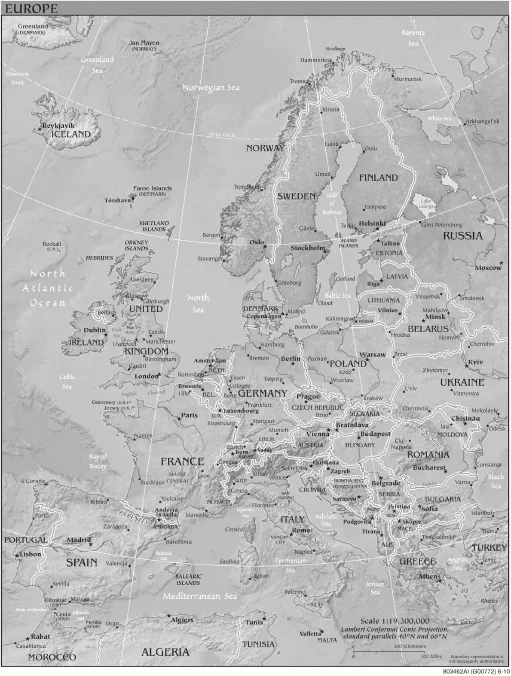
Map 1. Europe
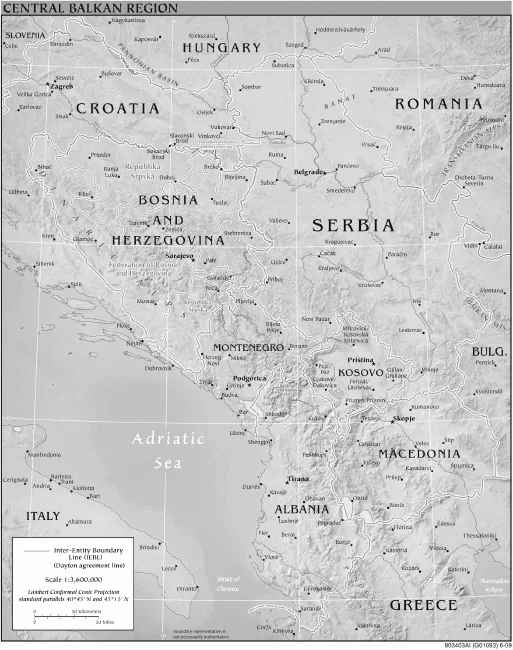
Map 2. Central Balkan Region
Acknowledgments
I would like to thank Ms. Marie Claire Antoine at Continuum Books for supervising the entire project from beginning to end. She demonstrated great interest in the initial stages and worked steadily and patiently with me on all aspects of the book during the past two years. In addition, I am indebted to Murali at Newgen Imaging for his masterful and extremely prompt work on copyediting and page proofs. Further, I am appreciative of the continuing interest in the project demonstrated by my colleagues in the Department of Political Science at Valdosta State University. I would also like to express a special thanks to Dr. Ivan Nikolov, Director of International Programs at Valdosta State. He showed genuine interest in the book and sent me timely recommendations for sources, all of which I fitted into the book. My colleagues in the Department of Politics and European Studies at Palacký University in Olomouc, Czech Republic deserve special thanks. Discussions with them about key topics and use of their library have added a unique dimension to several chapters. Further, colleagues at the Department of Political Science and Sociology at Tavrida University, Simferopol, Crimea, Ukraine opened new windows of interest for me in the nations of the Black Sea Region. Finally, Bob Evanson of the University of Missouri/Kansas City offered his moral support and wisdom at several points during the completion of the book.
A version of Chapter Ten, ‘European Security, East and West’ appeared in The Carl Beck Papers in Russian & East European Studies, Center for Russian & East European Studies, University of Pittsburgh, USA.
Introduction
Capturing the changes in the North Atlantic Treaty Organization (NATO) in the two decades since the end of the Cold War is no easy matter. It is the thesis of this book that the capturing process entails three levels that have each been in continuous motion and that have together become inter-locked with one another. There is no chronological sequence to the actions of the three dynamic forces, and they impact one another without notice or warning. The level that ranks first and possesses the most force is clearly terrorism activity itself. Although the acuity of this factor is most evident in the post-9/11 world, its visage appeared in the previous decade in both sporadic outbursts and rogue state behavior. The second-ranked level is the transformation of the missions of the military alliance itself. Instead of the Cold War focus on the European theater, the missions expanded and multiplied to stretch from Bosnia to the shores of Somalia. The third level of analysis, most affected by the others but a powerful factor in its own right, is the organizational expansion of the alliance. Under the twin pressures of terrorist violence and changing missions, NATO expanded its membership by 75 percent in the two decades that followed the close of the Cold War in 1989. Interpenetration of these three levels set the agenda for NATO, but the constant uncertainties, disagreements, and explosions within this interactive system made it difficult to complete successfully and fully many of the ensuing challenges. However, a deeper understanding of this imperfectly functioning, three-layered dynamo can generate conclusions that will enable an expanded organization to be better prepared to confront, contain, and eventually defeat the most serious threat to the global community to emerge in the post-Cold War period.
The first and last chapters are bookends between which the topical chapters are arrayed and stacked. In Chapter One, the obvious impact of the increased pace and lethality of terrorism on the military alliance with its Cold War membership composition is at the center of the stage. In Chapter Twelve, NATO’s assumption of very different kinds of missions receives analysis in light of their ability to reconfigure the machinery of engagement with an enemy whose terrorist tactics seem to have no civilized bounds.
The second and third chapters are also paired by theme, as they emphasize the process of expansion of the alliance from 16 to 19 members. In Chapter Two, the efforts of the Clinton Administration to create a feeder system called the Partnership for Peace (PfP) Program receive analysis. His administration spotlighted those nations in the northern part of Central Europe that had acquired statehood in the formative period after the end of World War I. In Chapter Three, the three nations that navigated the process from PfP Status to full membership in NATO are the subjects of concern. Those new alliance partners included the Czech Republic, Hungary, and Poland.
Chapters Four and Five are joined in spirit through the spotlight that they cast on the more tricky membership questions that ensued after 1999, and especially after September 11, 2001. NATO took seven more countries formally into its structure in 2004, three years after the terrorist attacks on the Twin Towers and Pentagon. In fact, the key decision to bring them in was made symbolically in Prague, the capital city of a new member from the class of 1999. Further, the inclusion of Bulgaria and Romania as the twenty-fifth and twenty-sixth members of the alliance had much to do with confronting the increased terrorist threat from the Middle East and Persian Gulf region. On the map, the two countries look to be almost physical barriers against dangers emanating from the east. Inclusion of the other five members was also more problematic than the initial expansion of 1999. The three Baltic States of Estonia, Latvia, and Lithuania had been Republics in the old Soviet Union. Slovenia had been part of the Yugoslav Federation until 1991, while Slovakia had been left out of the 1999 class due to the rigidity and even intolerance of some of its domestic policies in the late 1990s. After a lull of several years, alliance expansion emerged as an important question at the Bucharest Summit in spring 2008. As a result, Albania and Croatia joined the military organization in 2009. Georgia and Ukraine did not receive invitations at that time, but the likelihood of their eventual membership continued to roil the waters throughout the period.
The image of a “shadow” is the unifying theme of Chapters Six and Seven. Bosnia, the subject of Chapter Six, had been the scene of a tragic civil war among Serbs, Muslims, and Croatians in the years 1992–1995. With a Russian blessing, the Yugoslav/Serb leader Slobodan Milosevic moved into Bosnia and pushed back the Muslims and Croats to the benefit of Bosnian Serbs. Thus, the shadow of the Cold War darkened the entire scene of operations and actions. NATO played a forceful role only in the last months of that war. Kosovo, the scene of much more intense NATO military action in 1999, was still part of Yugoslavia. The shadow of Milosevic was ever-present, as he sought victories for a local Serb minority that he had not been able to win in Bosnia. In both settings, NATO troops worked with UN (United Nations) personnel after the wars to keep the peace.
Considerable NATO capabilities were involved in the American-led wars in both Afghanistan and Iraq early in the twenty-first century. Chapters Eight and Nine treat those wars from the vantage point of the effect on NATO as well as NATO’s influence on their outcomes. The alliance formally took control of the Afghan operation against the Taliban/al Qaeda in late 2006, although many NATO partners had contributed earlier. The war in Iraq was quite a different story, as America clearly sparked that effort of a “coalition of the willing.” However, the war drained United States and partner nation capabilities to the detriment of critical alliance objectives in Afghanistan and elsewhere. A number of NATO partners, most notably the Poles, took on major duties in Iraq right after March 2003, even though their alliance membership did not require such responsibilities. A formal alliance role emerged with regard to the great need for training police and military personnel through NATO Training Mission—Iraq (NTM-I).
Finally, Chapters Ten and Eleven are paired through parallel but contrasting regional thrusts. The regional dualism for Chapter Ten is East and West, and the theme is European security. To the east lies Russia with its unpredictable policies that eroded, in many ways, the sense of security in Europe. To the west lay the United States with its interest in both deterring Russian interests and protecting NATO partners in Europe. The 2008–09 Missile Shield Proposal lies at the heart of this regional dualism, and it will receive careful attention, as will successor plans outlined in 2009–10. In Chapter Eleven, the emphasis is on the North/South dualism with the image of coastal borders. NATO interests in the Baltic Sea region to the north and to the Black Sea region to the south will take the stage. Scandinavian nations see NATO as an important anchor in smoothly incorporating the Baltic nations, in light of Russian adventurous policies towards them. In the Black Sea region, Russian ambitions have been even more evident. This was especially evident in its war with Georgia in 2008, and then again in its cut-back of natural gas supplies to Ukraine in early 2009. In these two chapters, NATO is engaged in a somewhat polarized struggle with Russia both on an east/west basis and on a north-south dimension. However, it would be a mistake to overestimate the Russian factor, for regional conflicts and perspectives added to the turbulent brew.
Abbreviations
| BALTBAT | Baltic Battalion |
| BALTNET | Baltic Air Surveillance Network |
| BEAC | Barents Euro-Arctic Council |
| BSEC | Black Sea Economic Cooperation Pact |
| CBRN | Chemical, Biological, Radiological, and Nuclear |
| CFE | Conventional Forces Agreement/Europe |
| CFSP | Common Foreign and Security Policy |
| CIA | Central Intelligence Agency |
| CIS | Commonwealth of Independent States |
| CSCE | Conference on Security and Cooperation Europe |
 | Czech Social Democratic Party (acronym is for Czech words) |
| CVVM | Center for Research on Public Opinion(acronym is for Czech words) |
| ESDF | Europe Security and Defense Force |
| ESDP | Europe Security and Defense Policy |
| EU | European Union |
| EUFOR | EU Force |
| FRTD | Facilitated Railway Transit Document |
| FTD | Facilitated Transit Document |
| GDP | Gross Domestic Product |
| GMD | Ground-Based Midcourse Defense |
| ICBM | Intercontinental Ballistic Missile |
| IED | Improvised Explosive Device |
| IFOR | Implementation Force |
| ISAF | Intern... |
Table of contents
- Coverpage
- Half Title
- Title Page
- Dedication
- Contents
- Map 1
- Map 2
- Acknowledgments
- Introduction
- Abbreviations
- Chapter 1 The Battle against Terrorism Reshapes the NATO Organization
- Chapter 2 Partners for Peace after the Cold War
- Chapter 3 From Partnership to Membership in 1999
- Chapter 4 The Class of 2004 and the Post-9/11 World
- Chapter 5 Further Class Memberships and the Traps of Southeast Europe
- Chapter 6 Bosnia in the Lengthened Shadow of the Cold War
- Chapter 7 Kosovo in the Shadow of Bosnia’s Lessons
- Chapter 8 NATO Applies its Capabilities in Afghanistan
- Chapter 9 The War in Iraq Shakes NATO Capabilities
- Chapter 10 European Security, East and West
- Chapter 11 The Coasts of NATO, North and South
- Chapter 12 NATO Missions Reshape the Battle against Terrorism
- References
- Index
- Copyright
Trusted by 375,005 students
Access to over 1.5 million titles for a fair monthly price.
Study more efficiently using our study tools.
Frequently asked questions
Yes, you can cancel anytime from the Subscription tab in your account settings on the Perlego website. Your subscription will stay active until the end of your current billing period. Learn how to cancel your subscription
No, books cannot be downloaded as external files, such as PDFs, for use outside of Perlego. However, you can download books within the Perlego app for offline reading on mobile or tablet. Learn how to download books offline
Perlego offers two plans: Essential and Complete
- Essential is ideal for learners and professionals who enjoy exploring a wide range of subjects. Access the Essential Library with 800,000+ trusted titles and best-sellers across business, personal growth, and the humanities. Includes unlimited reading time and Standard Read Aloud voice.
- Complete: Perfect for advanced learners and researchers needing full, unrestricted access. Unlock 1.5M+ books across hundreds of subjects, including academic and specialized titles. The Complete Plan also includes advanced features like Premium Read Aloud and Research Assistant.
We are an online textbook subscription service, where you can get access to an entire online library for less than the price of a single book per month. With over 1.5 million books across 990+ topics, we’ve got you covered! Learn about our mission
Look out for the read-aloud symbol on your next book to see if you can listen to it. The read-aloud tool reads text aloud for you, highlighting the text as it is being read. You can pause it, speed it up and slow it down. Learn more about Read Aloud
Yes! You can use the Perlego app on both iOS and Android devices to read anytime, anywhere — even offline. Perfect for commutes or when you’re on the go.
Please note we cannot support devices running on iOS 13 and Android 7 or earlier. Learn more about using the app
Please note we cannot support devices running on iOS 13 and Android 7 or earlier. Learn more about using the app
Yes, you can access NATO and Terrorism by James W. Peterson in PDF and/or ePUB format, as well as other popular books in Politics & International Relations & International Relations. We have over 1.5 million books available in our catalogue for you to explore.