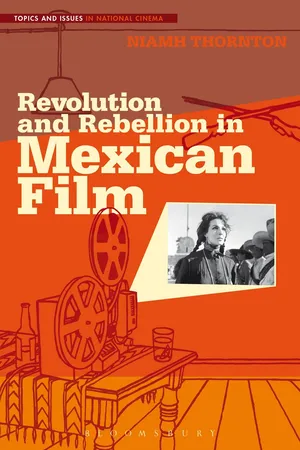
Revolution and Rebellion in Mexican Film examines Mexican films of political conflict from the early studio Revolutionary films of the 1930-50s up to the campaigning Zapatista films of the 2000s. Mapping this evolution out for the first time, the author takes three key events under consideration: the Mexican Revolution (1910-1920); the student movement and massacre in 1968; and, finally, the more recent Zapatista Rebellion (1994-present).
Analyzing films such as Vamanos con Pancho Villa (1936), El Grito (1968), and Corazon del Tiempo (2008), the author uses the term 'political conflict' to refer to those violent disturbances, dramatic periods of confrontation, injury and death, which characterize particular historical events involving state and non-state actors that may have a finite duration, but have a long-lasting legacy on the nation. These conflicts have been an important component of Mexican film since its inception and include studio productions, documentaries, and independent films.
- 224 pages
- English
- ePUB (mobile friendly)
- Available on iOS & Android
eBook - ePub
Revolution and Rebellion in Mexican Film
About this book
Information
1
War Stories on Film: Chaos, Confusion and Creativity
In the late 1800s and early 1900s, similar to patterns in other Latin American countries, the first Mexican films were documentaries. Early silent films were made by travelling entertainers who recorded the inhabitants of a town or city and then projected these familiar scenes to the local audiences (see, for example, de los Reyes, 1996). Other films show prominent figures in ordinary activities, such as the dictator, Díaz, strolling through the park with his family. However, the onset of the Revolution in 1910 interrupted the trend of making easy pieces of entertainment as filmmakers began to follow the conflict. Therefore, from the inception of the national industry, films of political conflict have been central to Mexican cinema. Examples of these can be seen in the compilation films Memorias de un mexicano [Memories of a Mexican] (Carmen Toscano, 1950) and Epopeyas de la Revolución [Epic of the Revolution] (Jesús H. Abitia and Gustavo Carrero, 1961) (see Noble, 2005; Pick, 2010; Vázquez Mantecón, 2010; Fabio Sánchez and García Muñoz, 2010a). Starting with the Revolution, this is a pattern that would continue through to 1968, albeit in a contested and partly censored way, and up to the time of the Zapatistas and the international attention they have garnered.
The Revolutionary film became central to Mexican cinema. So much so that early Mexican cinema formulated new and innovative methods of staging battles in the middle of the Revolution in order to create newsreels for international distribution, which were influential in the filming of later conflicts (see de Orellana, 2003; Mora, 1989). Notoriously, towards the end of the Revolution Villa, the leader of the División del norte (Northern Division) signed a contract with the Mutual Film Company whereby he fought at times that suited their needs (see de Orellana, 2003; de la Vega, 2010; Fabio Sánchez and García Muñoz, 2010b).1 Gradually, fictional representations of the Revolution evolved, providing a suitable backdrop, an ideological battlefield or a grand stage on which to play out dramatic stories. All major armies had their own ‘embedded’ filmmakers who followed them into battle resulting in popular documentaries and newsreel footage, some of which can be seen in Epopeyas de la Revolución and Memorias de un mexicano.
Here, I shall consider one of these compilation films in order to reflect on the re-packaging of the early documentaries for a general audience. For Andrea Noble Memorias de un mexicano reads as ‘a prime example of the attempts to install the memory of the revolution at the centre of the processes of national “imagining”’ (2005, p. 61). It is an edited compilation of the filmmaker and agency owner Salvador Toscano’s archival footage taken between the 1890s and 1927 and told as if it were a personal reflection by Carmen Toscano on her father’s life as witness to the political events of the time. The narration over-determines Toscano’s role as witness, despite the fact that much of the footage would have been taken by his employees. Noble suggests that through the editorial techniques employed, as well as the use of voiceover and music, which serve to dramatize the events, the film can be read as a Revolutionary melodrama, as defined by Deborah E. Mistron (1984). It is evident that there is a blurring of the lines between fact and fiction in the aesthetic manipulation of the original early footage, which is something that recurs throughout many of the films concerning the different conflicts.
Each of the three conflicts: The Revolution, 1968 and the Zapatista rebellion have been significant in Mexico for reasons that will be fully explored in this book. This means that their representation on film needs to be carefully contextualized in each chapter and there will be a reflection on the significance of capturing a major historical event and the facts, myths, subjective experiences, memories, memorializing and attempts to forget that surround each.
To grasp the scale and trajectory of the significance of films of political conflict, this chapter will consider the eras being examined in this book, taking in some of the key literature in the field. In order to ground the parameters of the discussion, it will consider ¡Vámonos con Pancho Villa! [Let’s Go With Pancho Villa] (1935), the most prominent of Fernando de Fuentes’ trilogy set during the Revolution. Revolución (La sombra de Pancho Villa) [Revolution (the Shadow of Pancho Villa)] (Miguel Contreras Torres, 1933) was the first sound feature to be made on the topic and was a commercial flop on its release. In the 1960s and 1970s the Nuevo Cine [new cinema] group, a loose collective of radical and influential filmmakers and critics interested in the study of cinema as a formal activity who encouraged the dissemination of independent Mexican and international cinema and thereby attracted new audiences, reclaimed ¡Vámonos con Pancho Villa!. The film then became emblematic of iconic imaginings of the Revolution for later generations and scholars and, consequently has become a point of reference for later contestatory films of political conflict.
Revolution on screen: ¡Vámonos con Pancho Villa!
Jorge Ayala Blanca, who has provided an idiosyncratic approach to Mexican cinema in his alphabetically titled chronological series (published between 1979 and 2006), dismisses the first two sound films of the Revolution, Revolución (La sombra de Pancho Villa) and Enemigos [Enemies] (Chano Urueta, 1934), as films that ‘sólo alcanzan a percibir esa guerra civil como una anécdota apta para la demagogia’ (1979, p. 18) [only managed to show that civil war as an anecdote fit for demagogy]. Dismissing these films as propoganda, he, like Emilio García Riera (author of the seventeen volume Historia documental del cine mexicano, which provides a brief summary and commentary on the films released between 1929 and 1976), is more comfortable with the Revolution as represented in de Fuentes’ trilogy, praising how ‘a de Fuentes sólo le interesa lo esencial: cómo la revolución va a trastornar la vida de sus personajes sencillos’ (1979, p. 28) [de Fuentes was only interested in the essential: how the revolution would change the lives of his simple characters].
¡Vámonos con Pancho Villa! was followed by El prisionero 13 [Prisoner 13] (1933) and El compadre Mendoza [Godfather Mendoza] (1933). El prisionero 13 tells the story of Colonel Julián Carrasco [Alfredo del Diestro], a Huertista, who is the embodiment of the Revolutionary disillusionment with Victoriano Huerta (1850–1916), whose ‘black legend’ served ‘to “whiten” the reputations of other revolutionary leaders who were often as corrupt and not much more progressive’ (Mraz, 2009, p. 94). Thus, de Fuentes started his trilogy with a very pessimistic vision of the Revolution. El compadre Mendoza recounts the experiences of a hacendado during the Revolution, his shifting allegiances and eventual affiliation with the Zapatistas. El compadre Mendoza was ‘an explicit challenge to the ideological concoction which would soon come to dominate Mexican culture’ (Mraz, 2009, p. 98). Darker than many of the films that would become the standard fare of the studios, John Mraz compares the trilogy with José Clemente Orozco’s murals, ‘they emphasize the pain and torment, rather than the transformations; they exude a disenchantment with the revolution’s shortcomings instead of celebrating its achievements’ (2009, p. 92).
While all of these films merit due attention, I shall focus on the last of this trilogy, ¡Vámonos con Pancho Villa!, which follows the story of a group of soldiers, ‘los leones’ [the lions], from a small village, who join the Revolution pledging to protect one another. This film is episodic in structure, recounting the incidents and battles which result in all but one of the men’s deaths, variously: In battles, in a game of Russian roulette and following Villa’s orders when it is discovered that he has smallpox, to prevent an epidemic. It is a tragic film, which could go some way to explaining its lack of success on its original release.
The Revolution is represented as a terrible episode in Mexican history. The film’s ‘preámbulo’ [prologue] declares that
Esta película es un homenaje a la lealtad y el valor que Francisco Villa, el desconcertante rebelde mexicano supo infundir en los guerrilleros que le siguieron. De la crueldad de algunas de sus escenas no debe culparse ni a un bando ni a un pueblo, pues recuerda una época trágica.
[This film is an homage to the loyalty and bravery that Francisco Villa, the disconcerting Mexican rebel, knew how to inspire in the warriors who followed him. Of the cruelty of some of the scenes neither one side nor the other should be held responsible. This film recalls a tragic time.]2
This prepares the viewer to expect a brutal depiction of the conflict. The apology for the violence seems quaint to the present-day viewer who is accustomed to much greater cinematic violence than is ever shown in ¡Vámonos con Pancho Villa!. However, it may also be interpreted to act as a warning which demonstrates an understanding on the part of the filmmakers that the audience, so recently brutalized by the actual events, may not appreciate a graphic visual reminder. The film’s opening titles establish not only the greatness of the struggle and the heroism of the soldiers, but they also foreground Villa’s inspirational leadership. Yet, this is coloured by the word ‘desconcertante’ [disconcerting]. Drawing attention to Villa’s personal flaws is a puzzling choice in a film which received considerable state support and, in many ways, celebrated the armed struggle given how celebrated he was as a figure by successive governments. From the opening, the film implicitly questions the enthusiasm implied by the title and its excitable exclamation marks.
¡Vámonos con Pancho Villa! was adapted from the eponymous novel by Rafael F. Muñoz (1931).3 Of the 20 chapters in the novel, nine were dramatized on film (see Serrano, 1978, p. 58). Max Parra describes the novel as
a by-product of urban readers’ demand for blood-and-glory tales about the revolution in newspapers and magazines. The author’s narrative strategy, based on the exaggerated treatment of soldierly male bonding, was designed to appeal to the reading public’s craving for morbidly violent anecdotes. (2005, p. 10)
While the novel was a bestseller for the reasons Parra suggests, the film was a commercial failure (O’Malley, 1986, p. 110), disappearing for years until its revival by the Nuevo Cine group. O’Malley considers the reason for the original failure of the film,
[i]t was cohesive, emotional, dramatic; it contained popular stereotypes of the revolution as well as some battle scenes which are even today cinematically breathtaking. The most plausible explanation of the movie’s box office failure is that it did not give the public the Villa that had proven so popular in the literary version of Muñoz’s story. (1986, p. 110)
Read in conjunction with Parra’s statement, far from what could be implied by the warning at the opening, we can conclude that the filmmakers did not visualize the violence in a way that was convincing to the audience, who confounded the filmmakers’ expectations regarding their reticence to see violence on screen.
The film was shot with considerable support from Lázaro Cárdenas’ government (1934–40), who gave financial backing and ‘provided federal troops and military equipment for its impressive battle scenes’ (O’Malley, 1986, p. 104). Despite this support, the ending does not glorify the Revolution, as it portrays the poor farmer Tiburcio returning to his family disillusioned with the struggle and mourning the loss of his friends, without any change in his economic or social conditions.4
This negative ending suggests that although the battle might be exhilarating, the result will not be tangible for the ordinary soldier, thereby undermining the myth of the glorious popular Revolution put forward by the establishment. Further, as O’Malley contends, the 1930s audience were not ready for this version of Villa. She explains,
[p]opular tastes wanted Villa to be thrilling, not respectable. They were enamoured of Villa the daring Robin Hood, the satyr and monster, the unpredictable deviant, the grimy guerrillero and outlaw with uncanny power over men. The public rejected the movie which showed a well-groomed, impersonal Villa who looked and acted like a professional officer from the National Military Academy. (1986, p. 111)
Such a negative portrayal of Villa, which contributed towards its failure when originally released, would get more sophisticated treatment in Leduc’s film Reed, México insurgente (1970). For the Nuevo Cine group ¡Vámonos con Pancho Villa! was an exemplary alternative to the celebratory Revolutionary studio films. They could signal it as their historical predecessor, yet reject much of its aesthetic as well as the melodramatic elements of the plot.
From the first Revolutionary film Revolución (La sombra de Pancho Villa), Villa has been a recurrent character. His distinctive outsider status made him appealing as a popular leader, as O’Malley (1986), Margarita De Orellana (2003), Parra (2005) and Andrés de Luna (1984) have elucidated.
O’Malley (1986) examines Villa alongside other mythologized Revolutionary heroes, such as Zapata, and compares their legacy through fiction, film and historiography. For her, Villa, alongside Zapata, became ‘prototypes of the “revolutionary/macho”, who, with cartridge belts across his chest, a huge sombrero, and a large mustache, has become one of the most prevalent symbols of the Mexican internationally and in Mexico as well’ (1986, p. 3). O’Malley also compares the almost cartoonish Villa that has emerged on celluloid with the more limited and reverential approach that has been taken towards the representations of Zapata, the troubled trajectory of which will be explored in Chapter 4.
De Orellana (2003) examines Villa and his representations in US film through his contract with the Mutual company. Andrés de Luna (1984) considers the Revolution as a phenomenon that is ‘repleto de pluralidades’ [full of pluralities] (p. 15). He looks at the generic, thematic and stylistic commonalities in Revolutionary films with particular attention paid to Villa. Villa recurs as a focus of examination, not only because of the importance granted to ¡Vámonos con Pancho Villa! but also due to the number of subsequent films that had Villa as a character, or celebrated the iconography of Villismo, such as the wide-brimmed hat. In his discussion of the literary representations of Villa, Parra sums up why he is so ubiquitous,
[t]he popular revolutionary leader was, indeed, regarded by all segments of Mexican society as a vivid and forceful expression of the people’s power, pride, and resilience. Even those who opposed him took delight in mythologizing his controversial life and military feats. (2005, p. 4)
Similarly, Fabio Sánchez and García Muñoz discuss how Villa represents an indefineable everyman in film, ‘se rebela contra la definición del héroe posrevolucionario debido a las múltiples dimensiones de su personalidad, casi nunca en conciliación: bandido-revolucionario, asesino-caudillo, encarnación de la crueldad filántropo’ [he rebels against the definition of post-Revolutionary hero because of the multiple dimensions of his personality, which are hardly ever reconciled: bandit-revolutionary, murderer-leader, incarnation of generous cruelty] (2010b, p. 279). Villa’s representation on film (and other creative forms) has been ever-evolving.
Following the development of Villa as a character functions as a useful form of understanding how the Revolution evolved cinematically. Given that he featured in more than 35 films, this is but a small sampling (de la Vega, 2010, p. 58). Many of the films, like ¡Vámonos con Pancho Villa! and the later Con los dorados de Villa (Raúl de Anda, 1939), have Villa’s army as the focus and Villa as a peripheral, yet controlling force. In other films, such as Las mujeres de mi general (Ismael Rodríguez, 1950), he is embodied in a different character, in this case the everyman general, Juan (Pedro Infante). In the figure of the star, Infante, he is the object of a female tug-of-war between the soldadera Lupe (Lilia Prado), who represents the Revolution, and the vampish Carlota (Chula Prieto), who represents the old guard porfiriato. Natura...
Table of contents
- Cover
- Half-title
- Introduction
- 1 War Stories on Film: Chaos, Confusion and Creativity
- 2 A Woman at War: María Félix
- 3 Revisiting the Revolution: Mexico’s Independents Challenge Conventions
- 4 Mexico 1968 on Film: Screening State Violence
- 5 Zapata and the (Neo)Zapatistas: Indigenous Heroes and Online Warriors
- 6 Romance, History and Violence: The 1990s and 2000s
- Conclusion
- Bibliography
- Filmography
- Index
Trusted by 375,005 students
Access to over 1.5 million titles for a fair monthly price.
Study more efficiently using our study tools.
Frequently asked questions
Yes, you can cancel anytime from the Subscription tab in your account settings on the Perlego website. Your subscription will stay active until the end of your current billing period. Learn how to cancel your subscription
No, books cannot be downloaded as external files, such as PDFs, for use outside of Perlego. However, you can download books within the Perlego app for offline reading on mobile or tablet. Learn how to download books offline
Perlego offers two plans: Essential and Complete
- Essential is ideal for learners and professionals who enjoy exploring a wide range of subjects. Access the Essential Library with 800,000+ trusted titles and best-sellers across business, personal growth, and the humanities. Includes unlimited reading time and Standard Read Aloud voice.
- Complete: Perfect for advanced learners and researchers needing full, unrestricted access. Unlock 1.5M+ books across hundreds of subjects, including academic and specialized titles. The Complete Plan also includes advanced features like Premium Read Aloud and Research Assistant.
We are an online textbook subscription service, where you can get access to an entire online library for less than the price of a single book per month. With over 1.5 million books across 990+ topics, we’ve got you covered! Learn about our mission
Look out for the read-aloud symbol on your next book to see if you can listen to it. The read-aloud tool reads text aloud for you, highlighting the text as it is being read. You can pause it, speed it up and slow it down. Learn more about Read Aloud
Yes! You can use the Perlego app on both iOS and Android devices to read anytime, anywhere — even offline. Perfect for commutes or when you’re on the go.
Please note we cannot support devices running on iOS 13 and Android 7 or earlier. Learn more about using the app
Please note we cannot support devices running on iOS 13 and Android 7 or earlier. Learn more about using the app
Yes, you can access Revolution and Rebellion in Mexican Film by Niamh Thornton in PDF and/or ePUB format, as well as other popular books in Media & Performing Arts & Film History & Criticism. We have over 1.5 million books available in our catalogue for you to explore.