Marshall McLuhan was dubbed a media guru when he came to prominence in the 1960s. The Woodstock generation found him cool; their parents found him perplexing. By 1963, McLuhan was Director of the Centre for Culture and Technology at the University of Toronto and would be a public intellectual on the international stage for more than a decade, then linked forever to his two best known coinages: the global village and the medium is the message.
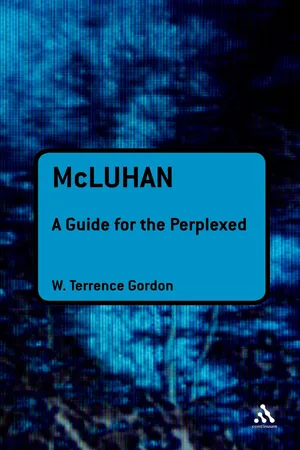
Taken as a whole, McLuhan's writings reveal a profound coherence and illuminate his unifying vision for the study of language, literature, and culture, grounded in the broad understanding of any medium or technology as an extension of the human body. McLuhan: A Guide for the Perplexed is a close reading of all of his work with a focus on tracing the systematic development of his thought. The overriding objective is to clarify all of McLuhan's thinking, to consolidate it in a fashion which prevents misreading, and to open the way to advancing his own program: ensuring that the world does not sleepwalk into the twenty-first century with nineteenth-century perceptions.
- 216 pages
- English
- ePUB (mobile friendly)
- Available on iOS & Android
eBook - ePub
McLuhan: A Guide for the Perplexed
About this book
Information
Chapter One
Background, Context, Definitions, and … Stumbling Blocks
Norman Mailer said Marshall McLuhan had a mind that could only think in metaphors. The metaphor for McLuhan’s life and life’s work is a voyage of discovery, and it emerges from a literary classic that was one of his favorites: Edgar Allan Poe’s A Descent into the Maelstrom.
The story tells of a fisherman caught in a fearsome whirlpool off the northwest coast of Norway, known to mariners as the Maelstrom. The narrator of Poe’s tale recounts that he and his two brothers had spent years repeatedly risking their lives to cross this treacherous expanse of the Arctic Ocean in order to reach the rich fishing grounds beyond. They were skilled in timing their trips to coincide with slack waters, but they knew well that any miscalculation would put them at the mercy of a force strong enough to suck down trees, whales, boats and ships of all sizes. They had at times been stranded beyond the Maelstrom as it churned longer than usual; once they had nearly starved to death, as a full week of becalmed waters kept them from returning home.
After years of eluding disaster, the brothers find themselves heading for port as a monstrous hurricane brews with such great speed that they are driven into the dark and angry waters at the center of the whirlpool. One brother lashes himself to the mast for safety, but when it snaps he is carried overboard and drowns. The other brothers remain aboard their boat as it begins to descend into the spinning water. Amid total chaos, the one who would survive to tell of the experience sees both horror and beauty. As he notices which objects go most quickly to their destruction on the rocks at the bottom of the vortex, he discovers a pattern that offers a clue for a survival strategy. When he fails to make his brother understand what must be done to escape a watery grave, he leaps overboard alone, lashed to a barrel that will keep him afloat. The other, trusting in the apparent safety of a ring-bolt aboard their vessel, vanishes with it.
As the Maelstrom’s own force abates, the hurricane continues to rage, carrying the surviving brother down the coast, where he is rescued by other fishermen. Though the horror of the ordeal leaves him temporarily speechless, he is finally able to summon enough strength to relate what happened in full and explain how he came to understand the way to escape. But those who hear his account not only fail to understand but react with disbelief. Poe portrays himself as a traveler who is among those listening to the fisherman, whom he describes as broken in body and spirit and resigned already to retelling his story without any expectation of anyone believing him.
McLuhan first referred to the story of the Maelstrom in an article published in 1946, titled “Footprints in the Sands of Crime.” It became a perennial favorite in his teaching and in his writing. It is given pride of place in his first book, The Mechanical Bride, where readers are told explicitly how much importance McLuhan attaches to it and precisely what place it occupies in his emerging method of analysis: “Poe’s sailor saved himself by studying the action of the whirlpool and by cooperating with it. The present book likewise makes few attempts to attack the very considerable currents and pressures set up around us today by the mechanical agencies of the press, radio, movies, and advertising. It does attempt to set the reader at the center of the revolving picture created by these affairs where [s/]he may observe the action that is in progress and in which everybody is involved.”1
McLuhan, like Poe’s surviving fisherman, could say: “I became obsessed with the keenest curiosity about the whirl itself. I positively felt a wish to explore its depths, even at the sacrifice I was going to make; and my principal grief was that I should never be able to tell my old companions on shore about the mysteries I should see.”2
And, like the survivor of the Maelstrom, McLuhan found amusement through rational detachment, as he surveyed new environments gathering enough force to endanger the cultural values he personally cherished. No less than the solitary figure of Poe’s tale, McLuhan would meet with skepticism in offering his explanation of how to escape the maelstrom of the electronic age.
At age 17, Marshall McLuhan built and sailed a fourteen-foot boat. Some years later, writing to his mother, he would relate the experience explicitly to his conversion to Catholicism. “An innate distaste for spiritual perversion and incontinence would have kept me neutrally agnostic forever unless there had come opportunities for knowledge of things utterly alien to the culture—the grim product of life-denying other worldliness—that you know I hated from the time I turned from our pavements and wheels to boats and sails.”3
The reference to pavements, wheels, boats, and sails also anticipates one part of the analytic framework that McLuhan would develop for examining the relationship between culture and technology: modes of transportation and their impact on social organization and interaction. McLuhan never limited his study of media to mass communication but defined a medium as any technological extension of body or mind. Inevitably, some readers were surprised that alongside chapters on radio, television, press, and film, Understanding Media offered many more dealing with clothing and clocks, comics and credit cards … Other readers were exasperated when McLuhan’s late writings challenged them to understand what features safety pins and bulldozers shared with the metaphors of everyday language. Was this just an outrageous piece of rhetoric? Not at all, as we shall see in Chapter Five. McLuhan had too profound a respect for rhetoric to use it merely as a zapper.
At 19, he was an undergraduate student at the University of Manitoba, Canada. It was the 1930s, and the world of advertising caught his attention for the first time. He ventured the opinion that fifty years later the ads of that day would prove to be interesting cultural artifacts. Over those fifty years, McLuhan analyzed advertising repeatedly—first in The Mechanical Bride, then in journal articles, a major chapter of Understanding Media, and finally in Culture Is Our Business.
McLuhan earned a B.A. and M.A. from the University of Manitoba, a second M.A. in English literature from Cambridge University, where he then enrolled in the Ph. D. program. When he left Cambridge and took up his first teaching position at the University of Wisconsin, he experienced a shock effect. At age twenty-six he was barely older than his students, but he felt as though he was teaching them across a wide chasm. He recognized that this had something to do with ways of learning, ways of understanding, though he could not pinpoint it. But like Poe’s sailor, he began observing what was happening around him, searching for a clue to a way out. He was on his way to the study of media that would absorb him for the rest of his life.
Media analysis was not a detour from literary studies for McLuhan. On the contrary, he constantly buttresses his academic publications on writers from G. K. Chesterton to T. S. Eliot with articles and books aimed not only at educators grappling with the same challenge he had first faced in Wisconsin but all readers with a stake in literate culture and its survival against the backwash of the electronic age. The writers of particular interest to McLuhan were those who galvanized language and inspired the development of his pivotal view of language as mankind’s first technology. The list is long and runs from the Elizabethan era to the period of high modernism, from Thomas Nashe to Ezra Pound, from William Blake to Wyndham Lewis. James Joyce is the most frequently quoted author in Understanding Media; Harold Innis (Empire and Communications, The Bias of Communication) is absent.
Understanding Media is undoubtedly the best-known book by McLuhan. In print continuously since it first appeared in 1964, it has passed many publication milestones, with an anniversary edition dating from 1994 and the definitive critical edition released in 2003. Chapter Four below will provide a detailed analysis; the present chapter, intended as a gradual initiation to McLuhan’s key terms and themes, is organized around critical reaction to the book. It is also intended to encourage newcomers and set all readers on the path to a fruitful reading of McLuhan by making an example of fine minds that stumbled there and identifying the stones that they failed to see.
The first edition of Understanding Media caused a splash, a deluge of reviews, commentaries, and reactions (a sampling will be given in Chapter Four) throughout North America and abroad. At first, the reception was somewhat muted in McLuhan’s native Canada, even in the popular press, where he would later draw much attention. Fellow Canadian author Pierre Berton published The Cool Crazy Committed World of the Sixties in 1966, titling his introductory chapter “The Mood and the Medium” but without so much as mentioning McLuhan’s name. Perhaps Berton did not wish to be the first to pronounce judgment on the significance of the man that the Haight-Ashbury generation would soon be embracing as cool.
McLuhan’s arch-rival in the English Department at the University of Toronto, the already legendary Northrop Frye of The Anatomy of Criticism fame, showed no such reticence. Writing one year after Berton, his criticisms were pointed and broad-ranging, jabbing even at McLuhan’s commitment to rhetoric, and perhaps subtly discounting the value of the inspiration that McLuhan had drawn from Canadian economist Harold Innis:
The role of communications media in the modern world is a subject that Professor Marshall McLuhan has made so much his own that it would be almost a discourtesy not to refer to him in a lecture which covers many of his themes. The McLuhan cult, or more accurately the McLuhan rumor, is the latest of the illusions of progress: it tells us that a number of new media are about to bring in a new form of civilization all by themselves, merely by existing. Because of this we should not, in staring at a television set, wonder if we are wasting our time and develop guilt feelings accordingly: we should feel that we are evolving a new mode of apprehension. What is important about the television set is not the quality it exudes, which is only content, but the fact that it is there, the end of a vortical suction that ‘involves’ the viewer. This is not all of what a serious and most original writer is trying to say, yet Professor McLuhan lends himself partly to this interpretation by throwing so many of his insights into a deterministic form. He would connect the alienation of progress with the habit of forcing a hypnotized eye to travel over thousands of miles of type, in what is so accurately called the pursuit of knowledge. But apparently he would see the Gutenberg syndrome as a cause of the alienation of progress, and not simply as one of its effects. Determinism of this kind, like the determinism which derives Confederation from the railway, is a plausible but oversimplified form of rhetoric.4
Nearly twenty years later, French philosopher and social critic Jean Baudrillard would reflect on McLuhan and cast him not as a technological determinist but as a technical optimist:
There is the technological optimism of Marshall McLuhan: for him the electronic media inaugurate a generalized planetary communication and should conduct us by the mental effect alone of new technologies, beyond the atomizing rationality of the Gutenberg galaxy to the global village, to the new electronic tribalism—an achieved transparency of information and communication … In reality, even if I did not share the technological optimism of McLuhan, I always recognized and considered as a gain the true revolution which he brought about in media analysis (this has been mostly ignored in France).5
Whether McLuhan himself would accept the phrases generalized planetary communication and achieved transparency of information as accurate reflections of notions that he had framed is debatable. It might also be possible to argue that in spite of branding McLuhan a technological optimist, Baudrillard has allowed for an interpretation that is closer to the technological determinism that Frye laid to McLuhan’s charge, at the point where Baudrillard speaks of the mental effect alone of new technologies.
Between Frye and Baudrillard came Arthur Kroker, whose Technology and the Canadian Mind: Innis/McLuhan/Grant, a detailed and insightful study that, like Baudrillard’s, makes McLuhan the representative of technological optimism, reserving the label of technological determinism not for Harold Innis (the apparent implication of Frye’s oblique reference to him) but for social philosopher George Grant. For Kroker, Innis represents technological realism.
McLuhan drew a reaction from one of England’s high-profile persons about the arts, Jonathan Miller, when McLuhan traveled to London to do a radio broadcast for the BBC. He must have been satisfied that Miller had fully grasped a fundamental and crucial tenet of Understanding Media and flattered to find himself being whisked into the pantheon of twentieth-century intellectual giants when Miller declared that McLuhan was doing for visual space what Freud had done for sex: revealing its pervasiveness in the structuring of human affairs. (Soon after, Tom Wolfe would challenge readers to consider the consequences, if McLuhan was what he sounded like—the most important thinker since Newton, Darwin, Freud, Einstein, and Pavlov.)
But not long after McLuhan’s return to Canada, he received a letter from Miller, declaring himself to be a disciple, offering suggestions to the master, along with his own reflections on television as a medium. Miller professed to be worried about McLuhan’s use of the terms cool and hot, noting that four distinct meanings could be teased out of these terms in McLuhan’s writings, though he did not quote chapter and verse. If Miller was indeed a disciple, he was questing after an orthodoxy that he found wanting in Understanding Media, an orthodoxy that McLuhan could not have woven into the tapestry of his text without violating the principle of probing his subject matter in a tentative manner that is comfortable with stretching meanings. In particular, Miller was keen to challenge McLuhan on his description of television as the cool medium par excellence.
Miller’s cavil failed to take into account the full range of the defining features of television that McLuhan had carefully set out to show how the medium demands maximum sensory involvement from users, thus making it quintessentially cool. Of course, HDTV was unknown when Understanding Media first appeared in print, but that technical advance did not transform television into a hot medium. Much greater sharpness and clarity of the image on the screen has been accompanied by the decreased visual intensity of color transmission. For McLuhan, color was tactile, not visual, a matter discussed in his Through the Vanishing Point. From this point of view, color is cooler than black and white, ensuring that television retains the cool and tactile qualities that McLuhan ascribed to it, a state of affairs that Jonathan Miller apparently could not accept as the factor responsible for making television the coolest medium.
Television camera shots are most often close-ups, framed for viewing on a small screen. By contrast, postcards and photographs are also small, though not restricted to close-ups, because they are printed, and print is a high definition medium. The low definition medium demands close-up shots; television bathes the viewer’s eye in a flow of images that remain in low definition, even on a large-screen set. Miller’s reservations about McLuhan’s take on television took no account of this fundamental point about the technology.
The image on a television screen is not photographic, like that of film. It is, as McLuhan constantly stressed, iconic and sculptural rather than pictorial. Whereas a reel of film is a series of visible and isolatable images permanently embedded in celluloid, no fixed image ever appears on the television screen. Nothing but a configuration of light of varying intensity and in a constant state of flux washes over the screen. It is produced by light through, not light on—by an endless barrage of electrons on the picture tube. HDTV has not changed this process. The television set of today has come a long way from the clunky cabinet of yesteryear, but it remains the cool medium it was when audiences watched the North American debut of the Beatles in the same year that McLuhan published Understanding Media. Jonathan Miller was ready to challenge McLuhan on his und...
Table of contents
- Cover
- Title Page
- Contents
- Preface
- Chapter One: Background, Context, Definitions, and … Stumbling Blocks
- Chapter Two: Literary Links
- Chapter Three: From Madison, Wisconsin to Madison Avenue: The Mechanical Bride and Her Electrical Brood
- Chapter Four: From Media as Political Forms to Understanding Media
- Chapter Five: Mcluhan’s Tool Box: From Through The Vanishing Point to Laws of Media
- Chapter Six: Using Mcluhan’s Tools
- Notes
- References
- Further Readings
- Index
- eCopyright
Trusted by 375,005 students
Access to over 1.5 million titles for a fair monthly price.
Study more efficiently using our study tools.
Frequently asked questions
Yes, you can cancel anytime from the Subscription tab in your account settings on the Perlego website. Your subscription will stay active until the end of your current billing period. Learn how to cancel your subscription
No, books cannot be downloaded as external files, such as PDFs, for use outside of Perlego. However, you can download books within the Perlego app for offline reading on mobile or tablet. Learn how to download books offline
Perlego offers two plans: Essential and Complete
- Essential is ideal for learners and professionals who enjoy exploring a wide range of subjects. Access the Essential Library with 800,000+ trusted titles and best-sellers across business, personal growth, and the humanities. Includes unlimited reading time and Standard Read Aloud voice.
- Complete: Perfect for advanced learners and researchers needing full, unrestricted access. Unlock 1.5M+ books across hundreds of subjects, including academic and specialized titles. The Complete Plan also includes advanced features like Premium Read Aloud and Research Assistant.
We are an online textbook subscription service, where you can get access to an entire online library for less than the price of a single book per month. With over 1.5 million books across 990+ topics, we’ve got you covered! Learn about our mission
Look out for the read-aloud symbol on your next book to see if you can listen to it. The read-aloud tool reads text aloud for you, highlighting the text as it is being read. You can pause it, speed it up and slow it down. Learn more about Read Aloud
Yes! You can use the Perlego app on both iOS and Android devices to read anytime, anywhere — even offline. Perfect for commutes or when you’re on the go.
Please note we cannot support devices running on iOS 13 and Android 7 or earlier. Learn more about using the app
Please note we cannot support devices running on iOS 13 and Android 7 or earlier. Learn more about using the app
Yes, you can access McLuhan: A Guide for the Perplexed by W. Terrence Gordon in PDF and/or ePUB format, as well as other popular books in Social Sciences & Media Studies. We have over 1.5 million books available in our catalogue for you to explore.