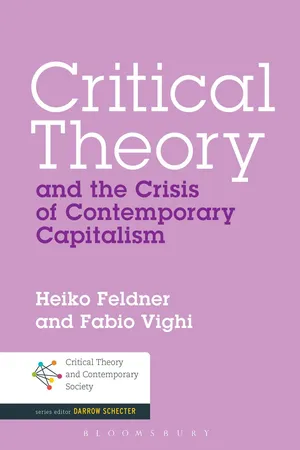
This volume reassesses the nature of the current global economic crisis and its implication for the 21st century, through the unique lens of Marx's theory of the value-form as the unconscious matrix of modern society.
Going beyond orthodox Marxist and postmodernist accounts, the author offers fresh new readings of Marx, Benjamin, Foucault, and Žižek. Here he argues that capitalism has not only entered its greatest crisis since WWII, but has in fact reached its historical limit and is in terminal decline. In this light, the book seeks to answer how a rerun of Keynesian regulations could possibly resolve the crisis. It also inquires as to whether a Green New Deal might succeed when the gap between work to be had and work to be done widens, and what alternatives neo-Marxian approaches offer considering the failure of Marxism in the 20th century.
This far-reaching, critical examination of the crisis not only builds on critical theory, but also offers new readings of key theorists that will appeal to anyone interested in political theory, critical theory, and political economy.
- 152 pages
- English
- ePUB (mobile friendly)
- Available on iOS & Android
eBook - ePub
Critical Theory and the Crisis of Contemporary Capitalism
About this book
Information
1
Collapse without salvation?
Assuming it is out of the question to hang, draw and quarter Sir Fred Goodwin [the former CEO of the Royal Bank of Scotland], pluck out his intestines while they are still warm and wriggling, stuff them into his greedy mouth and then display his severed head on a spike at the Tower of London, could we settle for shooting him instead?
rawnsley 2009
The political economists who pretend to explain the regular spasms of industry and commerce by speculation, resemble the now extinct school of natural philosophers who considered fever as the true cause of all maladies.
marx 1980 [1857]: 401
Bankomania
‘We are what we pretend to be,’ as we know from Kurt Vonnegut (1961: 5), and must therefore ‘be careful about what we pretend to be’. The delightfully excessive jokes about CEOs, their stupendous bonuses and untold greed, cannot hide the fact that there is a widespread, disconcerting readiness to embrace the fateful tradition of opposing (constructive, manufacturing, hard-working, respectable, schaffendes) productive capital with (parasitic, profiteering, interest-bearing, exploitative, raffendes) finance capital, with the former representing the ‘real economy’ while the latter is identified with capitalism per se or bad capitalism, which, in this view, is seen as the cause of economic crises.1
Right from the beginning, the most popular reaction to the current crisis has been to blame it on the greed of the bankers and financial speculators, and to call for a more moral form of capitalism which not only puts an end to ‘casino banking … murdering honest-to-God commercial banking’ but includes the public ‘checks and balances that keep capitalism honest’ and ensure it ‘will be arranged more fairly in future’ (Hutton 2008, 2009 and 2010: ix). Business analyst William Keegan expressed the spirit of the imagined new era of honesty and responsibility when he concluded that ‘the fact of the matter is that a capitalist economy runs on debt; it is just that banks and consumers need to regain a sense of proportion’ (Keegan 2009). Understandable as it is, to blame rapacious CEOs as the central causal agent of the current dilemma is politically misleading and factually wrong.
A brief look at Capital is instructive in this context. Right at the beginning, in the preface to volume one, Marx felt obliged to ‘prevent possible misunderstandings’ of his critique of capitalism by pointing out that, even though he did not ‘depict the capitalist and the landowner in rosy colours’, his standpoint ‘can less than any other make the individual responsible for relations whose creature he remains, socially speaking, however much he may subjectively raise himself above them’ (Marx 1990: 92). Indeed, the vast majority of ‘greedy’ managers have acted in conformity with the imperatives of the capitalist system, insofar as their primary responsibility within this system is neither to serve their customers, nor to look after the common good, but to make profit, and enough of it to stay afloat and keep their shareholders happy. Far from being a pathological preference of the individual entrepreneur, ‘the production of surplus-value, or the making of profits, is the absolute law of this mode of production’ (Marx 1990: 645). That the bankers were dealing with ‘toxic’ rather than ‘honest’ products did not matter much so long as the going was good. On the contrary, their financial wizardry triggered waves of rapture while the social standing of hedge fund managers reached staggering heights. Now that things have turned sour, we may as well skip the ritual lament over the usual suspects – greedy bankers, incompetent government, the idle rich – and turn to the elementary question of why the banks were able to act so ‘irresponsibly’ in the first place, knowingly dealing with ‘toxic assets’ from subprime mortgages and collateralized debt obligations to credit default swaps and other ‘derivatives’. In fact, why they had to act like this.
As we are writing these lines, the Bank of England and the European Central Bank put forward a joint paper, published on 27 May 2014, which proposes to revive the market for asset-backed securities, i.e. the category of assets which had been castigated as ‘toxic’ because of the part they were playing in triggering the financial collapse in 2008 (BoE and ECB 2014). A week later, when questioned on BBC Radio 4’s Today programme, Deputy Governor of the Bank of England Jon Cunliffe acknowledged that the reputation of asset-backed securities has been tarnished by recent events, but insisted at the same time that with the right safeguards in place they would be a useful mechanism for lending.
Securitisation is a mechanism, it could be exploited, it could be abused. And what happened in the financial crisis, particularly with assets originating in the US, is that it was exploited and abused and it spread risk, the so-called toxic assets, through the system. But in the end securitisation is just a mechanism for banks to make loans, to bundle up those loans and to be able to sell on those loans to other investors who want to be lending to the real economy, to households, to businesses. (BBC Radio 4, Today programme, 2 June 2014, 6:15am)
Securitiation in itself then is a neutral instrument which could be put to good or bad use. The aim of the banks’ proposal would not be to take the risk out of lending but to make it transparent and easy to understand. As Cunliffe added: ‘Some securitisations will be securitisations of high risk lending; there is nothing wrong with that as long as the people who buy that know what they are getting and feel that they are able to manage those risks’ (ibid). In other words, ‘Securitisation is now back in vogue’, as Jennifer Rankin puts it, ‘as it is seen as a cheap source of funding when many investors are still struggling to get credit’ (Rankin 2014). The rhetoric of transparency and intelligibility turns the systemic problem of asset-backed securities into one of good policy, sufficient knowledge and proper conduct, while shifting the responsibility for potential failure onto the individual economic actors – you only have yourself to blame!
Neoliberalism was not a mistake. While it did give rise to a regime in which ‘finance exploits us all’ by ‘profiting without producing’ (Lapavitsas 2013), it has not unbalanced or distorted an otherwise productive, ‘honest-to-God’ system. Rather than pathologize the current crisis, naturalize the economic system that gave rise to it and hunt for scapegoats, we have good reasons to look at the neo-liberal turn of the past three-and-a-half decades as a rational response to the historic crisis of industrial capitalism in the 1970s. Deregulation and financialization – the economy’s shift in gravity from production to finance – were not simply mistakes that could be reversed, but utilitarian responses to an irreversible profit crunch.
Let us recall the structural crisis of the 1970s. When the Fordist growth model of industrial society hit the buffers, the state-capitalist economies of the Soviet bloc tumbled into a state of collapse, while in the West the reign of Keynesianism ended in stagflation – the double bind of stagnant growth and rising inflation. In either case, the attempt by the state to subsidize the lack of real growth had proven unsustainable. The hour had come for the ‘neoliberal revolution’.
In the event, the crusade to subordinate all aspects of life to the imperatives of the corporate bottom line did much to damage the fabric of society, but it could not bring back the growth dynamic of the post-war boom. The growth rates of the OECD economies continued to fall from a buoyant 5.3 per cent per year on average in the 1960s to 3.7 per cent (1970s), 2.8 per cent (1980s) and 2.5 per cent during the 1990s. Furthermore, the deregulation of the labour markets aggravated the problem of declining purchase power, while the ostentatious anti-state fanaticism ruined the public infrastructure required for long-term profitability. Intoxicated by their own ideological trademark belief that money was simply a ‘veil over barter’ (Say 1816: 22), the class warriors of neoliberalism had merely shifted the debt problem from the state to the financial markets. Two-and-a-half decades of debt-financed growth ensued, based ever more on money without substance. The rest is history.2
When the debt bubble burst in 2008, a nostalgic pining for a return to Keynes led to the oxymoronic hybrid of neo-liberal Keynesianism as a last-ditch response. As the bailout and stimulus packages shifted the debt problem back to the state, the crisis of the financial markets morphed into a sovereign debt crisis, only on a much higher level than in the 1970s and with no leeway to repeat the operation of finance-driven growth. In their doomed endeavour to square the circle, policymakers have finally ‘run out of policy rabbits to pull out of their hats’ (Roubini 2012). We have been living on borrowed time, as Wolfgang Streeck (2014) has put it, and we continue to do so, since the cynically disguised nationalizations of corporate debt have been paid for by state resources that have yet to be contrived. The success of the latter relies on the creation of future surplus-value at a historic magnitude that is most unlikely ever to materialize. Without real growth, however, it is not only that the question of debt sustainability becomes trickier. The ideological covenant of capitalist societies itself is rendered nil and void, as the acceptance of capitalism as a social partnership is inextricably linked to the prospect of a good life.
Sovereign debt
‘Even by his own high standards, Nicolas Sarkozy excelled himself,’ reported the Guardian’s European editor, Ian Traynor, on Saturday, 15 May 2010, from Brussels. ‘The French president bounded out of the emergency summit of European leaders and onto a specially made-for-TV stage. The tension was palpable, the theatrics mesmerising.’ What had happened? When in their emergency meeting on the previous weekend, which was designed to resolve Greece’s sovereign debt crisis as the most pressing issue in the unfolding saga of the European sovereign debt crisis, the Eurozone leaders did not seem to get anywhere after their Friday supper, France’s head of state finally had enough:
Sarkozy claimed the political leadership of the 16 members, announced a defining victory against the markets and the ‘speculators’ wrecking the currency. The metaphors were all martial. Europe was at war. He would not give away his ‘lines of defence’. But by the time the markets opened on Monday morning, the enemy would have learned its lessons and beat a retreat. … In the previous hour upstairs at the summit, Sarkozy had thrown a wobbly. ‘It was really a drama,’ said an experienced European diplomat. ‘A very abrupt end to the summit – because Sarkozy said he had had enough and really forced Merkel to face her responsibility.’ A European Commission official added: ‘He was shouting and bawling. The Germans were being very difficult, and not only the Germans. It was a big fight between Sarkozy and Merkel.’ … ‘Sarkozy went so far as banging his fist on the table and threatening to leave the euro,’ an unnamed Zapatero [the then Spanish prime minister] colleague told the paper: ‘That obliged Angela Merkel to bend and reach an agreement’. (Traynor 2010: 44)
What an extraordinary drama. Teutonic eagle versus Gallic rooster – have we not known this all along? Yet it was not only the Germans and the French that were at loggerheads, far from it:
The French had Spain, Italy, Portugal and the European Commission lined up behind them. On the other side stood Germany, ranged alongside the Dutch, the Austrians and the Finns, all quietly hoping Merkel would prevail. The leaders’ after-dinner debate signalled that Europe was in the throes of an existential crisis. … ‘It was a fundamental discussion about sovereignty, about the role of the member state, about what the EU is for, the role and power of the European Commission’, said a second diplomat. Sarkozy claimed the outcome as a famous victory. In fact, he had bought himself some time, with the leaders agreeing to convene an emergency session of the EU’s 27 finance ministers the next day to agree the fine print. By 2.15 am on Monday, the deal was done: a €750bn (£639bn) safety net for the single currency, made up of three elements – a fast-track fund run by the European Commission, a much larger system of loans and loan guarantees from the 16 eurozone governments, with the International Monetary Fund putting up one euro for every two from the Europeans. Europe was opting for shock and awe. Repeatedly in the past two weeks, Merkel had declared that ‘politics has to reassert primacy over the financial markets’. This was the attempt. (Traynor 2010: 44)
Away with lowly animosities: all for one and one for all, and everyone united in the struggle against plutocracy. Yet there is a lot more to this than meets the timid eye. After all, Sarkozy was by no means the only one to make a mighty stand for sovereignty. The US administration was discontented as well, for old Europe’s crisis management had clearly been out of control.
Joe Biden, the US vice-president, privately told European leaders to get their act together. A few hours before the Sarkozy show on 7 May, Timothy Geithner, the US treasury secretary, pressed European finance ministers for a big decision and promised help from the US Federal Reserve or central bank. Then last Sunday, President Barack Obama went on the phone to Sarkozy and Merkel. ‘The €750bn fund was the idea of the Americans, who insisted on the need to mobilise massive money to impress the markets and to stop bleeding confidence. That was their concrete message,’ said a diplomat. … By early on Monday, the finance ministers were rushing to meet Sarkozy’s promise that the huge rescue package would be ready by the times the markets opened in the Far East. They missed the deadline for Australia and New Zealand. Outline agreement had been reached on the European fund of €500bn. But who would control it? The Germans insisted that had to be national governments, not the European commission. They won t...
Table of contents
- Cover-Page
- Half-Title
- Series
- Title
- Contents
- Introduction
- 1 Collapse without salvation?
- 2 Homo economicus: Greenspan’s misanthropy in context
- 3 Ontology of crisis
- 4 The Capitalist discourse: Digging its own grave
- 5 Agamben’s messianism, or: Trouble with the dialectic
- Epilogue: Nothing to be liberated
- References
- Index
- Copyright
Trusted by 375,005 students
Access to over 1.5 million titles for a fair monthly price.
Study more efficiently using our study tools.
Frequently asked questions
Yes, you can cancel anytime from the Subscription tab in your account settings on the Perlego website. Your subscription will stay active until the end of your current billing period. Learn how to cancel your subscription
No, books cannot be downloaded as external files, such as PDFs, for use outside of Perlego. However, you can download books within the Perlego app for offline reading on mobile or tablet. Learn how to download books offline
Perlego offers two plans: Essential and Complete
- Essential is ideal for learners and professionals who enjoy exploring a wide range of subjects. Access the Essential Library with 800,000+ trusted titles and best-sellers across business, personal growth, and the humanities. Includes unlimited reading time and Standard Read Aloud voice.
- Complete: Perfect for advanced learners and researchers needing full, unrestricted access. Unlock 1.5M+ books across hundreds of subjects, including academic and specialized titles. The Complete Plan also includes advanced features like Premium Read Aloud and Research Assistant.
We are an online textbook subscription service, where you can get access to an entire online library for less than the price of a single book per month. With over 1.5 million books across 990+ topics, we’ve got you covered! Learn about our mission
Look out for the read-aloud symbol on your next book to see if you can listen to it. The read-aloud tool reads text aloud for you, highlighting the text as it is being read. You can pause it, speed it up and slow it down. Learn more about Read Aloud
Yes! You can use the Perlego app on both iOS and Android devices to read anytime, anywhere — even offline. Perfect for commutes or when you’re on the go.
Please note we cannot support devices running on iOS 13 and Android 7 or earlier. Learn more about using the app
Please note we cannot support devices running on iOS 13 and Android 7 or earlier. Learn more about using the app
Yes, you can access Critical Theory and the Crisis of Contemporary Capitalism by Heiko Feldner,Fabio Vighi in PDF and/or ePUB format, as well as other popular books in Politics & International Relations & International Relations. We have over 1.5 million books available in our catalogue for you to explore.