- 140 pages
- English
- ePUB (mobile friendly)
- Available on iOS & Android
eBook - ePub
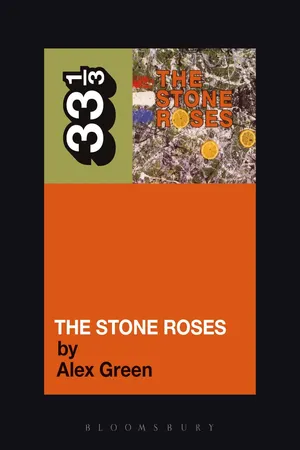
The Stone Roses' The Stone Roses
About this book
The Stone Roses shows a band sizzling with skill, consumed with drive and aspiration and possessing an almost preternatural mastery of the pop paradigm. This book explores the political and cultural zeitgeist of England in 1989 and attempts to apprehend the magic ingredients that made The Stone Roses such a special and influential album.
Information
1
“I Wanna Be Adored” (4:52)
I swear I’d send myself straight to the devil
If I were not a devil as it is!
If I were not a devil as it is!
—Goethe,
“Faust” (11. 2809-2810)
“Faust” (11. 2809-2810)
I have always clung fiercely to my heroes. I own every Woody Allen movie available; I bought the Golden Palominos’ Visions of Excess because Michael Stipe sings on it and I paid more than I’ll ever admit for an old New Yorker with a hard-to-find J. D. Salinger story in it. My loyalty runs deep, making me forgiving of obvious creative stumbles or ill-advised career choices, because when you admire or love someone for whatever reason—their artistic achievements, their winning personality, their physical beauty—you tend to let them get away with things.14 There will, however, come a point when you have to draw the line somewhere, even though it may break your little heart. It took me a while, but I can now freely admit that I can’t stand Elvis Costello’s album with the Brodsky Quartet and that I haven’t liked a David Lynch movie since Blue Velvet.15 And although a healthy percentage of the band’s fans would passionately argue with me, judging by their recorded output prior to the release of their self-titled debut, the Stone Roses were not a great band at all.
In fact, aside from the dazzling “Sally Cinnamon,” the band’s early work is decidedly average. I know it’s hard to admit, but early singles like “So Young” and “Here It Comes” are interesting and certainly show promise, but they just aren’t that good. I recognize in them the sonic amniotic fluid that would eventually mature into something extraordinary, but next to anything on the debut album, the early work sounds thin and tentative, representing a band trying to find their swing. “We were terrible at the start,” Brown told Japan’s Rockin’ On magazine in 1989, “we could not write even a melody line, the sound was just rubbish. … Even now I blush to think of it.” Later that year in an interview with NME, Brown said of the band’s evolution: “Inevitably things have changed; no one’s any good when they first start out. Our songs are better now, we’re generally a much better band.”
“Perhaps in the beginning,” Squire added, “we might have done things differently. I suppose we’ve learned from our mistakes. But again that’s inevitable. Otherwise you must believe that everything we’ve ever done is top.”
So how can one explain the brilliance of The Stone Roses?
A conspiracy theorist at heart, when I consider the Stone Roses’ sudden genius and it’s sudden disappearance, my mind conjures a wicked Faustian bargain, struck in the din of a cheap hotel somewhere in Manchester; a bargain that ensured an enduring legacy for a very specific price.
But look, the Stone Roses didn’t make a deal with the devil because, to be frank, they didn’t have to. To find out why, all you have to do is listen to the first line of The Stone Roses’ opening track, “I Wanna Be Adored,” where Brown says as much. Emerging through a thick, but parting musical fog of winding, digitally echoed guitars, a disembodied bass line and the lone pull of a steam train, Brown audaciously announces, “I don’t have to sell my soul / He’s already in me.”16 So there.
The song itself, a meditation on achieving immortality through success, is a shameless but catchy blast of sheer self-promotion. Employing a lyrical brevity (there are really only four different lines in the entire song), the economy of the composition makes the message rather clear: Desire us. And make it fast. The line “I wanna be adored” is delivered in hypnotic reprise throughout the first half of the song, but at the 3:41 point, Brown employs a Jedi mind trick and subversively switches gears to “You adore me.” And you do.
“Without this song the album would have been totally different,” says Jeremy Eade, singer of the New Zealand indie guitar band Garageland. “It’s a great opening track and it informs the spirit of the whole album thereafter; without it the agenda seems conceptually murky and light. Squire’s guitars are shaped magnificently (as they are on the whole album) and the opening arrangement is a thing of great music wank and beauty. Street rumble, wind, bass, cupped chords, delicate lead guitar, oversized bass drum, the riff, tubular bells, vocal. It sounded tough and rock and roll stupid and it carried all the pathos of those celebrated indie Northern crooners McCulloch and Morrissey.”
Despite the fact that musically it may come across with a certain degree of atmospheric distance, made all the more distant by Brown’s trademark half whisper, the song still manages a rushing immediacy. “He’s singing in a soft pop voice,” says Eade, “and a soft pop voice is always risky because guitar music is inherently loud, but give him his due: he does one of the great soft pop vocal performances ever heard on top of electric guitar. Ian Brown has a great voice, forget the pitching problems. It’s the grain of voice that’s vital and Ian Brown has it in spades on this record.”
Reminiscent of the Rolling Stones’ “Sympathy for the Devil,” “I Wanna Be Adored” possesses decidedly fewer lyrics, but is far more revealing. In the Stones’ song, Mick Jagger, assuming the role of the devil himself, gives a tour of his past deeds by enumerating his mischief through the ages:
I stuck around St. Petersburg
When I saw it was a time for a change,
Killed the czar and his ministers,
Anastasia screamed in vain”
And later:
I watched with glee
While your kings and queens
Fought for ten decades …
Far from the pronouncement of “Sympathy for the Devil” to “Just call me Lucifer,” as the narrator of “I Wanna Be Adored” Brown comes across as being quite human. While Jagger’s confident and charming devil introduces himself with a dapper top-hat-and-cane entrance (“Please allow me to introduce myself / I’m a man of wealth and taste”), Brown’s misty invocation clearly lacks the kind of flashy resumé that demands this kind of respect. His is instead a very mortal plea from one who thinks he deserves fame and immortality based on what he’s going to do as opposed to what he’s already done.
In “Sympathy for the Devil,” the devil quickly enumerates his centuries of dastardly deeds—the default setting of which he knows will engender a fearful respect. But if that’s not enough to cultivate dread, he follows it up by warning: “Just call me Lucifer ‘cause I’m in need of some restraint,” and cautions, “Use all your well learned politesse / Or I’ll lay your soul to waste.” Conversely, “I Wanna Be Adored” may start with a shocking and confident devil inside kind of admission, but not only can it make no soul-stealing threats, there’s not even anything to be afraid of. At least for the listener. But for Brown it’s another story. On the surface, Brown seems to fear failure above anything else, but it’s even deeper than that. He’s most afraid of being average, which is worse than failure because at least failure, though a negative achievement, has some external resonance; but when you’re average you’re forgotten overnight.
Just how badly he craves success is revealed at 4:06 when Brown tips us off and gushes, “I gotta be adored.” This, in spite of how it looks, is no small revelation. As we all know, wanting something is very different from needing it, and with the way Brown lets this breathlessly slip, his longing for idolatry is corporeal and resonant, exposed as nothing less than an uncompromising pathology.
Critics were a little afraid of Ian Brown after the release of The Stone Roses, and Brown has recounted in interviews on more than one occasion how during this time period he was repeatedly asked, thanks to the opening line of “I Wanna Be Adored,” if he was indeed the son of the devil. But what critics really feared most were his stony silences in interviews, his blank stares, his way of making their questions sound so stupid as he threw them right back at them in the form of questions of his own. But while “I Wanna Be Adored” finds him declaring to be a devilish sort, it’s a far more vulnerable number than it appears. On the surface the repetition of the song’s title in the framework of the composition reveals a desperate yearning for success and adoration, but deeper than that, it’s a shameless, almost adolescent searching for approval.
But mortal as it is, “I Wanna Be Adored” remains a dark and potent number. “The way it builds from its opening is scary and spooky,” says Ken Stringfellow of the Posies and lately Big Star. “It takes its time to build from a bass riff and a bunch of Eraserhead-like background noises,” he continues, “and it’s perhaps the first (and maybe only) example of psychedelic minimalism that I’ve encountered.”
In “Sympathy for the Devil” the devil is quite literal, but for the Roses, the reference, metaphorical as it may be, is not one that’s wasted. It’s used as a symbol of the band’s drive, copping to an almost possessed will to power. Not only that, but this is Brown’s moment to make his nominations for new pop heroes (his band) and a new pop deity (himself). “I Wanna Be Adored” is the only instance on The Stone Roses where the band lets their guard down to reveal their master plan of worldwide domination. Sure, it sounds conniving and premeditated, but it’s a truly glorious, nearly five minute admission that is more than just an acknowledgment of wanting fame—it’s an attempt to induce it. It’s a sentiment that comes and goes in a smooth glide, and though it is never mentioned again, it somehow stitches itself throughout the album. It also demonstrates that the band, cocky as they may have been, were consumed with hope and ambition; “I Wanna Be Adored” is their battle cry for immediate pop ascension.
“‘I Wanna Be Adored’ is still my favorite,” says the Chills’ Phillips. “To my mind, it is the only song on the album which has that indefinable X factor—the only melodies from the gods, so to speak. The other good songs seem more due to a bit of inspiration, some reasonably good structuring and a large dose of youthful drive and arrogance, especially with the lyrics. It is only ‘I Wanna Be Adored’ that indicates that the angels of music hovered around Ian Brown and John Squire for any length of time at all.”
More than just a great opening track, “I Wanna Be Adored” is The Stone Roses’ pièce de résistance, the song that provides a titular thesis and gives the subsequent numbers their steam, both sonically and thematically. With that in mind, the ghostly train effect at the beginning of the song could very well be an aural explanation of the Stone Roses’ perception of where all this gathering steam was taking them—they knew their train was leaving the station, heading straight for stardom, and those who adored them were already on board, and those who didn’t had better get on fast.
“The rest of the album,” Eade says, “flowed from this ‘adored’ agenda and you felt ready to give over to any suggestion of wit and intelligence on the album because these guys were gonna be our new big band, and we secretly thought we were finally gonna get our own Rolling Stones because the old ones were really starting to stink. And you could sing ‘I Wanna Be Adored’ like an anthem at all the better indie parties and sound convincingly new wave ironic and bored. It sounded knowingly narcissistic and throwaway yet it also hypocritically tipped you into those drunken happy late-night conversations when ya broke your bedsit indie gloom face and admitted, ‘Geez being a rock and roll star must be fucking amazing.’”
2
“She Bangs the Drums” (3:42)
When England was the whore of the world
Margaret was her Madam.
Margaret was her Madam.
—Elvis Costello,
“Tramp the Dirt Down”
“Tramp the Dirt Down”
As the Prime Minister of the United Kingdom from 1979 until 1990, Margaret Thatcher believed in lowering taxes, privatizing government-owned industries, decreasing government spending and employing a supply and demand economic strategy that was based on the principles of monetarism. The term “Thatcherism” itself was introduced by Jamaican-born cultural theorist Stuart Hall in an essay where he provided a thorough critiquing of her administration, and now, years later, the term is used almost exclusively with derision. And it’s not hard to see why: although Thatcher served longer than any other Prime Minister in the 20th century, she widened the gap between the wealthy and the poor and caused massive unemployment across England.
In his book Britpop!, author John Harris reveals the imbalances between the classes that Thatcherism encouraged. He writes, “For those who did well out of Thatcherism, the period was bound up with the indulging of instincts that the post-war period had often held in check: the thrill of climbing the social ladder, conspicuous consumption, the brazen patriotism that reared its head when the Task Force sailed for the South Atlantic. Among the many messages Thatcherism sent forth to its constituency was the assurance that what had been previously snickered at as vulgar and brash should now be celebrated.”
Like the yuppies of the Reagan years, Thatcherism urged those with money to gorge themselves on anything they liked. As the recession of the early part of the 1980s gave way to an economic rise, certain sections of British society found themselves thriving even more as people embarked on exotic vacations, drove expensive cars, wore pricy (and often alarmingly brash) outfits and purchased an endless stream of other superfluous material possessions.
Fun as that may have been for a select few, Thatcherism effectively destroyed Britain’s manufacturing base and excluded the working class from the material obscenity of the era, leaving them pining for political change and to break free from the constraints of a conservative government.17 But it wasn’t just the working class who were affected. Harris observes that the artistic community was also restless for a change: “For most of the Thatcher years, a loose coalition of musicians stood on the opposing side. Their opinions had been forged in the righteous fire of punk rock; the necessity of maintaining one’s radical stance was only confirmed by the result of the 1979 election. For many artists, voicing opposition to the government became an in-built part of their aesthetic.”
“During Thatcher’s reign there was quite a groundswell of protest and discontent, at least initially,” says Birmingham-born Matthew Edwards, singer of the San Francisco-based band the Music Lovers. “Unfortunately,” he says, “the ‘lady was not for turning’ and won the [class] war of attrition, leaving in its place a terrible sense of impotence, especially amongst the young. Artists became embittered or desperately hedonistic.”
With that in mind, it’s no coincidence that the rise of rave culture—twenty-four-hour warehouse parties, rampant drug use and the tireless quest for an extended good time—all coincided with the end of Thatcher’s government. Musically, the shoegazing miserablists of the indie guitar bands were replaced by buoyant, danceable pop groups and innovative, pioneering DJs—and this new sonic euphoria became the inadvertent but blissful soundtrack for political liberation.
While the 1980s spawned plenty of anti-Thatcher anthems from folks like the English Beat (“Stand Down Margaret”), Elvis Costello (“Big Sister’s Clothes,” “Tramp the Dirt Down”) and Morrissey (“Margaret on the Guillotine”), the Stone Roses may not have had an anti-Thatcher tune of their own, but they openly resented Thatcher’s reign and in interviews felt free to take a few shots at her. Although they had begun to reap the financial and social rewards of pop stardom, they weren’t too busy being rock stars to still be frustrated by Thatcher’s conservative policies. During a press conference in 1989 the openly antagonistic Brown even opined, “Thatcher should have gone up in the Brighton bomb.”
Fighting words, indeed, and keeping them in mind, “She Bangs the Drums” with its defiant, lippy tagline of, “Kiss me where the sun don’t shine / The past was yours / But the future’s mine,” comes off as a rallying cry for governmental change that not only prefigured Thatcher’s departure a year later, but joyfully anticipated it.
Perhaps to interpret “She Bangs the Drums” through a political filter may be nothing more than misguided revisionism, but in light of the political situation in England, where the denouement of the Thatcher years was on its way, the end of the song’s big chorus, which gushed, “There are no words / To describe the way I feel,” is a clear call for jubilation. The Stone Roses would never be considered a political band, but Brown was quick to remind the press in the late eighties that they had no qualms engaging in civic discourse. “We’re quite happy,” Brown told NME, “to speak about politics.”
Meanwhile in America, Reaganomics helped fuel the fire of suburban hardcore. With his face making regular wickedly satirical appearances on the covers of hardcore albums and his name appearing in many of their angst-ridden songs, among American punk kids, Reagan was the posterboy of what was wrong in their world.18 But it wasn’t just punk rock. And it wasn’t just Ronald Reagan. In 1987, when trash-talking folk troubadour Mojo Nixon and his sideman Skid Roper opened for Camper Van Beethoven at the Fillmore in San Francisco, Nixon, in the style of the famed Miller Light commercials, divided the audience down the center, having one side chant “Nancy Reagan” and the other “Sucks the devil’s dick.” And we happily complied.19 From frustrated suburban punks to the more studied Mohawked anarchists, American kids were...
Table of contents
- Cover Page
- Title Page
- Acknowledgments
- Prologue
- 1. “I Wanna Be Adored” (4:52)
- 2. “She Bangs the Drums” (3:42)
- 3. “Elephant Stone” (3:01)
- 4. “Waterfall” (4:37)
- 5. “Don’t Stop” (5:17)
- 6. “Bye Bye Badman” (4:00)
- 7. “Elizabeth My Dear” (0:59)
- 8. “(Song for My) Sugar Spun Sister” (3:25)
- 9. “Made of Stone” (4:10)
- 10. “Shoot You Down” (4:10)
- 11. “This is the One” (4:58)
- 12. “I Am the Resurrection” (8:12)
- Epilogue
- Footnotes
- Copyright Page
Trusted by 375,005 students
Access to over 1.5 million titles for a fair monthly price.
Study more efficiently using our study tools.
Frequently asked questions
Yes, you can cancel anytime from the Subscription tab in your account settings on the Perlego website. Your subscription will stay active until the end of your current billing period. Learn how to cancel your subscription
No, books cannot be downloaded as external files, such as PDFs, for use outside of Perlego. However, you can download books within the Perlego app for offline reading on mobile or tablet. Learn how to download books offline
Perlego offers two plans: Essential and Complete
- Essential is ideal for learners and professionals who enjoy exploring a wide range of subjects. Access the Essential Library with 800,000+ trusted titles and best-sellers across business, personal growth, and the humanities. Includes unlimited reading time and Standard Read Aloud voice.
- Complete: Perfect for advanced learners and researchers needing full, unrestricted access. Unlock 1.5M+ books across hundreds of subjects, including academic and specialized titles. The Complete Plan also includes advanced features like Premium Read Aloud and Research Assistant.
We are an online textbook subscription service, where you can get access to an entire online library for less than the price of a single book per month. With over 1.5 million books across 990+ topics, we’ve got you covered! Learn about our mission
Look out for the read-aloud symbol on your next book to see if you can listen to it. The read-aloud tool reads text aloud for you, highlighting the text as it is being read. You can pause it, speed it up and slow it down. Learn more about Read Aloud
Yes! You can use the Perlego app on both iOS and Android devices to read anytime, anywhere — even offline. Perfect for commutes or when you’re on the go.
Please note we cannot support devices running on iOS 13 and Android 7 or earlier. Learn more about using the app
Please note we cannot support devices running on iOS 13 and Android 7 or earlier. Learn more about using the app
Yes, you can access The Stone Roses' The Stone Roses by Alex Green in PDF and/or ePUB format, as well as other popular books in Medios de comunicación y artes escénicas & Música «rock». We have over 1.5 million books available in our catalogue for you to explore.