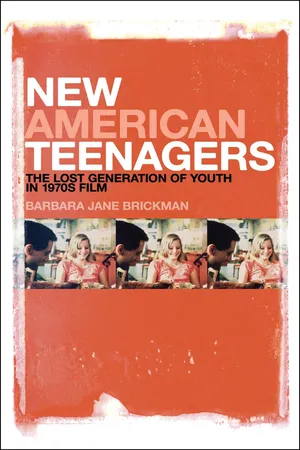
Films like The Rocky Horror Picture Show, Halloween, and Badlands offer a reprieve from the 'straight' developmental narrative, including in the canon of study the changing definition of the American teenager. Barbara Brickman is the first to challenge the neglect of this decade in discussions of teen film by establishing the subversive potential and critical revision possible in the narratives of these new teenage voices, particularly in regards to changing notions of gender and sexuality.
- 280 pages
- English
- ePUB (mobile friendly)
- Available on iOS & Android
eBook - ePub
About this book
Taking a closer look at teen film in the 1970s, New American Teenagers uncovers previously marginalized voices that rework the classically male, heterosexual American teenage story. While their parents' era defined the American teenager with the romantic male figure of James Dean, this generation of adolescents offers a dramatically altered picture of transformed gender dynamics, fluid and queered sexuality, and a chilling disregard for the authority of parent, or more specifically, patriarchal culture.
Information
Chapter 1
The Rock ’n’ Roll High School Picture Show: A Genre Deconstructed
Since the 1960s, the teenpic hero has more often been a Weird and Wimpy One, more liable to flash watery eyes than snarling lips. He is a hapless kid seeking direction, not a tough rebel fleeing restriction.1
Thomas Doherty, Teenagers and Teenpics
In the final chapter to the expanded edition of Doherty’s groundbreaking study on teen film, the critic evaluates recent teen films from the position of a new millennium and, frankly, finds them wanting. The era his original text took as its subject, the heyday of the “teenpic” in the 1950s and early 1960s, stands for him as a watershed moment before the countercultural or New American Cinema films and then the blockbuster persuaded mainstream American film producers to take the youth market and audience as the target for most films, not just niche genre pictures. This sea change would naturally alter the form and address of those films sold to teenagers, apparently taking the teeth out of teenage rebellion and conflict. Simply, for Doherty, after the 1960s the “most fascinating trend in teenpics has been their palpable desire for parental control and authority, not their rebellion and autonomy.”2 These “postclassical” teen films for him lack a strong and adversarial parental authority in a culture supposedly without rules or a moral center so that the teen protagonist or rebel has no worthy antagonist, causing him to yearn for parental direction, control, and discipline. Here enters the “Weird and Wimpy” hero of the teenpic described in the introductory quote to this chapter. Without a strong or even present parent culture, post-1960s teenpics are populated by male victims, not rebels, whose longing for “parental (read: paternal) authority” leads to a preference for “stern discipline and father-son bonding” seemingly miles away from the resistance, alienation, and dangerousness of the classical (again, male) teen protagonist.3
As I argued in my Introduction, this sweeping claim by Doherty seems to conflate the 1970s and 1980s, neglecting the subversive potential that I find in many 1970s youth films, but it also appears to ignore the father-son focus and reconciliation with parent culture that Doherty himself insists often direct the teenpics of the 1950s. Even before the wholesome “clean teenpics” of the late 1950s and 1960s, one would have very little trouble locating a “palpable desire for parental control and authority” in monumental teen films of the 1950s—where, for example, Jim Stark desperately begs his father to “stand up” and be the paternal authority he needs. While I would certainly argue that the Weird or Wimpy teenpic hero has existed longer than Doherty would care to admit here—how else might one explain the career of Sal Mineo, for example, or the male heroes of the “weirdies” that Doherty himself catalogues—the point I would like to stress is that he has missed a key step in the evolution of the genre (the troublesome films of the 1970s) at the same time that he does a disservice to the “postclassical” period of teen films in the 1980s and 1990s that both resemble and revise their classical forerunners in enlightening ways. Although I will not be addressing the latter point until the epilogue of this book, I would like to use this opening chapter to establish the 1970s as a key moment in the evolution of the genre of teen film—its baroque or deconstructionist phase—where the weird kid is a figure to be admired and paternal authority is either rejected or lacking altogether.
However, in order to understand that baroque or deconstructionist moment in the century’s films about youth, I must establish the basic parameters, formulaic features, and motifs of the genre through a brief overview of the previous decades of teen film, or a very short history of representations of youth on the American screen. Necessarily, this history will limit itself to representative films and trends for each decade or period of teen film and make use of other critical histories, such as those by Considine or Scheiner, which have already performed exhaustive studies of the periods in question. My broad strokes here are merely meant to serve as a background for the chapter’s ultimate examination of the 1970s and the more traditional and then truly revisionary films to be found there. One needs to understand the basic tradition, particularly in its “classical” form, to recognize how significant films in the 1970s parody, revise, and deconstruct the values or codes of the genre and, thereby, set up a space for other narratives and counter-discourses (such as those examined in the later chapters of this book) to emerge.
A Brief History of Cinematic Representations of Youth
Although many commentators might place the birth of the teen film in the decade of the “teenager” (the 1950s), Considine compellingly argues that Hollywood has capitalized on stories of youth since its earliest days. Established for example by the Gish sisters and Mary Pickford, the sentimentalized or plucky young female heroine was a staple of early dramas and adventure serials, particularly Pickford’s courageous and self-reliant tomboys, but it was not until the entrance of the flapper in the 1920s that the adolescent drama truly became a sensation. In this era of flaming youth, films such as The Wild Party (1923), Our Dancing Daughters (1928), and The Road to Ruin (1928) drew in eager adolescent (and adult) audiences as their exploitation material profited from what Georganne Scheiner calls “the popular image of wild adolescence and youth run amuck” and necessarily concluded with cautionary messages about troubled teens whose drinking, smoking, and sexual promiscuity ended in ruin.4 Our Dancing Daughters earned countless youth fans for a young Joan Crawford, who as the unrestrained and spirited flapper Deana Medford could be the life of the party without losing her virtue unlike her careless and self-interested friends Beatrice and Ann, but it is perhaps The Road to Ruin that best captures the cautionary and sensationalizing spirit of these lucrative early youth exploitation films.5
In a quite graphic and shocking way, 1928’s The Road to Ruin pushes the limits of acceptability with its supposed exposé of female delinquency, which was both shown to adolescents in high schools as a cautionary tale and banned in many cities, ending as the title promises in teenage ruin, death, and parental (specifically, maternal) culpability. The virtuous adolescent Sally Canfield (played by Helen Foster in the 1928 silent film as well as the 1934 remake) somewhat innocently starts down this road with a bit of drinking and smoking with her aptly name temptress friend Eve, but soon she is having sex not only with a high school boy but also then with an older man whom she meets at a roadhouse. Essentially, the film titillatingly exposes her descent into the debauched life of a “full-blown flapper,” where unchecked pleasure and lack of parental (maternal) guidance doom her to venereal disease, pregnancy, a botched abortion, and an inevitable death.6 Although few audience members would have needed the title card that summarizes the film’s message— “Those who transgress the moral laws pay the bitter price”— the moral that was supposed to scare adolescent audiences straight as it were was muddied by the sensational scenes of pleasure, freedom, and thrilling parties, as was so often the case with exploitation films of the era. The Road to Ruin, then, is exemplary for its early enactment of a fundamental dichotomy in the teen film: that films meant to have a pedagogical or cautionary function for youth and adult or parental audiences often contain contradictory or disturbing sensational elements, which might leave particularly young audience members with the ‘wrong’ impression, ideas, or set of pleasures with which they exit the movie house.7
A number of films continue this focus on delinquency and ambivalent messages into the 1930s, perhaps the most notable of which are the “Dead End Kids” films. The topic of delinquency in this period begins to move away from being fodder for exploitation and more toward the form of a “social problem.” While films like The Road to Ruin might expose serious adult problems such as venereal disease, prostitution, and drug abuse, the “social problem” film takes as its goal a kind of examination and rectification of societal issues. Whether juvenile delinquency, crime, poverty, and general misbehavior, these problems should be solved or tamed, either domesticated or brought in line though fair-mindedness, compassion, and a dose of morality. Although with an emphasis on edification, social justice, and morality, these films also owe a great deal to the crime film genre. Both the “Dead End Kids” films of the late 1930s and studio prestige features like MGM’s Boys Town (1938) explored the possible causes for delinquency, particularly in terms of its environmental roots, but they also brought from the crime genre the familiar concluding homily that “crime doesn’t pay.” In fact, Considine asserts that Hollywood saw itself as capable of making a real social impact with these films, showing “no hesitation in pressing itself upon the courts, the schools, and the police force.”8 Taurog’s Boys Town serves this purpose by holding a mirror up to society and saying through the mouthpiece of its savior-hero Father Flanagan that “there is no such thing as a bad boy,” only bad social environments and corrupt institutions. Much like Boys Town’s criticism of the conditions of poverty in urban centers and the effects on juveniles of parental neglect, early arrest, or tough reformatories where lessons on further criminal acts might be learned, the “Dead End Kids” films, beginning with Wyler’s Dead End in 1937 and made more notable by the fine cast and direction of Curtiz’s Angels With Dirty Faces in 1938, focus on tenement life on New York City’s East Side to expose how poverty and environment can breed a cycle of criminal behavior and gang allegiance from an early age. Angels With Dirty Faces particularly mirrors Boys Town’s moralizing social message, as its hero-priest Jerry Connolly leads the wayward kids (with ‘tough guy’ handles like Soapy, Bim, and Swing) away from the charismatic gangster Rocky Sullivan (played, of course, by James Cagney), who ends up getting the chair for his crimes, and towards an honest life. Yet, even so-called “social problem” films were not immune to the lure of the sensational crimes and pleasures that they decry, again attracting youth audiences thrilled by the darker criminal elements and thrilling events.9
However, the seriousness of a nation embroiled in the worst depression in its history also called for a different, more optimistic face of the future and so were born the clean teens and “fix-it” kids of the 1930s led by Mickey Rooney, Deanna Durbin, Judy Garland, and, though younger, Shirley Temple. These wholesome young stars brought an innocence, youthful energy and enthusiasm, and optimistic outlook to relatively light cinematic narratives, solving problems both personal and communal or social. Usually with a smile and good cheer, they were independent, strong-willed, and often more capable than their elders to provide solutions, help each other, rescue adults, and, of course, put on a show.10 As Shirley Temple’s title character in Rebecca of Sunnybrook Farm (1938) continually reminds the audience, kids like her are “very self-reliant,” able to warm the hearts of an eager national audience (in this case as radio star “Little Miss America”) by offering happiness through, as she sings it, “millions worth of golden sunbeams.” Similarly, although she only saves or, to be exact, rekindles her parents marriage in her first major role in Three Smart Girls (1936), Deanna Durbin was every bit Temple’s match in self-reliant pluck and can-do spirit, described by one critic as a “Pollyanna missionary” who might “sporadically burst into song between her incessant do-gooding.”11 Perhaps the film That Certain Age (1938) better captures her particular allure, as her character becomes enamored of a much older man who must let her down gently and then ultimately directs her energies into putting on a show to benefit underprivileged Boy Scouts with her more appropriately aged boyfriend.12 Optimistic, uplifting, and wholesome roles like these were incredibly popular in the period, making major stars of these young performers and earning sizeable profits for the studios, but none was perhaps so profitable or successful as Mickey Rooney, who won fame for his role as the spirited Andy Hardy, son of upstanding and understanding Judge Hardy in a series of films that ran through the 1940s (and was even revived in 1958 with an adult Andy).13
The Andy Hardy series, one of the most profitable series in the history of American film, solidified both Mickey Rooney’s prominence as one of the most successful male performers of his era and the image of the typical American teenager before World War II. Although the films began in 1937 with A Family Affair, which focused on the entire Hardy family, soon they would revolve around the character of Andy Hardy and his teenage concerns, mistakes, and romantic trials and tribulations. At the heart of the series was Andy’s relationship with his moral paragon of a father, Judge Hardy, who could be stern and somewhat commanding while allowing his softer, compassionate side to show through in climactic heart-to-heart talks with his son. In Love Finds Andy Hardy (1938), Rooney’s first Hardy film costarring Judy Garland, a typical conundrum ensues when Andy attempts to balance his finances and his romances, nearly failing miserably at both. His foolhardy decision to buy a car without all the financing lands him in a sticky dating situation where a friend’s girl becomes nothing more to him than “an installment on car,” but once he fails to secure the necessary funds, he must depend on the mercy, guidance, and eventual generosity of his stalwart father to excuse his debt—an act that secures Andy’s unabashed love and admiration once again for Judge Hardy. According to Mark McGee, for his time period and for an audience invested in traditional values, Andy Hardy was “the perfect image of an American teenager: sometimes misguided, often confused, but basically decent, energetic, and obedient.”14 Certainly, this conclusion is supported by Rooney’s special Academy Award in 1939 (along with Deanna Durbin) for their “significant contribution in bringing to the screen the spirit and personification of youth” and the special Oscar bestowed on the Andy Hardy series in 1943 for “representing the American way of life.”15 In Rooney, the period had not only a representative of American can-do spirit and fortitude—on display, for example, in the closing number “God’s Country” in Babes In Arms (1939) performed with Garland—but also an antidote to the troubled delinquents and wayward daughters of earlier films about youth. He is, especially in the incredibly popular role of Andy Hardy, the American teenager that Hine describes in my Introduction: a white, middle-class, heterosexual (even Protestant) male who may not always obey his father’s wishes from the outset but who eventually is reconciled with or even thankful for paternal values, rules, and discipline. However, World War II and its aftermath seriously shook the foundations for this adolescent figure such as the sanctity of the patriarchal home, and the specter of the uncontrolled juvenile delinquent haunted the screen once more.
As World War II brought in its wake uncertainty and the stirrings of significant social change for the country, so the teens on screen necessarily exhibited more turmoil and instability than “fix-it” plans and uplifting philosophies. Films like Shirley Temple’s juvenile romance The Bachelor and the Bobby Soxer (1947) with its flirtation with Daddy-love so familiar from her earlier roles were fewer and farther between in comparison to the renewed interest in gritty depictions of juvenile delinquency. Shane’s City Across the River (1949), developed from Irving Schulman’s disturbing novel about street gangs, gives a sense of the changed climate after the war a...
Table of contents
- Cover
- Half-Title
- Title
- Dedication
- Contents
- Acknowledgments
- Introduction
- Chapter 1: The Rock ’n’ Roll High School Picture Show: A Genre Deconstructed
- Chapter 2: Coming of Age in the 1970s: Revision, Fantasy, and Rage in the Teen-Girl Badlands
- Chapter 3: The Queer Kid and Women’s Lib
- Chapter 4: Bad News Jodie, or How the Disney Family Got Freaky
- Chapter 5: Brothers, Sisters, and Chainsaws: Sibling Rivalry and Peer Centrality in the Teen Slasher Film
- Epilogue
- Notes
- Bibliography
- Index
- Copyright
Trusted by 375,005 students
Access to over 1.5 million titles for a fair monthly price.
Study more efficiently using our study tools.
Frequently asked questions
Yes, you can cancel anytime from the Subscription tab in your account settings on the Perlego website. Your subscription will stay active until the end of your current billing period. Learn how to cancel your subscription
No, books cannot be downloaded as external files, such as PDFs, for use outside of Perlego. However, you can download books within the Perlego app for offline reading on mobile or tablet. Learn how to download books offline
Perlego offers two plans: Essential and Complete
- Essential is ideal for learners and professionals who enjoy exploring a wide range of subjects. Access the Essential Library with 800,000+ trusted titles and best-sellers across business, personal growth, and the humanities. Includes unlimited reading time and Standard Read Aloud voice.
- Complete: Perfect for advanced learners and researchers needing full, unrestricted access. Unlock 1.5M+ books across hundreds of subjects, including academic and specialized titles. The Complete Plan also includes advanced features like Premium Read Aloud and Research Assistant.
We are an online textbook subscription service, where you can get access to an entire online library for less than the price of a single book per month. With over 1.5 million books across 990+ topics, we’ve got you covered! Learn about our mission
Look out for the read-aloud symbol on your next book to see if you can listen to it. The read-aloud tool reads text aloud for you, highlighting the text as it is being read. You can pause it, speed it up and slow it down. Learn more about Read Aloud
Yes! You can use the Perlego app on both iOS and Android devices to read anytime, anywhere — even offline. Perfect for commutes or when you’re on the go.
Please note we cannot support devices running on iOS 13 and Android 7 or earlier. Learn more about using the app
Please note we cannot support devices running on iOS 13 and Android 7 or earlier. Learn more about using the app
Yes, you can access New American Teenagers by Barbara Jane Brickman in PDF and/or ePUB format, as well as other popular books in Media & Performing Arts & Film History & Criticism. We have over 1.5 million books available in our catalogue for you to explore.