De Boever's readings of the novels revolve around what he calls the 'aesthetic decision.' Which aesthetics do the characters and narrators in the novels adopt in a situation of crisis? How do these aesthetic decisions relate to the ethical and political decisions represented in the novels? What can they reveal about real-life ethical and political decisions? This book uncovers the politics of allegory, autobiography, focalization, and montage in today's planetary state of exception.
eBook - ePub
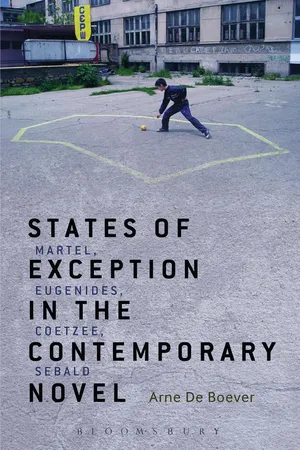
States of Exception in the Contemporary Novel
Martel, Eugenides, Coetzee, Sebald
- 176 pages
- English
- ePUB (mobile friendly)
- Available on iOS & Android
eBook - ePub
About this book
In the aftermath of the September 11 terror attacks, the political situation in both the United States and abroad has often been described as a "state of exception": an emergency situation in which the normal rule of law is suspended. In such a situation, the need for good decisions is felt ever more strongly. This book investigates the aesthetics, ethics, and politics of various decisions represented in novels published around 9/11: Martel's Life of Pi, Eugenides' Middlesex, Coetzee's Disgrace, and Sebald's Austerlitz.
De Boever's readings of the novels revolve around what he calls the 'aesthetic decision.' Which aesthetics do the characters and narrators in the novels adopt in a situation of crisis? How do these aesthetic decisions relate to the ethical and political decisions represented in the novels? What can they reveal about real-life ethical and political decisions? This book uncovers the politics of allegory, autobiography, focalization, and montage in today's planetary state of exception.
De Boever's readings of the novels revolve around what he calls the 'aesthetic decision.' Which aesthetics do the characters and narrators in the novels adopt in a situation of crisis? How do these aesthetic decisions relate to the ethical and political decisions represented in the novels? What can they reveal about real-life ethical and political decisions? This book uncovers the politics of allegory, autobiography, focalization, and montage in today's planetary state of exception.
Information
1
States of exception in Yann
Martel’s Life of Pi
Martel’s Life of Pi
Introduction
Yann Martel’s novel Life of Pi tells the story of how a young, devout Indian boy named Pi Patel survives for 227 days at sea after the ship that was supposed to take him and his parents as well as some of his father’s zoo animals from India to Canada sinks. As if the story of Pi’s survival were not already miraculous enough, the reader is asked to believe that Pi’s companions in the lifeboat were a hyena, a zebra with a broken leg, an orangutan, and an adult Bengal tiger. Of course, at the very end of the novel, it turns out that the animals in Pi’s survival story might also have been standing for human beings. The criticism that the novel invites would thus seem to be a crossover between animal studies and testimony studies (both of which arguably co-constitute the so-called ethical criticism that emerged in literature departments as part of a broader “ethical turn” during the 1980s and 1990s). And indeed, this crossover is part of what I am going to undertake. But I want to push such a reading into a realm from which the novel at first sight appears to steer clear: politics.
Published in September 2001, a date that has entered into our collective memory because of the 9/11 terror attacks, Martel’s novel seems to be far removed from the realities of the post-9/11 political world. Indeed, this may be one of the reasons why the novel was so popular. One can imagine critics, such as John Banville or Martin Amis, criticizing the novel for this very reason: the last thing we need from a novel today is the aesthetic ideology that much of post-9/11 fiction in the view of these critics provides.1 I am going to show, however, that Life of Pi’s interest in animals fits into the novel’s less obvious obsession with sovereignty. Indeed, it is in the topic of sovereignty that Life of Pi’s interests in animals and religion meet. In what follows, I argue that the novel challenges sovereignty’s relation to both animals (which it internally excludes or excepts from its realm of protection) and religion (sovereignty’s political theology). Life of Pi does so through its use of allegory as a narrative strategy. The novel thus turns into a powerful aesthetic tool, opening up new forms of individual and collective lives.
Political state of exception
Imagine, then, that something like the following happens on a ship or on many ships.
—PLATO, Republic2
[A] human being is by nature a political animal . . .
—ARISTOTLE, Politics3
Although Life of Pi revolves around Pi’s tale of his survival at sea, it is worth noting that this tale—which constitutes the second, middle part of the novel—is preceded by 36 introductory chapters in which Pi talks about his childhood in India in the mid-1970s, his father’s zoo, and his love for zoology and religion. In these chapters, the novel reveals that the tale of Pi’s survival at sea has a political origin. As Pi notes early on in the novel, the mid-1970s were “troubled times”4 in India. In 1975, after she had been found guilty of using illegal practices during her last election campaign, Indira Gandhi declared a brutal state of emergency in which her political enemies were imprisoned, constitutional rights were suspended, and the press was placed under strict censorship. When Tamil Nadu—the province where Pi’s family lives and one of Gandhi’s “most vocal critics”5is brought down by Delhi, Pi’s father decides that he has had enough, and that the family will emigrate. Undemocratic politics are bad for Pi’s father’s business, a zoo.
The life of a zoo, like the life of its inhabitants in the wild, is precarious. It is neither big enough a business to be above the law nor small enough to survive on its margins. To prosper, a zoo needs parliamentary government, democratic elections, freedom of speech, freedom of the press, freedom of association, rule of law, and everything else enshrined in India’s Constitution.6
It is in response to Gandhi’s sovereign suspension of the law that Pi’s family sets sail for Canada.
Life of Pi shows, however, that the state of emergency is not so easily left behind. When the cargo liner that is supposed to take Pi from India to Canada sinks, Pi finds himself in a lifeboat with a hyena, a zebra with a broken leg, an orangutan, and a tiger. This is where the actual story of Pi’s survival begins. Very soon, the hyena had killed and eaten the zebra and the orangutan. After the tiger kills and eats the hyena, we are down to Pi and the tiger. It does not take much of a political theorist to recognize in this situation what has been called a “state of nature,” a situation or state before the constitution of a legal and political order in which human beings are like animals to each other and have not quite made true on Aristotle’s definition of the human being as a “political” animal yet. Given that a state of nature, unlike Pi’s state, is technically supposed to precede—in other words: be chronologically prior to—law and politics, the term “state of exception” might be more precise to describe Pi’s situation.7 Unlike a state of nature, a state of exception is a situation or state in which the legal and political order has disintegrated and become dissolved. With Pi, the reader finds her- or himself in a lifeboat situation, a situation in which a human being is stripped of all legal and political protections, and is confronting her or his life-world from scratch, outside of the usual guarantees of rights and regulations.
How does Pi respond to such a full-blown situation of crisis? At first, he considers his fate to have been irrevocably sealed: in a state of nature—more precisely, a state of exception—in which, as the seventeenth-century fabulist Jean de la Fontaine knew well, “the strong are always best at proving they’re right,”8 Pi’s precarious human life does not stand much of a chance against an adult Bengal tiger. In addition, if for some reason the tiger were not to turn Pi into his “midday snack,”9 there is still a high chance that Pi will die of hunger and thirst before he is saved. In the state of exception in which Pi has landed, his life is thus reduced to a life that comes in close proximity to death, to a life that is barely alive, that is virtually already dead, and has entered into a zone of indistinction between life and death.
Very soon, however, Pi also becomes aware of a certain potential that is liberated in this state of exception. He realizes that through the good use of his reason and of his imagination, he might be able to gain the upper hand over the tiger: he might be able to establish a kind of rule over the tiger that would prevent him from being killed and eaten. And so, by providing the tiger with food and drink and by taming him through spinning the lifeboat around so that the animal turns seasick, Pi is able to overcome the state of nature/state of exception in which he is caught up: he implements a state of government that will enable him to survive for 227 days at sea.
Pi’s survival tale thus reads like Daniel Defoe’s Robinson Crusoe all over again. It is through the application of the modern, zoological principles that are expounded in the first part of the book—principles that Pi’s father, a zookeeper, applied with extraordinary success in his zoo—that Pi is able to survive. Once again, modernity and its principles of organization, calculation, and regulation conquer over premodern chaos. Pi—whose full name is Piscine Molitor Patel, and who was named after a pool in Paris called the Piscine Molitor, “the crowning aquatic glory of Paris, indeed, of the entire civilized world”10does justice to his name and brings the light of modern civilization to this lifeboat situation.
Although at first sight, Pi’s act of instituting a rule over the tiger might appear to be the opposite of Gandhi’s act of suspending the Indian constitution, Life of Pi also shows these two acts to be related. For both Pi’s institution of the law and Gandhi’s suspension of it are executed from the same structural position, namely from the vantage point of a sovereign who takes up a paradoxical place inside/outside the law. That does not mean, of course, that Pi’s and Gandhi’s political acts are identical; what it does reveal, however, is a complicity between Pi and Gandhi that deserves further investigation. Both Gandhi and Pi find themselves in a crisis situation in which a decision needs to be taken. Gandhi decides to declare a state of emergency in which the constitution is temporarily suspended so as to maintain order and guarantee the survival of the state. Pi decides to declare a state of rule, of government, so as to guarantee not only his own survival but also that of the tiger. One could read Pi’s decision as a variant of contract theory that, because it establishes a relation of government between a human being and a tiger, can be said to target, for example, Thomas Hobbes’ theory of sovereignty, in which animals are explicitly excluded from the contract. Pi’s ability to live together with a tiger under such stressful circumstances would disprove the inhuman image of the animal that Hobbes adopts (without providing much evidence for his case) in his classic work of political theory, Leviathan. Although the point against Hobbes certainly has something going for it—the animal does indeed take up a contested position in the history of political theory—it should also be pointed out that because Pi is dealing with an animal, one cannot really speak of a contract, since the animal has no say in the agreement. Pi’s rule is similar, rather, to that of an enlightened despot who will not hesitate to use biological conditioning in order to tame his subject. In this sense, Pi’s decision to institute the law comes very close indeed to that of Gandhi to suspend it.
Gandhi suspends the law in order to guarantee the survival of the state. Pi institutes the law in order to guarantee his own survival. As a result of both actions, different subjects—Pi’s family; the tiger—are produced as a kind of life that, although it might survive, is no longer fully alive. Pi’s family can no longer do business in a state in which democratic principles have been suspended; the tiger in the lifeboat is really only the shadow of a tiger, the sad spectacle of a tiger living under Pi’s government at sea. Through both Gandhi’s and Pi’s political decisions, the life of their subjects is reduced to a life-less-than-life, a life that is barely alive, a life in close proximity to death. Pi has escaped his own situation of being barely alive by reducing the tiger to bare life. It turns out that in this lifeboat situation, it is not the strongest, but the one who can apply modern techniques of government, who is right. Whereas Pi’s family used to be in the weaker position with respect to Gandhi’s decision, and whereas Pi used to be in the weaker position in the state of nature/state of exception with the tiger, the tables have been turned and now Pi has taken up the position of Gandhi that he despises, and that his family was running away from. It will enable Pi to survive; but it is also complicit with a position of power that stands at the origins of Pi’s sufferings, and that Pi is very critical of.
In his recent work Homo Sacer: Sovereign Power and Bare Life, Giorgio Agamben has theorized the particular kind of life that is produced by political decisions such as the ones I have analyzed above as “nuda vita,” or “bare life.”11 Agamben adopts this notion from Walter Benjamin’s essay “Critique of Violence” and uses it to refer to the particular life that is produced in a state of exception: neither human life nor animal life, bare life refers to a kind of inhuman life in between all chairs, a life that has been stripped of its ethical ...
Table of contents
- Cover
- Half-Title Page
- Introduction: Decision time
- 1 States of exception in Yann Martel’s Life of Pi
- 2 Autobiography and human rights in Jeffrey Eugenides’ Middlesex
- 3 Literary economies in J. M. Coetzee’s Disgrace
- 4 Architectures of exception in W. G. Sebald’s Austerlitz
- Conclusion: From exception to care
- References
- Index
- eCopyright
Trusted by 375,005 students
Access to over 1.5 million titles for a fair monthly price.
Study more efficiently using our study tools.
Frequently asked questions
Yes, you can cancel anytime from the Subscription tab in your account settings on the Perlego website. Your subscription will stay active until the end of your current billing period. Learn how to cancel your subscription
No, books cannot be downloaded as external files, such as PDFs, for use outside of Perlego. However, you can download books within the Perlego app for offline reading on mobile or tablet. Learn how to download books offline
Perlego offers two plans: Essential and Complete
- Essential is ideal for learners and professionals who enjoy exploring a wide range of subjects. Access the Essential Library with 800,000+ trusted titles and best-sellers across business, personal growth, and the humanities. Includes unlimited reading time and Standard Read Aloud voice.
- Complete: Perfect for advanced learners and researchers needing full, unrestricted access. Unlock 1.5M+ books across hundreds of subjects, including academic and specialized titles. The Complete Plan also includes advanced features like Premium Read Aloud and Research Assistant.
We are an online textbook subscription service, where you can get access to an entire online library for less than the price of a single book per month. With over 1.5 million books across 990+ topics, we’ve got you covered! Learn about our mission
Look out for the read-aloud symbol on your next book to see if you can listen to it. The read-aloud tool reads text aloud for you, highlighting the text as it is being read. You can pause it, speed it up and slow it down. Learn more about Read Aloud
Yes! You can use the Perlego app on both iOS and Android devices to read anytime, anywhere — even offline. Perfect for commutes or when you’re on the go.
Please note we cannot support devices running on iOS 13 and Android 7 or earlier. Learn more about using the app
Please note we cannot support devices running on iOS 13 and Android 7 or earlier. Learn more about using the app
Yes, you can access States of Exception in the Contemporary Novel by Arne De Boever in PDF and/or ePUB format, as well as other popular books in Literature & Literary Criticism. We have over 1.5 million books available in our catalogue for you to explore.