- 128 pages
- English
- ePUB (mobile friendly)
- Available on iOS & Android
eBook - ePub
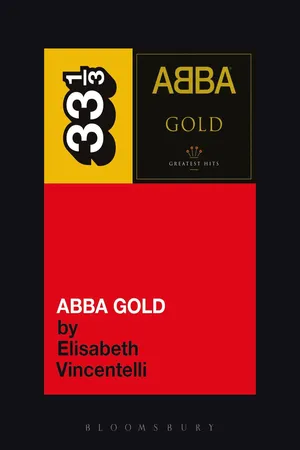
Abba's Abba Gold
About this book
33 1/3 is a new series of short books about critically acclaimed and much-loved albums of the last 40 years. Focusing on one album rather than an artist's entire output, the books dispense with the standard biographical background that fans know already, and cut to the heart of the music on each album. The authors provide fresh, original perspectives - often through their access to and relationships with the key figures involved in the recording of these albums. By turns obsessive, passionate, creative, and informed, the books in this series demonstrate many different ways of writing about music. (A task which can be, as Elvis Costello famously observed, as tricky as dancing about architecture.) What binds this series together, and what brings it to life, is that all of the authors - musicians, scholars, and writers - are deeply in love with the album they have chosen.
Information
1992: The World Is Ready for Abba … Again
Between 1973 and 1982, Abba sold millions of albums globally. However, it took only ten years to bury that impeccable track record and by the early 1990s the band’s above-ground legacy endured mostly in bargain bins. The Swedish quartet had become a victim of its own success: It incarnated a dated decade, a dated look and a dated type of pop. The music world had moved on, and Abba had been left behind. It didn’t help that none of its four members had kept a high media profile: Benny Andersson and Björn Ulvaeus, the men who wrote Abba’s songs, were focusing on musical theater; after releasing middlingly successful solo albums in the early and mid-’80s, singers Agnetha Fältskog and Anni-Frid “Frida” Lyngstad had progressively abandoned the music scene. Both couples—Benny and Frida, Björn and Agnetha—had divorced and it felt as if they all had lost interest in preserving their band’s legacy. “We have little in common and it’s seldom that we meet,” Agnetha said in 1985.5 It was hard to fathom that, just 10 years before, their faces had adorned mugs and socks from Melbourne to Manchester.
By now, the saga of the little Swedish band that could has become a fairly well-known chapter in pop history; still, certain elements bear repeating. While many think that the band exploded out of nowhere in 1974, when its song “Waterloo” won the Eurovision Song Contest, the four musicians who made up Abba already had quite a rich past in their home country. In the ’60s, Björn was a member of a popular folk outfit, the Hootenanny Singers, while Benny was in the Hep Stars, a Beatles-influenced pop combo that was the biggest Swedish group at the time. Both groups toured relentlessly and built extensive stage experience from the very beginning. Indeed, Benny and Björn had met when their respective bands crossed paths on the Swedish Folkpark circuit in 1966. The two hit it off immediately and started collaborating, playing on each others’ records, writing songs together. At roughly the same time, in 1967, Agnetha and Frida were (separately) doing the rounds of Swedish cabarets and talent contests; both started cutting singles in the late ’60s, though Agnetha met with more success than Frida, who plied her trade in small-town stages with small-town bands. The two couples were formed in 1969, and immediately established relationships in which the romantic and the professional were intricately interwoven. After several false starts, Abba was chosen to represent Sweden at the 1974 Eurovision Song Contest. Its song, “Waterloo,” won and became a European hit: It topped the charts in the U.K., Belgium, Finland, Ireland, West Germany and Switzerland. More surprisingly, it reached No. 6 in the United States, a country in which awareness of the Eurovision extravaganza hovers somewhere between nil and zilch. With the help of manager and label head Stig Anderson (who also contributed lyrics to many early songs), Abba became a habitual presence on European television screens, radios and magazine covers all through the ’70s. The group’s reach extended to Australia, where a 1977 tour provoked astonishing scenes of hysteria, and Latin America, where Spanish versions of some of the songs helped open the market.
During the years framed by its 1974 victory and its last studio recording in 1982, Abba was a worldwide superstar band, selling records by the truckload and scoring dozens of No. 1 hits in as many countries. It managed to have ten Top 20 singles in America, and that’s one of the countries where the group was the least popular: The quartet scored almost 20 Top 10 singles in the U.K., for instance. In addition to records, Abba was pervasive enough to be plastered over T-shirts, lunchboxes and trading cards; famous enough to have its own mockumentary, 1977’s Abba—The Movie; and infamous enough to embody the excessively gaudy side of the ’70s.
And yet all these achievements had gradually receded from public consciousness in the decade following the band’s demise (it never officially broke up). As Carl Magnus Palm put it, with a certain sense of understatement, “When the Eighties were over, it was clear that none of the former Abba members had any relevance whatsoever in the international pop landscape.”6 The release of 1986’s Abba Live (which included material from 1977, 1979 and 1981) felt like a frustrating afterthought and marked the nadir of the group’s story: The album spent a couple of weeks in the Swedish top 50, and it wasn’t even released in some of the countries in which the band had previously been successful. While it did cover most of the group’s phases, Abba Live didn’t present it at its best—let’s just say there was a reason Abba, like all good pop bands, had studiously avoided guitar solos on its studio efforts.
At the same time, the music world had evolved in a direction that didn’t leave much space for hit-making Swedes perceived to tread the thin line between wholesome and campy. Punk had become a force to be reckoned with in 1977; electronic music was growing in leaps and bounds thanks to the development of house and techno; hip-hop came into its own, eclipsing pop— and, to a lesser degree, mainstream rock, which went through a slump only to be electro-shocked back to life in 1992, when Nirvana’s Nevermind hit full force. That album sent a tremor through popular music, redefining indie and mainstream rock—and their connection with each other—for the following decade. Nevermind’s impact was global, despite Kurt Cobain’s reluctant relationship with fame and its trappings, an ambivalence partly explained by what he believed to be an irreconcilable difference between artistic and commercial successes. Yet Cobain was an avowed admirer of Abba, a group that bridged the gap between art and commerce with ease; he even asked for a goofy (and fairly successful) Abba cover band called Björn Again to open for Nirvana at the Reading Festival in 1992.
But if 1992 was Nirvana’s year, it also witnessed the eruption of a worldwide phenomenon that would redraw the pop landscape as much as the Seattle grunge band had redrawn the rock one. Forerunning signs could be glimpsed as early as 1987, when the Justified Ancients of Mu Mu—a.k.a. English quasi-situationist pranksters the KLF—sampled large chunks of a nine-year old Abba hit called “Dancing Queen” for a track titled “The Queen and I”; Abba’s publishers suggested the JAMM destroy all copies of the album, elegantly tided 1987 What the Fuck’s Going On? A couple of years later, the aforementioned Björn Again performed its first show in Melbourne in May 1989; by the time it was a guest of Cobain’s at Reading, the band was selling out club dates around the globe.
In the summer of 1992, U2 included a cover of “Dancing Queen” in the set of its Zoo Tour (at the time, the peak of the Irish group’s half-ironic, half-earnest exploration of pop tropes). To top it all off, U2 was joined on stage by Benny and Björn when it performed the song in Stockholm in July. But the most significant indicator of what was to come was the release of Erasure’s Abba-esque EP in June. Erasure had toyed with the idea of doing an entire album of Abba songs but because time was at a premium (the group was in production rehearsals for its Phantasmagorical Entertainment Tour), it only covered four: “Lay All Your Love on Me,” “SOS” “Take a Chance on Me” and “Voulez-Vous.” The British synth-pop duo had been around since 1986, winning critical praise and a fair amount of sales, but it wasn’t until Abba-esque that it topped the U.K. charts. In addition to going to No. 1 in England, Abba-esque also did surprisingly well in the U.S., the one country in which the Swedes had struggled to establish a solid foothold. The EP reached the Billboard Top 100, which doesn’t seem that impressive now but at the time was quite an accomplishment for a British electro-pop band fronted by an openly gay singer.
Erasure wasn’t new to Abba, having already tested the waters by putting a cover of “Gimme! Gimme! Gimme! (A Man After Midnight)” on the B side of “Oh L’Amour” in the spring of 1986. The duo was the perfect mongrel act to help usher in the Abba renaissance: Po-faced synth master and composer Vince Clark had been in an early incarnation of Depeche Mode and in the short-lived Yazoo, while the adjectives used to describe singer Andy Bell never failed to include “flamboyant” (he describes playing Frida in the “Take a Chance on Me” video as “a particular highlight” of his life). The combination was a knowing, liberated mirror of the division of labor adopted by the Swedish quartet itself. Erasure was signed to Mute Records, home to the dark side of synth-pop and an unlikely but oddly fitting place to release a tribute to a ’70s pop band. Erasure’s success was the biggest clue that Abba’s popularity had not evaporated in the ’80s, but simply gone underground.
As if this weren’t enough, in October of 1992 Björn Again put out a single titled Erasure-ish (“A Little Respect” b/w “Stop”). If Erasure put a face on Abba’s gay following, Björn Again examplified one of the main elements that would mark the Swedish group’s revival: From the very beginning, Björn Again teetered between homage and parody. Always in character on stage, its four leads—Agnetha Falstart, Frida Longstokin, Björn Volvo-us and Benny Anderwear—performed sets made up exclusively of Abba material, complete with Abba-inspired costume, choreography and groan-inducing stage banter in caricatural Swedish accents. But the humor didn’t completely obscure the affection and faithfulness with which the Abba catalog was performed, and Björn Again, for better or for worse, paved the way for what would become a cottage industry of Abba tribute bands.
The combination of these factors suggested that the Abba momentum was increasing throughout 1992. The band’s “heritage” produced the tidy sum of $4 million a year in publishing and mechanical income. The back catalog had remained a steady seller, even while its members had mostly deserted the pop field: In addition to Erasure, off-the-wall projects flourished and even an album in which Abba’s material was performed by the Munich Symphony Orchestra managed to sell 130,000 copies.7 Still, the attention of the group members was focused somewhere else. Björn and Benny’s musical-theater career was taking off (their first effort, Chess, came out as a concept album in 1984, preceding a proper stage production by two years), while Frida and Agnetha had gradually retired from the pop life. So it was left to a new record company to make a move, and it so happened that the way was suddenly clear.
In May 1989, Stig Anderson had sold Sweden Music, the publishing company he led, to the multinational behemoth Polygram; one of Sweden Music’s assets was Polar, the label that had been associated with Abba from the very beginning (and even before that, since the Hootenanny Singers had signed on it in 1963). The purchase was estimated at 300 million kronor ($25 million)8 and included, among other things, Abba’s songs and masters. By then, the band members had strained relations with Anderson. Frida herself had already sold her shares, but in early 1990, the financial representative of Benny and Agnetha found out that for several years the band members had received less royalties than they were owed. The matter went to court, which, needless to say, didn’t improve things between the musicians and Stig. The lawsuit felt final nail: This time, the Abba book was closed for good, as least as far as the main participants in the saga were concerned.
Once everything was sorted out and it had retrieved all the rights previously spread out over various countries, Polygram decided to release a greatest-hits collection, undaunted by the fact that there had been a flock of similar releases in the past 15 years or so. Greatest Hits had come out in November 1975 (only three albums into the band’s career), followed by Greatest Hits Vol. 2 in October 1979 and the optimistically titled The Singles—The First Ten Years in 1982. Variations on the 1975 album came out in several countries—one titled The Best of Abba was No. 1 for four weeks in Germany. In addition, there were several various budget collections that were often tailor-made for the countries in which they were released. But the main difference between these releases and Gold is that Polygram’s acquisition marked the first time the catalog was owned by one company. According to Tobler, “When Polygram acquired worldwide rights to the Abba catalog in the early 1990s, Abba records could be released worldwide for the first time. Any record company that can release a ‘Greatest Hits’ album of an act that has enjoyed worldwide success will do so, not least to recoup some of their outlay in buying the catalog. I suspect that there was no one individual who suggested the idea of Abba Gold, but rather Polygram’s marketing department.”9
Once the Abba catalog was brought under control, Polygram’s London office decided to go ahead with Gold. According to Ingemar Bergman, who helped put the album together, the British-based conglomerate “‘sucked the market dry’ of Abba records and ‘killed’ all contracts Anderson had made with everyone everywhere. In a record landscape devoid of any traces of old Abba compilations put out by more or less respectable record companies, Abba Gold was finally launched.”10
Apparently, the original plan was to go for a box set but it was scaled down to one disc. Long-time Abba expert Ian Cole recalls that “in the months before Abba Gold was released, there was a group of fans campaigning for the release of the box set instead of the compilation, and they were writing to other fans, encouraging them to write to Polygram in protest.”11 A box set, of course, is to a regular compilation what a Rolls-Royce is to a Hyundai: It’s more prestigious, and that prestige makes the label, the band and the buyer feel good about themselves. Still, in 1992 nobody was sure that Abba warranted a deluxe treatment and Polygram was hesitant about the presence of a market (two years later, the label would change its tune and put out the four-CD box set Thank You for the Music). As head of Polygram Music Publishing, David Hockman had worked on the deal with Polar. In a 2000 interview, he explains that “Abba were actually considered a bit passé at that time [the early ’90s], no one cared about them. Björn and Benny were involved in other things, and neither they nor anyone else believed Abba had much glitter left. Even Stig thought it was all over. We ourselves were taken unaware when Abba Gold did so well.”12 According to Palm, “the record company was fortuitous in that they were preparing this compilation album at exactly the same time as this interest in Abba was reawakened.”13
Abba Gold was first released in Europe in September 1992; the U.S. version followed a year later on September 21, 1993, by which time the international release had already spawned 5.1 million copies and 13 No. 1 hits in countries such as the U.K., Sweden, France, Israel, Singapore and Argentina. As Polygram prepared the box set’s release in 1994, a German retailer remembers Gold’s impact well: “It was absolutely crazy. Everything remotely connected with Abba—printed music as well as the records—was bought up straight away. Within a short space of time, there was an Abba boom here among the general public.”14 The boom was only bolstered when two Australian movies with a big Abba presence, Muriel’s Wedding and The Adventures of Priscilla, Queen of the Desert, came out in 1994. Both served as echo chambers to the Abba revival, which by 1994 had turned into a worldwide phenomenon. Abba was a bit of a running joke in Priscilla, but it played an integral part in Muriel, with symbolic and aesthetic implications on which I will return to later. Taken together, the movies underline that numbers alone don’t explain Gold and its impact: Whatever the cause, what happened in 1992-1994 was nothing less than an artistic resurrection—and that’s something that sets Gold apart from even its mega-selling rivals (their Greatest Hits didn’t make Eagles any cooler). If yet another definition of an album is that it allows us to gauge a band’s impact, then Gold is the most important entry in the Abba canon: It single-handedly retooled the band’s image and symbolized the moment when it became acceptable to take Abba seriously. And the critical reevaluation started right with the compilation’s cover art.
The covers of Abba’s studio albums all displayed portraits of the group. Some of them were relatively straightforward (1973’s Ring Ring and its smiling couples; 1979’s Voulez-Vous with the group ready to go to an upscale discotheque) while others were dramatically staged (the four band members crammed into a helicopter for 1976’s Arrival; the Fellini-esque crowd scene of 1980’s Super Trouper). But Abba...
Table of contents
- Cover Page
- Title Page
- Contents
- Acknowledgements
- Introduction
- 1992: The World Is Ready for Abba … Again
- Arrival
- Abba
- Abba—The Album
- Voulez-Vous
- Super Trouper
- The Visitors
- “Waterloo”: The Beginning Is Not The End
- Footnotes
- Copyright Page
Trusted by 375,005 students
Access to over 1.5 million titles for a fair monthly price.
Study more efficiently using our study tools.
Frequently asked questions
Yes, you can cancel anytime from the Subscription tab in your account settings on the Perlego website. Your subscription will stay active until the end of your current billing period. Learn how to cancel your subscription
No, books cannot be downloaded as external files, such as PDFs, for use outside of Perlego. However, you can download books within the Perlego app for offline reading on mobile or tablet. Learn how to download books offline
Perlego offers two plans: Essential and Complete
- Essential is ideal for learners and professionals who enjoy exploring a wide range of subjects. Access the Essential Library with 800,000+ trusted titles and best-sellers across business, personal growth, and the humanities. Includes unlimited reading time and Standard Read Aloud voice.
- Complete: Perfect for advanced learners and researchers needing full, unrestricted access. Unlock 1.5M+ books across hundreds of subjects, including academic and specialized titles. The Complete Plan also includes advanced features like Premium Read Aloud and Research Assistant.
We are an online textbook subscription service, where you can get access to an entire online library for less than the price of a single book per month. With over 1.5 million books across 990+ topics, we’ve got you covered! Learn about our mission
Look out for the read-aloud symbol on your next book to see if you can listen to it. The read-aloud tool reads text aloud for you, highlighting the text as it is being read. You can pause it, speed it up and slow it down. Learn more about Read Aloud
Yes! You can use the Perlego app on both iOS and Android devices to read anytime, anywhere — even offline. Perfect for commutes or when you’re on the go.
Please note we cannot support devices running on iOS 13 and Android 7 or earlier. Learn more about using the app
Please note we cannot support devices running on iOS 13 and Android 7 or earlier. Learn more about using the app
Yes, you can access Abba's Abba Gold by Elisabeth Vincentelli in PDF and/or ePUB format, as well as other popular books in Social Sciences & Music. We have over 1.5 million books available in our catalogue for you to explore.