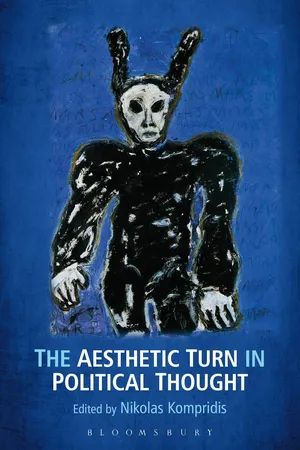
The growing exploration of political life from an aesthetic perspective has become so prominent that we must now speak of an "aesthetic turn" in political thought. But what does it mean and what makes it an aesthetic turn? Why now? This diverse and path-breaking collection of essays answers these questions, provoking new ways to think about the possibilities and debilities of democratic politics.
Beginning from the premise that politics is already "aesthetic in principle," the contributions to The Aesthetic Turn in Political Thought from some of the world's leading political theorists and philosophers, disclose a distinct set of political problems: the aesthetic problems of modern politics. The aesthetic turn in political thought not only recognizes that these problems are different in kind from the standard problems of politics, it also recognizes that they call for a different kind of theorizing – a theorizing that is itself aesthetic.
A major contribution to contemporary theoretical debates, The Aesthetic Turn in Political Thought will be essential reading to anyone interested in the interdisciplinary crossroads of aesthetic and politics.
- 320 pages
- English
- ePUB (mobile friendly)
- Available on iOS & Android
eBook - ePub
The Aesthetic Turn in Political Thought
About this book
Information
PART ONE
Aesthetic politics, judgment, and worldly things
CHAPTER ONE
“Delightful Horror”: Edmund Burke and the aesthetics of democratic revolution
Acknowledgments: This essay has benefitted from the questions of political theory workshop audiences at Trinity College (Hartford, Connecticut), Northwestern University, University of Pennsylvania, New School for Social Research, and the University of California, Los Angeles. I would like to thank Lida Maxwell, Bonnie Honig, André Munro, Ella Myers, Anne Norton, Banu Bargu and Rebekah Sterling for their insightful comments on earlier drafts. Kyong-Min Son provided valuable research and editing assistance, and I owe an enormous debt to my colleague Isaac Kramnick for many conversations on these and related topics.
Abstract: This essay examines Burke’s aesthetics in order to grasp a central but slippery category of his political thought: his concept of authority. Burke’s theory of the sublime identifies an instinctive “delight” that human beings take in their own subordination. It is an affective device for naturalizing order and rank in human society and the psychological foundation of such distinctive Burkean formulations as “proud submission,” “dignified obedience,” and “ennobled freedom.” The French Revolution however, and its enthusiastic reception by British radicals, occasioned a dramatic revision of Burke’s political aesthetics, whereby the sublime was no longer associated with astonishment, novelty and ennobling disorientation but with the gravity of an historical inheritance transmitted across time by the ancient constitution. Burke’s anti-revolutionary writings mark a transition in his thinking from a political aesthetics of sublime transcendence to one of immanence. Burke’s critical account of the aesthetics of democratic revolution provides useful orientation for contemporary theorists engaging the aesthetic dimensions of democratic authority.
Out of the tomb of murdered monarchy in France has arisen a vast tremendous unformed specter, in a far more terrific guise than any which ever yet has overpowered the imagination and subdued the fortitude of man.
—EDMUND BURKE, LETTERS ON A REGICIDE PEACE
Edmund Burke lives in the popular imagination as the prophet of modern political conservatism. He stands for conservatism in the same way that John Locke stands for liberalism, or Karl Marx for communism: a foundational thinker who established the basic parameters of discourse defining a political ideology (Kramnick 1977). For much of the history of Burke scholarship however, this was not how he was received. He has been celebrated as a utilitarian reformer, a romantic critic of the Enlightenment, a Christian philosopher of Natural Law and, most recently, as a sophisticated critic of British imperialism and a theorist of cultural difference (Morley 1993; Stanlis 1958; Mehta 1999). All of these frameworks illuminate distinct patterns of thinking in the rich tapestry of Burke’s writing, but do not give the reader a confident sense of interpretive finality. There is something in Burke that prevents us from fitting him into one of the ready-made paradigms that often frame scholarship in the history of political thought.
One central element of Burke’s political thinking that previous approaches have often neglected is his aesthetics. Burke’s readers have often recognized what one scholar, Neal Wood, calls the “aesthetic strain in Burke’s responses to political events and theories,” and there is a growing awareness that Burke’s aesthetics might offer a robust theoretical framework for tracing continuities across the diversity of his more explicitly political works (Furniss 1993; Wood 1964; White 1994; Hindson 1988; Eagleton 1989; O’Neill 2011; Gibbons 2003). While C. B. Macpherson once easily dismissed Burke’s aesthetics as “of little theoretical interest,” some Burke scholars argue that his aesthetics provide “a unifying element of Burke’s social and political outlook,” giving “a degree of coherence and system to the welter of words which he bequeathed to mankind” (Macpherson 1980, 19; Wood 1964, 42).
The turn to Burke’s political aesthetics has history on its side, because it was the aesthetic dimensions of Burke’s political thinking that some of his most insightful and influential contemporaries—both admirers and critics—emphasized in their encounters with his work, particularly his anti-revolutionary writings. Two of Burke’s radical critics, Mary Wollstonecraft and Thomas Paine, wrote books condemning Burke’s aestheticization of political life and defending the French Revolution. Those books have become canonical works of political theory in their own right. Like such readers, I see aesthetics as central to Burke’s political thinking, but this essay departs from their accounts to explore how Burke’s aesthetic theory illuminates a central but notoriously slippery category in his political thought: his concept of authority. The internal relationship that I will identify between Burke’s aesthetics and his account of authority is first presented in his Philosophical Enquiry into the Sublime and the Beautiful (1756) (the Enquiry), but can also be traced across many of Burke’s subsequent political works, including his parliamentary speeches from the 1770s urging conciliation with the colonies in America, and his later rousing condemnations of imperial corruption in India. The relationship between Burke’s aesthetics and his account of authority is most fully articulated however in his famous attacks on the French Revolution, not only in his Reflections on the Revolution in France (1790) (the Reflections), but also in such important texts as his Appeal from the New to the Old Whigs (1790) (the Appeal), Letter to a Noble Lord (1796), and Letters on a Regicide Peace (1795–6), the last work Burke published before his death in 1797.
The essay proceeds in two parts. In the first part I outline Burke’s aesthetics as presented in the Enquiry, emphasizing the centrality of the sublime to his account, and showing how Burke’s innovative conceptualization of the sublime enabled him to identify a natural and instinctive “delight” human beings take in their subordination, inscribing this passion into the very structure of human experience and subjectivity.1 Burke’s early theory of the sublime is an affective device for the naturalization of order and rank in human society. This account of the sublime is essential for an understanding of how Burke conceptualizes the complementary rather than antagonistic relationship between individual freedom and authority that he places at the very center of his political thinking. It is the psychological foundation of Burke’s understanding of such important concepts as “proud submission,” “dignified obedience” and “ennobled freedom.” A more textured and broadly experiential account of authority emerges from these reflections than the juridical emphasis that political theorists usually place on the role of prescription in Burke’s work.
In the second part I turn to Burke’s writing on the astonishing spectacle of the French Revolution. In his anti-revolutionary writings Burke identified a worrisome aesthetic pleasure animating and uniting the various classes of revolutionaries and their radical admirers across the Channel. In this emerging ethos “the mere pleasure of the beginner” became “the sole guide” of political action, with devastating consequences for authority and the “orderly and social freedom” Burke affirms (A 184, 71). Burke’s concern with the radical democratic sublime enacted by the Revolution bears a discomforting similarity to central elements of his own earlier aesthetics, which were themselves revolutionary in the central emphasis Burke placed on the overriding aesthetic value of the unexpected and unrecognizable. The pressure of political events surrounding the French Revolution occasions a shift in Burke’s aesthetics, whereby the sublime is no longer primarily associated with the characteristics of astonishment, novelty, and productive or ennobling disorientation, but with the gravity of an immanent historical inheritance transmitted across time by the ancient constitution. Burke’s Reflections marks a development in his thinking from an aesthetics of sublime transcendence to one of immanence, although one that contrasts with the dangerously willful immanence exemplified for Burke by the Age of Democratic Revolutions.
Aesthetics and authority
In the opening pages of the Enquiry Burke announces he will provide nothing less than “an exact theory of our passions, [and] a knowledge of their general sources” (1998, 51). Signaling his engagement with the broad eighteenth-century understanding of aesthetics as a discourse on experience, sensation and judgment, Burke writes that the Enquiry will examine how the properties of objects in the world: their color, size, smell, sound etc., work through uniform laws of nature to affect the body, and through the body to incite particular passions in the subjects that experience them. Burke thus offers an inductive and empirical survey of the scale of human passions along with detailed discussions of the specific properties of the objects that produce them. He attempts to establish a solid foundation for the legislation of taste by appealing beyond the relatively weak capacities of human understanding and reason to the reliable uniformity of visceral responses to the surrounding world. All objects are, in this sense, aesthetic for Burke, which leads Terry Eagleton to describe the Enquiry as a “subtle phenomenology of the senses” (Eagleton 1989, 54).
For political theorists, two things may stand out immediately in this summary description of Burke’s Enquiry. The first is his attempt to establish universal but highly particular criteria for aesthetic judgments, universal because shared across cultures and classes, particular because grounded in the evaluation of individual sensory experience. The second is Burke’s radical diminishment of reason’s role in producing these judgments. As he makes clear in the introductory chapter, “On Taste” (added to the second edition of the Enquiry in response to David Hume’s essay of the same title), Burke seeks to avoid the pitfalls of subjectivism—placing beauty merely in the eye of the beholder and relegating aesthetics to the realm of unreliable whims and fancies—by anchoring aesthetic evaluation in a uniform and corporeal response to physical sensation. Agreements in sensation are surely stronger than tenuous agreements in ideas or opinions, and Burke grounds the authority of these judgments in the natural responses of the human body to its environment. Like many subsequent conservative political thinkers, Burke urges his readers to go with their gut reactions and trust their God-given senses and “untaught feelings.” Burke seeks to establish the natural grounds of a passionate social consensus. If aesthetic judgments were unstable, then so too would be the social sympathies founded upon them, and with them the whole fabric of social and political life. What David Bromwich calls the “physiologism” of Burke’s aesthetics is rooted not in custom or tradition but in the shared sensory apparatus of human beings (Bromwich 1989; see also Ryan 2001). “We do and we must suppose,” Burke writes, that “since the physical organs have the same conformation the same sensation must be common to all men” (1998, 65).
In basing aesthetic evaluation in physical response Burke frees aesthetics from the uncertain dictates of human reason. Burke’s diminishment of rational faculties is frequently reiterated in his later political writings, but the Enquiry gives this theme powerful theoretical articulation. “The cause of feelings arises from the mechanical structure of our bodies,” Burke writes, “from the natural frame and constitution of our minds,” not from the uncertain dictates of our “reasoning faculty” (1998, 91). Burke has sometimes been described as a “philosopher of unreason in the age of reason,” as the “gravedigger of the Enlightenment,” but these familiar descriptions rest on a caricatured, highly rationalist view of the Enlightenment itself, one Burke’s own later writing did much to promote (Cobban 1960). The diminishment of reason’s role in making aesthetic and moral judgments was actually extremely widespread in eighteenth-century Anglophone thought, especially in the moral sentimentalism of the Scottish thinkers who so deeply influenced Burke; Francis Hutchinson, David Hume and Adam Smith. Instinctive passionate response was for Burke a more reliable guide to judgment in aesthetics as well as politics.
Burke believed the visceral responses to the surrounding world were at once natural and infused with divine purpose. In trusting our uncorrupted senses we follow a providentially ordained authority and align ourselves with the harmonious order of the universe where everything—and everyone—is assigned its proper place. “Whenever the wisdom of our Creator intended that we should be affected with any thing, he did not confide the execution of his design to the languid and precarious operation of our reason,” Burke writes, “but he endowed it with powers and properties that…captivate the soul before the understanding is ready either to join with them or to oppose them” (1998,142). These affectations were animated by and sustained the divine order of the world. While very much a man of the Enlightenment, Burke was also committed to a theistic “great chain of being” that was such an essential part of an older Elizabethan worldview: a “great primeval contract of eternal society…which holds all physical and all moral natures, each in their appointed place” (1987, 85). As Don Herzog writes, for Burke this meant that “politics extends far past King, parliament, and the like. Instead, relations of rule and authority pervade all the orderly regularities of the universe” (Herzog 1991, 340). Burke relied on this hierarchical metaphysics to ground his critique of emerging conceptions of moral autonomy, in which the Enquiry played an important role (see Schneewind 1998). Moral subjectivity required that human beings be “brought into subjection,” Burke writes, “and this can only be done by a power outside of themselves.” Instinctive aesthetic response “seizing upon the senses and imagination” before the “understanding” or “even the will” could assess and evaluate, was the Creator’s way of captivating the human heart—Burke also uses the term “enchain”—in the “execution of his design.”
Burke’s distinctive theory of the beautiful and the sublime, categories which he argued had been hopelessly confused in most previous accounts, is based on these visceral responses to the physical world, and interwoven into this hierarchical metaphysics, beginning with a hedonistic calculus of pleasures and pains. Burke associates pleasures with the urge of procreation and the desire to enjoy the society of others, grouping sympathy and various forms of love with these (relatively weak) longings, and in turn associating them with beauty. The sublime is linked to pain—by far the more powerful motivator for Burke—and thus with self-preservation, solitude and fear. “I call beauty a social quality,” Burke writes, in that it inspires “sentiments of tenderness and affection” which lead us “to draw willingly into a kind of relation with the objects that incite this passion” (1998, 89). Beauty is for Burke “that quality…in bodies, by which they cause love, or some passion similar.” Burke envisions beauty as a crucial component of sociality, immanent to human history and sustaining the social relations that make u...
Table of contents
- FC
- Half title
- Title
- Dedication
- Contents
- Acknowledgments
- List of contributors
- Introduction: Turning and returning: The aesthetic turn in political thought Nikolas Kompridis
- PART ONE Aesthetic politics, judgment, and worldly things
- PART TWO Poetics, theory, and utopian politics
- PART THREE Receptivity, re-inscription, affirmation
- Part Four Aesthetic “seeing as,” politics of the “as if”
- Index
- Copyright
Trusted by 375,005 students
Access to over 1.5 million titles for a fair monthly price.
Study more efficiently using our study tools.
Frequently asked questions
Yes, you can cancel anytime from the Subscription tab in your account settings on the Perlego website. Your subscription will stay active until the end of your current billing period. Learn how to cancel your subscription
No, books cannot be downloaded as external files, such as PDFs, for use outside of Perlego. However, you can download books within the Perlego app for offline reading on mobile or tablet. Learn how to download books offline
Perlego offers two plans: Essential and Complete
- Essential is ideal for learners and professionals who enjoy exploring a wide range of subjects. Access the Essential Library with 800,000+ trusted titles and best-sellers across business, personal growth, and the humanities. Includes unlimited reading time and Standard Read Aloud voice.
- Complete: Perfect for advanced learners and researchers needing full, unrestricted access. Unlock 1.5M+ books across hundreds of subjects, including academic and specialized titles. The Complete Plan also includes advanced features like Premium Read Aloud and Research Assistant.
We are an online textbook subscription service, where you can get access to an entire online library for less than the price of a single book per month. With over 1.5 million books across 990+ topics, we’ve got you covered! Learn about our mission
Look out for the read-aloud symbol on your next book to see if you can listen to it. The read-aloud tool reads text aloud for you, highlighting the text as it is being read. You can pause it, speed it up and slow it down. Learn more about Read Aloud
Yes! You can use the Perlego app on both iOS and Android devices to read anytime, anywhere — even offline. Perfect for commutes or when you’re on the go.
Please note we cannot support devices running on iOS 13 and Android 7 or earlier. Learn more about using the app
Please note we cannot support devices running on iOS 13 and Android 7 or earlier. Learn more about using the app
Yes, you can access The Aesthetic Turn in Political Thought by Nikolas Kompridis in PDF and/or ePUB format, as well as other popular books in Politics & International Relations & Aesthetics in Philosophy. We have over 1.5 million books available in our catalogue for you to explore.