What is a liberal arts education? How does it differ from other forms of learning? What are we to make of the debates that surround it? What are its place, its value, and its prospects in the contemporary world? These are questions that trouble students and their parents, educators, critics, and policy-makers, and philosophers of education--among others.
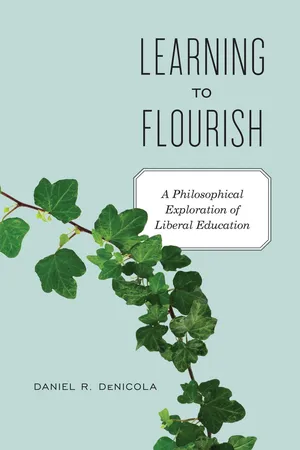
Learning to Flourish offers a lucid, penetrating, philosophical exploration of liberal learning: a still-evolving tradition of theory and practice that has dominated and sustained intellectual life and learning in much of the globe for two millennia. This study will be of interest to anyone seeking to understand liberal arts education, as well as to educators and philosophers of education.
Daniel R. DeNicola weighs the views of both advocates and critics of the liberal arts, and interprets liberal education as a vital tradition aimed supremely at understanding and living a flourishing life. He elaborates the tradition as expressed in five competing but complementary paradigms that transcend theories of curriculum and pedagogy and are manifested in particular social contexts. He examines the transformative power of liberal education and its relation to such values as freedom, autonomy, and democracy, reflecting on the importance of intrinsic value and moral understanding. Finally, DeNicola considers age-old obstacles and current threats to liberal education, ultimately asserting its value for and urgent need in a global, pluralistic, technologically advanced society. The result is a bold, yet nuanced theory, alert to both historical and contemporary discussions, and a significant contribution to the discourse on liberal education.
- 240 pages
- English
- ePUB (mobile friendly)
- Available on iOS & Android
eBook - ePub
About this book
Information
PART I
Toward a Theory of Liberal Education
1
Mixed Messages and False Starts
You cannot go anywhere without hearing a buzz of more or less confused and contradictory talk on this subject [liberal education].
T. H. HUXLEY, “A LIBERAL EDUCATION AND WHERE TO FIND IT”
What is a liberal arts education? How does it differ from other forms of learning? What are its place, its value, and its prospects in the contemporary world?
Anyone who entertains such questions today—and they are our questions at hand—encounters mixed messages and receives conflicting responses. There are, of course, many eloquent articulations of the ideal of liberal education, and there is ample positive, celebratory rhetoric of achievement and prestige promulgated by its advocates. But they coexist with a negative discourse: the jibes of popular culture, dire warnings of degradation and demise, and sophisticated scholarly critiques. The Association of American Colleges and Universities proclaims that “The spirit and value of liberal learning are equally relevant to all forms of higher education and to all students,” and “liberal learning is society’s best investment in our shared future.”1 In contrast, however, prominent educational and ethical theorist, Nel Noddings, contrarily asserts “straight-out” that liberal learning is “a false ideal for universal education.” It is not the best education for everyone, and moreover, “liberal education as it is now defined is not the best education for anyone.”2 Worse yet, at the low end of popular culture where once-snappy quips become clichés on T-shirts, mugs, and bumper stickers, one finds this: “I have a degree in liberal arts. Do you want fries with that?”
The situation is more a discord than a dialogue, for although all these voices seem confident in their grasp of liberal education, their conceptions are often quite divergent. The dissonance can be especially troubling to students and their parents, generating confusion and acute anguish as they confront fateful, educational choices: choosing the appropriate “track” in a secondary school curriculum, the ideal college, the best program, or the right major. And the dissonance afflicts educators as well: those who teach, advise, or administer sometimes harbor uncertainty or confusion about these questions regarding liberal education; they work at cross-purposes and may even misguide their students, however unintentionally. Occasionally, someone will conclude that “liberal arts education” has become such a freighted term that we should abandon it altogether.
What are we to make of this discord? Can the fundamental questions about liberal education be answered or even addressed clearly? Might a philosophical approach to the issues be of help? For some—not those most likely to be readers of this book—the value of a philosophical approach is dubious, for we live in a world that is increasingly impatient with theory. I can, however, offer three reasons for thinking that taking such an approach might be useful, even necessary. First, whenever discourse is so discordant, it is likely that a contributing factor is conceptual confusion or incongruence, and it is a basic aim of philosophy to clarify concepts—a task for which it has forged many helpful tools. Second, liberal education is broadly understood to embody a “philosophy of education,” so explicating it carefully will inevitably require philosophical work. Third, philosophers themselves have contributed to the dissonance, and indeed many of the deeper issues and genuine disagreements behind the mixed messages are philosophical in character.
What I propose, therefore, is to undertake a philosophical exploration of liberal education. Rather than simply plumping for “the correct view,” I want to develop a way to explain and clarify the differences in viewpoint, or at least a way to organize the conflicting claims. I hope, within this frame, to explicate the distinctiveness of liberal education, its dynamism, and its diversity; to examine and evaluate major lines of criticism; and to elucidate its vulnerability and its promise. Ultimately, I will offer a contemporary synthesis of the nature and value of liberal education. These are, I admit, embarrassingly ambitious goals, yet in this situation (as in most others), it seems wise to begin humbly: first, we need to listen more closely to the din, discerning patterns of disagreement in contemporary discourse.
The Champions of Liberal Education
The positive view is very positive indeed: liberal education seems to be the gold standard, the most valuable form of education. At the level of theory, it has a long line of distinguished and articulate champions: such thinkers as John Henry Newman, Mortimer Adler, Michael Oakeshott, Charles Bailey, and Martha Nussbaum, have written influential, visionary tracts that defend and commend liberal education.3 Its perceived worth is reflected in the ever-greater inclusivity advocated and established, both in the movement to extend liberal education to all and in the desire to include all within the greater scope and diversity of its content. As a practice, it is widely institutionalized in several forms in the various strata of schooling, being most prominent (and often required) in late secondary and undergraduate programs. An exemplary form, an institution developed in the United States, is the free-standing liberal arts college. Today, elite liberal arts colleges thrive across the land, admitting only a fraction of applicants, balancing hefty tuition fees with generous scholarships, concentrating on enriched undergraduate programs in the liberal arts, and projecting prestige and privilege. They describe themselves in mission statements, websites, admissions brochures, and public ceremonies, as offering a venerable but contemporary, intellectually challenging, skill-enhancing, character-building, life-altering, educational experience. “The most versatile, the most durable, in an ultimate sense, the most practical knowledge and intellectual resources that we can offer students are the openness, creativity, flexibility, and power of education in the liberal arts”4—so declares Williams College in a statement that exemplifies this group. These colleges evince and extol the success of their alumni—and they have indeed produced a disproportionately large share of successful scientists, writers, academics, and CEOs.5 Liberal education is, professedly, the commanding concern of these small colleges, which number in the hundreds in America, though many, especially the less elite among them, struggle to retain their liberal arts focus. Judging them simply as businesses, however, these colleges are, in general, remarkably successful enterprises, typically surviving for over a century already.6 (Gettysburg College, for example, where I now teach, was founded in 1832, has had only one name change—from “Pennsylvania College”—and has not had a deficit year within memory, perhaps ever. Few business corporations can claim such a record.)
But excellent liberal education is not confined to those distinctive liberal arts colleges. Historic European universities all developed from and within a liberal arts heritage. In the United States, major research universities—some of which grew up around historic liberal arts colleges (Harvard University, for example), and others which were founded as universities with several educational purposes (such as land-grant universities)—offer degrees in the liberal arts (both undergraduate and graduate) and often work to retain or embody attractive aspects of the small liberal arts colleges despite their difference in scale. Many states have designated one or more institutions as “public liberal arts universities”; they offer at least an emphasis on liberal arts programming and some have fully taken on the character of liberal arts colleges, but are subject to state budgeting and governance. Moreover, most contemporary universities endorse the essential worth of liberal learning by requiring every undergraduate student, regardless of area of study, to have some “exposure” to the liberal arts (truncated, of course, within a “university college” or in components of the degree known collectively as “general education”). No doubt, the level of genuine commitment to liberal learning varies among universities, but it is probably a safe generalization to say that the more influential and prestigious the university, the stronger the liberal arts ethos on its campus.7 And it is revealing that nearly all such institutions feel the need to display at least some pretense of the endorsement of liberal education.
Immediately after the collapse of the Soviet Union, there was a surge of interest in liberal education within former Soviet-bloc nations. Study in the liberal arts was identified with the apparent triumph of Western democracies. It seemed to empower individuals, to value critical thinking, self-expression, and debate; it was associated with freedom. It was the antithesis of the Soviet-era education, which was didactic, authoritarian, utilitarian, and technical. Reformers seemed undaunted by the challenges of such a shift, which would require significant and difficult changes not only in curriculum, but in pedagogy, in the expectations of students, and in institutional ethos. Not only in Eastern Europe, but also in progressive locations in Asia and Africa, the desire swelled to establish education in the liberal arts.8 (Ironically, the world seemed to be embracing liberal education just as, in the West—especially in Britain and the United States—the criticism and concern about liberal education were becoming strident.) In many places, it seemed easier to establish new institutions than to transform existing ones, and a host of aspiring liberal arts institutions—schools, colleges, universities, and programs—was launched. These fledglings have had varying fortunes in the last decade, but a particularly successful and interesting example is the European College of Liberal Arts (ECLA), located in Berlin. With substantial assistance from an American foundation, ECLA has become a state-recognized private university with an international student body, offering “a new form of liberal education” that is “dedicated to an integrated study of values.”9 Liberal education seems, in short, to reflect aspirations of free people around the globe, for themselves as individuals and for their nations.
Years before college, moreover, most pupils in developed countries hear the positive rhetoric about liberal education. Very young pupils are taught basic skills and foundational knowledge, which, in subsequent years, undergird a prescribed curriculum that likely includes mathematics, literature, social and natural sciences, and—if they survive school budget pressures—the arts. The official rationale for such requirements may invoke informed citizenship, the needs of the nation, and preparation for college—but they are most often presented as a liberal arts curriculum. “Pre-college” tracks and special honors opportunities, such as Advanced Placement courses and International Baccalaureate degrees, aim at refining and accelerating liberal learning. In short, the educational establishment, whether governmental or independent, whether at the introductory or advanced levels, seems to say that liberal education is both fundamental and preeminent.
Within this positive rhetoric, however, even a sympathetic observer might notice what appear to be puzzling contradictions or inconsistencies—though perhaps they are only superficial. Is liberal education for elite intellectuals, or is it essential for every democratic citizen? Does it celebrate learning that is of intrinsic value (“knowledge for its own sake” and “learning for the sheer love of learning”), or is liberal education immensely practical, invaluable because of the powerful and transferable skills it develops (such as critical thinking and effective communication)? Is it about the life of the mind or the crafting of character—or is there in some way an academic fusion of the intellectual and the moral? Is liberal education a foundational preparation for more advanced, professional study; or is it essentially a life-long learning? Even if they do not mark outright contradictions, such questions encapsulate perplexing divergences or creative tensions among the affirmations of liberal arts advocates. They suggest an agenda for examination.
And then there are the critics.
Worried Friends, Ardent Reformers, and Radical Foes
Critics of liberal education have been a boon to publishers since at least the 1980s, issuing a barrage of books and articles that range from the scholarly and philosophical to the polemical and sloganeering. To get some sense of this expansive literature, it is useful to make an initial partitioning by distinguishing two types: critiques of practice and critiques of theory.
I will call the first type “narratives of decline.”10 In general, these works are written by worried friends of the liberal arts, people who believe that the ideal of liberal education is sound, but we are everywhere failing to live up to it. They decry performance gaps: failures, degradations, corruptions, or perversions of the ideal in current practice. The impulsive retort, of course, is to cite the fact that any complex, institutionalized, normative practice will frequently display regrettable, even shocking, gaps in performance—think of the systems of criminal justice or health care. Alas, sound theory does not ensure excellent practice! But that response is insufficient, because these critics discern widespread and systemic degradations of performance, sounding the alarm by means of jeremiads, and ultimately aiming to motivate readers to reform practice. Many do indeed write prophetically and often apocalyptically: their critiques are torn between the dramatic recital of the sins of current practice and the pleadings to return to a salvational ideal of liberal education, to which ideal we are enjoined to keep faith henceforth. Frequently, they write nostalgically, as though there were a “golden age” which once manifested their ideal of liberal education, and many trace from there the melancholy history of decline. In the end, however, these critiques are calls to repent, to mend, to correct and reform; they are not strikes against liberal education itself. One might deplore widespread failures in our criminal justice system, for example, but that would not discredit the ideal of justice—on the contrary, to decry performance gaps or to be outraged over a decline is to endorse or reaffirm the value of the ideal.
Interestingly, these despairing loyalists often disagree about the causes of the perceived decline and its symptoms; they also differ in the particular ideal of liberal education they elevate. Their diversity can be illustrated with even a small sampling of this large genre; often the ti...
Table of contents
- Cover
- Title
- Contents
- Preface and Acknowledgments
- Introduction
- Part I: Toward a Theory of Liberal Education
- Part II: Paradigms of Liberal Education
- Part III: The Values and Moral Aims of Liberal Education
- Part IV: Obstacles, Threats, and Prospects
- Bibliography
- Index of Names
- Index of Terms
- Copyright
Trusted by 375,005 students
Access to over 1.5 million titles for a fair monthly price.
Study more efficiently using our study tools.
Frequently asked questions
Yes, you can cancel anytime from the Subscription tab in your account settings on the Perlego website. Your subscription will stay active until the end of your current billing period. Learn how to cancel your subscription
No, books cannot be downloaded as external files, such as PDFs, for use outside of Perlego. However, you can download books within the Perlego app for offline reading on mobile or tablet. Learn how to download books offline
Perlego offers two plans: Essential and Complete
- Essential is ideal for learners and professionals who enjoy exploring a wide range of subjects. Access the Essential Library with 800,000+ trusted titles and best-sellers across business, personal growth, and the humanities. Includes unlimited reading time and Standard Read Aloud voice.
- Complete: Perfect for advanced learners and researchers needing full, unrestricted access. Unlock 1.5M+ books across hundreds of subjects, including academic and specialized titles. The Complete Plan also includes advanced features like Premium Read Aloud and Research Assistant.
We are an online textbook subscription service, where you can get access to an entire online library for less than the price of a single book per month. With over 1.5 million books across 990+ topics, we’ve got you covered! Learn about our mission
Look out for the read-aloud symbol on your next book to see if you can listen to it. The read-aloud tool reads text aloud for you, highlighting the text as it is being read. You can pause it, speed it up and slow it down. Learn more about Read Aloud
Yes! You can use the Perlego app on both iOS and Android devices to read anytime, anywhere — even offline. Perfect for commutes or when you’re on the go.
Please note we cannot support devices running on iOS 13 and Android 7 or earlier. Learn more about using the app
Please note we cannot support devices running on iOS 13 and Android 7 or earlier. Learn more about using the app
Yes, you can access Learning to Flourish by Daniel R. DeNicola in PDF and/or ePUB format, as well as other popular books in Éducation & Éducation générale. We have over 1.5 million books available in our catalogue for you to explore.