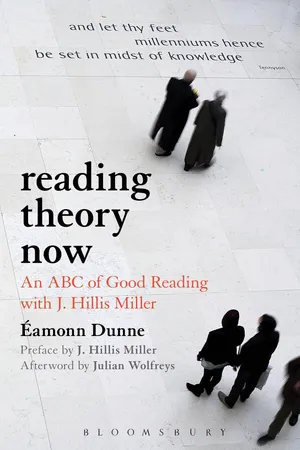
Reading Theory Now explores movements in critical thinking through a host of radical theorists, and channels those movements through the work of one of the most influential proponents of critical interpretation in the world today, J. Hillis Miller.
It enables its readers to see how and why theoretical models of reading are of use only in the practical event of reading literary and philosophical texts, that the politics and poetics of interpretive paradigms are constantly shifting, changing and evolving as present day perspectives transform those traditions unalterably. it seeks to invite its readers to challenge the concept of the paradigm, the school, the movement, even the sequence, by presenting them with a choice to read in their own way, to "dip" in and out of singular events of interpretation from A to Z. In this respect Reading Theory Now invites its audience to decide for him/herself where they begin and end their own critical analyses.
Reading Theory Now also contains:
*A Preface by J. Hillis Miller which comments on the significance of reading as an event and the centrality of political and ecological issues in his most recent work.
*An Afterword by Julian Wolfreys which tackles these issues in Miller's latest books.
*A select annotated bibliography which will help students coming to Miller's work for the first time to find their own way into his vast critical corpus.
- 144 pages
- English
- ePUB (mobile friendly)
- Available on iOS & Android
eBook - ePub
About this book
Information
A before B—of course. . .
a
“Anacoluthon doubles the story line and so makes the story probably a lie” (RN, 149). It expresses the impossibility of following the line from beginning to end, the impossibility of tracing any narrative thread from its origins to its completion without some kind of illicit wandering, that is, without becoming irresponsible or irresponsive (in whatever degree) to the demands made on us by the text. This of course applies to any story, including this one. The word also signifies the problematic of a response to the promise of the logos, therefore actually necessitating the lie. One could perhaps reiterate the idea by saying that storylines are assembled and dismembered by the implicit demand made on each reader to remember the way at all times, to follow the line back and forth from the clue (the word means the ball of thread from which the line is drawn) to the center of the labyrinth, “some triumphant Q.E.D” (AT, xii).
There is of course also something here in the clue itself that shares in the complexity of the narrative line, since the “clue” is another line, perhaps even more labyrinthine than the labyrinth, merely waiting to be unraveled. The clue as origin of the line is itself a labyrinth of labyrinths, a repetition of the problematic, just as the “I” is the promise of the logos and its undoing, the very (im)possibility of the story line. “‘I’ promise to tell the whole truth” is a performative speech act; it functions as a felicitous act which does not depend on the self-identical nature of the “I,” an impossibility, but rather on the memory of the “I” that posits. Promises are then always subject to yet more promises which cannot be known beforehand, promises are infinitely differed, great Nietzschean yea-sayings. They depend on the future, on the “super-monster of eventness,” the à-venir, as Derrida would have it. As such, like the narrative line, they imply an ethics as a kind of Socratic anamnesis, a remembrance which is somehow both knowable and nonknowable.
The line is a repetition of something that went before and will come again, in the sense that letters are lines whose differential curvatures separate and distinguish them from other letters. They are repetitions of a certain figure or figures. But they are also inaugural inscriptions to whatever infinitesimally minor or inconsequential degree. Each line figures (draws, weaves, patterns, quilts, represents, recites) a way and a wandering at the level of the letter and of the narrative: “The intelligibility of writing depends on this twisting and breaking of the line that interrupts or confounds its linearity and opens up the possibility of repeating that segment, while at the same time preventing any closure of its meaning” (AT, 8). The line, therefore, in an uncanny manner, depends on the possibility and impossibility of its function as a straight line: its possibility is dependent on its function as an approximation of its own ideal figuration, in the very same way that the letter of the text implies its ability to be identical to its forebears and different simultaneously. Lines are only linear because of their differences from other lines. They are only lines precisely because of their iterability within (or without) that system of differences; one doesn’t, for instance, ordinarily think of two parallel lines as the same line. Zeno’s paradoxes and Heraclitus’ philosophical fragments have expressed these sentiments for millennia, and can be shown to be at odds with the dominant presuppositions of the logocentric Western tradition, as Nietzsche’s eternal recurrence has also shown: “The line, Ariadne’s thread, is both the labyrinth and a means of safely retracing the labyrinth. The thread and the maze are each the origin of which the other is a copy, or each is a copy that makes the other, already there, an origin: Ich bin dein Labyrinth” (AT, 16).
The anacoluthon is an abrupt breach in the line, as when in Proust’s recherche Albertine shifts pronouns intermittently in mid-sentence, an agrammatically insinuating force breaking through the sequentiality of the narrative line and alerting us to the structurality or fabricated nature of all narratives. It makes the line a lie or nonsequitur. And it shows that the possibility of storytelling finds its grounds at the trembling limits of recollection and prevarication. Indeed, “it’s a fact that, like the self-identity of the subject, memory is or rather must, should be an ethical obligation: infinite and at every instant” (Derrida 2002, 163). This is why, as Miller informs us, Proust’s fascination with Albertine’s lie is an incessant reworking of the fissures between the performative and the constative nature of acts of lying and remembrance; the process of realization that says lying is either/or, distinguishable, separable from some truth or other that can be remembered at a point which says “ah! You were lying when you said that you were in love with her from the beginning,” or “I know that you lied when you said you didn’t like truffles because you are eating them now.”
The problem with the lie, of bearing false witness, is that it necessitates a distinction between speech acts—felicitous and infelicitous, as J. L. Austin would have it—which are not meta-discursively separable, that is, indubitably and epistemologically understandable on a structural level: “Truthful testimony,” in Peggy Kamuf’s reading of “Plato’s Pharmacy,”—and one can only believe that there has ever been any such thing—is conditioned by the possibility that it is false. And this possibility is irreducible. If it were not, then testimony would provide the certainty of a proof, and would, therefore, not be what it is, testimony. To be truly what is called testimony, rather than proof, it must possibly be false, a fiction.1 If a lie is to be effective as such, at the very moment of its performance, it must be felicitous because it must be taken in its context as truthful; it is taken for the truth because it performs its action and makes something happen. That something can never be known directly and, insomuch as the lie predicates a relation to intention and faith, the lie can only ever be known to have been a lie, retrospectively speaking. Like the imperative declensions in my previous quotation from Derrida—that humorously tentative trip from one must to one should—an obligation is shown to be a memory of fact about which one is never quite sure. Perhaps this may also be said of the act of memory necessitated by my own insinuating imperative that the reader must . . . should . . . remember the quotation from Derrida. Here, we have an ethical responsibility to infinite remembrance, an ethical responsibility to an economical accounting for the whole storyline from beginning to end. Like reading Proust’s novels or James’ somewhat unwieldy periodic sentences, narratives have an odd way of showing this to be the case. They also show us that reading closely is a critical (in the broadest sense of that word) enterprise which affords us a momentary glimpse of the “polylogology” (Miller’s word) of all narratives, the many-centeredness of the labyrinth in which we always already come to find ourselves to be. Lying against this is the alogical necessity of lying to ourselves by referring to the anacoluthon as a mere figure of rhetoric.2
b
“Having placed in my mouth sufficient bread for three minutes’ chewing,” begins Flann O’Brien’s undergraduate narrator in At Swim-Two-Birds with sparkling comic wit, “I withdrew my powers of sensual perception and retired into the privacy of my mind, my eyes and face assuming a vacant and preoccupied expression. I reflected on the subject of my spare-time literary activities. One beginning and one ending for a book was a thing I did not agree with. A good book may have three openings entirely dissimilar and interrelated only in the prescience of the author, or for that matter one hundred times as many endings” (O’Brien 2000, 9). Several ideas are of interest to me in this paragraph because they are intersections that seem fundamental to any practical or theoretical approach to speaking of beginnings.
Every writer knows, as Edward Said has said in his somewhat epic work on the topic, and as my own first teacher of English was wont to drill into the minds of his students, that the beginning is crucial.3 It inaugurates and opens up an idea, a passageway or vista for what will be to come. In that sense, the beginning in some ways determines the end, “the advanced point is at once beginning and end, it is divided as beginning end; it is the place from which or in view of which everything takes place” (Derrida 1992a, 24). It is, therefore, no coincidence that O’Brien’s beginning is really overdetermined by his usage of line imagery to signify the origin in terms of a supplementary or disseminative logic. A pervasive topo-tropological thrust throughout the opening passages of this antinovel (though can any novel be really called an antinovel?) confirms this. The fact is that while O’Brien comments on the importance of thinking about beginnings—really thinking about them, not just chewing on the idea—he begins to express the notion of the beginning as always already a plurality of other moments not present to themselves, of endings, of memories, of trajectories, of interrelationships and intertextualities, of temporal and spatial issues. Indeed, the ending and the beginning appear in the same sentence, and, as he relates, are related or not only by the far-sight of the author who, one expects, knows or intimates where he/she is going from the kernel of thought inhabiting the initiatory moment of inscription. This is what narrative means etymologically, the knowledge (L. “gnarus”) of the storyline—a logical impossibility since the complete narrative would have to be suspended in time and known from one end to the other as a vast frozen landscape seen from an elevated prospect.
But this is not entirely the case for Miller’s “ana-naratologies.”4 Beginnings are haunted.5 They are “both inside and outside the narrative at once,” requisite upon an antecedent foundation that can only be implied by that momentary breach into being of the narrative line itself, preparatory to anything else. “Narratives are in one way or another expedients for covering over this impossibility, which implies the impossibility of getting started” (RN, 58). They hide their beginnings by becoming part of what follows, or, as in the case above, they indicate that the process of beginning is peculiar and extrinsically challenging to what follows at all points in the narrative line. “In the beginning was the word,” says John in the fourth Gospel, and “in the end the world without end” for Stephen Daedalus and the Christian messianic tradition—the great paradoxical anti-Aufhebung (Joyce 1992, 626). Beginnings uncannily prefigure an end; the difficulty, as Miller quoting Kierkegaard puts it, is not the problem with the beginning per se, but with the beginning’s unstoppable force once it has been initiated. Once the narrative just begins, it seeks a place outside of itself to anchor itself. The beginning, the word, and the logos seek out their telos in the infinity of the narrative line and end without end. “The beginning was diacritical” (TNT, 92); “in the beginning there was contretemps.”6
c
What do we mean when we use the word character? The OED describes it variously as: “A distinctive mark impressed, engraved, or otherwise formed; a brand, stamp”; “a graphic sign or symbol – esp. a graphic symbol standing for a sound, syllable, or notion, used in writing or in printing”; “one of the simple elements of a written language; e.g. a letter of the alphabet”; “The series of alphabetic signs, or elementary symbols, peculiar to any language; a set of letters”; “The style of writing peculiar to any individual; handwriting”; “Kind or style of type or printed letter”; “A cabbalistic or magical sign or emblem; the astrological symbol of a planet, etc.”; “A symbol, emblem, figure; an expression or direct representation”; “A cipher for secret correspondence.” Its figurative senses are listed as: “A distinctive mark, evidence, or token; a feature, trait, characteristic. arch. in gen. use”; “One of the distinguishing features of a species or genus”; “The aggregate of the distinctive features of any thing; essential peculiarity; nature, style; sort, kind, description”; “The face or features as betokening moral qualities; personal appearance”; “The estimate formed of a person’s qualities; reputation: when used without qualifying epithet implying ‘favourable estimate, good repute.’”; “A description, delineation, or detailed report of a person’s qualities”; “Recognized official rank; status; position assumed or occupied”; “A person regarded in the abstract as the possessor of specified qualities; a personage, a personality”; “An odd, extraordinary, or eccentric person” [a usage I associate most clearly with North Dublin colloquial speech: ‘he’s some character that lad’]; “A personality invested with distinctive attributes and qualities, by a novelist or dramatist; also, the personality or ‘part’ assumed by an actor on the stage”; used as a transitive verb, “To engrave, imprint; to inscribe, write.” Its etymology is equally diffuse: “ME. caracterē, a. F. caractere, ad. L. charactēr, a. Gr. χαρακτήρ instrument for marking or graving, impress, stamp, distinctive mark, distinctive nature, f. χαράττ_ειν to make sharp, cut furrows in, engrave; or perhaps a refashioning of the earlier F. caracte after this. In Eng. it was further assimilated in 16th c. by (fictitious) spelling with ch-. (Wyclif used both caracte and caracter; he ma...
Table of contents
- Cover-Page
- Half-Title
- Title
- Dedication
- Contents
- Preface
- Introduction
- Acknowledgments
- Abbreviations of Works
- A before B—of course. . .
- Afterword
- Annotated Bibliography of Major Works
- Bibliography
- Index
- Copyright
Trusted by 375,005 students
Access to over 1.5 million titles for a fair monthly price.
Study more efficiently using our study tools.
Frequently asked questions
Yes, you can cancel anytime from the Subscription tab in your account settings on the Perlego website. Your subscription will stay active until the end of your current billing period. Learn how to cancel your subscription
No, books cannot be downloaded as external files, such as PDFs, for use outside of Perlego. However, you can download books within the Perlego app for offline reading on mobile or tablet. Learn how to download books offline
Perlego offers two plans: Essential and Complete
- Essential is ideal for learners and professionals who enjoy exploring a wide range of subjects. Access the Essential Library with 800,000+ trusted titles and best-sellers across business, personal growth, and the humanities. Includes unlimited reading time and Standard Read Aloud voice.
- Complete: Perfect for advanced learners and researchers needing full, unrestricted access. Unlock 1.5M+ books across hundreds of subjects, including academic and specialized titles. The Complete Plan also includes advanced features like Premium Read Aloud and Research Assistant.
We are an online textbook subscription service, where you can get access to an entire online library for less than the price of a single book per month. With over 1.5 million books across 990+ topics, we’ve got you covered! Learn about our mission
Look out for the read-aloud symbol on your next book to see if you can listen to it. The read-aloud tool reads text aloud for you, highlighting the text as it is being read. You can pause it, speed it up and slow it down. Learn more about Read Aloud
Yes! You can use the Perlego app on both iOS and Android devices to read anytime, anywhere — even offline. Perfect for commutes or when you’re on the go.
Please note we cannot support devices running on iOS 13 and Android 7 or earlier. Learn more about using the app
Please note we cannot support devices running on iOS 13 and Android 7 or earlier. Learn more about using the app
Yes, you can access Reading Theory Now by Eamonn Dunne in PDF and/or ePUB format, as well as other popular books in Literature & Literary Criticism Theory. We have over 1.5 million books available in our catalogue for you to explore.