The Environmental Documentary provides the first extensive coverage of the most important environmental films of the decade, including their approach to their topics and their impacts on public opinion and political debate. While documentaries with themes of environmental activism date back at least to Pare Lorenz's films of the 1930's, no previous decade has produced the number and quality of films that engage environmental issues from an activist viewpoint. The convergence of high profile issues like climate change, fossil fuel depletion, animal abuse, and corporate malfeasance has combined with the miniaturization of high quality recording equipment and the expansion of documentary programming, to produce an unprecedented number of important and influential documentary productions.
The text examines the processes of production and distribution that have produced this explosion in documentaries. The films range from a high-profile Hollywood production with theatrical distribution like An Inconvenient Truth, to shorter independently produced films like The End of Suburbia that have reached a small audience of activists through video distribution, interviews with many of the filmmakers, and word of mouth.
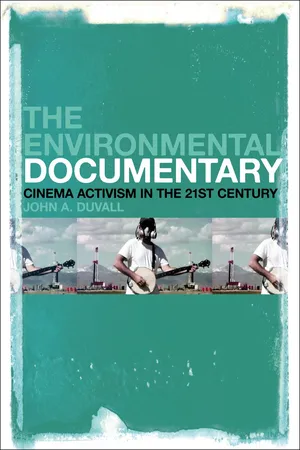
- 368 pages
- English
- ePUB (mobile friendly)
- Available on iOS & Android
eBook - ePub
About this book
Information
1
Documenting the Environment
What qualifies as an “environmental documentary”? A nature series like British Broadcasting Corporation’s (BBC) Life that describes the natural world from a scientific viewpoint? A film like An Inconvenient Truth that employs persuasion to forward a sociopolitical viewpoint? A film like Just Do It! that chronicles the activities of a countercultural environmental activist organization in Great Britain?
When we propose to talk about environmental documentaries, we first need to confront two challenging questions. First, what makes a film a documentary? How do we define the broad category of documentary in all its varied manifestations, from ostensibly value-neutral educational programs to overtly activist works of propaganda?
Second, how do we define the environment? What subject matter identifies a program as environmental, as distinguished from programs whose focus is more essentially political, economic, social, or even philosophical? How has the public understanding or social construction of the environment changed over the decades? Both questions involve a long history of debate and development, and neither is a particularly easy question to answer. So let us define our terms before we proceed to select and analyze our films.
What is a documentary?
A vast body of literature, roughly spanning the past eighty years, has attempted to define the term “documentary” in relation to cinema. We will make no attempt here to summarize all of the debates, but a brief review is in order. The first use of the term in relation to film is generally attributed to British filmmaker John Grierson, who defined documentary as “the creative treatment of actuality” (Kerrigan and McIntyre, 111). This definition attempts to reconcile the subject matter of a film—something that exists in the real world, as distinguished from fiction, wherein characters and settings are the product of a screenwriter’s imagination—and the vision of the filmmaker, whose art demands the creative interpretation of reality through the filter of a personal, subjective point of view, and whose craft requires innumerable technical decisions in the creative employment of the film medium and its production processes.
To some critics Grierson’s phrase seems an oxymoron, a futile attempt to reconcile the romantic subjectivity of the artist with the faithful representation of reality. A less ideologically rigid, more pragmatic perspective might conclude that if one defines the ideal documentary as a completely indexical reproduction of reality, such a production would prove theoretically impossible to produce, through the medium of cinema or any other. The cinema is an art form that requires conscious selective aesthetic judgments, but this fact shouldn’t erase the distinction between programs that depict avowedly fictional stories and those that address real-world topics without relying on the artifice of studio sets and actors’ performances.
Documentary film thus enjoys a privileged status as a mediated representation of reality compared to fiction films. This distinction is not lost on viewers, who approach documentaries with a different frame of mind compared to fiction. Documentaries represent what Weik von Mossner (“Emotions,” 2014) calls “discourses of consequence,” meaning that viewers expect documentaries to potentially convey a message or have an impact on their actual lives, or at least on their understanding of the real world. This expectation is not diminished even though documentaries may evoke emotional responses in addition to presenting factual information.
For decades debates have raged regarding the most desirable or appropriate forms of documentary to bridge that gap between photographic reproduction and the reality it captures. Favoring “objectivity” or “realism” are the stylistic approaches represented by cinema verité and direct cinema, wherein the filmmaker merely records what he sees, with a minimum of narration, reenactment, or manipulative filmic techniques. By this standard, the purity of a documentary depends upon how sparingly the filmmakers inject themselves into the portrayal of reality. This approach to documentary is exemplified in the works of filmmakers like the Maysles Brothers, D. A. Pennebaker, Frederick Wiseman, and Richard Leacock.
At the other extreme is the “essentialist” viewpoint, which categorizes a film as a documentary primarily on the strength of the filmmaker’s own intention to represent reality. A film may present a selective or even distorted view of reality, employing the most manipulative techniques of camera composition and editing, but if it represents the genuine vision of the filmmaker—if it is not intended to be received by an audience as fiction—then it still meets the criteria for being considered documentary. From this viewpoint, even blatantly propagandistic films like Leni Riefenstahl’s Triumph of the Will or Michael Moore’s Bowling for Columbine meet the definition of documentary.
In framing their documentary projects, filmmakers make a series of choices on how to approach their topics. In general, these choices are driven by the nature of the topic, the rhetorical strategy of persuasive argument, and judgments about the receptivity of the audience. How broad or narrow should their subject be? How should factual information be balanced with emotional appeal? What is the most effective stylistic approach to the topic? How long should the program run? Should it be designed to persuade neutral viewers or to motivate “true believers” to take action? Many variables play into this decision-making process, including the framing of the topic, the sponsorship of the production, and the experience and personality of the filmmaker, among others.
No artist is an island. Besides filmmakers and their production teams, there are other players in this process. Filmmaking takes place within a particular social context, assuming a certain level of awareness and congruence of values within its audience. The nature of a film’s reception depends to a great extent upon the expectations, knowledge, and values of its viewers. So a filmmaker frames her approach to a topic based on the audience’s anticipated knowledge of and predisposition toward her topic. Beyond those concerns, the design of the film’s narrative may be influenced by other social or cultural elements, such as its sponsorship by an organization, the degree of collaboration with its subjects, or coverage of the topic (attitudinal preparation) in other forms of media. Finally, in seeking an audience, a filmmaker must survey the field of “windows of distribution,” including but not limited to theatrical release, cable television networks, film festivals, DVD/Blu-Ray distribution, and online streaming.
Despite this wide variety of considerations—artistic, ideological, sociocultural, technological, or practical—there seems to be broad consensus on what a documentary is NOT. Unedited video footage from a security camera is not a documentary; although it preserves a continuous, indexical relationship to a certain frame of reality, it lacks any coherent thematic development. On the other hand, unedited handheld footage of the 2011 Japanese tsunami, encompassing several minutes of action and including a number of shifts in camera position and reframing of the field of view, does have a documentary quality, even though shot by an amateur observer.
At the other extreme, shots in fictional films could be not considered as documentary, even though they may possess an indexical relationship to what was in front of the camera at the time. The artificial structuring of these shots and their placement within an avowedly fictional narrative strips them of any claim to documentary status. The condensation of events and characters that occurs in “docudramas” likewise disqualifies such works from being considered documentary in terms of genre. The basic series of events they represent may have occurred historically, but the restaging of these events with actors and artificial sets deprives them of serious consideration as documentary.
There are films that are clearly fictional that nonetheless have a strong affinity for documentary. The neorealist films of Rossellini (Open City, 1945), de Sica (Bicycle Thief, 1947) and Pontecorvo (Battle of Algiers, 1966), while structured as fictional narratives with actors portraying fictional characters, nevertheless gain a feel of authenticity from their use of realistic locations, unknown or nonprofessional actors, and contemporary social themes. Also treading close to the line are films like Robert Flaherty’s Louisiana Story (1948), which tells a very naturalistic but still fictional story of a Cajun boy set against the very real world of the Louisiana oil fields; or Oliver Stone’s JFK (1991), which mixes actual documentary footage with reenactments involving Hollywood actors, in a documentary-style investigation into the real-world mystery of President John F. Kennedy’s assassination.
Few would be likely to assign these films to the category of documentary. Nevertheless, there are many styles of representation that lead into more ambiguous territory. One somewhat controversial issue involves the question of dramatic reenactment. Errol Morris’s The Thin Blue Line (1988), which investigated the possible innocence of a very real man convicted of murder and on death row in Texas, was regarded as too controversial for an Academy Award consideration in the Documentary Feature category, primarily because of the reenactments it contained. Twenty-five years later, such reenactments have become commonplace in documentaries to a great extent, because audiences are assumed to be sophisticated enough to recognize that reenactments are a convention not intended to fool the viewer but to creatively visualize events that actually happened in the past but were not or could not have been filmed or videotaped at the time.
Digital creation and re-creation of images or events, made possible by advances in computer technology over recent decades, present another problematic issue for documentary theory. Many television programs designed to be accepted by audiences as nonfiction employ digital imagery to visualize everything from the world of the dinosaurs to the speculative apocalyptic future portrayed in the cable series Life without People. Again, the central ethical question seems to be whether the filmmaker’s aim is to mislead the audience about whether something actually happened, or instead to portray a speculative reality that cannot possibly be photographed through ordinary means. The crucial questions seem to be how the audience will receive the audiovisual information, and whether the filmmaker’s creative vision is supported by credible research or testimony. Since the birth of the medium, film theorists have sought to understand how cinema constructs and conveys its messages. But an awareness of how cinema communicates its messages to audiences is critical to understanding the nature of documentary representation, since presumably the representation of the actualities of the world should be held to an even higher standard than the cinema of the imagination.
The basic aesthetic elements of cinema may be summarized as visual composition, lighting, movement, color, direction of action, editing, sound (dialogue, sound effects, and music), and special effects. These elements of film craft may represent aspects of actual subjects in the real world, but they may also embody subjective perspectives communicated by the filmmaker. For example, the angle of a shot may make a subject appear more or less powerful; a long take may convey a deeper sense of continuous reality than a series of quick cuts; and juxtapositions of shots through editing may imply new associations and meanings through the comparison or contrast of images. Sound effects recorded in postproduction may add realism and emotional resonance to footage shot in the field without sync sound. Adding a musical soundtrack may lend an emotional tenor to a scene, reinforcing the message of the imagery. Even in direct cinema—the most pure mode of documentary style, which often relies on long takes and neutral camera angles—the filmmaker still makes decisions about where to put the camera, when to move it, and when to make a cut. There is no avoiding the conclusion that, as an art form, cinema molds its own reality as much as it presents that of the world.
Many documentarians engage in persuasive argument, desiring to convince the audience to adopt a particular point of view toward the subject matter. Toward this end, filmmakers employ age-old strategies of rhetorical argument to engage and persuade their audiences. Following Aristotle, documentarians employ three primary rhetorical styles: (1) Logos—the use of factual evidence and reasoning—through logical argument, empirical visual representation (e.g., photographs or original footage), and statistical evidence (e.g., charts and graphs) to embody or clarify ideas; (2) Ethos—the reliance on authority, expertise, and ethical stature, established through testimony from recognized experts or those who speak from personal experience; and (3) Pathos—the appeal to values and emotions, often through cultivating an identification with sympathetic subjects, or feelings of anger toward their antagonists.
The world of film and video documentary inherits many nonfiction models of narrative form and rhetoric from the long traditions of writing, among them the historical account, persuasive essay, investigative report, biography, personal testimonial or diary, and sociological or anthropological study. These tried-and-true methods of storytelling find analogues in the rhetorical and structural modes of the audiovisual documentary, making them more narratively and emotionally accessible to viewers, and serving as elements in the process of identifying and elaborating genres.
Documentary films certainly qualify as forms of communication or “speech,” but it is crucial to respect the differences by which a viewer receives an audiovisual presentation, in contrast to a written or spoken address. Speeches based on factual evidence or appeals to authority are primarily left-brain, analytical activities. The listener weighs the evidence and reaches a conclusion, similar to the process in a jury trial. However, an image is “worth a thousand words”; it may appear to offer the strongest evidence of a state of affairs, as well as convey an emotional feeling, thus involving both analytical and intuitive mental faculties. For example, the juxtaposition of two images may establish an implicit link between them that creates a sort of “visual logic.” The combination of an image and a musical theme may engage one’s logical and emotional faculties simultaneously. The skillfulness of a persuasive documentarian often rests in his ability to weave these rhetorical threads together seamlessly.
Bill Nichols (1991, 2010) has identified six different “modes” of documentary representation: expository, observational, interactive, poetic, reflexive, and performative. These modes define the relationships between the subject matter, the filmmaker, and the viewer, in terms of interaction and stylistic interpretation. Briefly, the expository mode is what we often think of as the traditional or conventional documentary: an objective, didactic style of presentation, often structured through a compilation of interviews and supplementary “B-roll” footage, linked together by a voiceover narration. Although this mode may seem old fashioned in the light of more recent experimental innovations in documentary form, it remains true that the unfiltered realism and emotional honesty of people’s voices and faces can make a powerful impact on viewers.
The observational mode embodies the stylistic values of ethnographic documentary or direct cinema (exemplified by the works of Pennebaker, Wiseman, Leacock, and the Maysles Brothers), which convey meaning through observation minimally interrupted by interviews, stock footage, or interpretation by narration. Any editorial commentary is implied through the choices of camera composition and editing. The interactive mode, exemplified by the cinema verité of Jean Rouch and Edgar Morin, mixes observational footage with direct engagement between the filmmaker and his subjects. This style maintains a sense of immediate interaction with the everyday world, but in a manner that includes the filmmaker in that interaction.
In the poetic mode, the visual canvas is composed of images linked together (sometimes naturalistically, sometimes with editorial intent), while the soundtrack is carried primarily by natural sounds and music. In films of this mode—influenced by experimental and “art film” movements—the form and mood carry as much expressive weight as the content. Poetic documentaries sometimes dispense with vocal commentary entirely—both that of interview subjects and of narrators—although some poetic documentaries are guided by a single narrator. The style of the poetic mode tends to carry viewers along in an almost trancelike state, so that the task of interpretation is largely left to them. The reflexive mode, on the other hand, includes references to the filmmaker and/or the filmmaking process itself as part of the film’s central subject matter, implicitly inviting audience members to engage in a more critical viewing, reminding them that they are experiencing a cultural production with its own context, values, and purposes. This somewhat ironic mode is analogous to the Brechtian approach to live theater, wherein self-references to the production are intended to evoke an audience reaction more akin to critical reflection than emotional empathy. The performative mode puts the very act of production at the center of the documentary; the subject of the film is either the film production itself, or the active participation or performance of the filmmakers. These six modes should not be considered as exclusionary; many if not most documentaries are hybrids, embodying elements of multiple modes.
Finally, there are different categories of narrative, varied approaches to telling a story or expressing a theme. Some messages are most effectively conveyed through the conventional compilation style with expert interviews combined with supporting footage. In these programs the narrative tends to be topical, moving from one aspect of the subject matter to another in a logically structured sequence. When understanding a sequence of events is crucial, a chronological mode of storytelling may be the best approach, following the events in the order they occurred. Sometimes the story of a particular event or person can metaphorically represent a larger theme or struggle; in such a case, the film may take a biographical or ethnographic approach to an ...
Table of contents
- Cover
- Half Title
- Series Information
- Title Page
- Contents
- Introduction
- 1 Documenting the Environment
- 2 Ecocritical Perspectives
- 3 A Brief History of the Environmental Documentary
- 4 General Environmental History and Concerns
- 5 Climate Change
- 6 Peak Oil
- 7 Pollution and Waste
- 8 Food and Water
- 9 Animals and Extinction
- 10 Direct Activism and Community
- Conclusion
- References
- Index
- Copyright Page
Trusted by 375,005 students
Access to over 1.5 million titles for a fair monthly price.
Study more efficiently using our study tools.
Frequently asked questions
Yes, you can cancel anytime from the Subscription tab in your account settings on the Perlego website. Your subscription will stay active until the end of your current billing period. Learn how to cancel your subscription
No, books cannot be downloaded as external files, such as PDFs, for use outside of Perlego. However, you can download books within the Perlego app for offline reading on mobile or tablet. Learn how to download books offline
Perlego offers two plans: Essential and Complete
- Essential is ideal for learners and professionals who enjoy exploring a wide range of subjects. Access the Essential Library with 800,000+ trusted titles and best-sellers across business, personal growth, and the humanities. Includes unlimited reading time and Standard Read Aloud voice.
- Complete: Perfect for advanced learners and researchers needing full, unrestricted access. Unlock 1.5M+ books across hundreds of subjects, including academic and specialized titles. The Complete Plan also includes advanced features like Premium Read Aloud and Research Assistant.
We are an online textbook subscription service, where you can get access to an entire online library for less than the price of a single book per month. With over 1.5 million books across 990+ topics, we’ve got you covered! Learn about our mission
Look out for the read-aloud symbol on your next book to see if you can listen to it. The read-aloud tool reads text aloud for you, highlighting the text as it is being read. You can pause it, speed it up and slow it down. Learn more about Read Aloud
Yes! You can use the Perlego app on both iOS and Android devices to read anytime, anywhere — even offline. Perfect for commutes or when you’re on the go.
Please note we cannot support devices running on iOS 13 and Android 7 or earlier. Learn more about using the app
Please note we cannot support devices running on iOS 13 and Android 7 or earlier. Learn more about using the app
Yes, you can access The Environmental Documentary by John A. Duvall in PDF and/or ePUB format, as well as other popular books in Media & Performing Arts & Film History & Criticism. We have over 1.5 million books available in our catalogue for you to explore.