- 256 pages
- English
- ePUB (mobile friendly)
- Available on iOS & Android
eBook - ePub
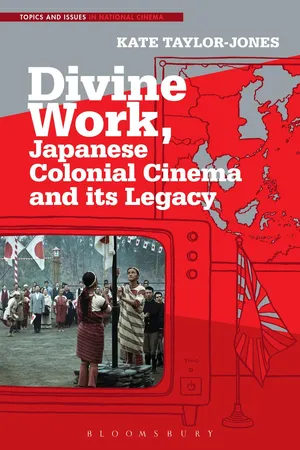
Divine Work, Japanese Colonial Cinema and its Legacy
About this book
For many East Asian nations, cinema and Japanese Imperialism arrived within a few years of each other. Exploring topics such as landscape, gender, modernity and military recruitment, this study details how the respective national cinemas of Japan's territories struggled under, but also engaged with, the Japanese Imperial structures. Japan was ostensibly committed to an ethos of pan-Asianism and this study explores how this sense of the transnational was conveyed cinematically across the occupied lands. Taylor-Jones traces how cinema in the region post-1945 needs to be understood not only in terms of past colonial relationships, but also in relation to how the post-colonial has engaged with shifting political alliances, the opportunities for technological advancement and knowledge, the promise of larger consumer markets, and specific historical conditions of each decade.
Information
PART 1
Colonial Cinema and the Imperial Machine
1
Constructing the Cinematic Japanese Empire: Taiwan and Korea
Our great national abilities can advance the Korean culture; they can also raise the achievement of Korean development. By creating a harmonious balance between intellectual and moral education, within 50–100 years that which is known to be Japanese-Korean will cease to exist, and we shall see on the Asian continent an intermarriage assimilation (tsūkon dōka) of perfect harmony among the peoples of the greater Japanese race.
The above 1925 statement by Aoyagi Tsunatarō, a highly influential right-wing newspaper editor, succinctly summarizes Japan’s vision of Empire. This was an Empire that was intimately intertwined with narratives of modernity, development and collectivity and yet, at the same time, was one that was heavily marked by racism and aggression.
This chapter charts the processes by which Japan sought to control and convert her two biggest colonial territories: Taiwan and Korea. I will explore how the cinema of the respective nations was formed in the colonial moment and the impact this had on both production and film content. I will chart how the process of colonial modernity that Japan enacted inside her colonies was bound with an ambiguity related to her own status in global politics. Japan was caught between two conflicting ideas – her own racial superiority and the narrative of pan-Asianism that was her battle cry for Imperial expansion.
Like all ideas, pan-Asianism during this period of Japanese development was a multifaceted and ever-changing discourse. Takeuchi Yoshimi (1963) notes that terms such as ‘pan-Asia/Han Ajiashugi’, ‘greater Asia/Dai Ajiashugi’ and ‘All-Asianism/Zen Ajiashugi’ were often used alongside more aggressive terms such as expansion/bōchōshugi and aggression/shinryaku. In the mid-1800s the focus was on the more modern Japan ‘helping’ its ‘less developed’ neighbours to achieve enlightenment. This paternalistic vision of Japan leading East Asia to a bright future was, however, in contrast to the strongly held Imperial discourse that offered a clear notion of Japanese superiority, and therefore, different from the rest of Asia. This approach became the fundamental national discourse from the 1890s onwards, and ideas of Asian solidarity (hosha shinshi (J)/poch’a sonch’I (kr)/fuche chunchi (ch))1 were, by the mid-Meiji era, ignored in favour of a more bellicose idea of Asia under Japan. The far-right ideologues became the voice of mainstream politics and their desire to increase and defend Japan’s newly acquired territorial powers resulted in state militarism (gunkokushugi) becoming the dominant discourse. This conflict between the ideals of a pan-Asia and the focus on Japan as different and superior resulted in continual conflict between the colonizing government and the local population.
China’s defeat in the first Sino-Japanese war had resulted in Taiwan been ceded to Japan in 1895. The make-up of Taiwan was varied with a population of three million at the time of annexation with approximately 94 per cent of the citizens being from Han Chinese descent and 6 per cent of indigenous aboriginal heritage. Neither group was pleased to be ruled by Japan.2 Korea may have been geographically and culturally closer to Japan but was likewise unimpressed by Japanese ambitions. Japan and Korea had engaged in some form of trade and cultural exchange for centuries but Japanese ambitions in the Meiji era had seen her force Korea to become a protectorate in 1905 before she was fully annexed in 1910. As with Taiwan, any attempts to defy Japanese rule were quickly and brutally quashed by the colonial authorities.
For Taiwan, colonialism and cinema came inside the same decade. The question of when cinema came to Taiwan is, as Hong (2011) notes, a complex one. Initially, it was widely believed that cinema did not enter Taiwan until 1901, a date that would place Taiwan behind nations such as Korea, China and Japan. However, archival research conducted by scholar Lee Daw-Ming (2012) would appear to support the idea that cinema arrived in Taiwan in August 1896. That means cinema arrived in Taiwan ahead of the first Japanese commercial screening in Kobe (November 1896). The idea that, in fact, the ‘backward’ colony would beat Japan in the first cinematic screening refutes the commonly held perceptions about Taiwan’s backward cinema culture. While it is clear that a fully independent domestic film industry did not flourish until several decades later, this does not necessarily mean that Taiwanese cinema culture did not exist. The case of Taiwan raises the wide issue that this book engages with: How can you define colonial cinema?
Cinema made under occupation is often dismissed as ‘other’ to the national cinema discourse and yet, to dismiss forty years of film in Taiwan or Korea as ‘other’ to the nation’s national cinema, is to clearly limit the discourse. By refusing to see colonial cinemas as part of a national cinema, one ignores the process of influence, training, stardom and receivership that develops and grows during these colonial periods which spills over, heavily influences and indeed operates as a founding construct of the postcolonial cinematic moment.
The colonial modern
Japan was determined to modernize her colonies, and from 1910 both Korea and Taiwan experienced a series of radical infrastructural and cultural shifts. Landownership, legal systems, rail, water and road networks, public development and taxation systems were all altered and then enforced rigorously by the military and civil police. New roads, irrigation and railway systems were built; modern production and distribution methods were enforced and there was a mass building of banks, public parks, schools, hospitals, museums and impressive government buildings that remain in situ today.
The analytical framework of colonial modernity is one that articulates a series of interlinked processes that are here pertinent.3 The first is that colonialism and modernity are both clear expressions of capitalist expansion. We see ‘the history of capitalist expansion’ as part and parcel of the colonial process and ‘it could make visible how globalizing colonial or imperial capital inhabited and reconfigured space, all space; not just some spaces’ (Barlow 2012: 624). Colonial hegemony far from being a monolith was rather ‘a historical process continuously negotiated, contested, defended, renewed, recreated and altered, by challenges from within and without’ (Robinson and Shin 1999: 9). If colonialism and modernity were inescapably entwined then nation, tradition, culture, civilization and other such categories, therefore, become inextricably interrelated to modernity and therefore colonialism. The final dynamic was one dependent on the interplay and interdependence of European/American and non-European modern cultures.
Modernity in the colonies, therefore, was imported from and articulated via Japanese colonization but this modernity, in turn, had been appropriated from the West and was not a one-way process. As Todd Henry notes in his writings on early colonial Seoul, what needs to be recognized is the many ways in which ‘Japanese ideologies and projects intersected and interacted with pre-existing institutions and practices in the colony itself’ (2005: 641). As Laura Ann Stoler states the colonial moment when examined in retrospect is the site of ‘the expectant and conjured – about dreams of comforting futures and forebodings of future failures’ (2010: 1). This sense of expectant futures is something that colonial Japanese cinema was heavily engaged in and yet, alongside this, in the tension-ridden process of Imperialism, the foreboding sense of potential failure was never far behind.
For Homi Bhabha, colonial structures are founded on ambivalence and any examination of the cinema of this period cannot escape the conflicting pulls of cinema as entertainment and cinema as a political tool. In short, cinema, as both Imperial and therefore external to the locality, was simultaneously situated inside and integrated into the local environs. As Baskett writes the Japanese cinematic empire was built on notions of ‘attraction’. This cinema of attractions was not only hoping to appeal the citizens of Japan but also to hold cultural power in the territories in which it was simultaneously created, exported and imported.
Herein lie the idiosyncrasies of colonial power: the need to appeal to, and embrace, the very subjects whom you hold to be inferior. Colonial studies, therefore, by their very nature transcend national and geographical boundaries. They are founded on a cross-cultural flow that, although at its heart unequal, nevertheless allows for cultures, histories and national desires and constructs to collide.
The cinematic development of each of the states Japan came to rule would be varied and dependent on a multiplicity of factors. From colonial modernity, Kikuchi states, the theoretical notion of ‘refraction’ has arisen (2007: 9). Refraction results in a process, where, as Bakhtin suggests with relation to the written word, ‘the prose writer makes use of words that are already populated with the social intentions of others and compels them to serve his new intentions, to serve a second master’ (2009: 508). Refraction allows the potential of outside influences being shifted and reinterpreted to become meaningful in the local context. Japan itself took what it needed and desired from the Western modernity and transformed it into its own national developmental narrative. Japan created her own vision of the ‘orient’ and it was one where she was the elite player among ‘lesser’ Asian nations, who required her help and support. This vision of modernity was the one imported to Taiwan, Korea and the other colonies. Therefore, the process of modernity that Japan’s colonies would undergo were part and parcel of the colonial experience.
The interlacing of the modern, the colonial and the national results in the necessity of grounding any examination of this period in a transnational framework: in short, to allow us to enter into the complex process whereby ‘national cultures … [are] rearticulated within the new global framework of colonial modernity’ (Baxendale quoted in Jones 2001: 21). The development of cinema in Korea and Taiwan both share common factors in that cinema was from the outset established as a transnational idea. In Korea, the early cinematic stage was dominated by a variety of interested parties who were mainly in Korea for economic potential and had the ability to spot a burgeoning market. Yecies and Shim (2011) note that the early magic lantern and cinematic projection companies oscillated around the various interested parties of Japanese and American film entrepreneurs who saw a way to make their mark on a new market. US missionaries intended to use magic lantern slides of the life of Christ to convert Korea to the path of Christianity, and a series of photographers, travelogue producers and documentary makers wanted to capture a vision of Korean life to export to their respective countries. Local influences were initially limited as Korea became an exhibition site where American, European and Japanese products vied for box-office success.
Taiwan’s history was a complex mix of colonialism, invasion and occupation,4 and this varied background meant that from its inception Taiwanese cinema was a mixture of ‘colonial government propaganda; Japanese, Taiwanese, and later Mainland Chinese entrepreneurs; commercial exhibitions and infrequent filmmaking; and numerous imports from Japan, Hollywood, Europe and China’ (Hong 2011: 19). Taiwanese cinema was a reflection of the various intricacies of a colonial nation where economics, culture, popular desire for entertainment and politics all vied for attention.
It is perhaps an irony of Imperialism that Japan in many ways opened up the idea of the Taiwanese nation as a bounded entity. Japan constructed an exotic and exciting Taiwan for her own entertainment and this was enhanced by a focus on ‘traditional’ Taiwanese artefacts. The anthropological studies Japan undertook in the territory were the first to have taken place in the nation and they continue to inform the engagement with indigenous Taiwanese today. Taiwanese crafts, art and paintings were distributed into the Japanese mainland fuelling a fascination with the island, and in turn, they also allowed Taiwanese nationals to develop an internal sense of self.
It would be Japanese business innovator Takamatsu Toyojirō5 who sparked the beginning of Taiwanese cinema. Takamatsu was strongly connected to the colonial government and his 1903 tour of newsreels from Japan and Europe was extraordinarily successful. The show visited numerous cities to vicariously entertain Japanese émigrés and provide ‘education’ for the native Taiwanese on the Japanese way of life. In 1907 Takamatsu was commissioned by the governor general’s office to make a film about life in Taiwan. Entitled Introduction to the Actual Conditions in Taiwan/Taiwan jikkō shōkai, the film’s purpose was to showcase the colony to both the citizens of Japan and the colony itself. For the people in Taiwan, the film not only focused on demonstrating the benefits that the Empire had brought them but also attempted to garner more popular support for the colonial enterprise. The aim was to present to the Taiwanese audience a new citizen identity that would make them a modern colonial citizen. For Japan, the transportation of the colony into the theatre of the metropole brought home the success of her Empire and confirmed to her own citizens her role as the great ‘moderniser’ of Asia. Modern Japan envisioned herself as an outward-looking nation and films and newsreels charting her colonial success supported this vision of herself as equal, if not superior, to the Western nations. As Baskett writes, for Japanese audiences, Taiwan ‘elicited lurid images of malaria-infested swamps teeming with murderous natives’ (2008: 14). This was about presenting a backward but exotic colony for the citizens of Japan to enjoy as part of her Imperial right as the ‘modernising saviour’ of Asia. In keeping with this, the first narrative feature film to be shot in the colony was directed by Tanaka Kinishi, who was based at the Tanaka Picture company in Tokyo. Buddha’s Eyes/Buddha no hitomi (1924) focuses on the tale of a miscarriage of justice and, despite the location of Taiwan and the usage of local extras in the production, there’s no evidence that I could locate that would indicate it was ever shown in the colony itself.
The Taiwanese governor general Goto Shimpei was keen to utilize cinema to promote this new identity. The aim was to ensure that the Taiwanese people were eventually assimilated into seeing themselves as an ‘extension’ of Japan. Film as the tool of colonial education (rather than as a mode o...
Table of contents
- Cover
- Half-Title
- Series
- Title
- Contents
- List of Images
- Notes on Japanese, Chinese and Korean Names
- Acknowledgements
- Introduction
- Part 1 Colonial Cinema and the Imperial Machine
- Part 2 Contemporary Manifestations and the Legacy of Empire
- Bibliography
- Selected Filmography
- Index
- Copyright
Trusted by 375,005 students
Access to over 1.5 million titles for a fair monthly price.
Study more efficiently using our study tools.
Frequently asked questions
Yes, you can cancel anytime from the Subscription tab in your account settings on the Perlego website. Your subscription will stay active until the end of your current billing period. Learn how to cancel your subscription
No, books cannot be downloaded as external files, such as PDFs, for use outside of Perlego. However, you can download books within the Perlego app for offline reading on mobile or tablet. Learn how to download books offline
Perlego offers two plans: Essential and Complete
- Essential is ideal for learners and professionals who enjoy exploring a wide range of subjects. Access the Essential Library with 800,000+ trusted titles and best-sellers across business, personal growth, and the humanities. Includes unlimited reading time and Standard Read Aloud voice.
- Complete: Perfect for advanced learners and researchers needing full, unrestricted access. Unlock 1.5M+ books across hundreds of subjects, including academic and specialized titles. The Complete Plan also includes advanced features like Premium Read Aloud and Research Assistant.
We are an online textbook subscription service, where you can get access to an entire online library for less than the price of a single book per month. With over 1.5 million books across 990+ topics, we’ve got you covered! Learn about our mission
Look out for the read-aloud symbol on your next book to see if you can listen to it. The read-aloud tool reads text aloud for you, highlighting the text as it is being read. You can pause it, speed it up and slow it down. Learn more about Read Aloud
Yes! You can use the Perlego app on both iOS and Android devices to read anytime, anywhere — even offline. Perfect for commutes or when you’re on the go.
Please note we cannot support devices running on iOS 13 and Android 7 or earlier. Learn more about using the app
Please note we cannot support devices running on iOS 13 and Android 7 or earlier. Learn more about using the app
Yes, you can access Divine Work, Japanese Colonial Cinema and its Legacy by Kate Taylor-Jones in PDF and/or ePUB format, as well as other popular books in Media & Performing Arts & Film History & Criticism. We have over 1.5 million books available in our catalogue for you to explore.