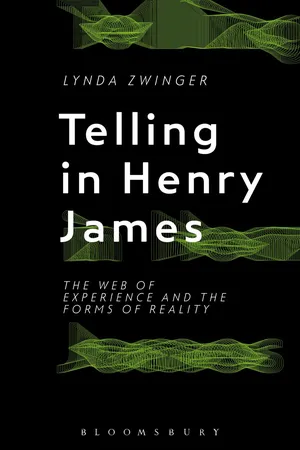
Telling in Henry James argues that James's contribution to narrative and narrative theories is a lifelong exploration of how to "tell," but not, as Douglas has it in "The Turn of the Screw" in any "literal, vulgar way." James's fiction offers multiple, and often contradictory, reading (in)directions. Zwinger's overarching contention is that the telling detail is that which cannot be accounted for with any single critical or theoretical lens-that reading James is in some real sense a reading of the disquietingly inassimilable "fictional machinery." The analyses offered by each of the six chapters are grounded in close reading and focused on oddments-textual equivalents to the "particles" James describes as caught in a silken spider web, in a famous analogy used in "The Art of Fiction" to describe the kind of "consciousness" James wants his fiction to present to the reader.
Telling in Henry James attends to the sheer fun of James's wit and verbal dexterity, to the cognitive tune-up offered by the complexities and nuances of his precise and rhythmic syntax, and to the complex and contradictory contrapuntal impact of the language on the page, tongue, and ear.
- 160 pages
- English
- ePUB (mobile friendly)
- Available on iOS & Android
eBook - ePub
About this book
Information
1
Henry James on Telling
“Yes, look, look,” she seemed to see him hear her say, even while her sounded words were other—
—Henry James, The Golden Bowl
. . . the doctor’s testimony does not substitute itself for the patient’s testimony, but resonates with it, because, as Freud discovers, it takes two to witness the unconscious.
—Shoshana Felman
Henry James offers his reader countless descriptions, analogies, and tropes for his conception of the kind of fiction he spent his life inventing. From houses, to fishing, to bookworms, to out of body experiences, within the fiction and without, James seems never to have tired of looking for “the right indications for sounding, the right implements for digging”1 to help the attentive reader (and, for that matter, himself) to grasp his view that it is not the case “that a novel is a novel, as a pudding is a pudding” (“Art,” 376). This book takes as centrally useful one of the analogies in “The Art of Fiction,” written in part as a response to Walter Besant’s overly prescriptive essay on the “rules” for novels.2 In this passage, James movingly testifies to the immensity of his own project, to the passion of his determination to get life itself, somehow, into—onto—the pages of his fiction:
Humanity is immense and reality has a myriad forms; the most one can affirm is that some of the flowers of fiction have the odour of it, and others have not; as for telling you in advance how your nosegay should be composed, that is another affair. It is equally excellent and inconclusive to say that one must write from experience; to our supposititious aspirant such a declaration might savour of mockery. What kind of experience is intended, and where does it begin and end? Experience is never limited and it is never complete; it is an immense sensibility, a kind of huge spider-web, of the finest silken threads, suspended in the chamber of consciousness and catching every air-borne particle in its tissue. It is the very atmosphere of the mind; and when the mind is imaginative—much more when it happens to be that of a man of genius—it takes to itself the faintest hints of life, it converts the very pulses of the air into revelations. (“Art,” 388)
This passage, it seems to me, has much to offer a reader thinking about how to characterize and work with Henry James’s “theory” of narrative, a theory, as we know, that is simply, in fact, James’s practice. We can see here, for example, why it has never been possible for literary critics to settle James’s work conclusively on one side or the other of the “realism/romance” divide: his working definition of “reality” is vast and capacious, and his approach to representing that reality has much in common with Chairman Mao’s famous aphorism, “Let a thousand flowers bloom,” as opposed to the less famous remarks of Walter Besant, James’s fictional interlocutor in this essay, who appears to have been advocating for conventional arrangements composed of a limited selection of flora. The passage uses its figures as argument rather than as illustration, taking the reader from assertion to figure to sensory impression to analogy, from the vastness of the cosmos to the particularity of embodied experience to the uncanny mixed figuration of the invisible yet palpable air surrounding that body—which houses the imaginative mind of the man of genius—as possessing a pulse. The “immense” and “myriad” matter of fiction cannot be limited to a definition of “experience” merely located in the individual, man of genius though she may be3: it is unidentifiable, illimitable, unending, infinite. It is “an immense sensibility” like that available to the spider which, in its much smaller world, uses its web to extend its “sensibility” to an intimate awareness of the “myriad forms” that define, by contact, the extent and reach of its universe. Just as the faintest “pulse” of the air will tell a tale to the occupant of the actual spiderweb, so every “air-borne particle” caught in the “finest silken threads” of the “huge spider-web” that is the “very atmosphere of the mind” will be converted by the writer into “revelations.” James declares here his guiding conviction that fiction can be a form of art upon which, like its creator, “nothing is lost”—no particle, no dust mote, no pulse of air—all of it can be present, all of it must be included, and this all becomes, as it is read, the “all” of the reader’s life experience as well.
Experience is “never limited and never complete” and reality has “a myriad forms.” From a commonsense view, the descriptive phrases seem reversed. Shouldn’t “experience” have forms and “reality” be unlimited and incomplete? What is the difference between James’s use of the words “experience” and “reality” in this passage? Experience, being the spiderweb, has literal forms of reality snagged in it, all of which solicit the awareness of those upon whom nothing is lost, both the writer and the reader; this awareness is the art. Fiction is the art of losing nothing, James asserts, and particles of reality, a congeries of miscellaneous detritus, are suspended in the web of experience. This conception of the relation of experience to reality is the reverse of commonsense perspective, which posits that reality is a prior datum from which we select our experience (or from which our experience is somehow selected or foisted upon us). In James’s figure, which is the Jamesian equivalent to argument, reality does not take priority—it is neither prior to nor more real than experience. By this account we can also infer that no particle of fiction takes priority over the web of words it presents to our awareness. Thus, character, plot, story, figure, objects, time, chronology, and narrative are equally presented to us as foreign objects adhering to our experience of the fiction; none of it should be lost on us, but no single object is equivalent or especially privy to the spiderweb tout court.
When Shoshana Felman uses the verb “resonates with” to particularize the relationship of the testimony of doctor and patient, she is registering the contributions psychoanalysis has made to our understanding of experiences, realities, and stories. Freud, like James, grants recognition to the detritus of the unconscious and the unacknowledged, asserting its value in the process of identifying the experience, known and unknown, of the individual; further, as Felman notes, Freudian analysis discovers and depends upon the assumption that a truth need not be available to a speaker in order to be addressed (“Education,” 24). We can recognize that Felman’s remarks apply equally to James’s fiction, which always tells us both more and less than seems to be presented by its narrator (narrative, narrative voice), offering, as it inveterately does, multiple, and often contradictory, reading (in)directions. As Eric Savoy puts it: “James’s narrative never coincides with ‘story’; there is always the residue of the unresolved or undisclosed, which is precisely what makes his fiction compelling” (254).
This study focuses on James’s multifaceted and innovatory exploration of the non-synonymous relation of narration to fiction, of the ways in which texts produce, inhabit, and absorb the reader while remaining alternately and also simultaneously a foreign and yet domesticated inhabitant of the reader’s mindscape.4 On the levels of story, character, material object, consciousness, language, and word, James, over a long and prolific lifetime as an experimental writer, conducted a tough-minded and exhaustive investigation of fiction, of the potentially endless capacities of the fictional machinery he inherited from novelists before him and exhaustively transformed for the novelists who inherited his work.
“Fictional machinery” is an unhappy locution, and I do not intend to try the reader’s patience with it often. I need something unlovely to break myself of the habit of substituting the words “narrative” and “narrator” for the entirety of what delivers the fiction to me. These words can become, I would argue, as loose and baggy as James once remarked Dickens’s novels were. “Narrative” and “narrator” are among the particles in the web; they are neither spider nor the web itself. They do not preexist the other forms of reality cohabiting the threads of the web, and they do not present those items to our awareness—they are themselves presented. None of the currently available critical nomenclature completely describes all of the characteristics of the fictional machinery.
In fact, even the most basic and thus most capacious critical terms tend to obscure if not render invisible much of the perversity and heterogeneity of Jamesian fiction, pre-naming and thereby limiting what can be said about all of what we see and hear when we read James: motiveless, naughty jokes like naming a character “Assingham,” for instance, are difficult to recuperate and include in analyses which deploy taxonomic labels that cannot factor in such anomalies—which are in fact designed to filter them out. Terms like “narrator,” “narrative voice,” and “point of view,” useful though they may be in certain arenas, are nevertheless and fundamentally inherently anthropomorphic: it is therefore not possible, I would argue, to deploy them without treating them as a figure for a purpose-driven author, and thus, in turn, narrowing our awareness to textual elements that conform to a lurking but active analogy to a single person uttering the text. “Narrative voice” of necessity conjures a more or less human possessor of vocal cords. “Narrator” does not improve the situation much. J. Hillis Miller, one of our best and most prolific narrative theorists and close readers, for example, in the course of entertaining the possibility that the narrator of “The Aspern Papers” may be “that notorious personage, the ‘unreliable narrator,’ ” remarks, “James may be speaking to me, ironically, through gaps and lapses in the narrator’s language” (emphasis added, Conduct 14). The term “narrative,” in its suggestive passivity, inherently fails to account for the active and visible ways in which this element of James’s texts works, on the page and in the reader. “Narrative level” implies a layer that remains distinct from the rest of the text, whereas a cardinal feature of the Jamesian text is its messy permeability—riotous barrages of only subliminally noticed ill-assorted figures of speech, tropes introduced by the narrator repeated or echoed in words spoken by characters and vice versa, narrators invoked as such during the course of the story who nevertheless cannot with certainty be located as the point of origin of the story, narratives posing as linear which in fact depend on and from “timelines” resembling nothing so much as an untidy mix of what psychoanalysis calls angstbereitschaft and nachtraglichkeit.5 Frustration with this possibly inherently anomalous (or at least, incompletely nameable) textual element may drive us to the manufacture of more labels (I have been known to insist, only half-joking, that a graduate seminar use the term “narratizer” to unsettle the assumptions the other vocabularies smuggle into discussions). In a similar vein, Miller remarks wryly of Gerard Genette, “One of the best of what I once called ‘canny’ critics, . . . a synecdoche for the small army of narratologists who have continued to work in the same region of descriptive intelligence”:
Genette is admirably inventive in finding or inventing names for the complexities of narrative form: prolepsis, metalepsis, analepsis, ellipse, analipse, diegesis, metadiegesis, and so on. The barbarity of these terms makes it unlikely that they would be adopted universally and so freeze into a machinelike system. . . . On the other hand, by naming features of narrative not often seen, they lead to a recognition of how complex an apparently simple novel or short story actually is. (On Narrative 48–49)
Taxonomies, by definition and however they are first developed, are a kind of inevitable (pre)organizing of what is seen—and therefore what can be seen—and so, necessarily and inherently, omit whatever might fall into the interstices of naming. Mary Douglas, in Purity and Danger, focuses on this interstitial matter in her investigation of ritual behaviors developed by cultures to deal with the unnamable and the multicategorizable detritus left out of account by any system of ordering.6 Her analysis provides terms without a long history of use in literary theory: borrowing her concept, if I can think of a peculiar and apparently unmotivated textual detail as “matter out of place,” as, essentially “dirt,” I can pay the kind of simultaneous attention that James’s spiderweb/particle analogy demands.
Narrativizing, by its nature, creates excesses and vagaries of signification, and textual meaning is always made, to underscore the point, in and by the process of intense, intimate exchange and negotiation that is reading.
—Eric Haralson
Schools of criticism and theory, modalities of organizing texts and reading approaches, approaches to defining the task of the literary scholar, and analytic vocabularies and terms of art—all produce (and in the producing, expel), in addition to order and productive lines of analysis, anomalous and ambiguous matter. Once any classification system, no matter how responsive and complex, is deployed, the polymorphous experience of reading a literary text is tamed, transformed from an unruly mass of unmappable and incommensurate cognitive and affective responses, to an object still complex, perhaps, but parseable even so. We need such systems. But we also need to resist them even as we use them, taking careful account of the “matter out of place” that is displaced by our analysis. The best technology to use in the course of this healthy resistance is close reading (in the course of its vicissitudes in the academy, it has been given other names as well). Close reading is a tool that can be used to see the anomalies and ambiguities, the detritus floating in the wake of literary analysis. In this book, I turn to close reading to engage such questions as: What is left out of account when a given vocabulary (system, taxonomy) functions as reading glasses, so to speak? How does that residue affect the work of the text and the work of the reader? More specifically, what, in the narrative in hand, functions as other to it?
I am not proposing a return to the glory days/bad ol’ days of “high” theory—all too often seen as merely a complicated game of verbal Jenga (pull out this piece and the whole text/enterprise falls down). Nor am I stuck in the bad ol’ days of the mostly excoriated New Criticism, sometimes seen as just another term for close reading, a technology it used in the pursuit of ideological projects most of us no longer share. My methodology, insofar as I have one, basically comes down to attention, a tool of all analytical inquiry, but the attention I am most interested in is unruly attention—“oh look! a shiny thing! and over here! another one!”—which is a useful counterpoint to received critical and theoretical wisdom, and more importantly, a necessary complement to both middle-distance reading (reading to find out what happens and what the text/author is up to) and long-distance attention (reading to figure out where a text/author/genre fits in larger textual, literary, or cultural taxonomies). It is my working hypothesis that close-in reading grounds and enhances the other two, but that as a tireless taxonomy generator, the study of literature has by no means outgrown its need for continued, sustained close-in attention to what Mary Douglas calls “dirt,” and what James’s arachnoid analogy might call the “pulse of the air,” which will, of course, carry literal dirt to any waiting web. Dirt, matter out of place, is to be understood metaphorically; it is the paradox, ambiguity, and disorder necessarily produced by any system of order; it therefore, to a significant degree, enables order. Whatever kind of literary criticism or theory we practice, the object we are studying as well as the work we produce is a system of order, and, as such, leaves all kinds of telltale dirt behind (which is to say on or within it).
This study attends, then, to such dirt, the complex stew of the “not-story” language of James’s texts, Eric Savoy’s “residue.” The ubiquitous heterogeneity of James’s machinery is what makes it Jamesian; the insufficiency of available narratological labels to encompass the entire narrative machinery (or even the most important moving parts) reveals this heterogeneity by default even as any given, chosen term smoothes and homogenizes the text, occluding the very theoretical issues James lays active hands upon. What interests me, as the succeeding chapters will make clear, are the incongruent, peripatetic, and eruptive textual gestures lying outside homogenizing labels—the gestures, that is, by which James addresses or manifests the complexities of telling.7
There is “telling,” and there is “what tells...
Table of contents
- Cover
- Half-Title
- Dedication
- Title
- Contents
- Acknowledgments
- Introduction
- 1 Henry James on Telling
- 2 The Europeans in the House of Fiction: “a foreigner of some sort”
- 3 Morganizing the Body of “The Pupil”
- 4 The Silver Clue Fish in The Golden Bowl
- 5 In the Vestibule of “The Jolly Corner”
- 6 Telling on Henry James
- Works Cited
- Index
- Copyright
Trusted by 375,005 students
Access to over 1.5 million titles for a fair monthly price.
Study more efficiently using our study tools.
Frequently asked questions
Yes, you can cancel anytime from the Subscription tab in your account settings on the Perlego website. Your subscription will stay active until the end of your current billing period. Learn how to cancel your subscription
No, books cannot be downloaded as external files, such as PDFs, for use outside of Perlego. However, you can download books within the Perlego app for offline reading on mobile or tablet. Learn how to download books offline
Perlego offers two plans: Essential and Complete
- Essential is ideal for learners and professionals who enjoy exploring a wide range of subjects. Access the Essential Library with 800,000+ trusted titles and best-sellers across business, personal growth, and the humanities. Includes unlimited reading time and Standard Read Aloud voice.
- Complete: Perfect for advanced learners and researchers needing full, unrestricted access. Unlock 1.5M+ books across hundreds of subjects, including academic and specialized titles. The Complete Plan also includes advanced features like Premium Read Aloud and Research Assistant.
We are an online textbook subscription service, where you can get access to an entire online library for less than the price of a single book per month. With over 1.5 million books across 990+ topics, we’ve got you covered! Learn about our mission
Look out for the read-aloud symbol on your next book to see if you can listen to it. The read-aloud tool reads text aloud for you, highlighting the text as it is being read. You can pause it, speed it up and slow it down. Learn more about Read Aloud
Yes! You can use the Perlego app on both iOS and Android devices to read anytime, anywhere — even offline. Perfect for commutes or when you’re on the go.
Please note we cannot support devices running on iOS 13 and Android 7 or earlier. Learn more about using the app
Please note we cannot support devices running on iOS 13 and Android 7 or earlier. Learn more about using the app
Yes, you can access Telling in Henry James by Lynda Zwinger in PDF and/or ePUB format, as well as other popular books in Literature & Literary Criticism Theory. We have over 1.5 million books available in our catalogue for you to explore.