From massive raves sprouting around the London orbital at the turn of the 1990s to events operated under the control of corporate empires, EDM (Electronic Dance Music) festivals have developed into cross-genre, multi-city, transnational mega-events. From free party teknivals proliferating across Europe since the mid-1990s to colossal corporate attractions like Tomorrowland Electric Daisy Carnival and Stereosonic, and from transformational and participatory events like Burning Man and events in the UK outdoor psytrance circuit, to such digital arts and new media showcases as Barcelona's Sónar Festival and Montreal's MUTEK, dance festivals are platforms for a variety of arts, lifestyles, industries and policies.
Growing ubiquitous in contemporary social life, and providing participants with independent sources of belonging, these festivals and their event-cultures are diverse in organization, intent and outcome. From ethically-charged and "boutique" events with commitments to local regions to subsidiaries of entertainment conglomerates touring multiple nations, EDM festivals are expressions of "freedoms" revolutionary and recreational. Centres of "EDM pop", critical vectors in tourism industries, fields of racial distinction, or experiments in harm reduction, gifting culture, and co-created art, as this volume demonstrates, diversity is evident across management styles, performance legacies and modes of participation.
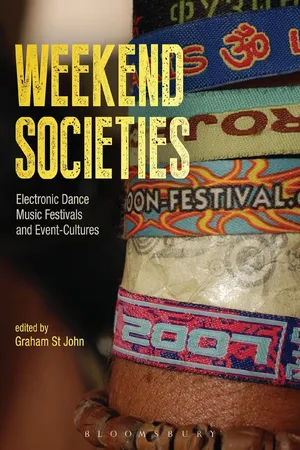
Weekend Societies is a timely interdisciplinary volume from the emergent field of EDM festival and event-culture studies. Echoing an industry trend in world dance music culture from raves and clubs towards festivals, Weekend Societies features contributions from scholars of EDM festivals showcasing a diversity of methodological approaches, theoretical perspectives and representational styles.
Organised in four sections: Dance Empires; Underground Networks; Urban Experiments; Global Flows, Weekend Societies illustrates how a complex array of regional, economic, social, cultural and political factors combine to determine the fate of EDM festivals that transpire at the intersections of the local and global.
- 264 pages
- English
- ePUB (mobile friendly)
- Available on iOS & Android
eBook - ePub
About this book
Information
PART ONE
Dance Empires and EDM Culture Industry
CHAPTER ONE
EDM Pop: A Soft Shell Formation in a New Festival Economy
Upon a hill across a blue lake
That’s where I had my first heartbreak
I still remember how it all changed
‘Don’t You Worry Child’, Swedish House Mafia (2012)
Since the late 2000s, a form of electronic dance music consisting mainly of commercial house music and contemporary top 40 pop music has enjoyed mass popularity around the globe. The music is often identified as ‘EDM’ in popular media without being distinguished from other forms of electronic dance music below the mass media surface. This chapter identifies the new formation as EDM pop and situates it within broader evolutions in the popular music festival landscape. EDM pop has been covered by EDM magazines but also by rock and pop music magazines such as Pitchfork and Spin, and by the trade magazine Billboard. The trajectory of EDM into pop culture and into the corporate music industry reflected in this journalism has been subject to little research. While scholars have studied the growing industrialization of EDM in local contexts (Montano 2009, 2011; Stahl 2014), a broader conceptual framing of EDM pop and its festivalscape has not yet appeared in print.
The aim of this chapter is to offer a broad analytical framing of EDM pop in terms of genre and industry. I argue that EDM pop is involved in mass culture and corporate industry formations beyond the conventional genre networks of EDM and that similar situations have occurred several times before in the history of popular music. EDM pop can be interpreted as an example of a soft shell genre formation, a term I adopt from culture industry sociology to map the dynamics of popularization and corporatization.
A crucial point in the chapter argument is that, following the soft shell theory, the evolution of EDM pop festivals can not only be interpreted as a formation within the genre but also within the broader popular music and popular culture landscape. By contrast to earlier soft shell developments in popular music history such as the Nashville Sound in country music, fusion in jazz, ‘tropical’ in salsa, or the ‘global pop’ trajectories of diverse local traditions, EDM pop is based in a live event economy. Professionally produced cultural events play a key role in the contemporary cultural economy of regions and cities, in the music business, in corporate sponsorship and in place marketing.
The chapter analysis therefore situates EDM pop more specifically within the new economy of popular music festivals. I argue that this economy involves three core evolutions: (1) The evolution of the popular music festival as format for the music business in the 1990s, (2) the evolution of popular music festivals as generic events to mainstream society and business1 in the 2000s and (3) the evolution of popular music festivals as social media events in the 2010s. These evolutions help explain fundamental aspects of EDM pop festivals and can inform more detailed musicological and ethnographic studies in the future.
The chapter is based on qualitative research on EDM pop festivals, with Tomorrowland in Belgium as the main example. I conducted field research at Tomorrowland in 2012 and 2013, interviewed the promoter ID&T, and researched the evolution in production, style and business of Tomorrowland marketing videos and livecasts. Complementary research on Creamfields, Electric Daisy Carnival, Sunburn and Ultra Music was conducted to explore general trends in the design and business of this festivalscape.
Conceptual approach: Industry sociology of mass culture
The scholarly literature on EDM can roughly be interpreted as a discourse for studying the underground formations that for decades formed the core base of the genre. The same can be said of the literature on popular music festivals, which has concentrated on countercultural festivals and which has not yet framed an agenda for their evolution into consumer culture festivals. These literatures have explored core aspects of culture and community and their capacity to constitute alternative realities in the individual festival sphere and in social movement contexts (Cantwell 1993; Giorgi, Sassatelli and Delanty 2011). Electronic music scholarship has paid special attention to intimacy, trance, ritual and utopia (D’Andrea 2007; St John 2009). The cultural landscape has changed considerably since the 1990s when festivals increasingly turned to mass popular music and evolved into industry-based events, awaiting analytical framing in the respective fields of scholarship.
This chapter marks a departure from the existing literatures by researching the mass culture side of festival culture and of EDM, framing it explicitly as mass culture entertainment. EDM pop festivals can fundamentally be conceived as consumer culture environments of live entertainment and have much in common with conventional mass culture forms. A general aspect is the prevalence of generic models (Holt 2007: 2) appearing in the form of hit songs, theme park designs and brand culture. Another typical aspect is the psychological simplicity and emphasis on light emotions in the crowds and in the many songs about juvenile love and happiness such as ‘Don’t You Worry Child’ quoted earlier. Like 1970s arena rock, for instance, EDM pop festivals are characterized by a fascination with magnitude and pyrotechnics. Like TV soaps, they do not shy from the superficial and mundane, as illustrated by the melodies and lyrics to which main stage crowds sing along. Many of the synthesizer riffs and ostinatos resemble elements of top 40 pop songs. Finally, the EDM festivalscape is industry-based. By 2015, it had become dominated by two corporate entities, SFX-IDT and Live Nation-Insomniac, which by then owned all of the festivals mentioned in the opening paragraph (except Sunburn).
How is industry-based entertainment commonly studied? There are traditions dedicated to this in the humanities within film studies, television studies and cultural studies from which popular music studies and other areas have drawn much inspiration. These traditions have developed conceptual approaches to studying texts and audience experiences, as in semiotics and reception studies (Hall 1980; Fiske 1990). Semiotics could be relevant for analysing how EDM pop festivals are differentiated from transformational festivals and boutique festivals, for instance, through their appeal to different lifestyle values, each gaining meaning in relation to one another through the principle of difference. Semiotics could also deliver analyses of the ‘language’ of EDM pop, its visual festival design and its discursive realities as a new global fashion (Bogart 2012; Dargis 2013) and a re-branding of 1990s rave culture (Reynolds 2012). Reception studies, moreover, is relevant for studying how meanings are produced in live and socially mediated consumption. So semiotics and reception studies are relevant for understanding the culture, but to understand its industry dimensions we need to consider two other traditions, namely culture industry studies and political economy (Hall 1981; Ryan 1992). The theory of soft shell is particularly useful in this study because it offers an explanation of the dynamics in the processes of popularization and corporatization that EDM is undergoing.
Soft shell theory
The concept of soft shell originates in Richard Peterson’s magisterial Creating Country Music: Fabricating Authenticity (Peterson 1997). The book is the product of twenty-five years of field research on the evolution of country music into a genre with a distinct place in the corporate music industry, from the first commercial recordings in the early 1920s to the institutionalization of the genre in the early 1950s. A sociologist of culture industry, Peterson identifies a dynamic tension between a perceived core of the genre and its softer shell. The book is written as an empirical history, and the soft shell concept is presented in the form of an empirical typology and narrative, but the ideas can be adopted into a more general discourse for understanding similar processes in other genres. Consider the following framing applicable to electronic dance music (replacing the distinction ‘hard vs. soft country’ with ‘underground vs. pop EDM’):
The basic justification for hard country is that it represents the authentic tradition of the music called country and that it is by and for those steeped in the tradition. The corresponding justification for soft country is that it melds country with pop music to make it enjoyable to the much larger numbers of those not born in to or knowledgeable about country music. The leading hard-core artists have received the most attention from contemporary commentators and later scholars as well. At the same time, the leading soft shell artists of an era have tended to be more popular with audiences and to make more money than their hard-core counterparts (Peterson 1997: 150).
Peterson offers typologies and rich descriptions, but he does not offer a theory in the strict sense of explanations in a general and abstract language, although elements thereof can be deduced from his writing. At the core of his thinking about the term soft shell is a core-boundary metaphor, which appears in descriptions of contrasting of musical styles, artist personae, audiences, production systems (independent vs. corporate) and media spaces (local genre radio vs. national top 40). Peterson, moreover, adopts the term soft shell into a historical narrative of the genre’s industrialization. While Peterson argues that hard and soft have co-existed throughout the history of the genre, it is clear that the relation between the two changes with corporate co-optation (in general, only the soft shell is co-opted). Peterson describes how soft country co-evolved with radio-based country music in the 1930s. In this process, the industry worked to smooth over the raw edges of the genre to establish it as family entertainment and increase its popularity with audiences beyond those who identified as fans of the music. This industry-driven popularization is a key aspect of soft shell dynamics (Peterson 1997: 229), and it is this point I interpret in the contemporary context in outlining the new festival economy provided on the following pages. The focus of the outline is the economic functions of festivals in a variety of commercial contexts outside the conventional boundaries of the festival sector and culture. Corporate culture industry develops, promotes and exploits soft shell culture. Intrinsic to this process is the influence of interests and logics outside genre spheres, of genre-specialized artists, producers and fans.
A distinction can be made between micro and macro formations of soft shell. At the micro-level are individual artists and productions, while the macro-level formation is a collective style that is named and systematically produced. EDM pop is an example of the latter and has parallels in country music with the Nashville Sound of the 1960s and in jazz with Creed Taylors jazz-pop productions of the same decade and later with the smooth jazz industry. The Nashville Sound and EDM pop are examples of soft shell formations that created a new image for the genre and the idea of a new beginning, in part because the mass penetration was so strong that foundational images of the genre were transformed decades after its formative stages.2 Soft shell processes in these genres have not subsumed the genre in its entirety but the processes have affected the overall dynamics of the genre.
Three evolutions in the economy of popular music festivals
Industry-based cultural events such as consumer culture music festivals involve economic activity across a number of local and international businesses, including musical entertainment, beverages, food, hospitality, media and transportation. Interest in the economic value chain in the host community has been central to the nominal field of events research within tourism studies for decades. There, scholars have typically analysed not the business of the festival organization itself but the impacts of the festival on other businesses in the community. This has led to a framing of the festival industry as a mixed industry (Getz 2012). The present chapter recognizes the value of this insight but does not use the term mixed industry because industry-based music festivals (1) are primarily framed within music markets and (2) do not mix with but conduct business with para-industries of more general commodity markets, such as advertising, hospitality and media. Few firms in the supply chain work only with festivals. In the present account, industry-based popular music festivals are identified as music industry, even as they are embedded in a network of para-industries.
1. The festival becomes a format for the music business in the 1990s
Logic: Music markets and headliners
The growing market value of live music in the late 1990s (Krueger 2005) transformed the role of festivals in the music business. Festivals went from being viewed as idiosyncratic cultural projects outside the daily business of the live music industry to becoming a generic format and avenue of commerce for the music industry as a whole. The transformation happened gradually during the 1980s and 1990s and peaked with the boom in the 2000s (e.g. Waddell 2013) when the number of popular music festivals doubled in many countries and several of the biggest festivals had doubled in size since the 1980s.3 By the 2000s there were more festivals, bigger festivals, and corporately owned festivals, some of which had started as a countercultural festival. Festivals have become one of the main areas of economic activity for artist agencies, managers and concert agencies. The large-scale festival became such a lucrative format during the festival boom that many event and concert promoters began promoting festivals.
The secondary role of festivals in the music industry of the 1970s and 1980s was reflected in pricing of performing artists. Rock festival promoters, for instance, were able to book artists at a discounted ‘festival rate’ compared with arena concerts.4 This arrangement eroded when festival headliners became a major source of revenue for corporate concert promoters in the 2000s. Festival promoters sought to compensate for the growing expenses by selling one-day tickets. The latter contributed to the rise of an arena concert culture within the festival, with thousands going mainly for one headliner, while remaining spectators to the festival culture.
A distinct aspect of this evolution of the festival as an industry format is the role of headliners in drawing mass audiences. This is mostly the case in rock and jazz festivals, which are concert-based, but EDM pop festivals, too, need superstar DJs to reach mass live and media audiences.5 Tomorrowland and EDC Las Vegas market themselves as event brands, em...
Table of contents
- Cover
- Halftitle Page
- Title Page
- Contents
- List of Figures
- Introduction: Dance Music Festivals and Event-Cultures
- Part One: Dance Empires and EDM Culture Industry
- Part Two: Underground Networks and Transformational Events
- Part Three: Cosmopolitan Experiments and Electroniculture
- Index
- Imprint
Trusted by 375,005 students
Access to over 1.5 million titles for a fair monthly price.
Study more efficiently using our study tools.
Frequently asked questions
Yes, you can cancel anytime from the Subscription tab in your account settings on the Perlego website. Your subscription will stay active until the end of your current billing period. Learn how to cancel your subscription
No, books cannot be downloaded as external files, such as PDFs, for use outside of Perlego. However, you can download books within the Perlego app for offline reading on mobile or tablet. Learn how to download books offline
Perlego offers two plans: Essential and Complete
- Essential is ideal for learners and professionals who enjoy exploring a wide range of subjects. Access the Essential Library with 800,000+ trusted titles and best-sellers across business, personal growth, and the humanities. Includes unlimited reading time and Standard Read Aloud voice.
- Complete: Perfect for advanced learners and researchers needing full, unrestricted access. Unlock 1.5M+ books across hundreds of subjects, including academic and specialized titles. The Complete Plan also includes advanced features like Premium Read Aloud and Research Assistant.
We are an online textbook subscription service, where you can get access to an entire online library for less than the price of a single book per month. With over 1.5 million books across 990+ topics, we’ve got you covered! Learn about our mission
Look out for the read-aloud symbol on your next book to see if you can listen to it. The read-aloud tool reads text aloud for you, highlighting the text as it is being read. You can pause it, speed it up and slow it down. Learn more about Read Aloud
Yes! You can use the Perlego app on both iOS and Android devices to read anytime, anywhere — even offline. Perfect for commutes or when you’re on the go.
Please note we cannot support devices running on iOS 13 and Android 7 or earlier. Learn more about using the app
Please note we cannot support devices running on iOS 13 and Android 7 or earlier. Learn more about using the app
Yes, you can access Weekend Societies by Graham St John in PDF and/or ePUB format, as well as other popular books in Mezzi di comunicazione e arti performative & Etnomusicologia. We have over 1.5 million books available in our catalogue for you to explore.