Despite being a minor language, Danish literature is one of the world's most actively translated, and the Scandinavian country is the home of a number of significant writers. Hans Christian Andersen remains one of the most translated authors in the world, philosopher Søren Kierkegaard inspired modern Existentialism, Karen Blixen chronicled her life in colonial Kenya as well as writing imaginary, cosmopolitan tales, and the writers among the circles of literary critic Georg Brandes in the late 19th century were especially important to the further development of European Modernism.
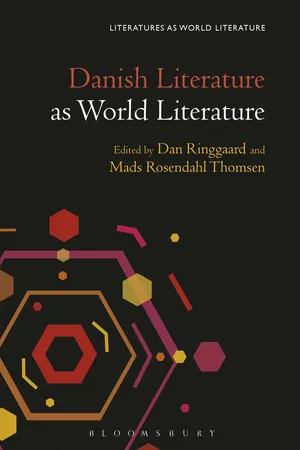
Danish Literature as World Literature introduces key figures from 800 years of Danish literature and their impact on world literature. It includes chapters devoted to post-1945 literature on beat and systemic poetry as well as the Scandinavia noir vogue that includes both crime fiction and cinema and is enjoying worldwide popularity.
- 224 pages
- English
- ePUB (mobile friendly)
- Available on iOS & Android
eBook - ePub
Danish Literature as World Literature
About this book
Information
1
‘History of the Danes’: Saxo the Grammarian and Saxo the Rune Master
William Shakespeare’s famous tragedy Hamlet: Prince of Denmark, from the early years of the seventeenth century, has as its most authoritative background Saxo the Grammarian’s (Saxo Grammaticus’ ) ‘History of the Danes’ (Gesta Danorum). The popularity of Shakespeare’s play throughout centuries constantly reminds new international audiences of Saxo’s medieval masterpiece, which was finished around 1210. Shakespeare’s play, which marks one of the absolute highpoints in the international reception of Saxo, is based on the story of the Danish prince Amleth. ‘History of the Danes’ is commonly divided into two parts, a legendary section (books 1–8) and a historical section (books 9–16), with the story about Amleth coming in the legendary part. It is only one among many stories in Saxo’s comprehensive text, which describes an unbroken line of Danish kings, from the first monarch, Dan, and ending with Valdemar I (the Great) and Canute VI. The text’s status as national literature is, however, not straightforward. First of all, it is written in Latin not in the vernacular Danish language, and secondly, it predates the rise of European nation states. The choice of language shows that Saxo was in part orientated towards the wider world, and that he might have aimed for an audience outside of Denmark. Yet despite this outward perspective, ‘History of the Danes’ represents an immensely important resource for medieval Nordic literary history, both its written and its non-written manifestations, and the text has – especially since the Renaissance when it was first printed and translated into Danish – been a central reference point in Danish literary history.
World literature
But can ‘History of the Danes’ be considered as world literature? The status of literary texts between the national and the foreign is – like in comparative literature – a topic of debate in medieval studies.1 As in contemporary, globalized culture, the medieval world and its literatures require models of understanding alternative to those attached to the idea of the national. Medieval literature was affiliated with and derived from, on the one hand, very local communities and, on the other hand, with communities that were distributed across wide geographical areas. Ernst Robert Curtius demonstrated how in the Middle Ages literature was not kept within narrow spatial and temporal boundaries.2 Basing his examples on the connection of Latin literature with Classical texts, Curtius argued how individual texts deriving from different spatial and temporal environments fitted into a single and unified literary corpus. In many ways, ‘History of the Danes’ fits well into the broad picture of literature of the Latin Middle Ages, and topoi studies – in the form suggested by Curtius – offer one among other relevant approaches to the text. However, ‘History of the Danes’ is a text that evokes multiple registers, all of which need to be considered when defining its status; it is a text that presupposes a huge amount of oral lore, and even if the text is in many ways a witness to a connected web of European literature, it is also attached to local narrative traditions.
In recent years the discussion about world literature has moved beyond the basic assumption that it consists either of literary works that have an extraordinary high quality or simply of literature from the world outside of one’s own.3 Besides the fact that ‘History of the Danes’ is actually a medieval text of high quality, some of the perspectives deriving from the current discussion of world literature, most of them coming from studies of modern literature, are enlightening for this piece of medieval literature. For instance, one perspective emphasizes that a literary work becomes world literature when it is received in a foreign cultural situation where it functions as an interactive space between different cultures.4 Shakespeare’s amplification of the story of Amleth demonstrates that ‘History of the Danes’ has actually functioned over time as such an interactive space. Another perspective underscores that formal compromises between foreign and local forms are criteria for world literature status and decisive factors for the development or evolution of new genres,5 a viewpoint that corresponds to the fact that ‘History of the Danes’ is very much the result of a dialogical relationship between local and foreign literary registers.
A literary memorial
‘History of the Danes’ was probably written in Lund, at that time part of the Danish realm, but now part of present-day Sweden. Saxo the Grammarian was a member of the Cathedral in Lund, where he was as a secretary (clericus) for the cathedral’s Archbishop, Absalon. Absalon died before Saxo finished the text, which was consequently dedicated to the Archbishop's successor, Anders Sunesen, as well as to King Valdemar II (the Victorious). Absalon belonged to the Hvide-family, a family that collaborated closely with the Valdemar dynasty, so the text is a result of a collaboration between powerful religious and secular groups. In the Prologue to ‘History of the Danes’, Saxo praises his patrons. When expressing the relationship between himself and Archbishop Absalon, he uses exordial topoi deriving from classical rhetoric and poetry:6
What man could have committed Denmark’s history to writing? […] So it came about that my small talent, though aware of its inadequacy for this massive assignment, preferred to strive beyond its powers rather than refuse the bidding […] Nervous therefore of shirking the command, I had to submit my clumsy shoulders to a burden untried by all writers of bygone ages; I obeyed with more presumption than efficiency, borrowing from the encouragement of my great patron the confidence which my own poor wits would not supply.7
Through this humility topos the author shows his modest and submissive status, and establishes a hierarchy between (the nervous and clumsy) author and (the great) employer. Absalon and his environment, the cathedral and the household, indeed provided the facilities that made it possible for Saxo to write ‘History of the Danes’. But much authorial freedom might have been left in the hands of the Archbishop’s secretary, and Saxo could very well have been the one in control of the project: Essentially, the topos is a signal of the text’s rhetorical background, revealing its intertextual affiliation with classical literature.
‘History of the Danes’ is not only a literary project; it is indeed a political project too. Politically it presents two interrelated perspectives: An internal perspective concerned with the collaboration between king and church in Denmark, and an external perspective which is preoccupied with the position of Denmark in the wider world. Whereas the first perspective is indebted to power-struggles within Denmark (and Saxo wrote in support of the families of Absalon and Valdemar), the latter situates Denmark in a European, political context, one that is directed towards the Holy Roman Empire, that is the German Empire, to the south, which made claim to be the heir to the classical Roman Empire.8 On a grand scale and from a European perspective, Denmark belonged to the geographical and cultural periphery of Christian Europe. This position on the periphery is recognized in Saxo’s topographic description of Denmark:
The edges of this region, then, are partly bounded by another land frontier, partly enclosed by the waves of the adjacent sea. The interior is washed and encircled by the Ocean.9
In line with the mental geography of the time, Saxo considered the world to be circular and encircled by the ocean, and the northern part of Europe was placed close to the outer edges of the world.10 However, in a cultural sense, this position on the periphery was challenged; Saxo’s project negotiated centre and periphery, claiming that the Norse world could match the world that it became part of with Christianization.11 At Saxo’s time, many other European peoples (the English, Normans, etc.) had had their histories written, and consequently, the text was explicitly considered as a monument over Denmark, a monument that showed the present state of power-relations within Denmark, but even more so demonstrated to the world around that this country was rooted in an ancient civilization:
[…] if our neighbours exulted in the records of their past exploits, the reputation of our people should not lie forgotten under ancient mould, but be blest with a literary memorial.12
Saxo used classical writers as the models for his memorial, something which is confirmed by the fact that he chose to write – not in Medieval but – in Classical Latin. A classicizing approach is not unique for ‘History of the Danes’, it is evidenced in literature from especially Northern France but also other parts of Europe in the eleventh and twelfth centuries, making it relevant to consider Saxo as a Danish representative of a cross-cultural literary movement which used Roman authors’ language, style and structures as models in their works, the so-called renaissance of the twelfth century.13
Geography
One way that Saxo could impose high status to the Danish royal family was by referring to heroic kings of the past: A glorious past and a long, unbroken line of Danish kings served to legitimize the present. But also geography, that is, Denmark and its surrounding landscape, was evoked when the Danes and the Valdemar dynasty were presented in a glorious light. Saxo worked from the principle that the beauty and the exceptional quality of the physical environments added to the esteem and prominence of people living there. In the Prologue, he described the different parts of Denmark (Jutland, Funen, Zealand, Scania, Halland and Blekinge). From Saxo’s point of view, Zealand, the homestead of Saxo’s sponsors, and presumably of himself as well, was especially lovely, and was presented by him as the centre of Denmark:
Eastward again lies Zealand, worthy of praise for its exceptional richness in the resources of life. This island is the most lovely of all our provinces and is considered to be the centre of Denmark, since the farthest limits of the region’s circumference are equidistant from it.14
It is common for medieval history works to be preoccupied with geography – as such ‘History of the Danes’ is no exception to the rule. Its geographical concern goes beyond an interest in Denmark as other Nordic areas (Sweden, Norway, Iceland) are described as well. Saxo writes from the conviction that Denmark is an integral part of a Nordic region, held together by shared territory and related languages:
I shall record, besides the areas and climate of Denmark, those of Sweden and Norway, since the same geographic area embraces them, and because of their kindred languages.15
The different areas in the North are described on a scale ranging from ‘richness of resources’ and ‘highly civilized’ to ‘barren outlands’ and ‘lack of civilization’, which suggests a hierarchical ordering...
Table of contents
- Cover
- Halftitle Page
- Title Page
- Contents
- Contributors
- Acknowledgements
- Introduction: Danish Literature as World Literature
- 1. ‘History of the Danes’: Saxo the Grammarian and Saxo the Rune Master
- 2. Travelling Ballads: The Dissemination of Danish Medieval Ballads in Germany and Britain, 1760s to 1830s
- 3. Ludvig Holberg: A Man of Transition in the Eighteenth Century
- 4. A Man of the World: Hans Christian Andersen
- 5. Straight into the Bliss of Knowing: Søren Kierkegaard’s Influence on Franz Kafka
- 6. Modern Denmark: Brandes – Jacobsen – Bang
- 7. Towards a New World: Johannes V. Jensen and Henrik Pontoppidan
- 8. Out of Africa, into World Literature
- 9. Breaking New Ground – Danish Poets in the Intersection Between Modernism and Postmodernism
- 10. ‘A faithful, attentive, tireless following’: Cultural Mobility, Crime Fiction and Television Drama
- Index
- Imprint
Trusted by 375,005 students
Access to over 1.5 million titles for a fair monthly price.
Study more efficiently using our study tools.
Frequently asked questions
Yes, you can cancel anytime from the Subscription tab in your account settings on the Perlego website. Your subscription will stay active until the end of your current billing period. Learn how to cancel your subscription
No, books cannot be downloaded as external files, such as PDFs, for use outside of Perlego. However, you can download books within the Perlego app for offline reading on mobile or tablet. Learn how to download books offline
Perlego offers two plans: Essential and Complete
- Essential is ideal for learners and professionals who enjoy exploring a wide range of subjects. Access the Essential Library with 800,000+ trusted titles and best-sellers across business, personal growth, and the humanities. Includes unlimited reading time and Standard Read Aloud voice.
- Complete: Perfect for advanced learners and researchers needing full, unrestricted access. Unlock 1.5M+ books across hundreds of subjects, including academic and specialized titles. The Complete Plan also includes advanced features like Premium Read Aloud and Research Assistant.
We are an online textbook subscription service, where you can get access to an entire online library for less than the price of a single book per month. With over 1.5 million books across 990+ topics, we’ve got you covered! Learn about our mission
Look out for the read-aloud symbol on your next book to see if you can listen to it. The read-aloud tool reads text aloud for you, highlighting the text as it is being read. You can pause it, speed it up and slow it down. Learn more about Read Aloud
Yes! You can use the Perlego app on both iOS and Android devices to read anytime, anywhere — even offline. Perfect for commutes or when you’re on the go.
Please note we cannot support devices running on iOS 13 and Android 7 or earlier. Learn more about using the app
Please note we cannot support devices running on iOS 13 and Android 7 or earlier. Learn more about using the app
Yes, you can access Danish Literature as World Literature by Mads Rosendahl Thomsen,Dan Ringgaard in PDF and/or ePUB format, as well as other popular books in Literature & European Literary Criticism. We have over 1.5 million books available in our catalogue for you to explore.